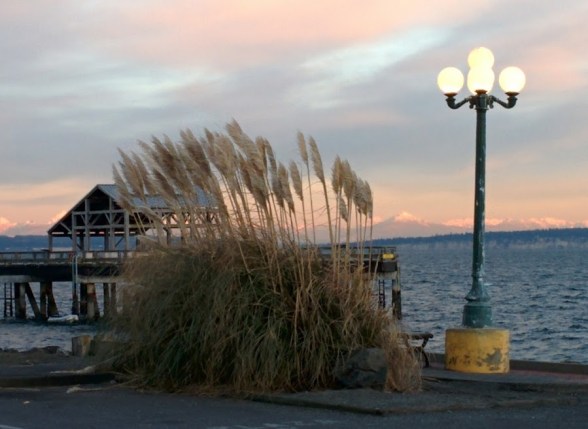
I took this in the early morning at Port Hudson after having coffee. The pole is a tsumani siren. I love being out for the sunrise and now it is getting easier to wake up for it as the days get longer.
Morning


I took this in the early morning at Port Hudson after having coffee. The pole is a tsumani siren. I love being out for the sunrise and now it is getting easier to wake up for it as the days get longer.

This is taken at night from the beach, camera at full zoom. The mountain is Mount Tahoma, also known as Mount Rainier. The object that looks like a gibbet for hanging people is at the end of a dock. It is a small crane. The perspective makes them look like they are the same size, doesn’t it? But one is very close and the mountain is very much further away.
We have to be careful not to misinterpret what we see when we don’t have enough information or when we are given misinformation. Truth is complicated and there are people who will lie for power and advantage and their own agenda. Consider the source, use more than one source, consider if what you are seeing has been edited, exaggerated, placed out of context or if it’s really just a lie.
For the Daily Post challenge: Conventional Wisdom.

While my daughter was home from college over break, she went for night walks and runs on the beach. I went along sometimes, on the walks. It is so beautiful in the evening light and in the dark…
This is for photrablogger’s Mundane Monday #3.
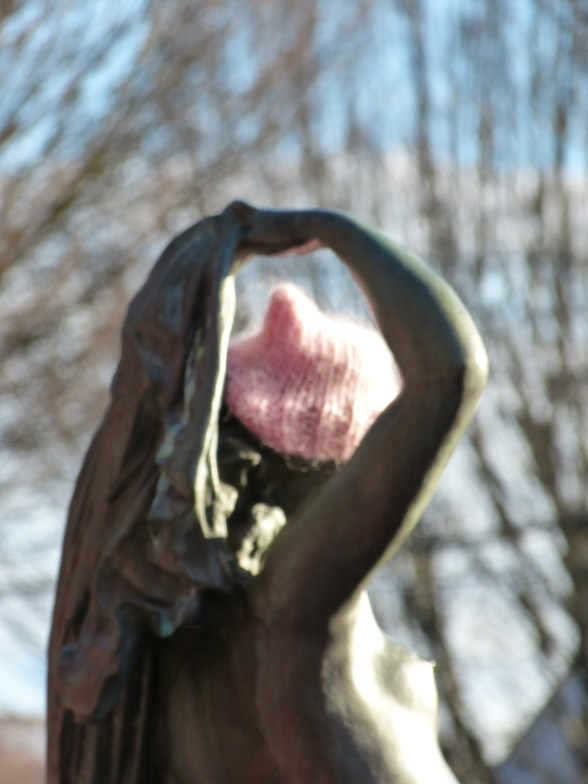
This is our local Haller Fountain, a statue of Galatea, taken on Saturday during the Women’s March. I’d like to say the soft focus was on purpose, but that is more of an “alternative fact”.

My daughter and I marched yesterday.
She decided to come home from college for the weekend, planning to leave Saturday night. I decided not to go to the Seattle Womxn’s march, but do the Port Townsend one and asked her to join me.
We went out to breakfast and then to our small downtown. I no longer have television and look at news sites daily though a bit erratically, so neither of us had a pink hat. I wore my Mad As Hell Doctors t-shirt, my lab coat from working at the National Institutes of Health with the National Cancer Institute Patch, my Rotary name badge and pins gathered from going across the country trying to get medicare for all, single payer health care, from 2009 until now.

Four bus loads went from our county to the Seattle march. We heard that the Bainbridge ferry was FULL. That is, they couldn’t not take any more walk on people. Another thirty people or more flew to the Washington DC march. And in Port Townsend, my guess is that we still had 200-300 people, women, men and children, people in wheelchairs, babies, gay, lesbian, straight, bi, trans, that marched from a small park downtown to the Haller Fountain. Galetea, naked statue at the fountain, sported a pussy hat.

Our local organizer spoke and our House Representative, Derek Kilmer.

Older women spoke about demonstrating over and over in their lives. A friend of mine called me up to help her sing Holly Near’s Singing for Our Lives, making up new verses on the fly. They invited people to speak.

I spoke: “I am one of your local doctors. I want to be able to treat anyone who comes to my clinic. We are one nation: health care for all. No discrimination: medicare for all.”


Home then, and tired. My daughter has decided she wants to learn guitar, to play while people sing. I taught her basic chords and basic strumming. We sang Jamaica Farewell. She picks it up immediately, after all of those years of viola. And she will take one of my father’s guitars back to college.
And this is amazing: https://www.nytimes.com/interactive/2017/01/21/world/womens-march-pictures.html?smid=fb-share
Blessings all around.
Physicians for a National Health Care Program: http://www.pnhp.org/

I took this in Portland, a couple months ago. Leaves down but fruit still on the tree, each with a droplet in the rain.

On call for my patients, I get a call about flu.
The spouse sounds worried. I speak to the sick person.
“Do you have a fever?”
“Yes, 100.6. I am throwing up and I don’t want to eat.”
“Do you have muscle aches?”
“Not really. I know I need to drink water.”
“Are you coughing?”
“Not really. Not much.”
“Not very congested. Do you have diarrhea?”
“Yes, lots. And my stomach hurts when I eat.”
People often say “flu” meaning “stomach flu” which is not influenza. “Stomach flu” is gastroenteritis, another set of viruses entirely. It could be a bacterial food poisoning, but in 17 years in my rural town, I have seen a total of two food poisoning bacterial infections. Most here are viral.
“Is there blood in the diarrhea?”
“No.”
Viral, then. Blood in the stool is more likely to be bacterial.
The important thing is to stay hydrated. If the person gets too dehydrated, they tend to just keep throwing up and may need iv fluids. To keep them out of the emergency room, I give the following recipe:
One quart of water
one teaspoon sugar
A pinch of salt
(with or without a pinch of baking soda)
If the person is quite nauseated, try drinking just a tablespoon every 15 minutes, with a timer. The electrolytes and sugar help the fluids absorb. Small amounts are easier to absorb and less likely to come up. If they keep throwing that up, go to the emergency room.
“I’m not eating.”
That’s ok. A day without eating won’t hurt you unless you are starting very underweight. Get the fluids in first and then you can go on to chicken soup and try some crackers.
Gatorade or flat ginger ale or pedialyte contain electrolytes too, but the home recipe is fine. And for small children, regular or pedialyte popsicles, because they can’t really drink them quickly.
Most people will recover on their own, especially if they stay hydrated. We don’t tend to try to stop the diarrhea, it’s better just to hydrate people to keep up. If someone is immunosupressed, on chemotherapy or with HIV or after a transplant, they may need hospitalization.
Does the picture look upside down? A bit nauseating or disorienting? I took it in Portland, and yes, it’s upside down.

I was crossing from Coupeville to Port Townsend yesterday afternoon, and the Olympic Mountains were gorgeous. I wanted to capture the haze between the lower ridge and the high peaks, mist and mystery.
Influenza is different from a cold virus and different from bacterial pneumonia, because it can cause lung tissue swelling.
Think of the lungs as having a certain amount of air space. Now, think of the walls between the air spaces getting swollen and inflamed: the air space can be cut in half. What is the result?
When the air space is cut down, in half or more, the heart has to work harder. The person may be ok when they are sitting at rest, but when they get up to walk, they cannot take a deeper breath. Their heart rate will rise to make up the difference, to try to get enough oxygen from the decreased lung space to give to the active muscles.
For example, I saw a person last week who had been sick for 5 days. No fever. Her heart rate at rest was 111. Normal is 60 to 100. Her oxygen level was fine at rest. She had also dropped 9 pounds since I had seen her last and she couldn’t afford that. I sent her to the emergency room and she was admitted, with influenza A.
I have seen more people since and taken two off work. Why? Their heart rate, the number of beats in one minute, was under 100 and their oxygen level was fine. But when I had them walk up and down a short hall three times, their heart rates jumped: to 110, 120. I put them off from work, to return in a week. If they rest, the lung swelling will have a chance to go down. If they return to work and activity, it’s like running a marathon all day, heart rate of 120. The lungs won’t heal and they are liable to get a bacterial infection or another viral infection and be hospitalized or die.
I had influenza in the early 2000s. My resting heart rate went from the 60s to 100. When I returned to clinic after a week, I felt like I was dying. I put the pulse ox on my finger. My heart rate standing was 130! I had seen my physician in the hospital that morning and he grabbed a prescription pad and wrote: GO TO BED! He said I was too sick to work and he was right. I went home. It took two months for the swelling to go down and I worried for a while that it never would. I dropped 10 pounds the first week I was sick and it stayed down for six months.
Since the problem in influenza is tissue swelling, albuterol doesn’t work. Albuterol relaxes bronchospasm, lung muscle spasms. Cough medicine doesn’t work either: there is not fluid to cough up. The lungs are like road rash, bruised, swollen, air spaces smaller. Steroids and prednisone don’t work. Antiviral flu medicine helps if you get it within the first 72 hours!
You can check your pulse at home. Count the number of beats in one minute. That is your heart rate. Then get up and walk until you are a little short of breath (or a lot) or your heart is going fast. Then count the rate again. If your heart rate is jumping 20-30 beats faster per minute or if it’s over 100, you need to rest until it is better. Hopefully it will only be a week, and not two months like me!

you’ve relegated me to one small box
a place in your life, Sunday morning
not every Sunday, but some Sundays
to work together on the tree house
and talk a little
well, you talk. I am supposed to listen
and give another perspective. I don’t get to
pick the topic.
You don’t answer emails: not the poems,
not the essays. I am not your Facebook friend,
we don’t have dinner like civilized friends
you would not mention my birthday
nor will you take me out on your boat.
Holidays are on ignore. You even agreed
to watch my cat and left her, after one day.
you’ve relegated me to one small box
I climb out and wander the streets, howling
I am unedited, unwashed, unpredictable, unrelegated
howling about you and your treatment of me
Home to the Longette & Longette Lite
Intelligence that is not artificial: we are real.
BLIND WILDERNESS
in front of the garden gate - JezzieG
Discover and re-discover Mexico’s cuisine, culture and history through the recipes, backyard stories and other interesting findings of an expatriate in Canada
Or not, depending on my mood
All those moments will be lost in time, like tears in rain!
An onion has many layers. So have I!
Exploring the great outdoors one step at a time
Some of the creative paths that escaped from my brain!
Books, reading and more ... with an Australian focus ... written on Ngunnawal Country
Engaging in some lyrical athletics whilst painting pictures with words and pounding the pavement. I run; blog; write poetry; chase after my kids & drink coffee.
Coast-to-coast US bike tour
Generative AI
Climbing, Outdoors, Life!
imperfect pictures
Refugees welcome - Flüchtlinge willkommen I am teaching German to refugees. Ich unterrichte geflüchtete Menschen in der deutschen Sprache. I am writing this blog in English and German because my friends speak English and German. Ich schreibe auf Deutsch und Englisch, weil meine Freunde Deutsch und Englisch sprechen.
En fotoblogg
Books by author Diana Coombes
NEW FLOWERY JOURNEYS
in search of a better us
Less Noise. More Meaning
Art from the Earth
𝖠𝗇𝗈𝗍𝗁𝖾𝗋 𝖶𝗈𝗋𝖽𝖯𝗋𝖾𝗌𝗌.𝖼𝗈𝗆 𝗌𝗂𝗍𝖾.
Taking the camera for a walk!!!
From the Existential to the Mundane - From Poetry to Prose
1 Man and His Bloody Dog


You must be logged in to post a comment.