For the Ragtag Daily Prompt: rugged.
Rugged machines (some with purple rugs) and riders line up outside the American Legion for the 52 degree water section of the Kinetic Sculpture Race!
And the 2019 Race theme has been announced. More costumes….


For the Ragtag Daily Prompt: rugged.
Rugged machines (some with purple rugs) and riders line up outside the American Legion for the 52 degree water section of the Kinetic Sculpture Race!
And the 2019 Race theme has been announced. More costumes….

For Mundane Monday #179, my prompt is without words.
Let’s see a photograph where the communication is wordless.
Ms. Boa turns 15 as my daughter turned 21. For a cat, that’s approximately in her 70s. She is smaller, has lost muscle mass. She can still catch mice. And she communicates: ok, mom, enough computer for today. Do something else. This was yesterday and I decided she was RIGHT!
Link your blog or send a message and I will list them next week.
From last week Mundane Monday #178 light and dark:
KL Allendorfer: a gorgeous landscape.

Regardless of how the vote goes, I will keep speaking up.
It is so painful to have woman after woman saying, “I have stories too.”
And to the “nice” men who say, “I can’t believe that sort of thing. I can’t read about it. It hurts too much.” YOU are silencing too. YOU are part of the problem. As long as YOU refuse to listen, refuse to speak up, refuse to read about it: YOU PRETEND TO YOURSELF THAT IT IS NOT HAPPENING TO YOUR WIFE, YOUR SISTER, YOUR MOTHER, YOUR DAUGHTER. YOU PRETEND THAT IT ONLY HAPPENS TO “THOSE” WOMEN, THAT THEY ARE FEW, THAT IF THEY HAD TAKEN PRECAUTIONS IT WOULD NOT HAVE HAPPENED, THAT YOU ARE PROTECTING “YOUR” WOMEN.
Speak up, “nice” men. Are you ASKING the women in your life? Or are you silencing them?
Sweet Honey in the Rock: Joanne Little.

I wrote this after working at Madigan Army Hospital in 2009 for three months as a temporary doctor. I am posting it here because Shoreacres sent me this link about poetry and medicine.
____________________
I would pray if I could. It seems ludicrous to pray for a poet, but there it is.
It started with two soldiers. The Army was embedding a behavioral health specialists (the new politically correct term for mental health specialists) in units starting before 2010. Soldiers were trained in suicide prevention, instructed to stay with a buddy if they made any comments about suicide. A soldier was to walk his or her buddy directly to the behavioral health specialist or to to higher rank. As soldiers went on their fourth and fifth tours, post traumatic stress disorder, depression and traumatic brain injuries were rampant. Unfortunately, psychologists basically felt like they were putting Power Ranger band-aids on hemorrhaging brain arteries. It wasn’t working.
A soldier was accompanying a convoy in Iraq when an IED went off. Right through the bottom of a convoy truck. The driver died screaming from an arterial groin bleed. Two of the eight soldiers were killed. The truck was abandoned and the rest of the convoy got back to the safe (mostly) zone. That soldier had the glassed ghost look in her eyes and got quiet. The usual response was to avoid someone’s eyes and hope for the best, but another soldier wouldn’t let her alone. She kept asking, “Tell me. What happened?”
The first soldier finally snarled out part of the story.
The second soldier pinned a poem to her pillow, describing the event. Our first soldier came in screaming and threw the crumpled ball of paper at her chest. “That’s not what happened! That’s not how I felt! Not even close!”
“Well, what DID happen!” The rest of the unit tried to hide in plain sight or disappeared to the bathroom or got really interested in books or watching the same video over and over, but the two of them stood face to face and went at it. Words, not fists. The crumpled paper was retrieved, the poem rewritten. It took two weeks before soldier one suddenly said, “That’s it. That’s pretty good. For a poem.” But she was back, her gruff foul mouthed efficient self.
Of course it wouldn’t have gone anywhere if the behavioral health specialist hadn’t joked about it to his superiors. The Army was really desperate. In spite of all the work, the suicide rate was still challenging the combat death rate, and there just weren’t enough people to deploy.
The Army went looking for poets. Four were promptly deployed into units. Two of them turned out to be pretty useless, but the other two: the units thrived. Word started getting around. The poets were swamped with people from other units.
The recruiting campaign: “We want you, yes we do, poet show your heart so true!” was painful, but the Army did not care. And poets stepped forward from within the ranks! Don’t ask, don’t tell turned on it’s head. In spite of the medical community’s cries for waiting until more scientific studies were done, and the press and cartoonists drawing pictures recruiters welcoming wimpy pale asthenic writers with open arms, the Army embedded a poet in every unit, right beside the behavioral health specialist. Oh, of course they tried prose too. The academics had a field day fighting about why prose didn’t work. But it didn’t.
It’s the height of irony that we’re cut off with everything we need, except a poet. A water source, food, ammunition. We’re holding our position. Our back up poet is dead ten days ago, but our main poet got an IED blast. Traumatic brain injury, two weeks ago. We can’t get him out, of course. You would think someone would bleed if they were that bad, but he just can’t hold on to any memory. The soldiers tell him their stories, he struggles and tries, but he can barely hold on to one line. Can’t read, though he can write. Can’t see very well either.
The whole unit is starting to look glass-eyed and haunted. Smith asked to go in the jail yesterday and for the door to be closed. He promptly started screaming. It got quiet after a while so they went in. He was sitting on bunk. “Ok.” he said. “I might come back tomorrow.” Some soldiers are writing their own limericks or free verse. It’s ironic that it hurts morale so much, knowing there’s help available. Knowing the chances of a poet reaching us in time are very slim.
________________________
I will use this for the Ragtag Daily Prompt: comeback.
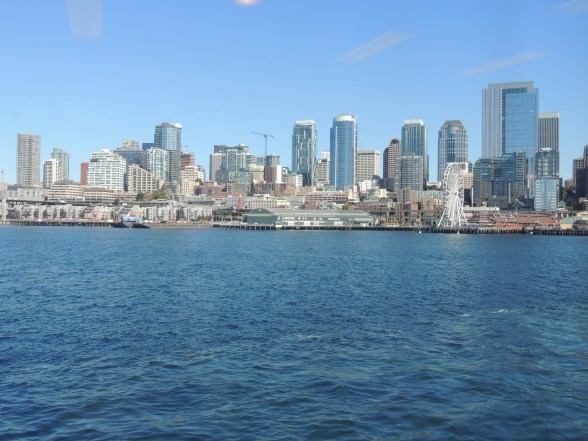
For Wordless Wednesday.

For the Lens-Artist Photo Challenge: #13 Look Up.
Taken last evening as I arrived at chorus.

For the Ragtag Daily Prompt: contrast.
I took this Friday, walking around north Seattle, waiting for my autoclave to finish testing. In the early morning these small flowers were by the road and scattered through a yard. For survivors everywhere: the earthquake and tsunami in Indonesia and for men, women and children who have been hurt and abused and go on. For the capacity to love, to grieve and to heal.

Last weekend my Aunt Pat and my Uncle Jim were visiting all the way from Virginia. It was lovely. On Sunday morning we hiked the beach, from Chetzemoka Park out to the lighthouse and back. It went from early am fog to sun during the hike.


I want us to have a culture where teens don’t drink to black out or to where they tell themselves that it’s ok to harm another person, where women are not punished for speaking up, where neither boys nor girls nor men nor women tolerate rape or domestic violence or discrimination or hatred.

OOOOooooo, maybe I should save this for Halloween, but I am going to use it anyhow.
For Mundane Monday #177, the theme is a photograph of something creature built.
We were leaving in the early morning and P nearly walked into this web. Then we both stopped and took photographs. It’s hard to capture the web in focus! When I moved to another angle, the spider is visible but the web can’t be seen with the white porch as a background. The spider is floating in space.
Link your photograph or send a message and I will list it next week.
Last weeks Mundane Monday #176, the theme was bones.
KL Allendorfer submits a fascinating project with students: Assembling the bones.
BLIND WILDERNESS
in front of the garden gate - JezzieG
Discover and re-discover Mexico’s cuisine, culture and history through the recipes, backyard stories and other interesting findings of an expatriate in Canada
Or not, depending on my mood
All those moments will be lost in time, like tears in rain!
An onion has many layers. So have I!
Exploring the great outdoors one step at a time
Some of the creative paths that escaped from my brain!
Books, reading and more ... with an Australian focus ... written on Ngunnawal Country
Engaging in some lyrical athletics whilst painting pictures with words and pounding the pavement. I run; blog; write poetry; chase after my kids & drink coffee.
Coast-to-coast US bike tour
Generative AI
Climbing, Outdoors, Life!
imperfect pictures
Refugees welcome - Flüchtlinge willkommen I am teaching German to refugees. Ich unterrichte geflüchtete Menschen in der deutschen Sprache. I am writing this blog in English and German because my friends speak English and German. Ich schreibe auf Deutsch und Englisch, weil meine Freunde Deutsch und Englisch sprechen.
En fotoblogg
Books by author Diana Coombes
NEW FLOWERY JOURNEYS
in search of a better us
Personal Blog
Art from the Earth
𝖠𝗇𝗈𝗍𝗁𝖾𝗋 𝖶𝗈𝗋𝖽𝖯𝗋𝖾𝗌𝗌.𝖼𝗈𝗆 𝗌𝗂𝗍𝖾.
Taking the camera for a walk!!!
From the Existential to the Mundane - From Poetry to Prose
1 Man and His Bloody Dog
Homepage Engaging the World, Hearing the World and speaking for the World.
Anne M Bray's art blog, and then some.
My Personal Rants, Ravings, & Ruminations
 KO Rural Mad As Hell Blog
You must be logged in to post a comment.