Last bonsai

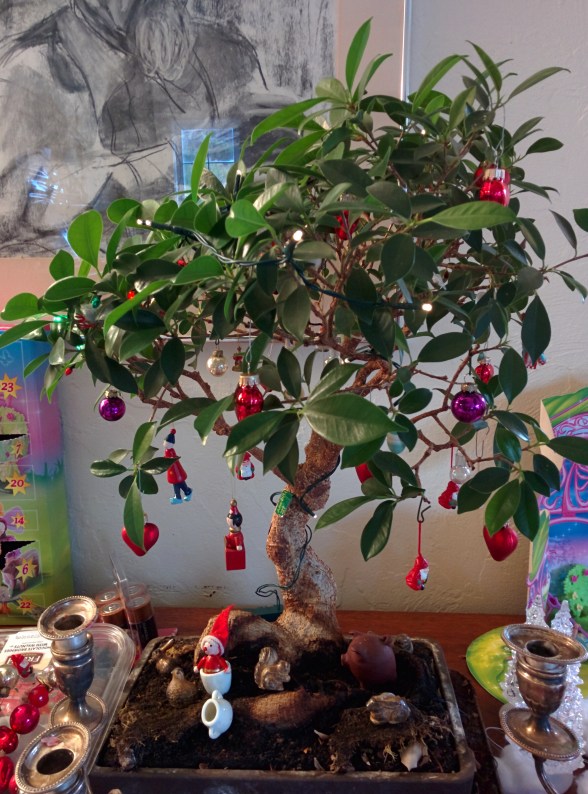
This year both my children are 18 or over and they wanted this small tree for the Christmas tree. “Don’t kill a tree, mom.” they said.

This tree is the last bonsai from my parents. My mother died in 2000 from ovarian cancer. She was at home in hospice for nearly seven weeks and we had over thirty visitors. My sister and my father and I all ignored the plants: and most of the bonsais died with her.

My father cared for the remaining ones even as his health deteriorated. He died at home as he would have wished, in 2013, alone and a sudden death. Two of the three remaining trees died. So this ficus came home with me. I water it faithfully and brought out the small ornaments to decorate for the holidays. I don’t know how old it is. After we lose our parents, we wonder about things: where is this from, how old is it, was it important to you, was it a random gift? Did you buy it, did you love it, was it not something that you cared about?

This holiday ask a family member to tell you a story about something in their house. Ask about something that you like, or is unique, or that really doesn’t fit in. Ask about a piece of art or a piece of furniture or jewelry. And write the stories down for the next generation…. while you can.


I will fight no more

I am tired of fighting
I am tired of fighting for justice
I am tired of fighting discrimination
I am tired of fighting for health care for all

I am tired of fighting insurance companies
I am tired of fighting medicare’s contractee
I am tired of fighting for prior authorization
I am tired

I will fight no more forever

I heal
I am a healer
I am trying to heal patients
I am trying to help patients heal

I am a healer
I help heal cancer
I help heal heart disease
I help heal PTSD
I help

heal cancer
heal heart disease
heal PTSD
heal addiction

I am a healer

heal the insurance company
heal the medicare contractor
heal the pharmaceutical company
heal

heal anxiety
heal depression
heal addiction

I will fight no more forever

I heal

The legs in the photograph don’t look delicate, do they? They are strong and beautiful and powerful. I took this at the National Junior Synchronized Swimming Competition in 2009. Those girls on the edge of being women are strong, they are a team, they work and play together. They have the skills and the strength to lift their bodies out of the water that far using their arms… think about the practice and strength needed to do that. We all want to heal and create fun and play and beauty. Let’s work as a team.

also on everything2.com

at the end of the massage

at the end of the massage
I was dreamy and he put a warm towel over me
and said that I was not to get up until
my body had absorbed all of the heat from the towel
and he left the room

and I thought dreamily that it was so nice
to have my armor removed and muscles unlocked
and to just be assigned to let warmth seep in to me
until I held it all

and I thought dreamily that if all of the archetypes
are in each of us and I am learning to love all of mine
and even and especially the most horrific ones the ones
we all want to reject, not mine, the monsters, oh, poor monsters
that howl in the wilderness that howl in the dark that howl
to be loved

and I thought dreamily that if I love all of the archetypes
inside me then they aren’t a group that is around a table
in my mind, when they are all loved they come together and I
am one and everything is one

and I thought dreamily that how surprising that I felt one
quite suddenly and with no warning and with warming and oh
Beloved all connected

and I thought dreamily that was I really feeling healed as if
all of the splits and breaks and damaged are healed just by
love and I can add to the love in the world loving the inside
terrible parts of myself oh and the monsters long to be loved so
their weeping is terrible

and I thought dreamily blessings monsters blessings Beloved and
love to all and I lay there until I had absorbed all of the warmth
from the towel

and I got up slowly

and returned to the world

Cindy gets real and skips the ball

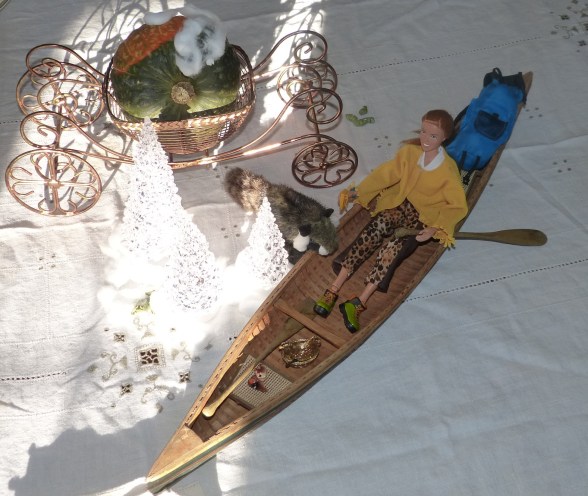
We had a lovely dinner with family and friends. I look at the tablecloths and napkins that I have inherited and I am glad that I live in a time where I can work as a female physician and am not embroidering elaborate tablecloths and napkins. Some of the ones that I have WERE done by female relatives. Amazing and work that is currently not very valued.

So my centerpiece was an acknowledgement of the changes: Cindy is not going to ride in the coach. She has a canoe and paddles and a backpack, sleeping bag, stove, water bottle and GPS. She is going to find her own way and paddle her own canoe.

Through storm and fear

This is for photrablogger’s Mundane Monday #34.

I was downtown in the early morning for coffee and a walk. I walked out to Port Hudson. The wind was blowing very hard and the rigging was singing that eerie whistle wail. There are giant cleats out as both seats and advertising. I put one of my earrings on the cleat and took the picture. The earrings were my mother’s. After she died I looked at her jewelry. She loved little boxes and I was trying to understand the organization of the earrings. It was not by value, since plastic and gold were all mixed together. She was an artist and organized the earrings by color. These little plastic eiffel towers were in the box with red and pink earrings of all sorts. They are probably at least 30 years old. The tower looks so small against the black cleat with the rainwater. I hope that we can all care for each other through storms and fear.

Fraud in medicine: mail order pharmacies

My clinic refuses to fax to mail order pharmacies. Instead, I give the prescription to the patient and tell them to mail it.

I started this policy over a year ago, when five different patients called in the same week, about two mail order pharmacies.

Patient: “I called my mail order. They say that they don’t have the prescription and the doctor just needs to cal.”

I check. Each of the prescriptions had been faxed. I called the two companies a total of five times that week. Each time they would ask for my identifying information, the patient’s identifying information, transfer me and then say, “Oh, yes, we have the prescription.”

Ah. This is a nice example of triangulation. The patient calls for their refill. The mail order company faxes me a request. I check the chart, see if the person is due for labs or a visit, and fax the prescription. Then the company sits on it. The patient calls them and the company says they don’t have it. They delay. Finally the patient calls me to call the company and then the company admits, oh, yes, actually we do have it.

So we refuse to fax to these companies.

Last week I saw a patient who had mailed her prescriptions. She did not get her medicine.

“I called the company five times. They told me they didn’t have it. They said to call you to send a “hard copy”. I said, “I mailed it to you myself on this date.” Then they said, “Oh, yes, we have it.” However she was out of her medicine for three weeks.

I said, “They saved the cost of three weeks of medicine. That is fraud.” I explained the scam.

Comprehension dawned on her face. “They do it on purpose?”

I shrug. “Five in one week seems like a business operation to me. I recommend that you write to the state insurance commissioner.

She said, “Next time I will mail it certified. And yes, I will call the insurance commissioner if they do it again.

The patient main insurance sends information that getting the prescriptions mail order will be cheaper, and so people want to use the mail order: but the mail order pharmacies in our area are saving costs by ripping people off and delaying prescribed medicine. I do hope they end up in jail: if we can’t jail the corporation, let’s at least jail the CEO and the top 4 officers.

I took the picture yesterday at sunrise.


Fallen

I took this photograph outside the Weyerhouser King County Aquatic Center, where my daughter was one of the many WA state high school swimmers. It rained driving all the way there, rained the entire time we were there and then rained on my entire drive back…

This is for Photrablogger’s Mundane Monday Challenge #33. Water again, but now the beauty of water and leaves and asphalt….

Safe harbor

For Ronovanwrites haiku challenge #70, prompt words cover and color.

cover, shelter all
colors, would you harbor me
should be a cover

Sweet Honey in the Rock: Would you harbor me? https://www.youtube.com/watch?v=i0XBXJjoXJ4

I thought about cover meaning shelter and meaning the song, and the refugees needing shelter, harbor and cover. We are frightened and seek cover, shelter, harbor. Who do we have to harbor us but each other?

The photo is a synchronized swimmer in 2012.

Adverse Childhood Experiences 8: Social cues

I am thinking about social cues for people with high Adverse Childhood Experience scores. With crisis brain wiring the response to social cues may be very different than what is considered the acceptable “norm”.

I always miss the cue when someone says “see you later”. I think “When?” Then I realize it’s a social comment and they do not in fact plan to see me later. I have a moment of disappointment. I do the same thing when someone says, “Let’s get together for dinner.” or “Let’s have coffee some time!” or “I will call you back!” or “Why don’t you come to our cabin some day?” Yes, I think, when?

And then I think “Liar.”

So I fail social cues….. or do I? Maybe I am not responding to the “correct” or “conventional” or “nice” social cues.

My father drank too much and especially while I was in high school and college. And my mother would enable and cover up and pretend nothing was happening. Children in this situation, which is way too common, develop special skills.

My sister was three years younger. As adults we discussed the stages of drinking and which one we hated most. We would both walk in the house from school with trepidation. In the door and almost feeling the air: what is happening? Am I safe? Do I need to hide? How dangerous is it? How much will it hurt?

I walked in once during high school and missed the cue. I was thinking about something. I thought my father was asleep in the kitchen. I went in to get something. I was very quiet so as not to wake him. I made a cup of tea.

He was not asleep, or else he woke up. And it was the worst stage, or the one I hated most.
Not physical violence. But he started talking. One of things he said was “You can tell me anything.” Now, he meant it. But he was crying by then and I knew I did not want to tell him anything and all I wanted was desperately to leave the room. And neither my sister or my mother was home. Finally I was crying too, because I said “I just want to go read my book.” and he was more crushed and maudlin and emotional and crying. And I tore out of the room and up to my room, as my mother walked in.

I did not cry much. Ever.

I refused to talk to my mother about it.

The next day she said to me, “Your father told me that you were talking about Lamont.” Lamont Cranston was a very beloved cat, The Shadow, who was missing now. Dead, we thought.

I said nothing. Because we had not talked about Lamont. So either my father was lying or else he’d had a blackout, didn’t remember and was making shit up. And if I told my mother the truth, she would back him and deny what I said or make it into a joke.

The stages my sister and I identified were:
1. sober
2. a little bit
3. goofy/silly/makes no sense
4. crying
5. asleep

We were ok with 2 and 5. I don’t think we saw 1 for years. We disliked 3 intensely, especially in public and especially when our mother was doing a cover up dance. And 4 we hated.
And yet I loved my parents and mostly miss them now that they are gone. Except when I remember things like this.

So, what is the point?

I miss “social cues” because that is NOT what the crisis brain, the ACE score brain, pays attention to. I am paying attention to far more intuitive things: body language. Whether what the person is saying matches what I know about them and what they have done in the past. I am looking for whether this person is telling me the truth.

I don’t trust instantly. Why would I?

I said to a counselor once that reading the “cloud” around the person was terribly useful in medicine but made me a social misfit. “I don’t know how to turn it off.” I said. She grimaced and said, “Why do you think I went into counseling?” She said, “I can’t turn it off either but I have learned to ignore it during social situations.” I was in my forties before I realized that there are people who don’t sense this cloud, who trust people until the person is dishonest, who understand that it is just fine to say “Let’s get together.” and not mean it.

Because actually, when someone says “I’ll see you later.” and they don’t mean it, they are saying an untruth. They are not planning to see me later. They don’t mean it. And my brain automatically files that under evidence that this person is not trustworthy. To them it is a social cue that is polite. To some of us, it is clearly something that is not actually true. I pick up on a cloud of social cues, but not the ones that are acceptable or conventional. And I am not the only one.

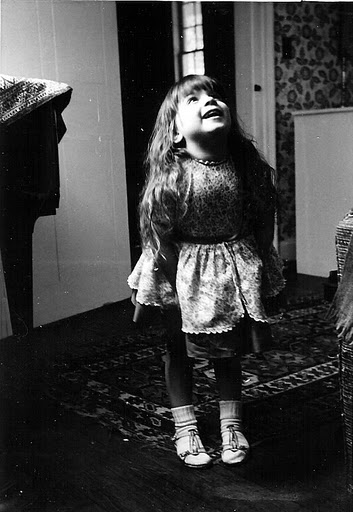
my sister on the left and me on the right, in the 1960s
Why care for addicts?

Why care for addicts?

Children. If we do addiction medicine and help and treat addicts, we are helping children and their parents and our elderly patients’ children. We are helping families, and that is why I chose Family Practice as my specialty.

Stop thinking of addiction as the evil person who chooses to buy drugs instead of paying their bills. Instead, think of it as a disease where the drug takes over. Essentially, we have trouble with addicts because they lie about using drugs. But I think of it as the drug takes over: when the addict is out of control, the drug has control. The drug is not just lying to the doctor, the spouse, the parents, the family, the police: the drug is lying to the patient too.

The drug says: just a little. You feel so sick. You will feel so much better. Just a tiny bit and you can stop then. No one will know. You are smart. You can do it. You have control. You can just use a tiny bit, just today and then you can stop. They say they are helping you, but they aren’t. Look how horrible you feel! And you need to get the shopping done and you can’t because you are so sick…. just a little. I won’t hurt you. I am your best friend.

I think of drug and alcohol addiction as a loss of boundaries and a loss of control. I treat opiate overuse patients and I explain: you are here to be treated because you have lost your boundaries with this drug. Therefore it is my job to help you rebuild those boundaries. We both know that if the drug takes control, it will lie. So I have to do urine drug tests and hold you to your appointments and refuse to alter MY boundaries to help keep you safe. If the drug is taking over, I will have you come for more frequent visits. You have to keep your part of the contract: going to AA, to NA, to your treatment group, giving urine specimens. These things rebuild your internal boundaries. Meanwhile you and I and drug treatment are the external boundaries. If that fails, I will offer to help you go to inpatient treatment. Some people refuse and go back to the drug. I feel sad but I hope that they will have another chance. Some people die from the drug and are lost.

Addiction is a family illness. The loved one is controlled by the drug and lies. The family WANTS to believe their loved one and often the family “enables” by helping the loved one cover up the illness. Telling the boss that the loved one is sick, procuring them alcohol or giving them their pills, telling the children and the grandparents that everything is ok. Everything is NOT ok and the children are frightened. One parent behaves horribly when they are high or drunk and the other parent is anxious, distracted, stressed and denies the problem. Or BOTH are using and imagine if you are a child in that. Terror and confusion.

Children from addiction homes are more likely to be addicts themselves or marry addicts. They have grown up in confusing lonely dysfunction and exactly how are they supposed to learn to act “normally” or to heal themselves? The parents may have covered well enough that the community tells them how wonderful their father was or how charming their mother was at the funeral. What does the adult child say to that, if they have memories of terror and horror? The children learn to numb the feelings in order to survive the household and they learn to keep their mouths shut: it’s safer. It is very hard to unlearn as an adult.

I have people with opiate overuse syndrome who come to see me with their children. I have drawings by children that have a doctor and a nurse and the words “heroes” underneath and “thank you”. IΒ  have had a young pregnant patient thank me for doing a urine drug screen as routine early in pregnancy. “My friend used meth the whole pregnancy and they never checked,” she said, “Now her baby is messed up.”

Addiction medicine is complicated because we think people should tell the truth. But it is a disease precisely because it’s the loss of control and loss of boundaries that cause the lying. We should be angry at the drug, not the person: love the person and help them change their behavior. We need to stop stigmatizing and demeaning addiction and help people. For them, for their families, for their children and for ourselves.

I took the photo of my daughter on Easter years ago.