mother, maiden and crone

When Beth is dying in Little Women, she says that it is like the tide going out….. sometimes I miss my sister so much. I am trying to make sense of the third stage, the stage after mother. With my daughter in college, I am living alone for the first time in 28 years. And I don’t have my sister or my mother or my grandmother to accompany me.

I took the title from one of my sister’s essays: An early promotion to crone. Here: http://e2grundoon.blogspot.com/2007/08/early-promotion-to-crone.html

I want to discuss my sister’s essay with her …. I can’t, except in dreams.

mother, maiden and crone

small child in my heart
baby cuddled warm
safe and loved
small girl dancing
sing run shout

woman seen and heard
woman silenced dressed undressed
woman learning searching writing
woman held and loved
woman gravid bearing carrying
woman feeding raising nurturing

crone quiet watching
white haired dismissed old
unseen unknown ignored
laughing playing dancing
crone alone
sing run shout
dancing

music: https://www.youtube.com/watch?v=JiP9WH0zN0Y

Sending love

Sometimes I wake in the morning, muscles tight and anxious.

This morning I dreamed that I was a teen, going on a trip. I packed my sleeping bag and the new pad. I finally bought a new inflatable pad for camping, last year. I still have my old one, patched and 30 years old and thin. I decided that I am old and stiff enough to have a newer one. I used it for the first time in the tree house. Yoga mat, pad and sleeping bad and I was warm. In the dream that was all I had time to pack: no clothes or books. There was barely room for that. I was worried about the trip and afraid.

When I wake anxious and feeling attacked, I send love. I send love to the people that I am finding most difficult in my life. A family member who with their spouse, have been mean since I was a teen. Not a family member any more: a blood relative, now. I will choose who is family and who is just a blood relative. In the manner of children of alcoholics, this is a terribly slow process. Raised in addiction and enabling, children love their parents anyhow, and it is a slow adult process to learn that love is not addiction, enabling nor enmeshment.

So I send love: may this person be peaceful. May this person be free. May this person be filled with loving kindness. May this person be safe. I send them loving kindness, especially if they are a blood relative who is still cruel. I don’t want them in my life any more and yet I want to forgive them. Forgive but not reconcile, if they are still in the dire pattern. No reconciliation if they continue the behavior.

Sending love.

Sweet Honey in the Rock: In the morning when I rise: https://www.youtube.com/watch?v=ZAJBZXIzKcY

I took the photograph of my mother in the early 1980s. I borrowed my first real camera and took one roll. I scanned this today and my scanner is not up to the detail, but I like the abstraction. I love this photograph of my mother because it is her thinking and concentrating expression.

Pain as a vital sign

A recent article in the Family Practice News says that a survey of 225 physicians reveals that 33% of them think that the opioid crisis in the US is caused by over prescribing opioids. 24% said aggressive patient drug seeking and 18% said it is due to drug dealers. How quickly things change.

In 1996 pain was declared the fifth vital sign, after temperature,  pulse (heart rate), respiration rate and blood pressure. I disagreed with it because it focused on pain, by telling the nurses in the hospital and the outpatient providers to always to ask about pain. I thought it would be better to focus on level of comfort than pain. I thought we were using opioids far too freely and I thought that patients were getting addicted. The pain specialists said that we had to treat pain, and we were given very few tools other than opioids. Primary care providers were told that they could be sued for too much or too little pain medicine.

I also disagreed with it because pain is NOT a vital sign. That is, the level of pain does not correlate with illness. If a person has a high fever of 104 I am sure they are sick, a fast or very slow heart rate, a blood pressure too high or two low, they are breathing too fast: these are vital signs. They often correlate to illness and help us decide if this is outpatient, urgent or emergent. But pain does not. A chronic pain patient may have a pain level of 8/10 and yet not be an emergency or in a life-threatening state at all. That does not mean that they are lying or that we don’t wish to help with pain.

In June, 2016, the American Medical Association recommended dropping pain as a vital sign. https://www.painnewsnetwork.org/stories/2016/6/16/ama-drops-pain-as-vital-sign. The Joint Commission for Hospital Accreditation dropped pain as a vital sign in August, 2016. https://www.jointcommission.org/joint_commission_statement_on_pain_management/

Why? Not only were people getting addicted to opiates, but they were and are dying of unintentional overdoses: sedation from opiates with alcohol, with anxiety medicines such as benzodiazepines, with soma, with sleep medicines such as ambien and zolpidem. If the person is sedated enough, they stop breathing and die. The CDC declared an epidemic of unintentional overdoses in 2012: https://www.cdc.gov/mmwr/preview/mmwrhtml/mm6101a3.htm and said that more US citizens were dying of prescription medicines taken as instructed then from motor vehicle accidents and guns and illegal drugs.

So the poem below and a second poem I will post tomorrow reflect how I thought about pain as a vital sign. It is not a vital sign, because a high pain level does not tell me if the person is critically ill and may die. It does not correlate. Pain matters and we want to treat it, but the first responsibility is “do not harm”. Letting people get addicted and killing some is harm.

Also, opioids have limited effectiveness and high risk for chronic pain. I have worked with  The University of Washington Pain and Addiction Clinic since 2010 via telemedicine. They say that average improvement of chronic pain with opioids is about 30%. Higher and higher doses do not help and increase the risk of overdose and death. And the risk of addiction.

I think of pain as information. Studies of fibromyalgia patients with functional MRI of the brain show that they are not lying about their pain. In a study normal and fibromyalgia patients were given the same pain stimulus on the hand. The normal patients said that they felt 3-4/10 pain. The fibromyalgia patients felt 7-8/10 pain with the same stimulus and the pain centers lit up correspondingly more in their brains. So they are not lying.

Why would opioids only lower chronic pain about 30% even with higher doses? The brain considers pain important information. We need to snatch our finger away from a flame, stop if we smash our toe, deal with a broken bone. I think of opioids like noise cancelling headphones. Say you are listening to music. You put on headphones/take round the clock opioids. Your brain automatically turns up the gain: the music volume or the pain sensors. Now it hurts again. You take more. The brain turns up the gain. Now: take the noise cancelling headphones off. The music/pain is too loud and it hurts! With music we can turn it down, but the brain cannot adjust the gain for pain quickly.

We do not understand the shift from acute pain to chronic pain, yet. The shift is in the brain. I think that we are too quick to mask and block pain rather than use the information. Now the recommendations for opioids are to only use them for 3-5 days for acute pain and injury. For years I have said with any opioid prescription: try not to take them around the clock and try to decrease the use as soon as possible. Some people get addicted. Be careful.

If we don’t hand people a pill for pain, what can we do? There are more and more therapies. Jon Kabot Zinn’s 30 years of studying mindfulness meditation is very important. His chronic pain classes reduce pain by an average of 50%: better than opiates. Pain and stress hormones drop by 50% in a study of a one hour massage. Massage, physical therapy, chiropracty and acupuncture: different people respond to different modalities. Above all, reassuring people that the level of pain in chronic pain does not correlate to the level of illness or ongoing damage. And pain is composed of at least three parts: the sharp nocioceptive pain, nerve pain (neuropathic) and emotional pain. We must address the emotional part too. We have no tool at this time to sort the pain into the three categories. My rule is that I always address all three. That does not mean every person needs a counselor or psychiatrist. It means that we must have time to discuss stress and discuss life events and check in about coping.

In the survey of 225 providers, 50% estimated that they prescribe opioids to fewer than 10% of their patients. 38% said less than half. 12% estimated that they prescribe opioids to more than half their patients. The survey included US primary care, emergency department and pain management physicians.

Handing people a pill is quicker. But we can do better and primary care must have the time to really help people with pain.

Vital Signs I

In the hospital now
I am told we have a new
Vital sign
Like blood pressure and pulse
We are to measure
Pain
And always treat it

Sometimes I wonder

Mr. X is in the ICU
I tell his family
He may die

On a scale of one to ten
What is his wife’s pain?
His daughter’s
We are not treating them
Only Mr. X

We try to suppress pain
Signals from our nerves
Physical pain is easier

I think of our great forests
We suppressed fire

And that was wrong
If fire is suppressed
Undergrowth builds up
Fuel levels rise
Fire comes
Rages out of control
All is destroyed

If fires burn
More naturally
More regularly
What is left?

At first it looks desolate
The tall trees are burnt
Around their bases
But they live
Adapted to the fire
Majestic pines
Revealed
Would our values were as clear

Some pines
Seeds
Pinecones
Will only germinate
In fire
When the undergrowth
Is cleared
Conditions are right
For new growth

Perhaps pain is our fire
Grief is our fire

If we block pain
Where does it go?
Does the fuel build?

I wonder if the tall pines
Fear fire
Would they avoid it
If they could

Perhaps suppression
Is not the answer

Perhaps we can change
Remain present
Acknowledge pain
As normal
As joy

Perhaps if I
Step into the fire
I can remain
Present
For you

And you will be
Less alone
Less afraid

I open my doors

Let the fire burn

poem written before 2009

CDC guidelines for treating chronic pain: https://www.cdc.gov/drugoverdose/pdf/guidelines_factsheet-a.pdf

Who is driving the car?

I am at my parent’s house.

My mother and I and the baby, a toddler, go out to the car which is a huge newish SUV. I open the back door and see a drawing lying on the seat, beside the car seat. It is a drawing of my son, from a photograph. My mother has written on it, her ideas about how she wants to do the painting. I took the photograph and know it: my son has an exuberant joyous toddler expression. I climb in to the SUV. My mother gets in the front and turns the car on. She pulls forward and I start screaming, “STOP! STOP DON’T DRIVE! THE BABY IS NOT IN THE CAR!” My mother is pulling forward and backing, in confusion. She stops.

I leap out and search. Under the car by the back wheel, but not under it, is a kitten. A black kitten, lying on its side. I reach and very gently pick it up, supporting its spine. I am crying. The kitten cries as I pick it up, with pain. I say, “She’s hurt! I am going to die!”

I wake up.

I think about the dream. Even though there is a picture of my son in the car, I am a teen in the dream. The toddler is not my son. The toddler is not my daughter. The toddler is my sister. My parents had old cars, never a new SUV. The house in the dream was my parent’s house in Alexandria, Virginia. We moved there when I started ninth grade and my sister started sixth. My parents sold the house and moved in 1996.

Who is driving the SUV? Is there a responsible adult? Are they taking care of the children? Or are they driving recklessly and leaving the children to try to care for each other? Some adults are not responsible and should not be driving.


My son took the photograph of my daughter in 2011 for a school project, recreating a movie poster: True Grit.

Alcohol

Let’s talk about alcohol.

I am a family practice physician and I talk to people of all ages about alcohol. The current recommendation is no more than seven drinks a week for women and fourteen drinks a week for men, no saving it up for the weekend. No more than two drinks in one day for women and no more than three for men.

“What?” you say “No way. Come on, that’s ridiculous.”

My patients don’t say “That’s ridiculous.” After all, they are paying me to do a physical exam and a preventative exam. I am supposed to give them advice. But what is the basis for that?

One drink is defined as a regulation 12 oz beer or 6 ounces of wine or two ounces of hard liquor. If it is a high alcohol beer or wine or liquor, the amount is less.

It is NOT the liver doctors that have given us these numbers. It is the cardiologists, the heart doctors. One drink in women or two in men lowers blood pressure and in general, has good effects. Go over that daily and there is a rebound in blood pressure as the alcohol wears off. Alcohol works in the same way as benzodiazepines: it makes people less anxious and more relaxed and lowers inhibitions. Both alcohol and benzodiazepines are addictive for many people. That is, they develop tolerance, it takes more of the substance to have the same effects, more tolerance and then it takes more and more substance to try to feel half way normal.

Cardiologists qualify this recommendation as follows: there is no recommended daily amount of alcohol that is considered heart protective because there are too many alcoholics. The recommended daily amount of alcohol for an alcoholic is none. The recommended daily amount of alcohol for the general population is none.

Alcohol withdrawal can be very very dangerous medically. I think that the three most difficult things to quit are heroin (and all opiates), methamphetamines and cigarettes, but alcohol is more dangerous. In heroin withdrawal all of the pain receptors fire at once, so it is torture, but people don’t die. With serious alcohol withdrawal, the blood pressure skyrockets and the person can have seizures, a stroke, a heart attack, delerium tremens and can die. In the hospital, benzodiazepines are used to slow the withdrawal, replacing alcohol in a controlled manner.

Alcohol does more than affect the blood pressure. Over time, alcohol can damage the heart and lead to congestive heart failure.

Of course, you know that it can damage the liver and lead to cirrhosis. Cirrhosis is sneaky: as long as there are a few functioning liver cells, the lab work can look pretty normal. The liver makes proteins for the blood and makes proteins that allow our blood to clot. Once there aren’t enough healthy cells to make those proteins, alcoholics will bleed quite spectacularly. If the amount of the protein albumin in their blood is low, fluid leaks from the blood into the tissues: so whatever part is “dependent”, that is, lowest, will be swollen. Alcoholics can have legs with swelling where I can push with my finger and there is a two or three cm dimple. Alcohol also can lead to gastritis and ulcers. If someone can’t clot and they are vomiting blood from an ulcer, the doctor gets a tummyache too, from worrying. Ow. The liver is also supposed to filter all of the blood in the body. As the liver gets blocked with dead liver cells, the blood starts to bypass it. The bypass is through blood vessels in the stomach. Remember that person vomiting blood? The swollen vessels in the stomach are called varicies and we don’t like them to bleed. They are big and can bleed really really fast. The person can die. I don’t like transfusing and really don’t like transfusing 12 units of blood. In end stage alcoholism, the liver no longer lowers the blood level of ammonia. Ammonia crosses the blood brain barrier and poisons the brain. We haven’t even discussed the lack of vitamin B12 and thiamine which can cause unraveling of the myelin sheaths on the long fibers in the spinal cord: this means that the person gets permanent asterixis and “walks like a drunk” even when they are sober. I’m sure I haven’t remembered all of the consequences of alcohol, but that will do for now, right?

How much alcohol daily causes the above charming picture? We Don’t Know. Really. And it is not okay to do randomized double blinded clinical trials to find out. Same with pregnant women: we don’t know if there is a safe amount of alcohol during pregnancy and we bloody well can’t test it. It is safer not to drink while you are pregnant.

In clinic, I ask how much people drink. If they say 1-2 drinks daily, I ask what the drink is. Sometimes they look confused. I explain that I have one patient who has two drinks a day: however, it is a 12 ounce glass with a little ice and a lot of whiskey. I asked him to estimate how much whiskey and he said, “6-8 ounces.” That is, each glass is 6-8 ounces. His blood pressure is not under control and so far I feel like a failure as a doctor with him; he is NOT reducing the amount. In medical school, the two jokes were: How much alcohol is too much? More than your doctor drinks. And: How much does the patient drink? Double or triple what they tell us.

The popular word in college used to be that you could drink one drink an hour and still be “okay”. “Okay” to drive and it would wear off. Sorry, nope. Breathalyzers are now pretty cheap; buy one if you are drinking more than the 1-2 per day. And the college students that are binge drinking 6-8 or more drinks on Friday and Saturday: it DOES have long term effects and it IS doing damage.

Lastly, sleep and depression. If you are having trouble sleeping, don’t drink. No alcohol at all. Alcohol is a depressant. It helps people to fall asleep. But they do not have “normal sleep architecture” and it works AGAINST them staying asleep. People often wake up as the alcohol wears off. And the blood pressure is having that rebound, remember, and often their heart will race. That is withdrawal. If you are having trouble sleeping or you are depressed, do not take a depressant. It makes it worse.

I saw a nineteen year old in clinic who admitted to “occasional” heroin use. “But I’m not addicted,” she said. I said, “Well, that’s good. But I took care of a bunch of people undergoing heroin withdrawal while I was in residency and it looked like one of the most painful things on the planet. So I would advise you to quit while you are ahead.” I saw her a year later and she said, “When I tried to quit, it WAS hard. I was addicted and didn’t know it. I’m off now and I won’t go back.” So if you tell me, no problem, I can quit alcohol any time, I say more power to you. Show me. And if it’s harder than you think, get help.
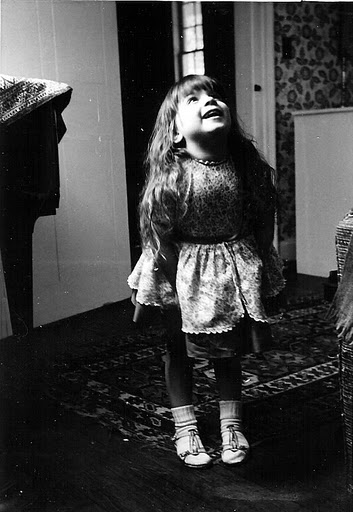
 

Originally written in 2009 and updated a little today. The picture is just a little fuzzy…like it might be if I was drinking…..

https://www.drugabuse.gov/about-nida/noras-blog/2015/06/addiction-disease-free-will

https://www.niaaa.nih.gov/alcohol-health/overview-alcohol-consumption/what-standard-drink

the unwashed masses

I don’t have any of THEM as patients. The unwashed masses. All of my patients are smart.

There aren’t any unwashed masses.

I have a gentleman who is overweight, obese, diabetes. He is not stupid. He is not unwashed. He is not exercising or controlling his blood sugar right now because the temperature is below freezing. He has a hole in his trailer floor and no heat. So he huddles under the electric blanket.

I have a gentlewoman, also diabetic. She too is not stupid. She is not unwashed. She lost her husband to cancer and then everything else and then was homeless for a period. She has a small house but she has no heat. She stays in bed to stay warm. Her contractor quit before he put in the furnace and he’s gone bankrupt. She is cold.

I have veterans. They are not stupid. They are not unwashed. One was homeless for a long period and pooled his resources with another to rent a section 8 house. I am so proud of them. They are having trouble living together, each would rather live alone. Only sometimes they would rather not be alone. It is hard.

I have a massage therapist. She started to train as a counselor. To be a counselor, she needs a certain number of supervised hours and was getting this through the county mental health. “I didn’t know.” she says. “It is taking twice as long as I thought because half the time they don’t show up. They don’t show up because they don’t have gas, they don’t have food, they have been evicted, their son is in jail, they are in jail. I had no idea. My massage clientele is so different, they pay. I thought poverty was in third world countries, but it is here, in my county. I didn’t know.”

I know the people who live in the woods. A schizophrenic who comes once a month for his shot. He was losing weight. “Why are you losing weight?” I demand. “I am only eating once a day.” he says. I nag him to go to the community meals. He is shy, he is afraid of people and he is hungry. He is not stupid. He is not unwashed.

I have opiate addicts. Six years ago one expressed concern. He is 6 foot 5 and big. “I am afraid of some of the other people. You shouldn’t be doing this! It’s too scary and dangerous!” My opiate addicts are not stupid. My opiate addicts are not unwashed. Sometimes they relapse. Sometimes they die, in their 50s, 40s, 30s, 20s.

One in six people in the US is below the poverty level. They are not stupid. They are not unwashed.

And when someone talks about the masses, the people, the stupid people, most people are stupid, the sheep….

….I am beyond angry….

….my heart hurts….

Poverty in the US: http://www.census.gov/newsroom/press-releases/2016/cb16-tps153.html.

More: http://www.census.gov/topics/income-poverty/poverty.html.

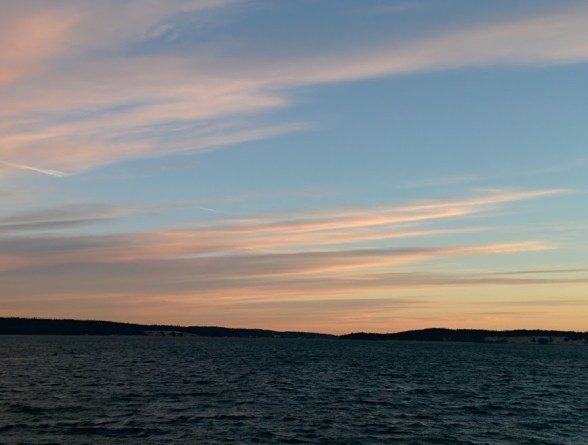
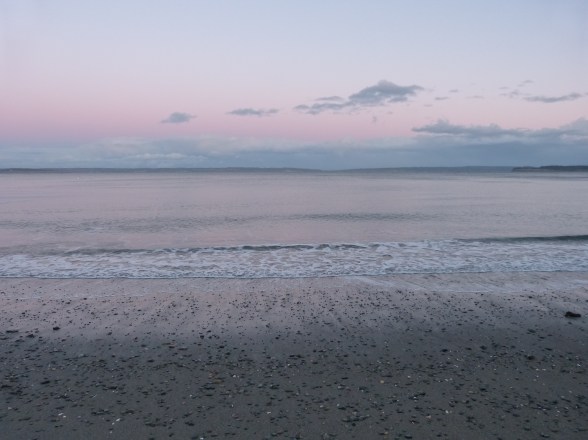
The examples are taken from 25 years of practice, details changed for hipaa, but I can list dozens at any one time. The photograph is during the sunset after clinic, when I walked down town, the view across the sound.


The dead are with me

I am at the lake. There are younger people with me. We go to the graveyard. The earth is soft and loose. There are no markers or stones. We do not need them.

“I can feel the people in the earth.” says one of the younger people.

“Me too!” says another.

“Of course.” I say. I name the people under the earth and introduce them. The young people are amazed. I am surprised that they have never felt the dead. I think the cities and concrete and phones and television and computers: all of these must block the signals. But we never allowed electricity here. The phones don’t work. Candles, aladdin lamps, propane stoves and heat with wood in old cabins. Thin shacks where we hear the wind and water, and tents, lying in the embrace of the earth.

We leave but when we come back, the young start to reach down into the soft earth, arms length. “Did they die young?” one asks. “We want to know more.”

“You must be patient.” I say. “Don’t push the dead.”

Later I return a third time to sit quietly alone with the dead. Dark falls, moonless, overcast, no stars. I stand to return to the cabins and my flashlight dies. I know the paths well, but not the path to the graveyard. I tie up my long skirt and kneel. I feel the ground gently. Yes, I can feel the path. I start to crawl slowly, stopping to feel the packed worn earth. I think of wolves and cougars but none have been here for years. It is not cold enough for exposure. It is just dark and slow. The dead are with me and approve.

Pick a plan right for you…..

We are in open enrollment for health insurance in the US. Meaning that they all are going up in cost and they are cancelling plans and offering new ones. And advertising: pick a plan right for you!

What the hell does that mean?

It means that all of the plans exclude things. Oh, well, aromatherapy…. that’s what you are thinking if you are not a US citizen. Of course the plan doesn’t cover aromatherapy or crystal healing or fringe treatments….

Well, no. I had to choose between two plans when my daughter was 17, that is, two years ago. I could choose the one that covered cancer OR the one that covered pregnancy. Uh, yes, that is correct. One EXCLUDED pregnancy healthcare and the other EXCLUDED cancer healthcare. For me and my children.

Which would you choose?

My mother died of cancer at 61 and my sister at 49. My daughter was not dating yet. Observing.

So we picked cancer.

I photographed the crows out on a walk the other day… how many does it take to make a murder?