Pathos

Beloved, what is my path?

I remember. You are gone and dead
I lie on my side, close my eyes
I feel your body behind mine
your arm tucked under me
your breath on my hair
your body warmth against me
your arm lying across my side
thighs and knees relaxed against mine
you are not gone and dead
as long as I can remember

Beloved, what is my path?

I remember. A path alone
so that I can see
so that I can hear
so that I can feel
so that I can write
Beloved, you set the path before me
a brief elaboration of a tube
Beloved, sometimes I want
Beloved, sometimes I say why
Beloved, sometimes I forget

And then I remember

_______________________________

For the Ragtag Daily Prompt: March.

Love and grief

I got a letter from a family member, talking about happy memories of my father, mother and sister, who are all dead. How much fun they were and my mother’s influence taking them to museums, art museums and the Smithsonian.

It’s a bit difficult to answer, since my memories are much more complicated and tangled.

I wrote a poem called Butterfly Girl Comes to Visit a long time ago. It is about my sister. My mother could charm a room full of people and enthrall them with stories. Sometimes the stories were about me and my sister and actually making fun of our feelings: fear or grief. However, my mother was so good with an audience that I didn’t break the stories down until after she died. She was 61. That involved exploring a lot of really dark feelings. My sister and I even asked my father what our mother was really like: his reply was “Morose”.

I inherited my mother’s journals. My sister told me not to read them because they were “too depressing”. I don’t agree. They explain some things. My parents often fought, screaming at each other at 2 am while I was in high school. The family story was that my father was an alcoholic. As an adult, I wondered why she would fight with someone who was drunk. Her journal says “I drank too much last night,” over and over. Well, that would explain it, right? It takes two to tango. Or fight.

My sister could also charm a room. That is the sparkle in the Butterfly Girl poem. There was a period where she would tell me that I couldn’t talk about certain things, that she was fragile, that I was hurting her. This is after I gained control my feelings and had actual boundaries: I could refuse to fight with her. Before that, she could set me off like dry tinder. Her first husband called me once, saying, “I can’t not fight with her when she wants to fight. What do I do?” I replied, “I can’t either. I don’t know. I am so sorry!” I think it took until I was in my early 30s to refuse to fight with her and took a lot of conscious work. A fiance that broke up with me right after college told me I was an ogre when I was angry. I took that seriously and worked on it. My parents were not good role models for dealing with anger or grief or fear.

I am not much in contact with my maternal family. One person said that we could be in contact if we only said nice things about my mother, father and sister. I suggested we never mention them at all. We did not reach an agreement. I realize that our society wants to speak well of the dead, but to really be someone’s true friend, I think we have to accept that people may be angry at the dead as well. I gave this handout, Mourner’s Rights, to a patient on Friday. He is in the midst of grief and we talked about it. He thanked me and said, “I am grateful to talk to someone who knows about grief.”

My parents moved to Washington State in 1996. My mother was diagnosed with stage III ovarian cancer in 1997. I moved to be near them when her cancer recurred, arriving on Y2K. My mother died on May 15, 2000, four and a half months after we arrived.

My mother was only in that area of Washington for four years. She made such a charming impression that I had people tell me how wonderful and charming she was for a full decade. I was working though the complex feelings about her and tried very hard to thank people, even though I did not feel thankful.

I have not answered the letter yet. I want to return a gentle replay but I will not play the “only happy memories game”. I don’t mind my dark feelings. The family member would mind my dark feelings, I think. It is nice to be a physician and to be allowed to let patients talk about their dark feelings. Our culture wants to deny them, remove them, be positive. That is a disservice to love and to grief.

People are astoundingly complicated.

For the Ragtag Daily Prompt: astound.

The photograph is of my friend Maline, me, and two of her husband’s family members. Maline was one of my alternate mothers, a friend of my parents. She died within the last few years.

1932 Letter

My cousins sent me a packet of letters. Some are from my mother to her mother, but this one is from… well, see if you can guess.

Dear Mother and Father,

We got in the car and Grandfather and me sat in front and Grandmother sat in back. Grandmother said, “Do you want your window closed?” and I said, “No.” Then, in a few minutes after that I said, “I am getting kind of chilly.” Then in a few minutes after that I tumbled over the back of the seat into the back seat. Then I shot my pistol out the window and tried shutting it again but it wouldn’t go. Then I waited awhile and then I shot off my pistol again and it worked. Then I shot off my pistol again in a few minutes after that but somehow it didn’t work. And then after awhile it started raining.

Then we got home. After a little while Eva May came over. Then after awhile Jimmie came. Jimmie brought over his gun with him. He had a long gun.

After supper I took my sparklers over to Jimmy’s and Eva May’s house. They invited me over before supper and then I started lighting my sparklers. I lit one after another and in a few minutes I said, “I’ll go over and get my pistol,” so I did.Then I went back for awhile and then I came home and stayed and we had the rest of my sparklers in the house. And then we all went to bed pretty early.

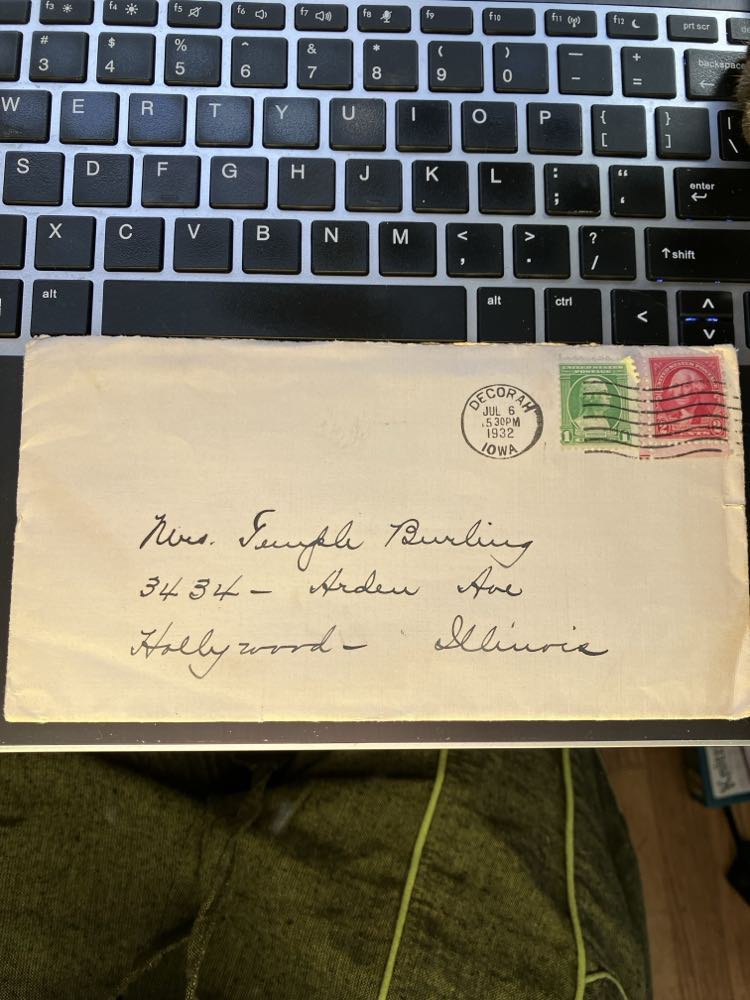
This is postmarked July 6, 1932 Decorah, Iowa. It cost .03 cents in stamps to mail. It was sent to Mrs. Temple Burling, 3434 Arden Ave, Hollywood, Illinois. The handwriting is quite beautiful. The letter is signed “Bobby” in quite different handwriting. The letter was sent from “Bobby” — Robbins Burling, age 6, as the narrator, with one of his grandparents transcribing to his mother (my grandmother) Mrs. Temple Burling (Katherine White Burling). I think it is a charming letter and so like a kid, with the repeats: “and then in awhile”. I am going to send it to “Bobby’s” grandson, who now has a child of his own. Here is the rest:

In the morning I got up and got dressed. Before I got up I was real quiet because I thought they were asleep because they were so quiet and they thought I was asleep because I was so quiet. Then finally they came past the door and when I knew – it they were awake – and they knew it – I was awake. And then I got up and got dressed.

Then after breakfast Grandmother and me went out and weeded. In a few minutes I said, “I’ll get the hay off the lawn for you.” so I did. I told her if she thought it was worth a penny and Grandma said, “Yes.” And then I said, “Do you think it’s worth any more than a penny?” and Grandma said “Yes.” In a few minutes we came in and she gave me a cent.

I left the penny in my hand and Jimmie came over and called me and we decided that we would make giant fingers and then as we were making giant fingers we decided we would make funny masks but we didn’t. We decided to make Chinamen’s hats but we didn’t.

Jimmie wore his hat in a funny pointed way and I wore mine with a round hole in the middle and kind of crooked too. And we went out to scare the girls and at first we didn’t scare girls but we scared Jimmie’s mother and we didn’t scare the girls after all. He went out to scare a man and he told me he’d be back and I got an idea while he was gone but he didn’t appear.

And then we went out and did some errands – got some peanut butter and then went to the library to see if they had any Dr. Doolittle books and they did. At first they asked if we’d read Dr. Doolittle at the Circus and I said, “I have.” and they put that back and looked some more and found another and asked me about that and it was called Dr. Doolittle and the Movie. Then at night Grandma read me some. We read part of it while I was in bed and then I started talking to Sixen and fell asleep finally and work up next morning. Then we had breakfast and I raked some more and I got another penny.

Bobby

For the Ragtag Daily Prompt: letter.

Keeper

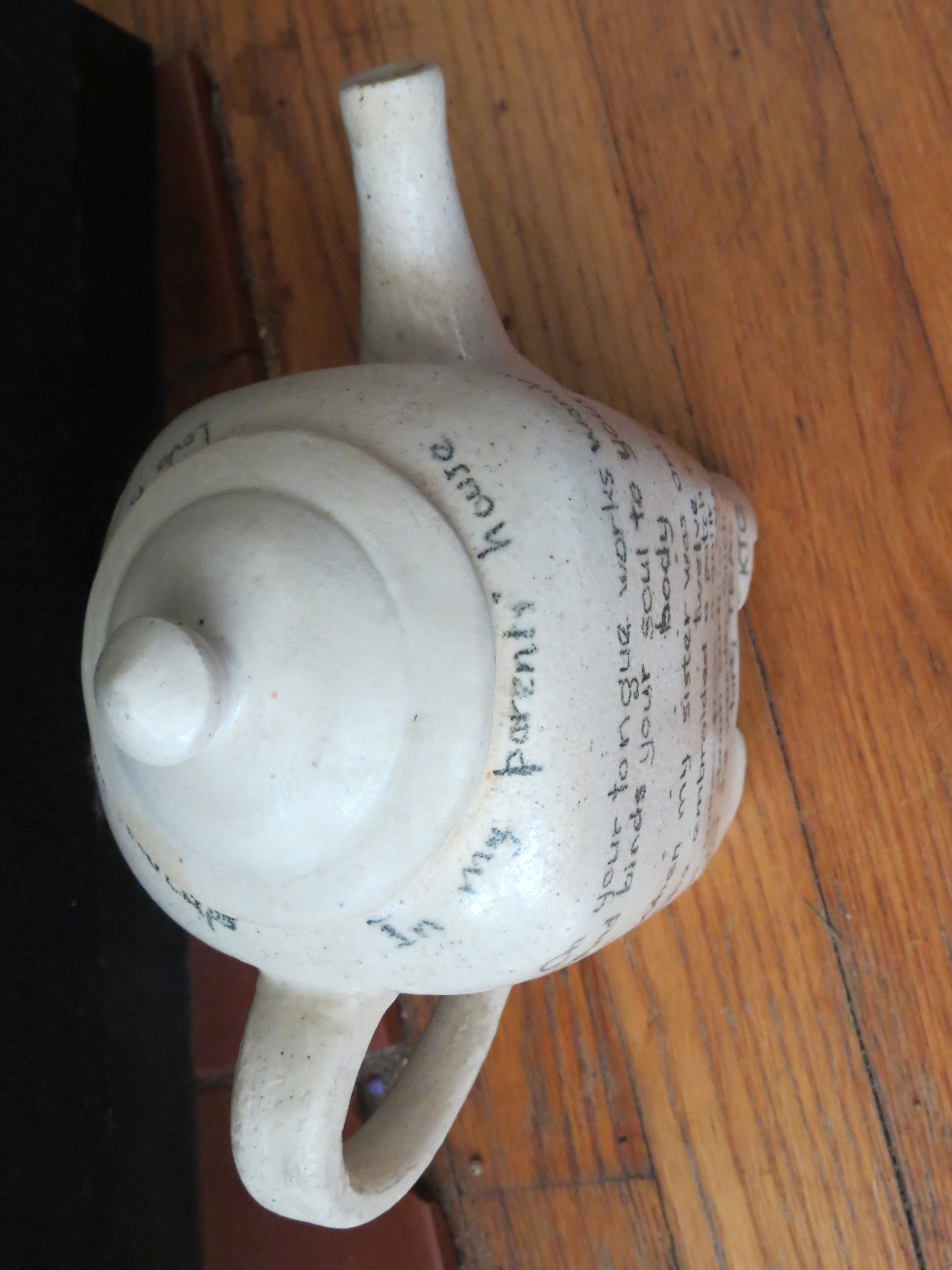
Here is my lovely momento.

I write a poem called “In my parents’ house”.

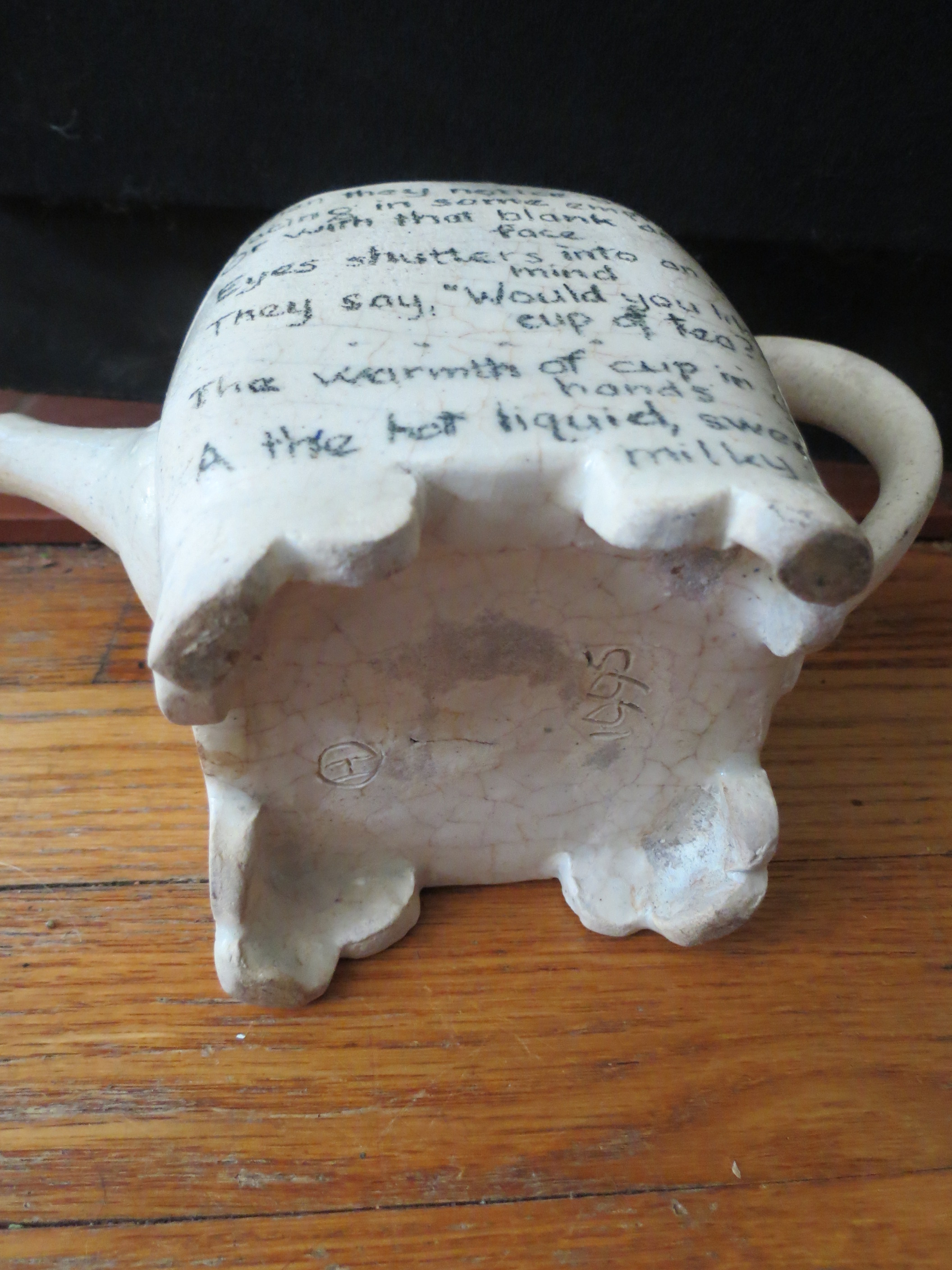
In 1995 my mother, Helen Burling Ottaway, makes teapots with the poem on the pot. She gives me one for Christmas.

She dies of cancer in 2000. My sister chooses my poem to read at her memorial.

A friend then reads the poem at my sister’s memorial in 2012 (also cancer), because I missed the California memorial. I was sick at home with pneumonia #2.

After she dies, I am sent a box of a few things from her house. Yarn and a second teapot. My sister had one.

I give the teapot to my niece, my sister’s daughter, telling her her grandmother made it.

My mother signed things with an H inside an O.

Here is the poem:

In my parents’ house
love is dispensed in teacups

When they notice you
Pacing in some empty mood
Or with that blank deserted face
Eyes shutters into an empty mind
They say, “Would you like a cup of tea?”

The warmth of the cup in your hands
And the hot liquid, sweet and milky
On your tongue works wonders
And binds your soul to your body

When my sister is twelve
She embroiders a patch for a quilt
In yellow flosses, a cup
with steam curling upwards
And the words, “Such a comfort. TEA.”

____________________

I think my maternal family still has the quilt, with jeans patches. My grandmother Katy B handed out squares to everyone at the cabins in Ontario and we all made squares. She and my cousin sewed them together and tied the quilt.

For the Ragtag Daily Prompt: momento.

Old men never die, they just spout poetry

I wrote this in 2009. I don’t know why this gentleman comes to mind today. Partly because I have a friend in the hospital. She is in her 80s. When the doctors ask how she is, she says, “Fine.” I want to yell “Liar! She is NOT fine!” Luckily she has her daughter-in-law and me and her sons saying “She is NOT fine!” Sometimes people are very stoic and will not tell you that they are not fine.

When I was in residency we rotated through the Veterans Hospital in Portland, Oregon. Most of our patients were either very elderly or they were alcoholics or addicts in their 50s, starting to really go downhill medically.

One elderly patient is particular vivid in my memory. He was in his 80s and black. He was weak and had various problems. I was not doing a very good job of sorting him out.

He wouldn’t answer questions. Or rather, he would give a reply, but it was not yes or no and I couldn’t figure out how the answer related to the question.

On the third day he gave a long reply to a question and I recognized it.

“That’s Longfellow,” I said. He nearly smiled. “We did a bike trip around Nova Scotia and read Evangeline aloud in the tents at night. The mosquitos tried to eat us alive. That’s Longfellow, isn’t it?”

He wouldn’t answer but the twinkle in his eye indicated yes.

So our visits were cryptic but fun. I would try to guess the author. He knew acres of poetry, all stored in his brain, no effort. I tried to relate the poems to my questions to see if he was answering indirectly. I wondered if he had schizophrenia and these were answers, but I didn’t think so. I thought he was just stubborn and refusing to answer.

I challenged him. “Ok, you are the right age. Come up with a song with my first name that is from early in the century. My father used to sing it to me when I was little. Can you?”

The next day he sang to me: “K-k-k-katy, beautiful Katy, you’re the only beautiful girl that I adore. When the m-moon shines, over the cow shed, I’ll be waiting by the k-k-k-kitchen door.”

We sat and grinned at each other. Soon afterward I moved on to the next rotation. I don’t remember his medical problems. But I remember him and remember wondering what he had done in his life to have a memory and a store of poetry in his head. A teacher? A professor? A man who loved poetry? I started matching him with my own store of poems, the Walrus and the Carpenter, songs, bits and pieces. I felt blessed and approved of when his eyes twinkled at me, when I recognized an author or even recognized the poem itself. I looked forward to seeing him daily on rounds. And he seemed to look forward to my visits. I was sad when I had to say goodbye and the next rotation was out of town. And since he had never told us his name, no way to stay in touch. Farewell, poetry man, fare thee well.

____________________

We were not doing nothing. He would not tell us his name, so we were awaiting an opinion from neurology. Waiting.

The photograph is not as old as the song. The young man holding the ball is my father, in the 1950s. My Aunt and I think this was at Williston in around 1956.

Boa Black in dishabille

This is my beloved cat who died in February 2020. She was named Boa Black or Feather Boa, depending on the situation. We got her as a tiny kitten at the pound. She had the softest fur and purred the instant I picked her up. She was 17 when she died.

For the Ragtag Daily prompt: dishabille.

the elk remember

I am trying not to curse you
for hurting my small child AGAIN
she doesn’t deserve that, how can you?
hasn’t she been hurt enough?

I am trying not to curse you
I am a scientist not a witch
witches curse people, I won’t do that
at least, I try not, try not

I can see your choices though
the map laid before you: you must choose
the path to take. A serious decision
that will take some honest work.

I can see your choices: it’s not a curse
it’s not my fault. It’s up to you, your choice
Grief again makes me hurt and angry
but I don’t curse you, I try not

I don’t know when it is too late to choose
you have refused the path over and over
but I am not part of it any more, not angry,
sad. The choice is yours alone and always was

I believe it is never too late to choose the path
and at the same time some people never do
my sister, dying, saying to me alone: “I’m bad.”
Me saying “No.” My sister: “I’m sorry.”

I don’t want to do that again, do you hear me?
If you choose not to change, stay on this path
I suppose I would relent at the end
But I don’t want to. Do you hear me?

I am trying not to curse you
for hurting my small child AGAIN
she doesn’t deserve that, how can you?
hasn’t she been hurt enough?

but there are the elk
I spoke to them once and they answered
to my surprise and yours. I can’t help it if
the elk remember

memorial

Today is my sister’s birthday, Christine Robbins Ottaway. She died of breast cancer in 2012 at age 49. She had gotten stage IIIB breast cancer at age 41. She went through mastectomy, chemotherapy and radiation and was clear for two years. Then it recurred and she returned to treatment, rounds of chemotherapy, a gamma knife radiation, another gamma knife and whole brain radiation. She was very very strong and tough and fought the cancer right up until the end.

This photograph was taken at my father’s 70th birthday party, in 2008. My friend Maline took the photograph. She and other old friends gathered and we sang the family folk songs.

Here is a drawing that my mother Helen Burling Ottaway did in 1978 of Chris. My mother always had a sketchbook. This is one she sent to me, because I was an exchange student in Denmark that year. At Christmas I received the wonderful sketchbook with my mother’s comments. My sister was 14 when I went to Denmark and I was 17.

Chris Ottaway by Helen Ottaway, 1978