In Practicing conflict, I wrote about practicing conflict by arguing different sides of a topic inside my head. I wrote that I don’t fear conflict and have learned to enjoy arguing with myself. I am a physician and physicians argue all the time.
What? No they don’t. Well, the doctor persona does not argue with the patient much. Some doctors give orders to patients, others try to negotiate, some try to convince. But behind the scenes, doctors are more like the Whacky Racer Car with the Cave Guys, running with their feet and hitting each other with clubs.
In residency in Family Practice at OHSU in Portland, Oregon, I start on General Surgery during internship. This is in the early 1990s and there was not much in the way of “disruptive physician” rules. I have to cover Trauma and Plastic Surgery and General Surgery at night on call. The resident is present but I get paged first for patients on the floor. I learn that I should go to all Trauma pages in the emergency room. If I know what is happening with the new Trauma patient, it’s a lot easier to handle the phone calls for more drugs and so forth. Also, the resident is less mean to me.
We attend the Trauma “Grand Rounds”. These are unreassuring to a new intern. A resident presents a trauma patient, giving the history in the accepted formal order. The Faculty Trauma Surgeons interrupt, disagree with management of the patient and yell. They yell at the resident and at each other. The upper level residents yell too, being well trained. The Trauma Surgeons do not agree with each other. They are inflammatory and rude. I am shocked initially: medicine is not a cookbook, is not simple and it appears that it is a controversial mess. It turns out that medicine IS a controversial mess.
There is not as much yelling on the next rotation. At that time Trauma Surgeons yelled more than any other set of doctors that I ran across. They yelled in the ER, at each other, at the staff, at the nurses, at the residents. The culture has changed, I suspect, but that’s how it was then.
I take Advanced Trauma Life Support as a third year resident. The Trauma Surgeons at OHSU helped write the course. They don’t agree with it. On some questions the teaching Surgeon says, “The answer to this question is (c), “ followed by muttering loudly, “though I totally don’t agree with that and I would do (b).” Another Trauma resident or surgeon then might start arguing with him, but they moved on pretty quickly, to teach the current agreed best practices in the book. Which change every few years. Great.
Years later (2009) I join the Mad as Hell Doctors, to go across the US talking about single payer. They are a group from Oregon. Physicians for a National Healthcare Program are a bit cautious with us the first year: we might be whackos. We have an RV with our logo and we have a small fleet of cars and what do you think we do in the cars? We argue. Or discuss. Or whatever you want to call it. We spend the driving dissecting issues and how to present things best and tearing apart the last presentation and rebuilding our ideas. The group does 36 presentations in 24 days. Each presentation takes an hour to set up, two hours to do and another hour to break down and debrief. We get more and more exhausted and cranky and um, well, argumentative, as the trip proceeds. Even though I think of the Whacky Racer Cave Guys running with their feet and bonking each other with clubs, this is the most wonderful group of doctors I have ever been with. A common goal that we all want to get to, discussing and disagreeing on strategy all the way! I feel closer to those physicians in a week then I feel to any of the physicians that I’ve worked with for the last 9 years in my small town. Conflict with a common goal.
Doctors are TRAINED to argue, even with themselves, to document every decision in the chart with reasons why they have reached that decision. And that they have thought about all of the reasons for say, a low potassium, thought of every possible cause and worked their way through testing. The testing always has two strands. One strand is rule out the things that could kill the person NOW, even if rare. The other strand is what is common? You have to think about both at the same time, always. And argue with yourself about which tests should be done, in what order, what is most important, how do you treat the person while awaiting results, and have I missed anything? And if we aren’t sure, we call another doctor, run it by them, wait for them to shoot holes in our logic or to say, no, I can’t think of anything else.
We can deal with conflict. We must deal with conflict. The world is too small not to deal with conflict, with disagreements, with different viewpoints and positions and ideas. If doctors can do it every single day at work, then everyone else can too. Trying to see all the positions and possible diagnoses saves lives in medicine. We need to extrapolate that to everything else. Try to see other positions, try to understand them, to respect them. We can and we must.
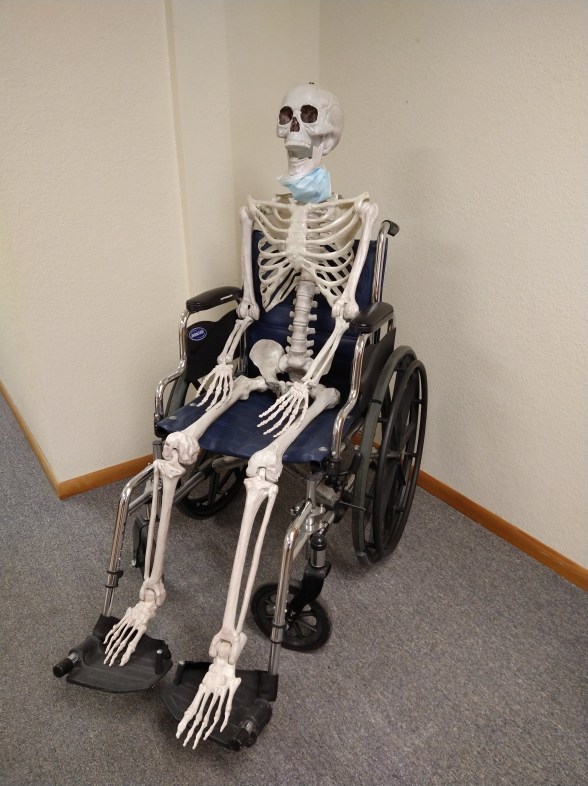
The photograph is from my clinic once we had stopped seeing patients and were selling everything. Mordechai was our clinic skeleton, made of plastic, from China. This was in January 2021.
Discover and re-discover Mexico’s cuisine, culture and history through the recipes, backyard stories and other interesting findings of an expatriate in Canada
Engaging in some lyrical athletics whilst painting pictures with words and pounding the pavement. I run; blog; write poetry; chase after my kids & drink coffee.
Refugees welcome - Flüchtlinge willkommen I am teaching German to refugees. Ich unterrichte geflüchtete Menschen in der deutschen Sprache. I am writing this blog in English and German because my friends speak English and German. Ich schreibe auf Deutsch und Englisch, weil meine Freunde Deutsch und Englisch sprechen.











 KO Rural Mad As Hell Blog
You must be logged in to post a comment.