Herd

For the Ragtag Daily Prompt: herd.

I am reading Dopesick, newly out this year, by Beth Macy. I am wondering what make people try addictive substances. At what age and why? To be popular? Herd mentality?

I’ve interviewed my older smokers for years, asking what age they started. Most of them say they tried cigarettes at age 9. Nine, you say? Yes. Parents then look horrified when I say that they should start talking about drugs and alcohol and tobacco by the time their child is in third grade. Recently a woman told me that she tried cigarettes at age 7.

It’s not just talking to your kids, either. It’s modeling as well. What do you model for tobacco, for alcohol, for prescription medicines, supplements and over the counter medicines? Do you say one thing but do another?

I am 100 pages in to Dopesick. The most horrifying new information is that more people under age 50 have died from opioid overdose then died in the 1990s from HIV and AIDS. Also the failure of history: we have had morphine available over the counter until addiction swept the country. Then heroin. This round is oxycontin. And I checked the index: no mention of kratom, sold from southeast asia. It is related to the coffee plant but it works as an opioid. It has been illegal in Thailand since 1943. I think they figured out that it too is addictive a long time ago.

I was an introvert, a smart girl, a geek before there was a word. I did not party and was not invited. I went to Denmark as an exchange student. I tried a cigarette there and decided that I couldn’t afford it and it tasted awful. I drank beer there, but was careful. I did go to a party where I was offered a bowl of pills: no. I was cautious and became even more cautious when I returned to the US.

When and what did you try first? And WHY? What makes us try these addictive substances? The evidence is piling up that the younger we try them, the more chance of addiction. And certain substances addict very very quickly.

Who chooses not to be part of the herd and why?

speaking up 4

For the Ragtag Daily Prompt: sequelae. We don’t know what the sequelae to the Supreme Court vote is yet. But I am not going to stop speaking up and I hope more women speak up. And girls. So here are two experiences when I was a girl.

I start grade school in upstate New York. I am at the Northeast School. I don’t remember tons about it, except that it has ramps instead of stairs. I am failing to learn to read with phonics, which make no sense to me.

In first grade, I need to go to the bathroom. My teacher gives me a hall pass. This is not a kindergarten privilege.

Outside the girls’ bathroom are two boys. They are older than me. I don’t know them.

“You can’t go in unless you show us your underwear.”

I am wearing a dress. I stare at them.

“Show us your underwear.”

I go back around the corner and wait. Hoping they will leave. They don’t.

I need to go. I go and lift my skirt for a second, humiliation as they laugh. I hurry in to the bathroom.

I go back to the classroom.

I never go to the bathroom during class again. I am careful. I go before class starts and at lunch.

And I’ve never told anyone until now. And this was a grade school. How were the boys acculturated to behave this way already in grade school? And does this still go on? All the girls in my daughter’s school quit wearing skirts by second grade. Jeans only.

We move before fourth grade to another town.

The boundaries for the school districts change before sixth grade and I am bussed to a new grade school.

On the bus, a boy starts harassing me. I don’t know him.

“Show me your underwear.” he says. The other kids are watching.

I don’t answer, glare at him with scorn.

Each day he escalates.

“Show me your underwear.”

I pull a pair out of my bag the fourth day. “There. Now you’ve seen some.”

The other kids laugh, but it’s not enough. He keeps hassling me.

He starts reaching for my skirt from the seat in front of me.

I’ve had it. I play flute. But I also play piccolo.

The next day he starts up, “Show me your underwear.” He reaches towards my skirt from the seat in front. I have my hard piccolo case in both hands. I smash his hand as hard as I can, against the bus seat.

He screams and pulls his hand away, clutching it.

The bus driver looks in the mirror. He doesn’t slow down or stop.

The boy never bothers me again. And neither does anyone else on that bus.

____________________________________

I took the photograph when school started this year. This is our “city” bus. The Redhawks are our football team. I can’t think that football is good for us, but I thank the adults for this support for the high school students…..

Music gives me hope: this.
Container dream

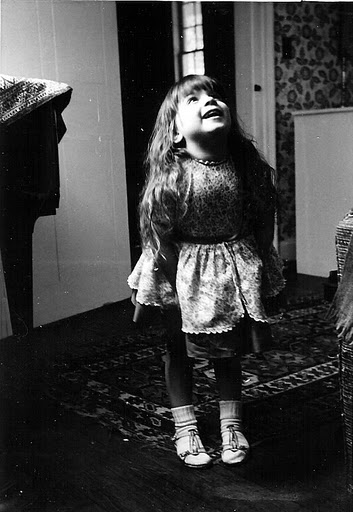
I dream I am at a concert in a park. Or some very big event. With my significant other. It is a beautiful day, the sun is shining, the grass is green, there are rolling hills and trees. People are arriving.

There is a gasp of horror. There is a large box, like the hold of a ship. We hurry to look in: there are three open containers down inside, tops removed. They are full of children. Smuggled? Immigrants? The containers are surrounded by water. My significant other and I drop our things and climb down the long hold ladder into the water, which is cold, filthy, and comes up to my thighs. I’ve kicked off my sandals. We are wading to the containers. An ICE agent in a black uniform, bullet proof vest, belt with tools and guns, and riot helmet, blocks me and says, “You have to be wearing shoes to help.” He is handing out plastic stretchers. He can’t see my feet. Yes, I know it’s dangerous and my feet could get cut, but this is probably sewage and dangerous even with shoes. We should really be in hazmat gear but the kids could be dying. I just look at him, silent, and he hands me a stretcher.

Enough people have come forward, into the water, that all the kids have been placed in one of the containers. None of them are dead. They are being lifted out one by one, to ambulances. Now the hold is surrounded by rubberneckers. I climb out and find my purse and camera and shoes. I am grateful no opportunist has stolen them. The ICE agents are telling people to back off and give them room to work. The news crews are there and a Washington State politician says, “This is Washington State, we will take care of these children, we will not see them separated and incarcerated, I will see that they are returned to their parents.” Good luck, I think, but at least there are tons of witnesses and cameras and news crews.

I need to find somewhere to scrub my legs down with soap and to find my significant other. It’s getting more crowded.

I wake up.

And what I notice is that the water did not stink and was not full of lumps of floating excrement. As I wake I hope that I won’t catch something horrible and die….usually my dreams have full sound, color and smells too. I wonder where the children were from, and why, and whether they had some sort of sanitation….

young alone

I have a double lot, L shaped, because the 1930s garage extends 5 feet into the second lot.

I don’t mow the second lot. It is in the center of the block and has an apple tree, a plum tree, a maple with a tree house, wild roses and weeds.

The deer leave their young to stay. Intemittently there are young alone in my lot. I went to go in the tree house this weekend, but this small one was alone. I don’t like to scare them into the streets or more exposed yards, so I backed off.

Mundane Monday #166: parent and child

My theme for Munday Monday #165 is parent and child.

I have this small statue in my clinic. I have a small collection of parent/child and mother/child art that I have collected for years. I was separated from my mother at birth, from my father and his family at 4 months and back to my mother and father at 9 months. I was sure that adults loved me but I did not trust them: they kept abandoning me.

As an adult I understand that it was because my mother had active tuberculosis and that the first separation saved my life. But…. I can love people, but trust must be earned.

A patient said last week that I had a political statement in my waiting room. “I do?” I said. He was talking about this statue.

If this is a political statement, I stand by it.

Attach your parent child picture, political statement or not. And much love and hope for every parent and child and love.

One entry from last week, Mundane Monday #165: sand:

KL Allendorfer: Sand.


inherit

For the Daily Prompt: inheritance.

Such soft colors. I am trying to capture the ferry wake color in the sunrise.

The news this morning and I am thinking of girls who are not believed and predators who are after them. And boys too. I am thinking of medical school, this essay.

I am thinking of the comment from a fellow male medical student, about the statistics of one girl in five sexually abused:Β  β€œI never believed it. I didn’t think women could be okay after that.”

There is still the idea in our culture of a woman “ruined”. Women are still not believed. Boys are assaulted, too. One in twenty. Here: http://victimsofcrime.org/media/reporting-on-child-sexual-abuse/child-sexual-abuse-statistics.

And in the end, I wonder, what are the adults thinking? It’s the woman’s fault for being pretty? It’s the girl’s fault for being vulnerable? The devil made me do it? I was tempted by evil? It isn’t my fault. I have money and power and therefore I can do whatever I want. Women and children aren’t people, I can buy and sell and use them.

I am so relieved to hear the news from Alabama this morning.


teens high risk for addiction

What teens are at high risk for addiction?

Would you say inner city, poor, abused, homeless?

This study : Adolescents from upper middle class communities: Substance misuse and addiction across early adulthood. which I first saw in WebMd, says that the privileged upper middle and rich children are at higher riskΒ  for addiction than many of their peers.

350+ teens in New England were studied.

Drug and alcohol use was higher than across country norms, including inner city.

Rates of addiction diagnosis by age 26 were
19%-24% for girls
23%-40% for boys
These rates are two to three times the norms across the country.

Rates for addiction diagnosis by age 22 were
11%-16% for girls
19%-27% for boys
These rates are close to the same in girls, but twice as high in boys as peers across the country.

The teens were often popular high achievers who are A students. Parents tended to drink more in those cohorts than the norms.

Also: “Findings also showed the protective power of parents’ containment (anticipated stringency of repercussions for substance use) at age 18; this was inversely associated with frequency of drunkenness and marijuana and stimulant use in adulthood.” That is, parents who sent a clear message that consequences for illegal and underage substance use including alcohol and marijuana would be serious, provided protection for their teens.

A second article: Children of the Affluent: Challenges to Well-Being says this:

“Results also revealed the surprising unique significance of children’s eating dinner with at least one parent on most nights. Even after the other six parenting dimensions (including emotional closeness both to mothers and to fathers) were taken into account, this simple family routine was linked not only to children’s self-reported adjustment, but also to their performance at school. Striking, too, were the similarities of links involving family dining among families ostensibly easily able to arrange for shared leisure time and those who had to cope with the sundry exigencies of everyday life in poverty.”

Other children’s perception of parenting examined included:

felt closeness to mothers
felt closeness to fathers
parental values emphasizing integrity
regularity of eating dinner with parents
parental criticism
lack of after-school supervision
parental expectations

This aligns with my observations both in my town and with patients. I see parents “check out” sometimes when their children are in their teens. “I can’t control him/her. They are going to use drugs and alcohol.” I told my children that if they partied I would NOT be the parent who says, “Oh, he needs to play football anyhow.” I would be the parent who would be yelling “Throw the book at him/her. Bench them.” And I saw parents of teens going out to the parking lot to smoke marijuana at a church fundraiser when it was still illegal. And saying “Oh, our kids don’t know.” I thought, “Your kids are not that dumb.” They invited me along. I said, “No.” And I really lost respect for that group of parents. What example and message are they sending to their teens? Yeah, cool, do illegal things in the parking lot, nod, nod, wink, wink.

Meanwhile, my children keep me honest. “You are speeding, mom.”

“Yeah,” I say. “You are right. Sometimes I do.” And I slow down.

Make a difference

In medical school I made a difference.

I was with two women and two men from class. We’d had a lecture on rape that day. One of the guys piped up, “If I were a woman and I was raped, I’d never tell anyone.”

“Man, I don’t feel that way.” I said, “I would have the legal evidence done, have the police on his ass so fast his head would spin and I would nail his hide to the wall.”

He looked at me in surprise. “Um, wow. Why?”

I took a deep breath and decided to answer. “You are assuming that you would be ashamed and that as a woman, it is somehow your fault if you were raped. I was abused by a neighbor at age 7. At age 7 I thought it was my fault. I thought I might be pregnant, because I was a bit clueless about puberty. I made it stop and tried to keep my sister away from the guy. When I went to the pediatrician the next time with my mother, I decided that since he didn’t say I was pregnant, I probably wasn’t. When I started school that year, second grade, I thought sadly that I was probably the only girl on the bus who wasn’t a virgin.

In college, I heard a radio show about rape victims, how they blame themselves, often think they did something to cause it, are often treated badly by the police or the emergency room, and feel guilty. All of the feelings that I had at age 7. I realized that I was 7, for Christ’s sake, I wasn’t an adult. It was NOT my fault.

If I walk down the street naked, I’m ok with being arrested for indecency, but rape is violence against me and no one has that right no matter WHAT is happening.

And child sexual abuse is one in four women.”

The two guys looked at the three of us. After a long pause, one of the other women shook her head no, and the other nodded yes.

The guy shook his head. “I never believed it. I didn’t think women could be okay after that.”

“Oh, we can survive and we can heal and thrive.”

We had the lecture on child sexual abuse a few months later. My fellow student talked to me later. “I thought about you and — during the lecture. I thought about it completely differently than before you talked about it. I would deal with a patient in a completely different way than I would have before. Thank you.”


previously posted on everything2.com in 2009

for the Daily Prompt: release

Adverse Childhood Experiences 9: crisis wiring

I spoke to a patient recently about ACE scores. A veteran. Who has had trouble sleeping since childhood.

“What was your childhood like?” I say. “Was sleeping safe?”

“No, it wasn’t. We were in (one of the major cities) in a very bad part of town.”

“So not sleeping well may have been appropriate. To keep you safe. To survive.”

We both think this veteran has PTSD.

“I think I had PTSD as a child. And then the military made it worse.”

I show the veteran the CDC website and ACE pyramid: https://www.cdc.gov/violenceprevention/acestudy/about.html.

Adverse childhood experiences. Leading to disrupted neurodevelopment. Leading to a higher risk of mental health disorders, addiction, high risk behavior, medical disorders and early death.

Ugly, eh? Damaged children.

“But I don’t agree with it.” I say.

My veteran looks at me.

“Disrupted neurodevelopment.” I say. “I don’t agree with that. Different neurodevelopment. Crisis neurodevelopment. We have to have it as a species in order to survive. Think of the Syrian children escaping in boats, parents or sibling drowning. We have to have crisis wiring. It isn’t wrong, it’s different. The problem is really that our culture does not support this wiring.”

“You can say that again.”

“Our culture wants everyone to be raised by the Waltons. Or Leave it to Beaver. But the reality is that things can happen to any child. So we MUST have crisis wiring. Our culture needs to change to support and heal and not outcast those of us with high ACE Scores.”

My Veteran is quiet, thinking that over.

I say, “You may read more about ACE scores but you do not have to. And we can work more on the sleep. And we do believe more and more that the brain can heal and can rewire. But you were wired to survive your childhood and there is no shame in that.”


I took the picture in Wisconsin in August.