Hormones and rabbit holes

Medicine is confusing right now. Ok, it is always confusing because we try to base it on science and science is always changing. There are always special areas that are currently a mess. Hormones!

I speak to a patient recently who is female, premenopausal, and is getting hormone replacement therapy for hot flushes and not sleeping well from an outside source. The person wants me to order hormone tests. I do order hormone tests but not the ones she has in mind. I test a TSH, thyroid stimulating hormone, to see if she is low or high in thyroid.

She is thinking of me testing estrogen and progesterone and other related hormone levels. The party line from gynecology MDs and DOs is that these are not useful tests because women’s hormone levels are so varible. However, there are lots of naturopaths out there and functional medicine MDs and DOs who will test levels. Why is the patient asking ME to test them? Most of those naturopaths and functional medicine providers do not take insurance and charge cash. Also, insurance may not pay for them anyhow because the party line is that they aren’t useful. Why would the cash providers check levels? One reason is CASH. Another is to prescribe “bioequivalent hormone replacement”. Sounds natural, right? Well, the natural thing was for the hormones to stop at menopause and all of the hormones are either made in a laboratory from plant pre-estrogens or from pregnant mare urine, so bioequivalent seems to imply natural but it really isn’t. Pills do not grow on trees, they are made by humans in laboratories.

However, I question party lines, and off I go down the hormone rabbit hole. The current guidelines are that female hormone replacement, after menopause, should be lowest dose possible and only for a maximum of three years because of the increased risk of breast cancer. This doesn’t address my question: does premenopausal hormone replacement count as part of those three years? I may need to ask gynecology. I don’t think it counts. A woman is postmenopausal when she has had no periods for a year. Or had her ovaries removed. Or if she’s had a hysterectomy and still has her ovaries, a yearly follicle stimulating hormone and lutienizing hormone test. Both tests rise when the ovaries stop making hormones and eggs.

Also, there is another caveat. We know that when men are on opioids, the opioids can suppress their hormones and lower testosterone. Here is a paper: https://pubmed.ncbi.nlm.nih.gov/31511863/. Half the men studied in multiple studies had low testosterone when on chronic opioid therapy. 18429 subjects (patients) in 52 studies. That is a lot. Women studied? NONE. What? Yeah, none. Why? Here is part of the answer: about a decade ago I worked with the UW Telepain group and asked the head of the UW Pain clinic a question. “If opioids lower hormones in men, do they in women too?”

His reply, “I don’t know.”

“Have you ever tested a woman?”

“No.”

“Isn’t that sort of sexist?”

“Yes.”

So here I am, rechecking a decade later, and we still don’t know if giving women chronic opioids messes up their hormone levels. It would be more complicated and difficult to check women. We might have to do individual hormone baselines or something in premenopausal ones, say, 2 weeks after menses. Remember that for most of the history of medicine, clinical drug trials were only done in men, because, well, sexism. They said women could get pregnant. Yes, but then we gave the drugs to women who could get pregnant. Also, postmenopausal women can’t get pregnant. The whole thing seems stupid to me.

There is an interesting new finding here: https://neurosciencenews.com/estrogen-t-cells-pain-28548/ . Apparently in women, estrogen and progesterone work on receptors at the base of the spine to reduce pain signals using T cells, part of the immune system. The article says this doesn’t happen in men, but they were studying mice. The male mice didn’t seem to have worse pain after estrogen and progesterone were blocked. The female mice were in more pain. But wait, estrogen and progesterone are produced in men as a by product of making testosterone. Less than women, until menopause. Then the 70 year old man has more estrogen and progesterone than his postmenopausal wife. The article says that they don’t know why the receptors are in women and female mice (um, my intuitive guess would be childbirth and micebirth, right? Men don’t do that and women giving birth to a child after the first one sometimes say, “WHY did I want to do THIS again?” I think those receptors are so that women and mice can get through more than one pregnancy.) Now I need to read the article again because maybe men and male mice don’t have the receptors, even though they do have some estrogen and progesterone. Maybe they just don’t have enough estrogen and progesterone.

Maybe we can’t figure out women’s hormone because men aren’t smart enough, heh, heh. Yes, that is sexist right back at all those historical figures who didn’t study women.

At any rate, that still doesn’t answer my two questions: does premenopausal hormone replacement count towards the three year total beyond which hormone replacement increases the risk of breast cancer? And does chronic opioid treatment lower women’s hormone levels?

_________________

For the Ragtag Daily Prompt: hormone.

I took the photograph of a Port Townsend rabbit in 2011.

Concord

my heart is broken
love doesn’t conquer all
unselfish love
unreturned
unrequited
opens me to wound after wound
some turn from love no matter what
cling to the lies they tell themselves
cling to the poison they embrace
turn from love into the uncaring bottle
turn from love into the insensate smoke
turn from love even to the grave

I wish my heart would let them go
and heal

__________________

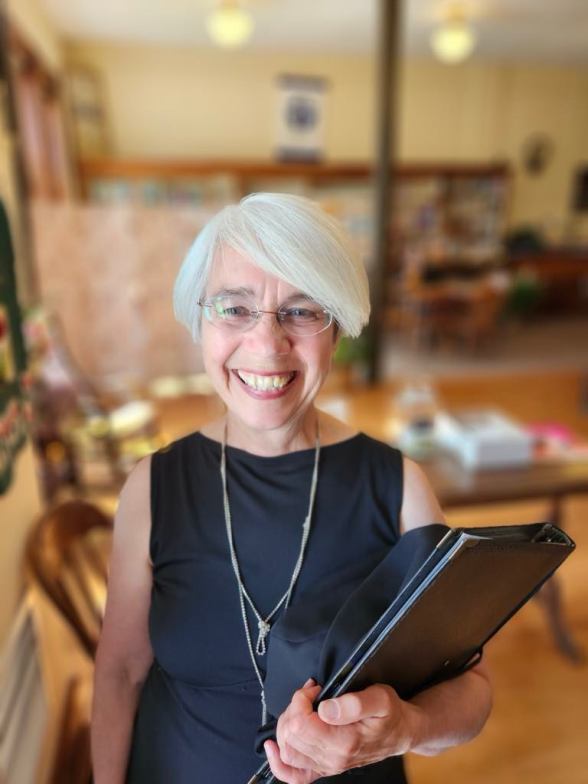
My friend Liz took the photograph, half way through the Rainshadow Chorale concert last Sunday.

Alcohol myths

I am back working in Colorado and a recurring theme this month is alcohol and alcohol myths.

Myth: If I only drink on my days off, I am not an alcoholic. Nope. People can binge one day a week and still be an alcoholic. A standard “dose” of alcohol is 12 ounces of 5% beer, 5 ounces of standard wine or 1.5 ounces of liquor. But what if someone drinks 8% beer, 12 ounces? Well, that’s 1.6 standard drinks. An 8% 16 ounce beer? That is 1.6 times 1.3, so 2.08 drinks. Perhaps we should have an app that calculates this. And locks the car ignition when we are over the limit.

How much alcohol means that we are an alcoholic? The guidelines right now in the US say 7 drinks per week maximum for women, 14 for men, no more than one in 24 hours for women, no more than 2 in 24 hours for men and no saving it up for the weekend. Here: https://www.niaaa.nih.gov/health-professionals-communities/core-resource-on-alcohol/basics-defining-how-much-alcohol-too-much#pub-toc3. However, alcohol is bad for the liver, bad for the heart, bad for the brain, and increases cancer risk. There is not a “safe” amount.

What is binging or heavy drinking? For women—4 or more drinks on any day or 8 or more per week, For men—5 or more drinks on any day or 15 or more per week. The rate at which people drink is also part of this.

MYTH: If I don’t throw up, I’m not an alcoholic. Now that’s an interesting one. When we drink, alcohol is absorbed into the blood and goes through the liver. The liver has enzymes which break alcohol down into aldehyde. Aldehyde is a carcinogen, causes cancer. Aldehyde is broken down by other enzymes into acetate and then to carbon dioxide and water. Some people break down the aldehyde quickly, fast metabolizers. They can drink a lot and not throw up because they break the aldehyde down fast. However, the process inflames and kills liver cells. If they keep drinking, the liver slowly dies, and this is cirrhosis. Eventually they will not be able to break down alcohol fast because the liver makes the enzymes. Then they will start throwing up.

Other people make enzymes that are slower or make less, and they get sick and have alcohol poisoning more quickly. The fast metabolizers are at higher risk for cirrhosis and the slow ones for liver cancer, but they can get either.

MYTH: “My blood pressure is fine.” I spoke to a person who stated that their blood pressure was ok during pregnancy so they did not have high blood pressure. The chart shows very high blood pressure for the last three years and I didn’t look back further. I ask, “Did you stop drinking alcohol while pregnant?” “Of course.” When NOT pregnant, this person admits to 4-5 drinks a day. Also, the history in the chart states that they had blood pressure complications in pregnancy. I did not have time to go through the chart and look at that, but this person is in denial. I think of denial as the addiction taking over and the addiction lies. It lies to me but it also lies to the person. They want to believe what they say. They want everyone else to believe what they say even if it is patently a lie and ridiculous. A woman who says a friend gave her something, she didn’t know what it was, for a headache. “How did you take it?” I asked, looking at the urine dip results. “I snorted it.” “So what things do you snort for a headache?” She was positive for cocaine and pleading ignorance was ludicrous. Another person has a positive urine drug screen for multiple things. “Can I try again?” Pause. “Sure.” I say. The first one is a false sample and I am very curious to see what the real sample will have. It has nothing. He is then surprised that I won’t fill his prescription and offer inpatient drug rehabilitation. Come now, sir, you got a urine sample from a dealer when you sold the medicine I gave you for something else. Your dealer must have been annoyed or gave you the wrong sample. When someone is really out of control, they do not have convincing lies and the only person they can convince is themselves. It is interesting to watch someone be all outraged that I do not buy the story, accusing me of discrimination or hating them or hating their race or whatever. They attempt to accuse and distract. It is harder for families because they desperately want to believe their loved one, even when the evidence shouts the opposite.

What does blood pressure have to do with alcohol? Alcohol drives blood pressure up and pulse, especially when it is wearing off. Severe alcohol withdrawal is delerium tremens and people can have such high blood pressure that they have a stroke or a heart attack or encephalopathy — a poisoned brain. They can hallucinate or have seizures and it is very dangerous. “Very dangerous” means they could die or have permanent disability. Tobacco, cocaine, methamphetamines, all raise blood pressure. The number one cause of death in the United States is the heart, but it’s not just from hypertension and weight and cholesterol and inactivity. Addictive drugs have a huge contribution.

There is nothing cheap about the cost of addiction in our country.

For the Ragtag Daily Prompt: cheap.

Taste

I am back in Colorado for another work stint.

I am in a different house.

I am in a neighborhood, of cul de sacs that don’t connect. My house is quiet in front but backs on a very busy road, an artery. The speed limit is 40 mph but people often go faster.

The house seems odd to me. There are curtains and shades on every window, all closed when I arrived. I open them, because I like light. There is a 3 by 4 foot television in the living room, another in the master bedroom and a third in a guest bedroom. There is a large kitchen with tons of shelves and cupboards, but a table only seats two, and there are two more chairs at the counter. This feels very odd to me. It seems as if the whole house is arranged to watch television.

I go for a walk in the neighborhood. There are many houses. There are beautifully trimmed lawns and there are flowers and some roses. What is missing? There are no people. Walking a mile and a half, finding the mostly hidden corridors from one cul de sac to the next, I see one man working on his lawn. Even though it is Saturday afternoon, I seen no children, no dogs, no toys. I see two garages that are open, one with a man and in the second I hear a child. Why are there beautiful lawns and no people? And many of the lawns have little flags saying, poison sprayed.

I do turn on one of the televisions after my first day of work. The living room one says that the antenna is not hooked up. The guest bedroom one works. I look on the service. Nearly every movie is about violence and conflict.

I do a little research on the internet. I go to the library and take out 8 books. One is Nonviolent Communication, by Marshall Rosenberg, PhD. Most of the others are fiction. Yet so much fiction is about conflict too. Good triumphing over evil. I am pretty good at nonviolent communication in clinic after 30 years: I want to meet each patient somewhere that is helpful. Sometimes they don’t like what I find, or don’t want to do what I recommend, but I have a deep and abiding faith that everyone can change, that they are smart, that I can make a difference and that they are capable. I think that belief helps daily in clinic.

I choose this book because I want to be better. Some of my family is estranged. I thought that was rare and horrifying at first, years ago. Now I think that it is horrifyingly common, much more common than I realized. How do we heal this? What can we change? I don’t want to be in a dark house with the shades down watching “good” triumph violently over “evil”.

There is a pond, man made, with a fence around it, half a block from my house. There are two male mallards, a female, and eight ducklings. They are fuzzy and delightful. I stop my car and watch the first time I see them, and I walk over too.

I haven’t seen anyone else there. I think we can change. I have hope. I have a deep and abiding faith that we can change.

For the Ragtag Daily Prompt: garlic.

Friends forever no matter what

My small child self is happy
Happy inside
She loves who she loves
Living or dead
In contact or fled
Distant or close
She loves who she loves
And I hold her close

My adult self is happy
Happy inside
I love who I love
And the world is so wide
Living or dead
In contact or fled
Loving forever
No matter what happens
I love who I love
My heart holds them close

My small child grieved losses
I hold her close
She loves them all
I guard her from most
She stays friends forever
No matter the grief
She is happy in loving
Her loves shine as stars
The ones who are hurtful
Are loved from afar
She’s held and she’s loved
And her love sings unmarred

_______________________________________

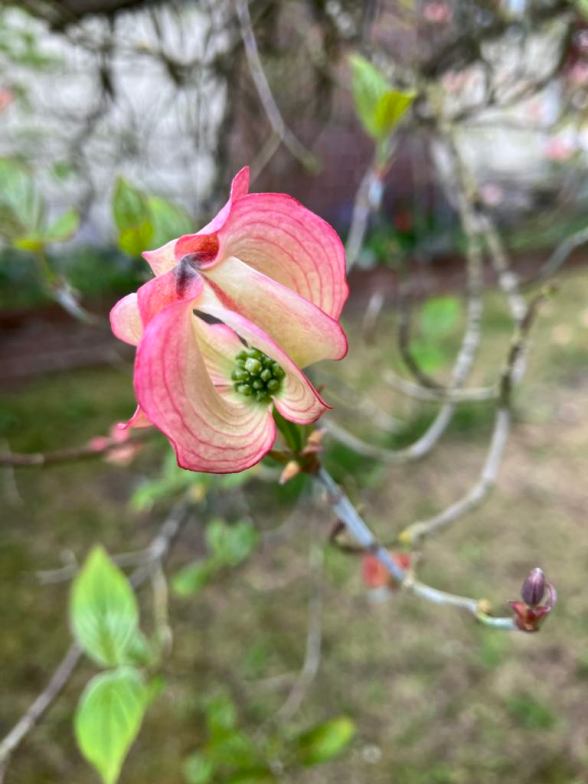
For the Ragtag Daily Prompt: dogwood and for Mother’s Day. Mine died 25 years ago.

Cracked

If all of the murderers were locked up
we would be safer.
We all can agree on that.
No, war is not murder.
Except when they are murderers.

If the immigrants were sent back,
we would be safer.
Only people who have been here for forty generations
should be allowed.

If we all followed the book
the right way
there would be no more pandemics.
God would smile upon us.
Which book? The right one, of course!
The right way!
Out of 45,000 different versions
of the right way.

Don’t step on a crack
Or you’ll break your mother’s back

Codified and punishable
But some punish the mother
Others will punish you

They are murderers
and wrong.

Listen

There is anger and blame and silence.
People talk about each other.
People talk about others.
What is truth? What is rumor?
No one wants to listen.
They want to blame.

I do not see
I do not feel
I do not hear
how to heal this, Beloved
if no one will listen.

Only love.
Anger drains away.
I send love
Into the anger
Into the blame
Into the echoing silence.

When I get older

Is it ok for me to be a bit lazy?
A bit unkempt?
Not care about dandelions?
Weigh more?
Want to lie around after lunch?
Maybe there is something I should be doing

Maybe there isn’t something I should be doing
Maybe I should be gazing at the navel of the universe
Maybe I should be gazing at the navel of the Beloved
Maybe I should not be doing all the time
Maybe I should wait
Maybe I should watch
Maybe I should appreciate
Being here

_________________________

I am posting this without a photograph.

For the Ragtag Daily Prompt: curtain.

Arrive and engage

Home again! I came home from Grand Junction, Colorado via Denver. Wrong direction and an additional 440 miles, more or less. I spent two nights at my daughter’s home and she and her boyfriend took me to the Botanic Gardens and to a birthday high tea at the fabulous Brown Palace Hotel. I guessed it was built in 1880. Close: 1892. We had tea in the atrium with ten or more stories above us, balconies all around and stained glass at the top. Quite gorgeous.

From Denver, I drove north and then northwest, Colorado, Wyoming, Idaho, Oregon and Washington. The pass in Wyoming had sleet and slush, terrible visibility and ice on the road. The speed limit was 35 and everyone ignored it. That was my second day and over 400 miles and both the cat and I were very glad to arrive at the hotel. Sol Duc complained quite a lot the first day and then settled down.

Driving into Oregon over another pass, suddenly it is green. Shades of brown before that but once over the pass, bright startling green. In Washington, Snoqualmie Pass brings the smell of the Salish Sea and we are close to home! We left Denver on Monday and arrive in Port Townsend on Thursday afternoon, delighted to get out of the car.

And hooray for being home! It was a little disorienting after being gone for most of eleven months. I miss Elwha cat and I think Sol Duc wondered if he was in the house too. A friend came over and brought some staples and another friend dropped off my first CSA farm box, from Wednesday! How wonderful!

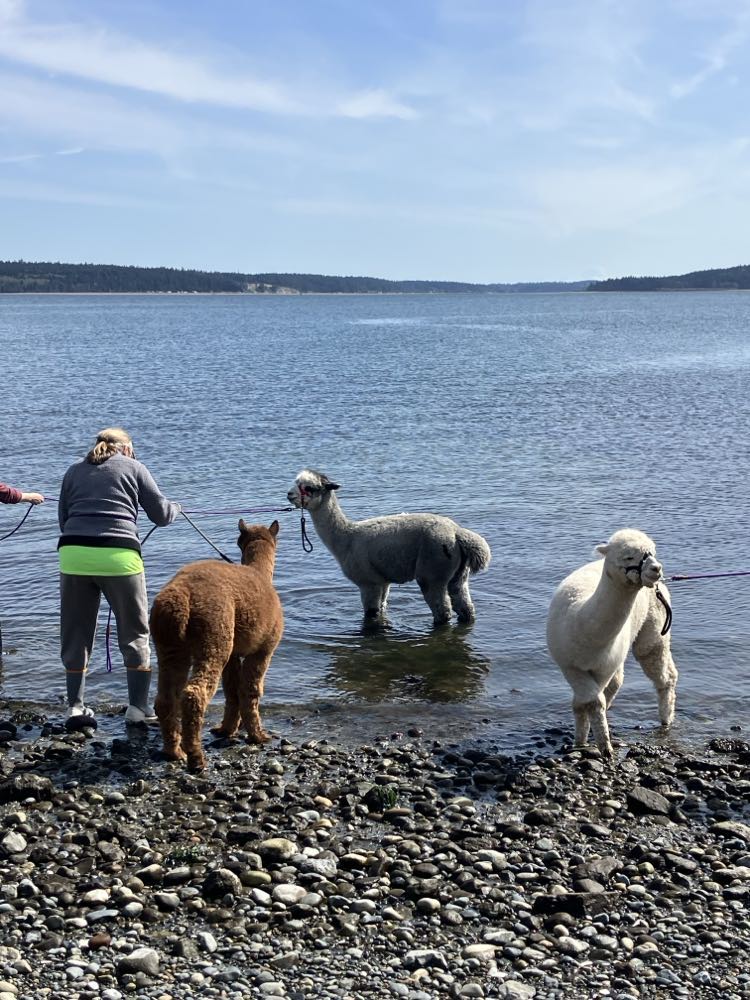
On Friday I went to walk with another friend downtown, while her husband and daughter went scuba diving. The alpacas were downtown, being socialized and wading in the sound. They have very expressive ears and clearly the sound tasted peculiar. They were all well behaved and so were we.

Home, arrived and engaged already, alpacas, friends and demonstrations against P47’s insanity.

For the Ragtag Daily Prompt: arrive and engage.

On guard

My nurse’s breath catches. “Oh, no,” she says.

I am new here. Less than a year. “What?” I say.

“We have Janna Birchfield on the schedule.”

“Who is Janna Birchfield?”

Tonna leans back in her chair at the nurse’s station, a high set desk that runs behind the front office. We have new glass barriers along it to make it more hipaa compliant. It is also more claustrophobic. She throws her pen down. “She’s one of the most hostile people here. She’s known for throwing a brick through her second doctor’s plate glass window.”

“Ah,” I say.

“She was Dr. M’s patient but apparently she and Dr. K got in a screaming fight in the hallway. She is banned from that clinic. So we are the last clinic in town.”

My nurse knows the local stories and she has seen a lot. She doesn’t have a lot of unconscious monsters. Yeah, there is some impatience and some anger there, but she’s pretty good. No real fear, nothing cringing at her feet.

“Hmm. Let me talk to Marnie.” Marnie is our office manager.

Marnie and I talk. I read the last notes from Dr. M and an account of the screaming fight with Dr. K. I call Dr. K. I don’t know of anything that scares her and she is tough. I rather enjoy envisioning her yelling back at this patient.

The day arrives and Mrs. Birchfield is put in a room. Vitals are done. I go in.

Janna Birchfield is big. She weighs about twice what I do, and it’s muscle rather than fat. She looks solid. Not like a body builder, just strong. She tops me by nearly a foot. She looks sullen and unfriendly.

And I am looking at her monsters. Three are guarding a fourth, at her feet. Fear is there, anger is the biggest and posturing, like a body builder, in front. The third is morphing back and fourth: envy and hostility. The fourth is in a stroller, guarded by the other three. Asleep? Unconscious? Well, yes, duh, but it’s not often that a monster is so undeveloped that it is still an infant. Not good.

“Hi, Miz Birchfield. I am Dr. Gen.” I hold out my hand, moving slowly and smoothly. Her monsters alert, fear flinching and anger ready to punch. I stand with my hand out. She eventually touches it, glaring.

“Hi,” sullen.

“We need to talk about the clinic rules first.” I say calmly. Anger puffs up and her shoulders rise as the monster swells and takes control, her elbows rising and hands are fists. Her eyes don’t turn red, but nearly. “I have heard about your argument with Dr. K.”

Furious voice, “She screamed at me. She’s a horrible doctor! She got me thrown out!”

I am smooth and calm, “I am not going to discuss Dr. K,” I say. Honestly, it’s even more fun to think of Dr. K taking this on and not budging an inch. Dr. K is my size, small. “In this clinic, I need you to understand that you are not allowed to yell at anyone at the front desk, in the hallways or on the phone.” Anger flees immediately, small again and she looks confused. “You may not yell at the staff, at the other patients, or at anyone on the clinic property.”

“Why would I agree to that?” she says. She is mostly confused because I am not scared or angry. I am not behaving the way she expects, the way most people behave around her.

“If you are upset, the only people you can yell at are me or the office manager and you need an appointment.”

“They are rude to me!” Basically she means everyone. “You can’t make me do that!”

“Take it or leave it.” I say. “You need to agree and keep the agreement, or we will discharge you immediately. If you say no, leave now, and I won’t charge for the visit.”

Her monsters are confused. Anger has shrunk back down and they are conferring, heads together. Confusion has shown up as well, morphing though different colors and stripes, stars and paisleys. She stares at me, frozen hostility. I just wait, sitting in front of my laptop, serene. This is going well. She isn’t yelling and she hasn’t left.

“What if they are mean?” she says.

“You will make an appointment with me or the office manager, and we will help you.”

“Ok,” she says. The monsters are still surrounding the carriage, but really, now confusion is in charge. We work through the rest of the visit, as I get to know her a little. She has had a hard, hard life.

I let the front office and the nurses know the rules. The office manager and I let them know that this is a contract with the patient and she has agreed. They feel protected. They feel protected enough that they are nice to her. She behaves and starts, infinitesimally, to relax. She is still angry and hostile in the exam room but it’s not directed at me. It is directed at the entire world, the rest of the world outside the clinic. I try to help her medically but also let the monsters have their say. The visits start with anger and hostility but tend to subside into confusion. I am not getting at the fear or whatever is in the stroller. It is one of the large old fashioned ones, heavy, navy blue, where an infant can lie flat. Clearly it does not fold up to go in a car or anywhere else convenient. There are no toys hanging from the top or across it, no stuffed animals. Only a form under the blankets, always still.

I may reach that form, or not. I do not know.

For the Ragtag Daily Prompt: paleontology.