A catlaptop.
warm furry technical assistance
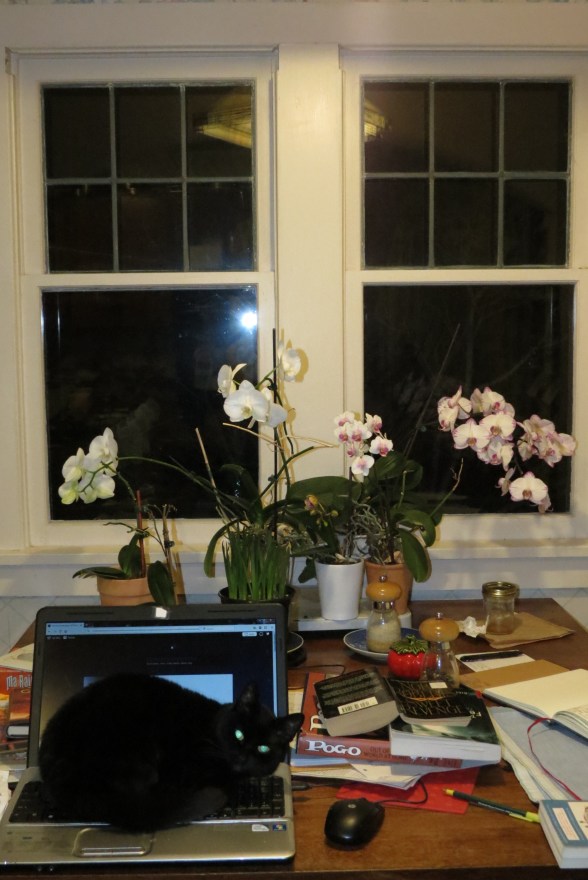

A catlaptop.

I want to offer hope to the people with Long Covid-19. Having been through four bad pneumonias, with increasingly long recovery times, and now disabled for doing Family Medicine, I have experience to share. First I want to talk about chronic fatigue and fibromyalgia.
I am a piler, not a filer. Including in my brain. I have been adding to the chronic fatigue and fibromyalgia pile since I was in medical school.
In residency a new patient questions me. “Do you believe in chronic fatigue?” he says, nearly hostile.
“Yes,” I reply, “but I don’t know what it is or what causes it or how to fix it.”
For years different causes were suggested. Often infections: EBV, mononucleosis, lyme disease. Some people didn’t have any infection. I did note even in residency that my chronic fatigue patients all had one thing in common: they were exhausting.
Does that sound terrible? They were all type A, high achievers, often super high energy. Often they got sick or crashed when they were working three jobs, or working 20 hours a day on their own business, or doing something that sounded insanely exhausting and unsustainable. And most of them wanted that back. “Ok, wait. You were working 20 hours a day, seven days a week, got sick and THAT is what you want to get back to?”
None of the chronic fatigue people seemed to be type B.
Eventually I read that one in ten people with ANY severe infection can get chronic fatigue.
Then I work with the U of Washington Telepain Clinic, on zoom. They start studying functional MRIs of the brains of people with fibromyalgia.
They use a thumbscrew. They put a measurable amount of pressure on a person with no fibromyalgia. The person reports 3-4 out of 10 pain. The brain lights up a certain amount in the pain centers on the MRI. The doctors can SEE it. Then they test the fibromyalgia people with the same amount of thumbscrew pressure. The fibromyalgia people report 8-9/10 pressure and they are not lying. The pain centers in the brain light up correspondingly more. So they ARE feeling 8-9/10 pain.
Is this a muscle problem? A brain problem? Or both?
It appears to be both. Chronic fatigue and fibromyalgia and other disorders with pain out of proportion to the physical findings were being called “central pain processing disorders”.
I thought of chronic fatigue as a sort of switch. As if at a certain level of stress or exhaustion or infection the body would throw a switch. And force the person to rest.
I wondered if the type B people just rested and got over it, while the type A people fought it like tigers. Which seemed to make it worse.
And now we have Covid-19. The study getting my attention is saying that 20%, or 1 in five people age 18-64, have Long Haul symptoms. Over 65 it is 25%, one in four. And it can happen in people with no preexisting conditions. Preexisting conditions or not, this sucks. The two biggest complaints are lung related and muscle related.
I have chronic fatigue following my third pneumonia in 2014. I might be just a little type A. I went back to work too soon (6 months after the pneumonia) and after a half day would crash asleep at 3 pm. For another 6 months. Now that I have had the fourth pneumonia and have been off for a year and been on oxygen, I feel better than I have since before 2014, even though I still need oxygen part time. Guess I was in denial about the chronic fatigue. NOT ME!
So, dear reader, learn from me and don’t be like me. The biggest thing that I have had to get through my thick type A skull is that when my body wants rest, I need to rest. This can be hella annoying, as my son would say. I have to pay attention to my energy level and decide what to do. And some of my precious energy has to go to things like laundry and paying bills! How very frustrating. My markers are energy level and also pulse. My pulse tells me when I need oxygen and when I am really sick. With the first pneumonia back in 2003, influenza, my resting pulse stayed at 100. My normal then was about 65. When I stood up, my pulse went to 135. It was EXHAUSTING to stand up. I had to rest half way up one flight of stairs. It was hard to walk two blocks to pick my daughter up from primary school. And I looked fine. Neither my doctor nor I could figure it out. I finally guessed that it was lung tissue swelling and hoped it would go down eventually. It did, but it was a full two months and my doctor partners thought I was malingering. I tried not to wish it on them. It sucked and I felt awful back at work, but my pulse had finally come down. We even did a heart ultrasound, but all it showed was a fast heart rate. My chest film looked “normal”, because the tissue swelling is throughout the lungs, so it cannot be seen on a chest xray. It was very weird, but I recovered. And all the descriptions of Long Covid sound like my lung swelling. Fast heart rate, difficulty breathing, muscle pain and terrible fatigue. Go back to the couch.
Go back to the couch and wait. Do what you have to but if your heart rate is over 100 when you get up, you have to rest. Otherwise you will prolong it. Seriously.
More later. Peace me and sending love and peace.
Anna’s hummingbirds can survive below freezing temperatures by slowing their metabolism at night, until it warms up in the morning. Talk about resting!

A friend comments that the country used to outnumber the city folk but now it’s the other way around, and that the split in our country is about values.
Hmmm. I am thinking about that. I am a city girl AND I am a country girl, both. We moved every 1-5 years and I was in cities and in the country. However, my family also had two anchor points. My mother’s family has shacks on a lake in Ontario, summer shacks. My father’s parents had a house on the beach in North Carolina on the outer banks. Wind and water in both places and we never watched tv in either place, because we were outside until we fell exhausted into a tent or into bed.
I don’t agree with my friend. I think we ALL share some values: that no one should go in a school and shoot kids, or a church and shoot people, or a store and shoot people. Right? We all agree on that if we are sane. That is a starting point. I read the mediation books when my (now ex-) husband was getting certified. The mediators start by trying to find the common ground.
I am pretty much equally comfortable in my small town, the woods, on the water and in cities. My friend warned me about Seattle being dangerous now. Well, it’s a matter of scale. I went to high school in Alexandria, Virginia and I lived at 3rd and Massachusetts in Washington, DC back in the 1980s. I was pretty careful just walking to the metro in that part of Washington at that time. I pay attention in Seattle, but in these cities I know what I am paying attention to. I ended up alone on a metro car once at night. A man got on at the next stop, looked around the car, grinned and came and sat next to me. I thought, oh, Sh-t, this is not good. I ignored him and continued staring at my book.
“Hi, what’s your name?” he says.
“I am reading.” I say coolly.
“Come on, honey,” he says.
I shut the book, stand up, and he lets me pass. I stand by the metro door until the next stop, get off that car and get on another car with more people. The car did have emergency alarms, so I could have hit one, but he let me by so I didn’t. I was kicking myself for being alone on the car, but honestly: what a stupid nasty male chauvinist threatening jerk. I shouldn’t have to worry about this crap. But after that, I didn’t get lost in a book on the metro because I had to pay attention to avoid being alone on a car. Annoying as can be.
My friend says he gets lost in cities. I don’t. I start building a map in my head when I arrive in a new city. It is completely automatic. If I am driving, it’s based on the highway. If it’s by airplane, it includes the airport, the hotel, the conference center. I have been to San Antonio once, but I stayed at a hotel along the River Walk and the conference center was towards the center and south. I could draw part of the city, still. I love maps!
I can’t say that I would be comfortable if dropped in a city in another country, necessarily. I was pretty happy on my trip in March, which was abroad. There are levels of familiar and what are the languages in common? Are there any?
What are these values that people might be split on? I read that people are polarized and can’t get along, but I don’t agree. I did Family Medicine in this town of 9000 for 21 years, and I had people from town, from the county and eventually from three other counties. I had nine people who had to take a ferry to see me. Talk about inconvenient for them. My people are all races, all genders, age zero to 104, all different stripes of politics. I don’t care what their politics are: I am there to see if I can maintain or improve their health. This could mean anything from encouraging exercise, doing a pap smear, diagnosing diabetes to discussing hospice and end of life issues or telling someone that I do not think they are safe to drive. This is not about “pleasing” people: recognizing opioid overuse in a person does not endear me to them. But it is about doing the best I can for people and with people. And isn’t that a value we all share too?
Now we have common ground, two areas to stand. Grow that space. Peace me, work for justice and kindness and peace to you.

I wrapped objects for a care package to mail to a family member today. The cats “helped”. They particularly enjoy the tissue paper. It crackles and you can pounce on it and hide under it and in it.
I wrote this in 2017, about influenza. However, I think covid-19 can do the same thing. Part of long covid is letting the lungs really heal, which means infuriating amounts of rest and learning to watch your own pulse. Watching the pulse is easier then messing around with a pulse oximeter. The very basics of pulse is that normal beats per minute is 60 to 100. If your pulse is 70 in bed and 120 after you do the dishes, you need to go back to bed or the couch and REST.
From 2017: Influenza is different from a cold virus and different from bacterial pneumonia, because it can cause lung tissue swelling.
Think of the lungs as having a certain amount of air space. Now, think of the walls between the air spaces getting swollen and inflamed: the air space can be cut in half. What is the result?
When the air space is cut down, in half or more, the heart has to work harder. The person may be ok when they are sitting at rest, but when they get up to walk, they cannot take a deeper breath. Their heart rate will rise to make up the difference, to try to get enough oxygen from the decreased lung space to give to the active muscles.
For example, I saw a person last week who had been sick for 5 days. No fever. Her heart rate at rest was 111. Normal is 60 to 100. Her oxygen level was fine at rest. Her oxygen level would start dropping as soon as she stood up. She had also dropped 9 pounds since I had seen her last and she couldn’t afford that. I sent her to the emergency room and she was admitted, with influenza A.
I have seen more people since and taken two off work. Why? Their heart rate, the number of beats in one minute, was under 100 and their oxygen level was fine. But when I had them walk up and down a short hall three times, their heart rates jumped: to 110, 120. Tachycardia. I put them off from work, to return in a week. If they rest, the lung swelling will have a chance to go down. If they return to work and activity, it’s like running a marathon all day, heart rate of 120. The lungs won’t heal and they are liable to get a bacterial infection or another viral infection and be hospitalized or die.
I had influenza in the early 2000s. My resting heart rate went from the 60s to 100. When I returned to clinic after a week, I felt like I was dying. I put the pulse ox on my finger. My heart rate standing was 130! I had seen my physician in the hospital that morning and he’d gotten a prescription pad and wrote: GO TO BED! He said I was too sick to work and he was right. I went home. It took two months for the swelling to go down and I worried for a while that it never would. I dropped 10 pounds the first week I was sick and it stayed down for six months.
Since the problem in influenza is tissue swelling, albuterol doesn’t work. Albuterol relaxes bronchospasm, lung muscle tightness. Cough medicine doesn’t work very well either: there is not fluid to cough up. The lungs are like road rash, bruised, swollen, air spaces smaller. Steroids and prednisone don’t work. Antiviral flu medicine helps if you get it within the first 72 hours!
You can check your pulse at home. Count the number of beats in one minute. That is your heart rate. Then get up and walk until you are a little short of breath (or a lot) or your heart is going fast. Then count the rate again. If your heart rate is jumping 20-30 beats faster per minute or if it’s over 100, you need to rest until it is better. Hopefully it will only be a week, and not two months like me!
Feel free to take this to your doctor. I was not taught this: I learned it on the job.
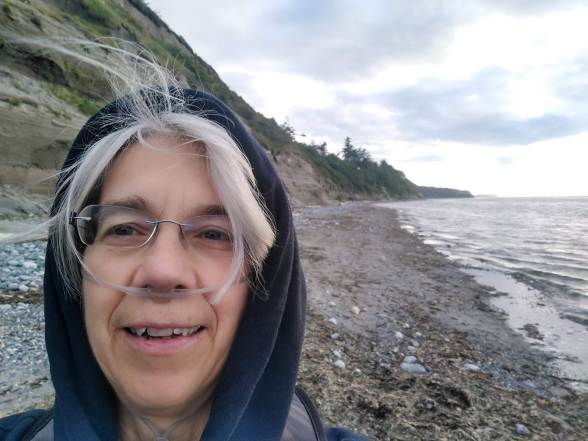
I took the photograph, a stealthie, in June 2021, when I was still on oxygen continuously.

Taken in September 2014.

A friend calls today and says that another person is bleeding and yet they have been set up to be seen Monday. Why isn’t this an emergency?
Based on the limited information the friend tells me, I agree with the doctors. It is NOT an emergency and I explain why. It is uncomfortable for the person because it may be cancer. Why is that not an emergency?
Let’s use chest pain in the emergency room as an example. Doctors have two brain tracks that are triggered simultaneously by every patient. The first one is “What could kill this person in the next five minutes?” The second is “What is common?” Common things are common and more likely. In medical school the really rare things are nicknamed zebras. You know there are a lot of horses but you can’t miss the zebra. I suppose that in Africa the common things are zebras and the rare ones are orcas or something like that.
Anyhow, the killers for chest pain are heart attacks, sudden death. But there could also be a dissecting aortic aneurysm, where the largest artery in the body is tearing. That person can bleed to death really really fast and that is a surgical emergency. No doctor wants to miss it. There could be a pulmonary embolism, a clot blocking the lung. Chest pain could be from a cancer. A very rare chest pain is from the valve leaflets in the heart tearing so that the person goes in to flash pulmonary edema. And there is Takayasu’s Arteritis, “broken heart syndrome”, where the heart suddenly balloons in size and again, heart failure ensues. Heart failure is actually pump failure, so fluid backs up in the lungs or the legs or both. It is usually slow but rarely very fast and dramatic. A collapsed lung can also cause a lot of pain. And my list is still not complete, I haven’t mentioned pericarditis or myocarditis or a compression fracture.
The common things do include heart attacks, but also anxiety, musculoskeletal problems, inflamed cartilage of the chest wall, fibromyalgia flares, broken ribs, trauma and other things. I was very puzzled in clinic by a woman with pain on both sides of her lower chest wall. In front but cutting through her chest. I ruled out many things. I thought that it was her diaphragm. I sent her to a rehab doctor for help. The rehab doctor sent her to radiology. She had a compression fracture of her spine and the nerves were sending pain messages on both sides. That was not even on my “differential diagnosis” list, because she had no back pain at all. My list changed that day.
Physicians and nurse practitioners and physicians assistants and registered nurses and licensed practical nurses and medical assistants are all trained to think of this differential diagnosis. We are alerted by the history and have to think down both pathways. Last year working as a temporary doctor, the medical assistant came to me saying, “This patient’s blood pressure is 80/60.” “Is he conscious?” I asked, as I went straight for the room. “Yes, he’s talking.” He WAS talking, which means that he’s gotten to 80/60 slowly or is used to it. His heart rate was fast, up near 120. I immediately had him drink water and keep drinking, as soon as he denied chest pain. The problem was dehydration: he was developmentally delayed and had only had one cup of fluid that day and it was now midafternoon. I spent time explaining that he needed 8 cups each day. Not more than that, because if he had too much fluid, it would lower his sodium and make his muscles weak. Most days he drank 3-4 cups. His chart graphed the problem: some days he had normal blood pressure and a normal heart rate. Other days his blood pressure was below normal and his heart rate was fast, his heart trying to make up for the low level of fluid. Cars don’t do so well when there is almost no oil, do they? His kidneys were affected as well. I asked him to drink the 8 cups a day, discussed the size of the cup (not 8 gallons, please) and then recheck labs in 2 weeks. If his kidneys did not improve, he would need a kidney specialist. It turned out that he had nearly fainted that morning in the waiting room. His group home person admitted that no one had noticed that he really was not drinking fluid. I thought that the patient understood and would try to drink a better amount of fluid.
So back to the person I was called about. Infection has been ruled out. This is blood in the urine. A kidney stone has been ruled out, but there is something in the kidney. This is urgent, but if the person is not bleeding hard, it is not emergent. When there is blood in the urine it does not take very much to turn it red. If there is a lot of blood, that can be an emergency, but from the story I got third person, it’s not very much. The emergency things are ruled out but there is still not a clear diagnosis. Yes, cancer is one of the possibilities but it could also be benign. Now a specialist is needed to figure out the next step and the differential diagnosis, the list of things it could be. They will order tests in the same dual order: what could kill this person quickly and what do we need to rule out as common? People often can be very anxious during this period, which is normal. The person says, “I don’t care what it ISN’T, I want to know what it IS.” But sometimes it is a zebra and it takes a while to get to that specific test.
Another example is a woman that I sent to the eye doctor. The optometrist thought it was something rare and bad. He sent her to the opthamologist, who ruled out the first thing, but thought it was something else rare and bad. He sent her to a retinal specialist. The retinal specialist ruled out the second rare and bad thing and said, “No, you have something very rare that is benign.” My patient said, “I have three diagnoses. Who do I believe?” I replied, “No, you have one. The optometrist knew it was unusual and sent you to an eye doctor. The eye doctor know it was unusual and sent you to an even more specialized eye doctor (a “sub specialist”. We keep them in basements.) Now you have a diagnosis. It was a scary process, but I think you should focus on the third opinion because hey, she said it’s benign and it won’t hurt you! That is the best outcome!” She thought about it and agreed. The process was frightening but the conclusion could not have been better.
For the Ragtag Daily Prompt: disquieting.

I took a photograph yesterday of a large chalkboard outside a coffee shop downtown. Isn’t it fabulous and creative? And she has a website, here: https://aine-sandford.format.com/#3
Now you can name another woman artist, who does chalk pastels and gorgeous water colors.
For the Ragtag Daily Prompt: creativity. My photograph of her chalk art and my blog!
I am a rural Family Medicine doctor, board certified and board eligible. I have used the Telemedicine groups in the nearest big University Hospital since 2010.
Initially I started with the Addiction Telemedicine. I accidentally became the only physician in my county prescribing buprenorphine for opioid overuse in 2010. I panicked when I started getting calls. Dr. Merrill from UW had taught the course and gave me his pager number. I acquired 30 patients in three weeks, because the only other provider was suddenly unavailable. Dr. Merrill talked me through that 21 day trial by fire.
I think that I presented at least 20 patients to telemedicine the first year. The telemedicine took an hour and a half. First was a continuing medical education talk on some aspect of “overuse”, aka addiction, and then different doctors would present cases. We had to fill out a form and send it in. It had the gender and year of birth, but was not otherwise supposed to identify the person. TeleAddiction had a panel, consisting of Dr. Merrill (addiction), a psychiatrist, the moderator/pain doctor, and a physiatrist. Physiatrists are the doctor version of a physical therapist. They are the experts in trying to get people the best equipment and function after being blown up in the military or after a terrible car wreck or with multiple sclerosis. There would usually be a fifth guest specialist, often the presenter.
After a while, TeleAddiction got rolled into Telepain and changed days. They added other groups: one for psychiatry, one for HIV and one for hepatitis C. These can all overlap. I mostly attend TelePain and TelePsychiatry.
After a while, I pretty much know what the Telepain specialists are going to advise. So why would I present a patient at that point? Ah, good question. I use Telepain for the weight of authority. I would present a patient when the patient was refusing to follow my recommendations. I would present to Telepain, usually with a very good idea of what the recommendations would be. The team would each speak and fax me a hard copy. I would present this to the patient. Not one physician, and a rural primary care doctor, but five: I was backed up by four specialists. My patients still have a choice. They can negotiate and they always have the right to switch to another doctor. Some do, some don’t.
I am a specialist too. Family Practice is a specialty requiring a three year residency. The general practitioners used to go into practice after one year of internship. My residency was at OHSU in Portland, with rotations through multiple other specialties. We rotated through the high risk obstetrics group, alternating call with the obstetrics residents, which gave me excellent training for doing rural obstetrics and knowing when to call the high risk perinatologist. In my first job I was four hours by fixed wing from the nearest more comprehensive obstetrics, so we really had to think ahead. No helicopter, the distance was too far and over a 9000 foot pass, in all four directions. That was rather exciting as well.

The latest issue of Family Practice Medicine has an article on patient satisfaction scores.
I remember my first patient satisfaction score VIVIDLY.
I am in my first family medicine job in Alamosa, Colorado. I receive a 21 page handout with multiple graphs about my patient satisfaction scores. I am horrified because I score 30% overall. I am more horrified by the score than the information that I will not receive the bonus.
I go to my PA (physician’s assistant). He too has scored 30%. We are clearly complete failures as medical providers.
Then I go to my partner who has been there for over 20 years.
She snorts. “Look at the number of patients.”
“What?” I say. I look.
My score is based on interviews with three patients. Yes, you read that correctly. THREE PEOPLE.
And I have 21 pages of graphs in color based on three people.
I am annoyed and creative. I talk to the Physicians Assistant and we plan. I call the CFO.
“My PA and I think we should resign.”
“What? Why?”
“We scored 30% on the patient satisfaction. We have never scored that low on anything in our lives before. We are failures as medical people. We are going to go work for the post office.”
“NO! It’s not that important! It is only three patients! You are not failures!”
“Three patients?” I ask.
“Yes, just three.”
“And you based a bonus on three patients? And sent me 21 pages of colored graphs based on three patients?”
“Um…”
“I think we should discuss the bonus further….”
I did not get the bonus. It was a total set up and I am not sure that ANYONE got that bonus. Much of the maximum “earning potential” advertised was impossible for any one person to get. You would have to work around the clock. They got out of paying us by having multiple bonuses that each required a lot of extra work…. They were experts in cheating the employed physicians. That became pretty clear and I was 5th senior physician out of 15 in two years, because ten physicians got right out of there. I lasted three years, barely. I knew I would not last when an excellent partner refused her second year of $50,000 in federal rural underserved loan repayment to quit AND stayed in the Valley working in the emergency room. I called the CEO: “Doesn’t this get your attention?”
“She just didn’t fit in.”
“Yes, well, I don’t think anyone will.” I asked my senior partner how she stayed. “You pick your turf and you guard it!” said my partner. I thought, you know, I hope that medicine is not that grim everywhere.
Unfortunately I think that it IS that grim and getting grimmer. Remember that in the end, it is we the people who vote who control the US medical system. If we vote to privatize Medicare, we will destroy it. Right now 1 in 5 doctors and 1 in 4 nurses want to leave medicine. Covid-19 has accelerated the destruction of the US medical non-system, as my fellow Mad as Hell Doctor calls it. We need Medicare for all, a shut down of US health insurance companies, and to have money going to healthcare rather than to paying employees $100,000 or more per year to try to get prior authorizations from over 500 different insurance companies all with different rules, multiple insurance plans and different computer websites. Right now I have specialists in four different local systems. The only person who has read everyone’s clinic notes is ME because it is nearly impossible to get them to communicate with each other. Two of them use the EPIC electronic medical record but consider the patient information “proprietary” and I have to call to get them to release the notes to each other. Is this something that we think helps people’s health? I don’t think so. I have trouble with the system in spite of being a physician and I HATE going to my local healthcare organization. Vote the system down and tell your congresspeople that you too want Medicare For All and single payer.
Physicians for a National Healthcare Program: https://pnhp.org/
Healthcare Now: https://www.healthcare-now.org/
I have had people say, but think of all the people out of work when we shut down insurance companies. Yes AND think of the freedom to start small businesses if we no longer have to fear the huge cost of insurance: Medicare for all!
BLIND WILDERNESS
in front of the garden gate - JezzieG
Discover and re-discover Mexico’s cuisine, culture and history through the recipes, backyard stories and other interesting findings of an expatriate in Canada
Or not, depending on my mood
All those moments will be lost in time, like tears in rain!
An onion has many layers. So have I!
Exploring the great outdoors one step at a time
Some of the creative paths that escaped from my brain!
Books, reading and more ... with an Australian focus ... written on Ngunnawal Country
Engaging in some lyrical athletics whilst painting pictures with words and pounding the pavement. I run; blog; write poetry; chase after my kids & drink coffee.
Coast-to-coast US bike tour
Generative AI
Climbing, Outdoors, Life!
imperfect pictures
Refugees welcome - Flüchtlinge willkommen I am teaching German to refugees. Ich unterrichte geflüchtete Menschen in der deutschen Sprache. I am writing this blog in English and German because my friends speak English and German. Ich schreibe auf Deutsch und Englisch, weil meine Freunde Deutsch und Englisch sprechen.
En fotoblogg
Books by author Diana Coombes
NEW FLOWERY JOURNEYS
in search of a better us
Personal Blog
Art from the Earth
𝖠𝗇𝗈𝗍𝗁𝖾𝗋 𝖶𝗈𝗋𝖽𝖯𝗋𝖾𝗌𝗌.𝖼𝗈𝗆 𝗌𝗂𝗍𝖾.
Taking the camera for a walk!!!
From the Existential to the Mundane - From Poetry to Prose
1 Man and His Bloody Dog
Homepage Engaging the World, Hearing the World and speaking for the World.
Anne M Bray's art blog, and then some.
My Personal Rants, Ravings, & Ruminations
 KO Rural Mad As Hell Blog
You must be logged in to post a comment.