Vaccination talk

My cousin asks me once, why do doctors say, “This will only hurt a little?’ when they give a shot.

I thought about it. “It’s a matter of scale. Picture this: in room one, I have a woman who thinks her lung cancer is back and it is. In room two I have a mother and daughter crying because the daughter is pregnant and frightened. In room three, I have a well adult who needs a vaccination. Scale their levels of pain.”

Room one is very high, room two is very high, room three barely registers on my pain scale.

I would give out a health department vaccination information booklet by 24 weeks to my pregnant patients, especially the first pregnancy. I previously had given it later, but then I had a woman who refused the child’s vaccines at visit after visit after visit, saying that they were still doing research. The child still had no vaccinations at 9 months.

Remember the woman who refused vaccinations for her children? She had more than four children. They all got whooping cough, pertussis. They whooped for months and were on quarantine. They were not allowed out of the household, any of them, until they were no longer infectious. The mother said she now was for vaccines and got them vaccinated.

I have seen adults with pertussis. Adults do not whoop but they cough. They can cough until they throw up or until they break a rib. For months. It is not fun at all. The adult Tdap stands for tetnus, diptheria, and acellular pertussis. I have never seen a case of diptheria and I don’t want to. It sounds horrible and can kill.

Have I seen a complication of a vaccination? One in 30 years of practice. And I know a person who had a complication, but they were not my patient.

The illnesses cause way more damage and disability than the vaccine. In residency I care for a young man in a group home. He can’t talk and has an odd skull shape. His mother got measles during the pregnancy. Measles is one of the infections that can cause severe birth defects. Get vaccinated before getting pregnant, though half the pregnancies in the US are “unintended”. That usually means “unbirthcontrolled”. I do not really understand that, since the risk of pregnancy in a fertile woman is one in four every time. Twenty five percent seems a pretty high risk to me.

I’ve written about my response to my last Covid-19 vaccination. It’s not a complication. It is an antibody response and it means that my immune system is WORKING, though admittedly it is weird and annoying. I don’t like the muscle dysfunction, but I will get the vaccinations anyhow.

I have a very alternative young woman in for prenatal care once. I give her the vaccination booklet. “Oh, my child is getting every vaccine there is,” she says.

“May I ask why? I was not expecting you to say that.”

“I was in the Peace Corps in Africa. I have seen kids die from every single one of the diseases we vaccinate for. My kid will get ALL the vaccinations.”

I said, “Please would you talk to my other moms?”

She smiled at that. “Maybe.”

I hope she did and does.

Conspiracy is easier than vulnerability and grief

“Our culture faces a flood of conspiracism” says the Atlantic Monthly.

My great Uncle forwards an article that says we are tracking along stages as we did to WWII.

I write back. No, I say, we are tracking towards WWI.

Because of Covid-19.

The problem with the pandemic is vulnerability and grief. It is difficult to be mature enough to accept vulnerability and grief. It is easier to find someone to blame and go after them. We can’t burn a virus, we can’t hang it in effigy, we can’t take it to court and give it the death penalty. Many people are terrified and do not want to feel vulnerable and do not want to grieve. So they fall into conspiracies: it is safer to believe that the pandemic is a lie, that alien lizards have taken over the US Government, that it is the fault of a country making it on purpose, or a race, or a religion. It is easier to believe that nanocomputers are being injected with the vaccine than to think about the number of dead. It is easier not to think about the number of dead, the terrifying randomness, to believe that this only affects people with preexisting conditions, or people who God wants to smite, or people the lizard aliens hate. Or that the whole thing is a lie.

We are mimicing the late 19 teens and early 1920s very well. A world pandemic. We have a war, that is not a world war. This time we have bombs capable of destroying current life on earth. We’d be left with tardigrades and those bacteria who live in the deep trenches in boiling water where the earth’s crust is thin. At least one of my friends thinks this might be a good thing.

We have just reached 8 billion people.

In London, the Black Death had a 50% kill rate in the 1400s. Half the people that got it died. It changed the world. Pandemics change the world. In this pandemic the death rate is about 1% or a little more. However, 10% to 30% of the people with Covid-19 have Long Covid. Today, Johns Hopkins says we are at 635 million people who have gotten Covid-19. 6.6 million or more are dead from it. Then we have between 65 million and 195 million people with Long Covid in the world.

We don’t know how long Long Covid lasts. We don’t know how to cure it. We do not know if we can cure it or if people will get better. We do not know, we do not know, we do not know.

Which is also terrifying. So the conspiracy and someone to hate or some group to hate or someone to fight is safer for many people.

Do not go there. We must grieve. We must help each other. We must face fear and not give in to it. We must not fall into the trap of the charismatic leader who will give us villains, who will lead us into a World War to distract us from our grief.

And from there into a world depression. Remember, the Roaring Twenties end with the worst depression the world has seen so far. Let us not repeat it, let us not beat it.

Peace you and blessings.

All of my patients are smart 2

I did a porch call a bit over a year ago. It’s like a house call except on a porch.

A friend/patient asks me to see a long time friend of his. The friend has multiple chemical sensitivities. We meet, the three of us, on his porch.

My friend has had me as a physician but he has not seen me at work with someone else.

I ask a lot of questions and then launch into an explanation of the immune system and how antibodies work.

My friend states, “He can’t understand that.’

I smile at his friend. “Oh yes he can. And you followed what I said, didn’t you?”

His friend grins back and said, “Yes, I did. Most of it. Or enough.”

All of my patients are smart. One day in clinic I think how blessed I am, that ALL of my patients are smart and fascinating people. Then I think, how could that be? And, how lucky am I?

And then I think: everyone is smart.

They are not all educated in the same way I am. They may not be well read. They may not have my science background or my geeky fiction and poetry and song brain. But they ALL are smart.

Some are brilliant at mechanical things. I have a patient who is an expert in restoring church organs and is working 3000 miles away in New York City. “They are driving me crazy.” he says. “You have to have the approval signed off on over 20 groups, historic preservation, the fire fighters, etc, etc, to remove one board from the church. The organ was covered over by bad repairs over the years. We’re trying to get it back. After this I will put in new organs, but this is my last restoration.”

Veterans, teachers, attorneys, physicians, retired computer engineers, car mechanics, marine engineers, parents, grandparents. They are all smart, men and women.

We finish the porch visit with some options and the friend of my friend says he will think about what I said and try some things.

A few days later my friend calls. “I couldn’t believe he was following your science talk, but he was. He got it. He remembers it and understood it.”

“Of course he did,” I say.

“I am actually impressed,” says my friend. “It was really interesting watching you do that.”

That may be one of my weird skills. To be able to listen to the person thoroughly and then respond in language that they understand and a bit more. An assumption, always, that they can follow a complex and intricate idea.

I do not know if they always follow what I say. But they always respond to the assumption that they are smart and that they can understand and that they are an equal. I am explaining from my expertise, but I know they can understand when I explain it correctly.

And I have not seen this in the physicians that I have seen. Out of 22 physicians since 2012, four were excellent and met me and explained as an equal.

The rest did not. They dismiss me. They talk down or avoid me once they realize that they do not understand why I keep getting pneumonia. They are afraid to say “I don’t know.” Four are not afraid and recognize that it’s something weird and say, “We do not understand this and we don’t know how to fix it.”

Four out of 22 have my respect. And that is a sad number. Medical training needs to change and physicians need time to listen and need to learn how to listen.

Meanwhile, all of my patients are smart. And I am so blessed.

Long Covid and fatigue

Sometimes medical articles are SO IRRITATING! Like this:

Symptomatic Long COVID May Be Tied To Decreased Exercise Capacity On Cardiopulmonary Exercise Testing Up To Three Months After Initial SARS-COV-2 Infection

Healio (10/18, Buzby) reports a 38-study systematic review and meta-analysis “suggested with low confidence that symptomatic long COVID was associated with decreased exercise capacity on cardiopulmonary exercise testing up to 3 months after initial SARS-COV-2 infection.” According to the findings published in JAMA Network Open, “underlying mechanisms may include but are not limited to deconditioning, peripheral mechanisms, hyperventilation, chronotropic incompetence, preload failure and autonomic and endothelial dysfunction.”

Wouldn’t it be nice if they believed the patients?

Let’s break this down. What does it all mean? Ok, the “low confidence” irritates me because it implies that the physicians can’t believe the patients who say “hey, I am short of breath and have a fast heart rate and get really fatigued if I try to do anything!”

I have had my fourth bout of pneumonia with shortness of breath and tachycardia. This time, since I am older, I had hypoxia bad enough to need oxygen. This is the FIRST TIME that some physicians have actually believed me. They believed the pulse oximeter dropping down to 87% and below, with a heart rate in the 140s, but they did not believe me and some accused me of malingering, for the last 19 years. Can you tell that I am a little tiny bit annoyed? If my eyes shot lasers, there would be some dead local physicians. And I AM a local physician, disbelieved by my supposed peers.

Let us simplify this gobbdygook: “underlying mechanisms may include but are not limited to deconditioning, peripheral mechanisms, hyperventilation, chronotropic incompetence, preload failure and autonomic and endothelial dysfunction.” The way I think of it is that sometimes a pneumonia will cause lung tissue swelling. Ok, think of the air space in your lungs as a large balloon. Now the wall of the balloon swells inwards and suddenly there is half as much air space. Guess how your body takes up the slack? The heart goes faster and you have tachycardia. This is a very simple way to think about it. I have tested patients who complain of bad fatigue after an upper respiratory infection with a very simple walk test. 1. I test them at rest, heart rate and oxygen saturation. 2. I walk them up and down a short hallway three times. 3. I sit them back down, and watch the heart rate and oxygen saturation. I watch until they are back to their seated baseline.

A friend tested recently and his resting heart rate was 62. After walking, his heart rate is in the 90s. H does not have a pulse oximeter, but his oxygen level is probably fine. However, that is a big jump. He has had “a terrible cold” for 8 days. I would bet money that his heart rate normally doesn’t jump that much. He still needs recovery time and rest.

In clinic, I had people who were ok at rest but needed oxygen when they walked. We would get them oxygen. More often, they did not need oxygen, but they were tachycardic. When they walked, their heart rate would jump, over 100. Normal is 60-100 beats per minute. If they jumped 30 beats or jumped over 100, I would forbid them to return to work until their heart rate would stay under 100 when they walked. If they went back to work they would be exhausted, it would slow healing, and they might catch a second bacteria or virus and then they could die.

Patients did not need a pulse oximeter. I would teach them to take their own pulse. The heart rate is the number of beats in 60 seconds. I have trouble feeling my own wrist, so I take mine at my neck. It’s a bit trickier if someone has atrial fibrillation but the pulse oximeters aren’t very good with afib either.

When I have pneumonia, my resting heart rate went to 100 the first time and my walking heart rate was in the 140s. I had influenza and felt terrible. My physician and I were mystified. It was a full two months before my heart rate came down to normal. I was out of shape by then and had to build back up. If I tried to walk around with my heart at 140, I was exhausted very quickly and it also felt terrible. The body does NOT like a continuous fast heart rate and says “LIE DOWN” in a VERY FIRM LOUD VOICE. So, I lay down. Until I recovered. For a while I was not sure if I would recover, but I did. This time it was a year before I could go to part time oxygen.

The fatigue follows the heart rate. Tachycardia is not good for you long term. If the heart is making up for reduced air space in the lungs, it doesn’t make sense to slow the heart rate with drugs. You NEED the heart to make up for the lungs. You need to rest, too!

Blessings and peace you.

The photograph is Elwha, helping me knit socks. With the bad air from the fires and my still recovering lungs, I am staying indoors and knitting socks .

Rebel in clinic

Right before my hospital district informed me that they no longer wanted my services, I was rebelling. The fight from my perspective, was over good patient care. They had set a quota. 18 patients a day. One every 20 minutes and one 40 minute visit. 8 am to noon and 1 pm to 5. I argued and argued and argued. I knew finishing the note in the room took me 25 minutes on the hateful electronic medical record and I had averaged 16 patients a day my whole career. I was not fast but I was super thorough and had just gotten an excellent report on a chart review and had been told that I was a great diagnostician. Which was mostly due to my nearly OCD thoroughness. I was not diplomatic with the hospital administration.

One day I was feeling wicked, just wicked. I had a brainstorm and started whistling softly. The other two doctors and PA were all in the same small office.

One took the bait. “What is that? I know that song.”

“Oh, we are singing it in chorus. For some reason it is in my head today.” So I sang this song.

I did not have the words memorized. I swear that the temperature in the room dropped and the male doctors hunched in their chairs.

“Yeah, don’t know why that one keeps playing in my head.” I said. “I hope you can all come to the concert!”

But answer came there none.

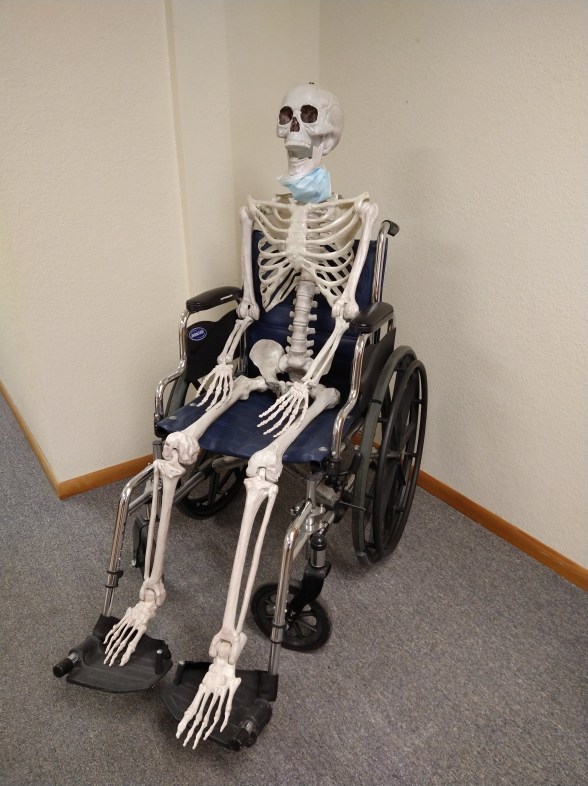
I took the photograph at Quimper Family Medicine, the clinic I opened after the hospital clinic kicked me out. The skeleton was named Mordechai in a contest. This is from 2014. Mordechai lived in our waiting room every October, with different outfits.

A Good Reaction 2

I am still working my way through my immune response to an influenza shot and six days later, my Covid-19 booster.

I am kicking myself a bit for having them that close together, but at least my immune system responds. I think my immune system takes a shotgun approach and raises ALL the antibodies, and since I most probably have some antibodies that attack my own tissues, it’s not terribly much fun. I’ve had to put pulmonary rehab on hold until my fast twitch muscles work again. They aren’t working and my slow twitch muscles are very pissed off and stiff at having to do double duty. If I do aerobic things, my rib muscles hurt for two days. THAT feels awful.

The good thing (ha.) is that I am having the antibody response but I do not have pneumonia. The working theory is that I have PANS and antibodies to tubulin. Tubulin powers muscles, including lung cilia. Their job is to clean any trash out that gets breathed in. I am at much higher risk for getting pneumonia while the lung cilia are on auto-immune vacation. I am mostly staying home and masking when I go out. A friend got exposed to Covid-19 and refused to test at day five. Well, ok for him, but he could be asymptomatic. So he’s not allowed anywhere near me for at least another ten days. I disapprove of his callousness towards me and others.

Tobacco also paralyzes lung cilia. When I was working I would warn smokers that they might cough more when they stopped smoking, because the cilia would wake up and clean house. “Hey! No one has swept here in years!” A year after quitting smoking, the lung cancer risk drops almost to that of a non-smoker, because those cilia clean house. Isn’t THAT cool?

I don’t know how long my fast twitch muscles will be screwed up. With the last pneumonia, it was nearly a year before the antibodies finally went down. I woke one morning with my slow twitch muscles insanely stiff and my fast twitch back but weak as a newborn kitten. My slow twitch muscles were yelling at my fast twitch: “Where have you BEEN? We’ve been doing YOUR WORK!!” My fast twitch were confused, weak and surprised. I could barely walk down my stairs that day.

Even so, I am lucky. I have a version of chronic fatigue, but because only my fast twitch muscles are affected, I can still do stuff while sick. The people who can barely get out of bed, my working theory is that it is both the fast twitch and the slow twitch muscles that are affected.

And then there are the brain antibodies. Ugh. The silver lining is that the antibodies make me a bit OCD and a bit ADHD, so I am organizing the house. I vacuumed the stairs. That sounds trivial except that I HATE the vacuum. I usually use this peculiar cat hair sponge thing on the stairs, but this time I got the vacuum out. I think organizing and vacuuming are hella funny symptoms of autoantibodies.

Here is a blog post by another physician, also about brain antibodies and encephalopathy. Brain inflammation.

https://www.potomacpsychiatry.com/blog/infectious-diseases-and-psychiatric-illness

Great blog post. And the NIH paper on multiple studies of encephalopathy:

https://www.ncbi.nlm.nih.gov/pmc/articles/PMC6455066/

If I have the energy today, I may try to look up the trajectory of antibody rise and fall after immunization. My brain tells me somewhere between 6 weeks and 6 months, pulling old data from somewhere, but I took immunology classes when I was working at the National Institutes of Health (late 1980s) and in medical school (early 1990s), so there may be new information. Science changes. I am hoping for less than six months really, and meanwhile trying not to get pneumonia.

Blessings and peace you.

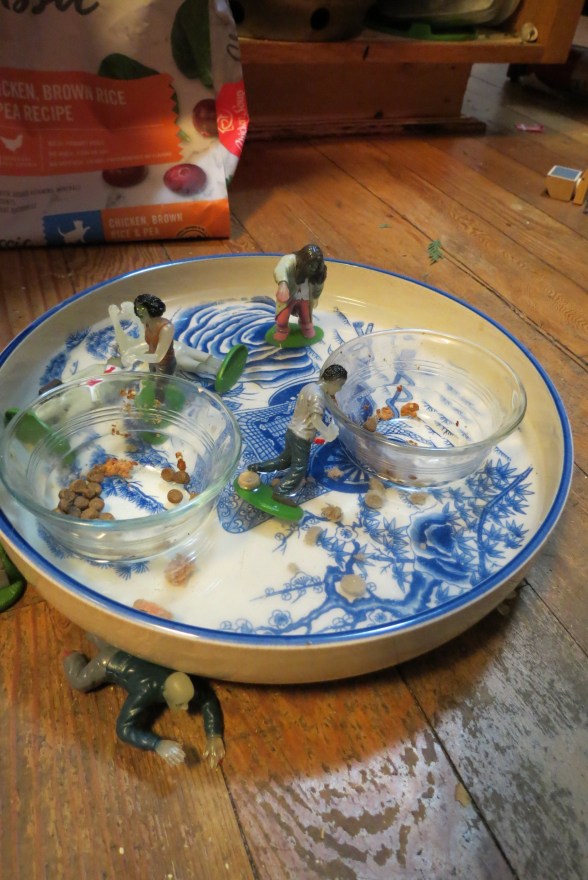
I took the photograph in 2021, while I was REALLY sick. Glow in the dark Zombies stealing the cat food. I have to entertain myself somehow when I have pneumonia.

A good reaction

The last ten days sucked but the results are probably good.

What? Wait, why?

I saw the pulmonologist week before last on Wednesday. Her office does not give the new Covid-19 shot but does give flu shots. I got my flu shot. It didn’t seem to bother me much except that I felt a bit tired and grumpy.

I saw my family practitioner on Tuesday, after my pulmonary rehab. For the first time I did not improve in pulmonary rehabilitation (12 weeks, twice a week). I also seemed to have a faster heart rate, up to 140 beats per minute, on the treadmill. My doctor had me walked and even going around the block, my heart rate went to 115. Weird, I thought.

My family doctor did have the new Covid-19 vaccine so I got that. The next day I was more tired and grumpy. On Thursday I lost ground on the treadmill and felt awful and my heart rate just seemed high all the time.

Oh. This is an appropriate reaction for me to two vaccines one week apart. What? you say. Well, when I get pneumonia (four times), I have a fast heart rate response, shortness of breath, fatigue and I feel grumpy and wired. The theory is that I have antibodies to the dopamine receptors, that turn the receptors ON. Dopamine can raise your heart rate. At the same time, I have antibodies to tubulin. Those antibodies make my fast twitch muscles not work right, as well as lung cilia. So: fast heart rate, treadmill is much more difficult, and I started sleeping ten hours a day.

This means my immune system is working. It is making LOTS of antibodies, which is what I theoretically want it to do, though I would rather not have the dopamine and tubulin ones. Just antibodies to influenza and Covid-19. However, my immune system seems to have PTSD and when it makes antibodies, it makes them to EVERYTHING. This makes me very tired, grumpy, screws up exercise and gives me shortness of breath and a fast heart rate.

How long will it last? I am not entirely sure. With infections, antibodies rise and then fall over 3 to 6 or more months. The naturopaths say that food intolerance antibodies fall in three weeks if you stop eating the offending item. I want my Covid-19 antibodies to persist for 3-6 months or more, flu antibodies as well, but I’d like the ones that give me a fast heart rate and shortness of breath to drop right away!

I guess I will find out. At least my immune system works, however oddly.

Blessings and peace you.

I took the photograph of the Great Blue Heron just after she took off yesterday. I am trying to catch more birds in flight! Mostly I catch parts of birds, the tip of a wing, or feet. I am really pleased with this one.

Practicing Conflict II

Practicing conflict II

In Practicing conflict, I wrote about practicing conflict by arguing different sides of a topic inside my head. I wrote that I don’t fear conflict and have learned to enjoy arguing with myself. I am a physician and physicians argue all the time.

What? No they don’t. Well, the doctor persona does not argue with the patient much. Some doctors give orders to patients, others try to negotiate, some try to convince. But behind the scenes, doctors are more like the Whacky Racer Car with the Cave Guys, running with their feet and hitting each other with clubs.

In residency in Family Practice at OHSU in Portland, Oregon, I start on General Surgery during internship. This is in the early 1990s and there was not much in the way of “disruptive physician” rules. I have to cover Trauma and Plastic Surgery and General Surgery at night on call. The resident is present but I get paged first for patients on the floor. I learn that I should go to all Trauma pages in the emergency room. If I know what is happening with the new Trauma patient, it’s a lot easier to handle the phone calls for more drugs and so forth. Also, the resident is less mean to me.

We attend the Trauma “Grand Rounds”. These are unreassuring to a new intern. A resident presents a trauma patient, giving the history in the accepted formal order. The Faculty Trauma Surgeons interrupt, disagree with management of the patient and yell. They yell at the resident and at each other. The upper level residents yell too, being well trained. The Trauma Surgeons do not agree with each other. They are inflammatory and rude. I am shocked initially: medicine is not a cookbook, is not simple and it appears that it is a controversial mess. It turns out that medicine IS a controversial mess.

There is not as much yelling on the next rotation. At that time Trauma Surgeons yelled more than any other set of doctors that I ran across. They yelled in the ER, at each other, at the staff, at the nurses, at the residents. The culture has changed, I suspect, but that’s how it was then.

I take Advanced Trauma Life Support as a third year resident. The Trauma Surgeons at OHSU helped write the course. They don’t agree with it. On some questions the teaching Surgeon says, “The answer to this question is (c), “ followed by muttering loudly, “though I totally don’t agree with that and I would do (b).” Another Trauma resident or surgeon then might start arguing with him, but they moved on pretty quickly, to teach the current agreed best practices in the book. Which change every few years. Great.

Years later (2009) I join the Mad as Hell Doctors, to go across the US talking about single payer. They are a group from Oregon. Physicians for a National Healthcare Program are a bit cautious with us the first year: we might be whackos. We have an RV with our logo and we have a small fleet of cars and what do you think we do in the cars? We argue. Or discuss. Or whatever you want to call it. We spend the driving dissecting issues and how to present things best and tearing apart the last presentation and rebuilding our ideas. The group does 36 presentations in 24 days. Each presentation takes an hour to set up, two hours to do and another hour to break down and debrief. We get more and more exhausted and cranky and um, well, argumentative, as the trip proceeds. Even though I think of the Whacky Racer Cave Guys running with their feet and bonking each other with clubs, this is the most wonderful group of doctors I have ever been with. A common goal that we all want to get to, discussing and disagreeing on strategy all the way! I feel closer to those physicians in a week then I feel to any of the physicians that I’ve worked with for the last 9 years in my small town. Conflict with a common goal.

Doctors are TRAINED to argue, even with themselves, to document every decision in the chart with reasons why they have reached that decision. And that they have thought about all of the reasons for say, a low potassium, thought of every possible cause and worked their way through testing. The testing always has two strands. One strand is rule out the things that could kill the person NOW, even if rare. The other strand is what is common? You have to think about both at the same time, always. And argue with yourself about which tests should be done, in what order, what is most important, how do you treat the person while awaiting results, and have I missed anything? And if we aren’t sure, we call another doctor, run it by them, wait for them to shoot holes in our logic or to say, no, I can’t think of anything else.

We can deal with conflict. We must deal with conflict. The world is too small not to deal with conflict, with disagreements, with different viewpoints and positions and ideas. If doctors can do it every single day at work, then everyone else can too. Trying to see all the positions and possible diagnoses saves lives in medicine. We need to extrapolate that to everything else. Try to see other positions, try to understand them, to respect them. We can and we must.

Blessings.

Here are the Whacky Racers:

And Madashell Doctors blog: http://madashelldoctors.com/category/uncategorized/page/3/

For the Ragtag Daily Prompt: discuss.

The photograph is from my clinic once we had stopped seeing patients and were selling everything. Mordechai was our clinic skeleton, made of plastic, from China. This was in January 2021.

Practicing Conflict

An essay from my church talks about the writer avoiding conflict, fearing conflict and disliking conflict. This interests me, because I do not avoid conflict, I don’t fear conflict and actually, I like it. Our emeritus minister once did a sermon in which he said that when you are thinking about two conflicting things at once, that is grace. I have thought about his words many times, especially when I am not in agreement about something.

Does this interest in conflict mean I fight all the time? Well, sort of, but not in the way you think. I don’t fight with other people much. I fight myself.

What? No, really. Most topics have multiple sides. Not one, not two, but many. Like a dodecahedron or a cut gem. Hold it up to the light, twelve sides, each different. I argue the different sides with myself.

I learned this from my parents. My parents would disagree about something, they would discuss or argue about it, and then they would bet. Sometimes they bet a penny, sometimes a quarter, sometimes one million dollars. Then one of them would get up and get the Oxford English Dictionary, or the World Atlas, or some other reference and look it up. This was pre-internet, ok? 1970s and 1980s.

Sometimes my parents would even pay each other. The penny or quarter. My father spoke terrible French and my mother had lived in Paris for a year after high school, so he could get her going by insisting that his French was correct. It wasn’t. Ever.

There were other arguments in the middle of the night that were not friendly and involved yelling, but the daytime disagreements were funny and they would both laugh.

Once my sister is visiting after my mother has died. My father is present. My father, sister and I get in a three way disagreement about physics. I’m a physician, my sister was a Landscape Architect and my father was a mathematician/engineer, so we are all three talking through our hats. However, we happily argue our positions. Afterwards, my gentleman friend says, “That was weird.” “What?” I ask. “That was competitive and you were all arguing.” “It was a discussion and we disagreed.” “I won’t compete.” “We let my dad win, because it makes him happy.” “That was weird.” “Ok, whatever.”

My gentleman friend is also shocked when my teen son challenges me at dinner. My son says, “I am researching marijuana and driving for school and there isn’t much evidence that it impairs driving.”  I reply, “Well, there is not as easy a test as an alcohol test and it was illegal, so it has not been studied.” We were off and having a discussion.

Afterwards my gentleman friend says, “I am amazed by your son bringing that up. We weren’t allowed to discuss anything like that at dinner.” I say, “We pretty much discuss anything at dinner and both my kids are allowed to try to change my mind. About going to a party or whatever.” He shakes his head. “That is really different.” “Ok,” I say.

This habit of challenging authority, including adults, did not go over well when my son was an exchange student to Thailand. It did not occur to me to talk to him about it. He figured it out pretty quickly.

Back to my internal arguments. If I take a position, I almost immediately challenge it. I think of it as the old cartoons, with the angel on one shoulder and the devil on the other. The devil will make fun of things and suggest revenges and generally behave really badly. The angel will rouse and say, “Hey, you aren’t being nice.” Then they fight. The internal battle very quickly becomes comic with the two of them trading insults and bringing up past fights and fighting unfairly. When it makes me laugh inside, I can also be over the driver who cut me off, or someone who spoke nastily, or whatever. My devil is very very creative about suggested revenges. When the angel says, “You are meaner than the person who cut you off!” I am over it.

When I was little and disagreeing with my family, my sister could tell. “You have your stone face on!” That meant I was attempting to hide a feeling, especially fear or anger or grief. Siblings and family are the most difficult because they can read us and see through us like glass. My physician training also teaches control of feelings. I have sometimes wanted to grab a patient and scream “Why are you doing this to yourself?” but that really is not part of the doctor persona. I am doing it inside, but I can put it aside until later. Then the devil goes to town! And the angel tries to calm the devil down.

Maybe we all need more of this skill. Pick a mildly controversial topic. Argue one side of it. Then switch positions and argue the other side. Go back and forth until it gets ridiculous. Let each side get unreasonable and inflammatory and annoying. This can play in your head and not on your face. Once you can do a mild topic, move on to something a bit more difficult. If you only know the arguments on your side, read. You can find the other side, the internet is huge. Start gently.

A friend says, “You always argue about things.” I say, “I prefer to think of it as a discussion.” “You always take the other side.” “Well, it interests me. And if there is no one to discuss something with, I discuss it with myself!” “Weirdo,” says the friend. I think he’s jealous, really I do. Don’t you?

Care bare? No, Care Barrier.

My cardiologist told me to go to the Mayo Clinic six months ago.

I saw him last week and he wanted an update.

I said, “I filled out a request for a visit and my primary care referred me, but Mayo Clinic never called.”

He replies: “I will refer you.”

A week later I get a call from Mayo Clinic. But I do not have an appointment yet because

  1. They are booked out until November 18th. I am advised to “call daily” to get my appointment. They open up a week at a time, but don’t say when. A new meaning to “maybe you’ll get lucky”.
  2. They do not take my insurance and want a $5000 deposit prior to seeing me. I can fill out paperwork to ask for patient assistance. This would be the fifth hospital system in which I have filled out that paperwork. I have had to do it for four other places. The paperwork is different for each one and some even want a copy of my taxes. Do you think it’s secure? Of course it isn’t.
  3. I have to go in person to Minnesota, so add a round trip plane ticket to that $5000. They may do tests while I am there, so I don’t know how much of the $5000 I would get back. If any.

At the moment this seems insurmountable, but I will keep chipping away at all the insane barriers and paperwork. What a stupid medical system the US has, right?

We still need single payer and medicare for all. There would be one set of patient assistance papers, not five.