Avoid death by fentanyl

Some of the West Point Cadets overdosed on March 12, 2022 are still on ventilators. They took what they thought was cocaine. It was laced with fentanyl and they all nearly died.

Not only that, but two of the bystanders who did not use the drug, but did cardiopulmonary resuscitation, CPR, also succumbed. They stopped breathing because they got a heavy dose of fentanyl giving CPR.

Fentanyl is being laced into ANY illegal drug, and being 50 times stronger than morphine, it can kill you by making you stop breathing. Also, fake pills are made. Do not buy pills on the street. And I don’t care if it is your friend. Remember that when someone is really addicted, the addiction is running the show. They need the drug more than your friendship. People will lie, steal and sell drugs. Protect yourself:

Please read the website at

https://www.cdc.gov/stopoverdose/

If you or a family member uses illegal drugs, please get naloxone to have at home. If the shot is given in time, very soon after the person stops breathing, it can save their life.

Here: https://www.cdc.gov/stopoverdose/naloxone/index.html

If you give someone a dose of naloxone CALL AN AMBULANCE. Because it is short acting and the opioid may take back over. The person may need to be on naloxone iv! You must get them to an emergency room as fast as possible.

Our local Health Department was giving out naloxone shot kits in the last few years for free. Our local police carry naloxone. If you are on prescription opioids, you should be offered a prescription for naloxone and your family should be instructed on how to use it.

And teach your children well. I interviewed my patients for years on the age they started smoking. Most of my patients started at age nine. One woman said age seven. We have to start talking to children about drugs and risk and not smoking anything by third grade. That is the horrific reality.

And Bless the punk band The Offspring for reaching out to opioid overuse people and saying, “Get help. You can do it. Please do not die.”

The Opioid diaries live by the Offspring.

And they too are inimitable.

Playlist: Stages of Grief 3

Stages of Grief Playlist 3

All women all the time today. Grieving for their men or our culture. Fighting back.

Denial

Dolly Parton: The Grass is Blue

Bargaining

Ann Peebles: I can’t stand the rain

Anger

Lily Allen: Not Fair

Acting Out/Fighting Back

Sweet Honey in the Rock: Give Your Hands to Struggle

Revenge

Dolly Parton: Silver Dagger

Grief

Tricia Walker: The Heart of Dixie

Acceptance

Bessie Smith: You been a good old wagon

Update on Addiction 2022: Mouse Cocaine Addict Studies

Recent experiments on mice are giving us interesting information on addiction, and suggesting that l-dopa may be able to control/mitigate addiction. This lecture about how dopamine works in addiction using a mouse model (poor mice) blew me away. The mice fell into two categories: maintenance users and vulnerable addict rats. The study of the dopamine postulates a reason for the difference.

20th Annual Drug Conference Washington State from 2019

Notes from lecture 3: Paul Phillips PhD
Dopamine Neurotransmission in Substance Use Disorders: from Preclinical studies

For a long time there were no agreed upon animal models: rats don’t steal money from other rats to buy drugs. However, rats do get addicted and this can be studied.

There are features in rats, rat behavior and rat brains that might translate to humans.

1. Basic discoveries about dopamine neurotransmission in substance use disorders is discussed.
A neurotransmitter study checking every ten minutes in brain examines two areas: dorsal and ventral striatum. Dopamine is increased in the area between cells from the administration of substances “first time use” in animal models: cocaine, alcohol, methadone, cannabinoids, nicotine, amphetamine, morphine. This is the first clue re addictive drugs, whether there is an increase in dopamine intraneuronally. The endpoint is that direct effect on dopamine receptors, which has a different brain mechanism for each drug. Cocaine blocks the receptor that reuptakes the drug into the neuron. Methamphetamines and amphetamines reverse the reuptake pump, makes the receptor spit it out. Gaba neurons act to inhibit dopamine neurons, normally mu receptors on the gaba interneurons and the opioids block those. Ethanol has another mechanism of action. It changes inhibitory activity, lowering the inhibition of the gaba interneurons. Nicotine REALLY messes with multiple receptors and multiple cells, but main effect is increase of dopamine in the striatum.
Increased dopamine in human brain relates to the feeling of being high: brain PET scans show amphetamine and dopamine bound less, reduction in the binding. Subjects were substance abusers. Subjective questioning of how high they felt correlated with the amount of dopamine released on the PET scan. Methylphenidate was used in that study. Canada study: cocaine increases dopamine in human brain by PET scan.
Addiction does lead to changes in the brain, on both PET scans and functional MRIs.
PET scans measuring dopamine binding in the brain show that the baseline in brains of substance abusers differs from non-abusers. The levels of dopamine receptors is lower in the substance overuses and there is lower binding than controls: heroin, alcohol, meth, cocaine (and obesity and ADHD…..). (This has been known for opioid overuse and chronic use for a while: the brain cells withdraw receptors, so the same dose does not reduce pain because there are less receptors. The change in receptors appears to vary in different subjects. Recovery is very slow.)
The role of dopamine has been confusing. It is known that it is involved in the cue evoking cocaine “craving”, but is also involved with — satiety. This has been confusing and contradictory — what does dopamine do but also the dynamic structural signaling.

2. The animal studies demonstrate that the dopamine signals are phasic.
Rat studies measure changes in dopamine minute to minute electrochemistry for sub-second dopamine detection in vivo, which means we can measure changes in dopamine in real time. There is an identified output signature for dopamine levels, measure in 8.5 millisecond, ten measures per second.
The rats were voluntarily taking cocaine. The cocaine was available in a liquid with a light that would come on when it was available, for two hours daily. The animal presses a lever when the light cue is on and gets an infusion of drug. With the ten measures per second, the first and smaller dopamine response in the brain is before the lever is pressed. That is, there is a rise in dopamine BEFORE the rat presses the lever. If stimulated dopamine, the animal would go press the lever. Then there is a larger reward dopamine signal when the drug hits.
Dopamine is the chicken and the egg: signal to USE and signal that has ARRIVED.

3. Changes that take place with drug use
There is a signal change over time that correlation with features of addiction.
The mice had an implanted brain electrode, tinier than human hair, 7 microns, biocompatability — don’t make the brain attack it as a foreign object so rat brain keeps working. The study involves tyrosine hydroxylase, a precursor of dopamine. A food pellet response of the tyrosine remains the same at 1, 2, 6 months so can monitor substance abuse brain changes. These are cocaine addicted rats. They get cocaine via a nose poke of a button when it lights up. Pellets, not iv (they learn that faster). There are 2 ports to nose poke: active and inactive. The signal that cocaine is available and the pellet is active: a light comes on for 20s and then drug arrives. Can take again after 20sec. The rats titrate cocaine use: not continuous. They pace cocaine use, wait for it to wear off. Over time, drug use 1 hour access daily… slow increase, relatively stable.
When the access is bumped up to 6 hours access daily… rats do increase use — first of 6 hours, escalation of drug use faster — in humans development of tolerance.
With 1 hour cocaine availability, the dopamine response to the cocaine in the rat brain is lower by the 2nd and 3rd week, slowly decreases, then with 6 hours of access the loss of dopamine is very robust, happens faster, dopamine signal gets smaller every time.
Rats long access: were there individual differences? Yes, metric, nonescalated vs escalated groups so like humans. 60 escalated 40 didn’t and stayed stable. So essentially I named these “Vulnerable addict rats” and “Maintenance rats”.
Which group most motivated to take cocaine? The study ups the price of cocaine for rats, how many times are you willing to receive the drug? The escalating animals made more responses, “worked harder” for the drug. The escalator brains, Vulnerable Addict Rats, had just about a complete loss of dopamine signal by three weeks.
The nonescalators had more stable dopamine responses, retained some dopamine brain function.
The greater the loss of dopamine, the more the animal escalates the drug use.
The Vulnerable Addict rats would use cocaine to the exclusion of food, water, sex and sleep and died early.
This is a feedback loop. The rats get a success signal when the drug is taken — but over time don’t get the success signal because dopamine receptors are gone — so take more. In the Vulnerable Addict escalators, the dopamine signal of anticipation goes down in response to the cue, the drug effect takes a little longer but the pharmacological response to drug actually remains.
They tried giving l-dopa, a parkinson’s drug and if treat, the rats get a restoration of the dopamine cue — pharmacological response didn’t change — how does this affect behavior? A daily shot of l-dopa and the animals on the l-dopa have less escalation. (wow!) The l-dopa didn’t affect the nonescalators/maintenance rats. When they remove the l-dopa in the vulnerable addict rats, the animals jump to higher use and so the brain changes are happening even when it is masked by the l-dopa but does not stop the brain changes.
They ask the question: can you reverse escalation? With the the l-dopa, they use less.
Dopamine signaling to take drugs (the anticipation cue when the light goes on) decreases in animals that escalate drug taking, but does not change in animals with stable drug taking.
Restoring dopamine signaling with l-dopa can prevent or reverse escalated drug taking.
This dopamine signaling….

4. Mechanisms — drug cue elicits dopamine.
So this is about triggers. This is a paired drug cue: the light signals that the drug is available. If a non-contingent drug given to animal, the light still elicits drug seeking. Using a naive animal: pair reward with cue, over time the cue will increase dopamine.
(hmm. Facebook. blogging. Instagram. “You have mail”. )
The initial addiction has a short access time. One hour out of 24. When this is changed to long access, some animals escalate vs non escalation — as take more and more drug, the response to the drug taking cue gets larger in the escalators/Vulnerable Addicts. Presentation of cue — by investigator vs animal:
If elicits drug seeking than the dopamine response gets larger to the cue over time.
If the cue is given but other choices of liquid, then the dopamine response gets smaller in some rats — so terminating drug seeking. The Vulnerable Addict Rats had a larger and larger dopamine craving cue spike, the longer they were off the drug. The the increase in the cue drives craving and decrease drives seeking — so both bad.
The conclusion in the rats is that craving for drug, related to cues, is dependent to length of time off drug. The longer the rats were off the drug, the larger the dopamine spike when the cue light comes on. The measure of cue behavior gets worse …. 60 day study in rats, this is not physiological withdrawal, is prolonged way beyond the withdrawal.
1. noncontingent
wait a day or wait a month
work harder to get drug, harder a month out
reaction to drug cue presentation, enhanced over time
at start of drug small signal to drug cue
long access then cue gets bigger
same a day after stop drug
but huge in a month after no drug — huge dopamine response

(my thought was then swearing. how do we treat this?)
In chronic drug use the cue signal shrinks which reinforces drug use AND stopping increases the cue response which ALSO reinforces.

5. Implications for treatment
treating rats
They discuss a virus with promotor that affects dopamine cells, light activated ion channel, cells release dopamine when light stimulated
only activates release of dopamine, to understand mechanisms.
For the self administered nose cue …. In the nonescalator maintenence rats, dopamine cue response stays fairly robust, stimulate those cells and no change.
In the escalator/vulnerable addict rats… if do a virus stimulation of dopamine in the brain, more dopamine to cue boosted, so they use less cocaine and look like the non-escalators.
5th cue less dopamine than 1st cue: if put dopamine back then maintains the drug seeking.

What underlies the decrease in dopamine release?
When the animals use cocaine, dynorphin goes up (kappa antagonist).
They injected a kappa receptor blocker — animal no longer escalate (not in humans at this time, don’t understand well enough) treating animals that are escalating, so the bad addict/vulnerable rats.
Most animals don’t escalate — but pretty serious amounts of drug cocaine so not abstinent.

For future
Dopamine diametric changes: dopamine may reduce consumption but might increase craving, so it is difficult to treat.
l-dopa — treatment — some studies, looking for abstinence, does NOT produce abstinence. Does not make abstinence worse. Says that promise seen relates to the status of the subject — helps with people who are still using (some) but doesn’t help increase or prolong abstinence. So could reduce harm but not abstinent….politically unpopular. Happier with turning alcoholic into a social alcohol user, but that idea is less popular/politically ok with cocaine/opioids (and especially meth).

They are studying mouse nosepokes for alcohol — reduced intake when the rats are on l-dopa.

There is a functional agonist for kappa receptors == buprenorphine, might have effects on drug consumption, speculation across different drugs.

Dynorphin is a stress related peptide, so does that signaling produce escalation of drug taking? So other stress drugs — like corisol, CRF, plan for more studies.

Question: Stress related hormones– babies in stress in utero and in stressful childhood have less dopamine receptors and need more dopamine for pleasure, susceptibility to drug addiction (ACE scores) so is still really early studying neurotransmitters.

Dr. Question: why do people do better with agonist therapy than abstinence in opioids vs other drugs? Answer: we don’t know….. yet.

further information:
https://www.ncbi.nlm.nih.gov/pmc/articles/PMC1920543/
https://www.ncbi.nlm.nih.gov/pmc/articles/PMC80880/
https://archives.drugabuse.gov/news-events/nida-notes/2017/03/impacts-drugs-neurotransmission
https://nida.nih.gov/

mad skills

What are your mad skills?

My maddest baddest skill, shared with my younger sister, is reading hidden emotions. Children of alcoholics and addicts learn that one young. Or die. Or start drinking/drugging to numb young.

Our culture is bloody weird. Emotions are stuffed like turkeys until people are near bursting. I swear that half my clinic time was letting people talk about emotions and then saying, well, those seem like pretty reasonable feelings in view of the insanity going on in your family. There would be a silence while the person thought about the horrible terrible feelings being reasonable and then I would say, “You said you want an antidepressant. Do you want to discuss that?”

Often people put it off. Once the feelings are OUT and present and looked at instead of stuffed/contained/terrifying, the person would say, “I don’t know. I don’t know if I need it.”

“Do you want to schedule to come back in two weeks?”

Sometimes yes, sometimes no. If they wanted to start an antidepressant, I would caution that the recommendation was to stay on it for six months minimum if tolerated. Also, if they were starting it in June, I would say, “Don’t stop it in January. Wait until the sun is back. Here that can be July 4th. At least wait until spring.”

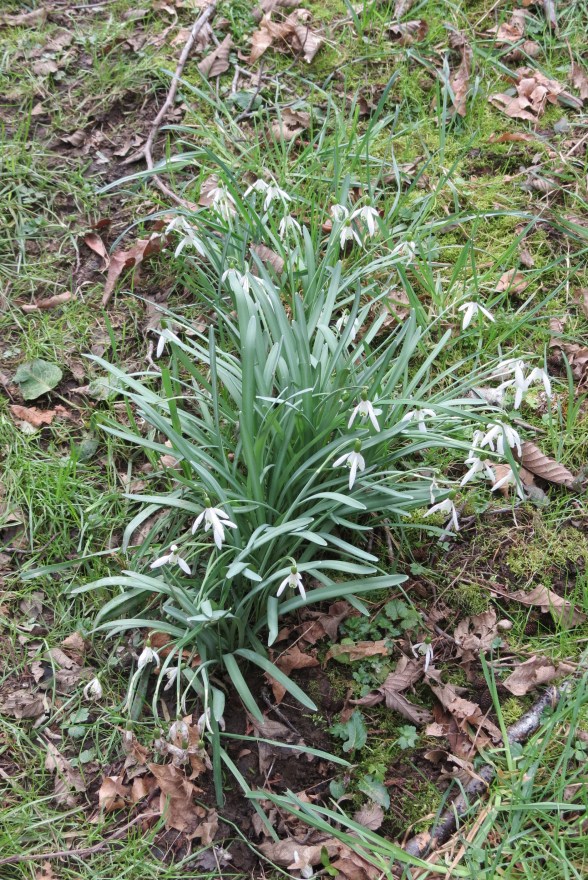
The plants are all thinking about spring now. My magnolia would like three more days of sun and then it will burst into bloom. The plums are budding and close to exploding. My camellia is usually first, but I trimmed it at the wrong time of year and so it is not blooming. It looks healthy, though. It is sort of sulking for a season. I would like to sulk for a season too.

Why is our culture, the US, so terrified of emotion? We think everything should be about logic. Emotions are both hormonally and electrically mediated through nerves and blood and they are INFORMATION about our environment and each other. We should let emotions roll through us like waves, and not worry about them so much. I think of myself as an ocean. The emotions are the weather. They roll through. Ok, big storm. Then rain, and lightening. Then low clouds and some fog. Then sun and a beautiful day to sail with a light breeze. But the deeper currents change slowly and the weather is not really that important. I reside in the depths.

The furor over rising prices seems ridiculous to me. The roaring twenties has begun already in housing and buying stuff on Amazon. I have bought two things from Amazon in the last two years. I like to buy local. One order was for my future daughter in law’s wish list. I think people are buying so that they do not have to feel. It is cultural mania. Everyone is rushing around trying to make money instead of grieving. Yesterday I thought, if this keeps up, we WILL have a depression like 1929.

Don’t do it. Don’t buy stuff to avoid the stuff inside. Sit still twice a day, for at least five minutes, and just listen. Try to listen to the depths.

Covid-19: Approach to Long Haul

Covid-19: Approach to Long Haul

This is written primarily for physicians, but is for anyone to read. This is a working theory.

I am very interested in Long Haul because I was diagnosed with PANS by an older psychiatrist who worked exclusively with physicians in 2012. That was during my third flare. The evidence is mounting that Long Haul is an autoimmune disorder like PANS. I am sharing my approach to Long Haul based on both my clinic and personal experience.

Step 1. Validate the patient. Patients are terrified, understandably, to have something “like” chronic fatigue, fibromyalgia, or are worrying that they are “crazy”. Evidence is appearing that Long Haul, chronic fatigue and fibromyalgia are all complex autoimmune disorders with multiple antibodies. We do not yet have vast antibody tests. So the first step is to say that we believe patients and also that we can help. This is a very new and evolving field. I tell patients that it will change fast over the next few years. What I tell them today may change within a year as we get new information. If this makes them anxious, remind them of the Women’s Health Initiative and how that changed hormone therapy, and that cancer treatments keep improving.

Step 2. Lower stress and antibody levels. When we are high stress, cortisol and adrenaline go up and impair the immune system. The immune system is fired up and looking for something to do. Bacteria like strep A have evolved with us and have surface proteins that “look like us”. Our bodies make antibodies to the Strep A or Covid-19 and sometimes those antibodies attack us too, because our own proteins look the same. One way of lowering the antibody level is sweating. Hot bath or shower, sauna, hot tub, exercise. Support these and explain. A second way to lower the antibody level is to quiet the sympathetic nervous system and activate the parasympathetic nervous system. The parasympathetic is the quiet, relaxed and laughing one. Where does the patient feel safe, relaxed, quiet? After my father died, leaving a complicated and messy estate with an out of date will, I did a Sudoku daily for a year. I realized that the Sudoku relaxed me because I could not solve the estate quickly, but I could nearly always solve the Sudoku. Stupid cat videos, rocking chairs, knitting, gentle walk in the neighborhood if it feels safe, a walk in a mall (without one’s purse if overspending is an issue) — how does this particular person relax? Teach the slow breathing: in for a slow count of five and out for a slow count of five. Or square breathing: in for five, hold five, out five, in five. Twenty minutes of slow breathing supposedly moves almost everyone from sympathetic to parasympathetic. It may take practice and feel unfamiliar: I have had a veteran say that it felt very very weird to relax and he was not used to it. He kept at it.

Step 3. Symptom picture. At present I am basing this on my own experience with PANS. This is my working theory. Antibodies can block receptors or “turn the key” and activate receptors. Buprenorphine does BOTH (though it is not an antibody): at lower levels it turns the key and at higher levels it blocks. I would ask specifically about five fields. You many well be able to come up with more.

a. Brain function. In my PANS, I have antibodies to dopamine that turn dopamine on very high. Other physicians assume that I am manic. I am not quite manic, but it certainly feels awful. I feel like I have been shot out of a cannon when I wake up, with the morning cortisol rise. For me, the caffeine in coffee calms me, and my assumption is that it displaces the anti-dopamine antibodies. Tea does not work. I quit coffee for seven years until the latest flare. Albuterol doesn’t work. Terbutaline does work. I don’t know about theophylline or adderall, I have not tried them. If someone has “brain fog”, I assume that they have blocker antibodies OR be sure to ask if they were different in the first 4-6 months of the illness. For me, the antibodies rise for about 2-3 months and then take 2-3 months to drop. I have a lot of fatigue when they finally leave and this time I could tell the day that the last antibodies “fell off” or dropped to my “normal” level.
For blocked people, does caffeine help? How about albuterol? Adderall, theophylline, SSRIs. Every person will have different antibodies. Treatment needs to be tailored.

b. Muscle function. My anti-tubulin antibody (I have PANS, remember?) shuts down my “fast twitch” but not my “slow twitch” muscles. Tubulin is what makes the lung cilia function, so presumably mine are paralyzed during a flare and that is why I get pneumonia. I am tachycardic, resting heart rate 100 and walking slowly or talking heart rate 135, so I get very short of breath. Both the lung dysfunction and antibodies that upregulate my dopamine receptors make me tachycardic. I think that the people who can barely get out of bed with chronic fatigue have both fast and slow twitch muscles blocked. They need validation and lower stress. With support, perhaps the antibody level can be lowered enough that they can function again. I also found that my muscles hurt when my blood sugar was up and that if I keep it low, I have minimal muscle pain. I do not know if this is true for other people.

c. Gut function. In PANS, there appears to be an antibody to lysoganglioside. I don’t understand it but when I am sick, I cut carbohydrates way back or I am horribly ill. I tolerate lactose but not fructose, sucrose or gluten. One year after getting my last flare, I can eat everything except gluten. With this round I figured out that rising blood sugar when I am sick makes me acidic. This in turn worsens lung function more, as my body automatically slows my breathing to balance the acidity. I found that taking bicarb before a meal helped tremendously. In the worst/highest antibody part of the flare, I eat fats, because anything else makes me ill. SO: what can the patient eat or not eat and support them. Food intolerances are on the rise. Ask if there are foods that they cannot eat and support them not eating them. They can go to a very restricted diet that works for them and wait three weeks. After three weeks, food antibody levels are supposed to drop. They can start adding foods back in, one every three days. I do not know if this will work in a bad flare, the antibodies may be too high.

d. Lungs: do a resting heart rate and oxygen saturation. Do a walking heart rate and sat. Then do a LOADED heart rate and sat, with the person carrying the equivalent of two bags of groceries or their toddler. If they are young, they may hold their sats, but if their heart rate jumps to 135, that is like running a continuous marathon. Try oxygen and see if the heart rate comes down. Sleep apnea testing is also highly recommended. If they are tachycardic with daily activities, of course they have fatigue! Rest. Patients can learn to check a pulse or have a pulse ox, but fingers and second hand are cheap.

d. Other. I am reading that the main complaints in Long Haul are fatigue, brain issues, tachycardia and shortness of breath. What else really bothers the person? Sound sensitivity, loss of the sense of smell. The first step in helping with this is to listen and validate.

Covid-19: long haul II

A few days ago my primary care doctor texts that she wonders if I have the autoimmune form of fibromyalgia.

Red alert. I have not heard about this.

I did a search last night and find this: https://www.sciencedaily.com/releases/2021/07/210701120703.htm.

Now, if you have been paying attention, you know that I was diagnosed with PANDAS in 2012, though Isuspect that it is really PANS. Both are autoimmune disorders. I also think that long haul covid is the same thing or something similar.

Meanwhile, they are now saying Covid-19 Long Haul may ALSO be an autoimmune disorder. Multiple sites below.

There is a paper in Nature that I don’t have access to, annoyingly enough. The fibromyalgia story in the above story is that they have spun antibodies down from human serum of affected and unaffected people and then injected them into mice. The mice get fibromyalgia symptoms from the affected antibodies but not from the unaffected ones. The symptoms in the mice go away when the antibodies fade out, in a few weeks. Aha.

The long haul story says that death from Covid-19 may be an autoimmune response, the antibodies going really nuts and making people bleed or their lungs close down. That is, swell shut. They have been drawing blood to study at different stages of Covid-19 and also checking autopsy patients. Usually autoimmune diseases are more prevalent in women then men but Covid-19 seems to be worse in men. This: “The mechanisms behind the production of such autoantibodies aren’t yet clear. Widespread and long-term inflammation during severe COVID-19 may cause the immune system to produce antibodies to pieces of the virus it wouldn’t normally recognize. Some of those pieces might resemble human proteins enough to trigger the production of autoantibodies.

Excessive inflammation could also boost production of autoantibodies that had previously only existed in the body at very low levels. Vaccination against COVID-19 is much less inflammatory than infection with the virus. In a separate study that looked at COVID vaccination, none of the healthy volunteers developed autoantibodies.” (2)(*)

Here is another fibromyalgia paper: https://www.verywellhealth.com/autoimmunity-neuroinflammation-in-fibromyalgia-5197944. That paper lists the autoantibodies that they are finding in fibromyalgia including gangliosides. The fourth antibody in PANDAS/PANS is anti-lysoganglioside. Aha! So this is sparking a serious revolution in medicine: it is looking like many of the mysterious and difficult to describe and quantify diseases may be autoantibody disorders. The anti-ganglioside antibodies were found in 71% of fibromyalgia patients. There are seven antibodies listed, including one to serotonin. In PANS, they are blaming two anti-dopamine antibodies. None of the fibromyalgia patients had ALL seven, but all of them had some of them. A different pattern in every patient, because we all make different antibodies. Fascinating.

One more: https://pubmed.ncbi.nlm.nih.gov/28339361/. People with lupus are more likely to have fibromyalgia and visa versa. “Increasing evidence indicates that N-methyl-D-aspartate receptors (NMDARs) play a major role in the induction and maintenance of central sensitisation with chronic pain. In this study, we evaluated the role of anti-NMDAR antibodies in the development of FM in patients with SLE.” Lupus and fibromyalgia share an autoantibody. Holy cats. NMDA is ALSO a neurotransmitter. Makes me wonder quite a bit about “psychiatric” disorders.

Remember that we make up all the words. So the autoimmune diseases are usually found by testing for a few antibodies. In the most common autoimmune disorder, hypothyroidism, we usually check the TSH and T4 level, so patient hormone levels rather than antibody levels. Over the last 30 years, we are able to test for more antibodies. Systemic lupus erythematosis, celiac, rheumatoid arthritis, juvenile rheumatoid arthritis. When I was in medical school in 1989, the rheumatology book was an inch and a half thick and there were loads of different patterns of disease. I am sure it is twice as thick now. Our initial test for autoimmune disease is for inflammation: an antinuclear antibody and an erythrocyte sedimentation rate. Some people have rheumatoid arthritis but their RF is negative: they have “sero-negative” rheumatiod arthritis, which is more likely “a different autoantibody that we have not tracked down” rheumatoid arthritis. In chronic fatigue and fibromyalgia, the antinuclear antibody and erythrocyte sedimentation rate are usually normal. I suspect both disorders of being “post” inflammation.

My prediction is a serious medical revolution, where we start regularly testing for autoantibodies. Whether that will be something like a pregnancy test but with hundreds of autoantibodies tested for, or whether there are some key indicator ones that we can find, is not clear. At any rate, trauma, stress and infection all increase the likelihood of getting one of these disorders and we have to figure out how to lower the load of all three.

Do you think people are instinctively quitting their jobs?

I had a phone visit with my pulmonologist yesterday. She was running about 35 minutes late, I sat on Zoom until she showed up. She looks exhausted. “We have less doctors and more patients.” she says. “I was on call for the critical care unit last week and I am on call Monday and Tuesday.” “Please take care of yourself,” I say, “We really need you.” She is smiling the whole time. She is worried about me dropping weight and I am worried about her.

Prayers and blessings all around.


1. https://www.cedars-sinai.org/newsroom/covid-19-can-trigger-self-attacking-antibodies/
2. https://www.nih.gov/news-events/nih-research-matters/autoimmune-response-found-many-covid-19
1. https://www.cedars-sinai.org/newsroom/covid-19-can-trigger-self-attacking-antibodies/
2. https://www.nih.gov/news-events/nih-research-matters/autoimmune-response-found-many-covid-19
3. https://thehill.com/policy/healthcare/591528-long-covid-study-author-explains-four-factors-that-can-predict-how-you-get
4. https://www.the-scientist.com/news-opinion/studies-identify-risk-factors-for-long-covid-69648
5. https://www.dailymail.co.uk/health/article-10436473/Is-people-sicker-Covid-19.html
*If that paragraph does not make people get the vaccine, they are living completely in a mad dream world, IMHO.
6. https://www.nih.gov/news-events/nih-research-matters/misdirected-antibodies-linked-severe-covid-19

For the Ragtag Daily Prompt: flickering. As in flickering hope.

acoustic bicycle

Over KwanChunChrisSoliday, we discuss bicycles. We now have a plethora of electric bicycles, so we need a phrase that describes the “old” style bicycle. We came up with acoustic or analog. I like acoustic bicycle, because it sings.

My friend B-from-Arlington (BfA): “But they don’t make noise.” He didn’t approve of either idea.

“Well, we had spoke bells, and playing cards. My bikes make noise.” Sometimes it’s me making it.

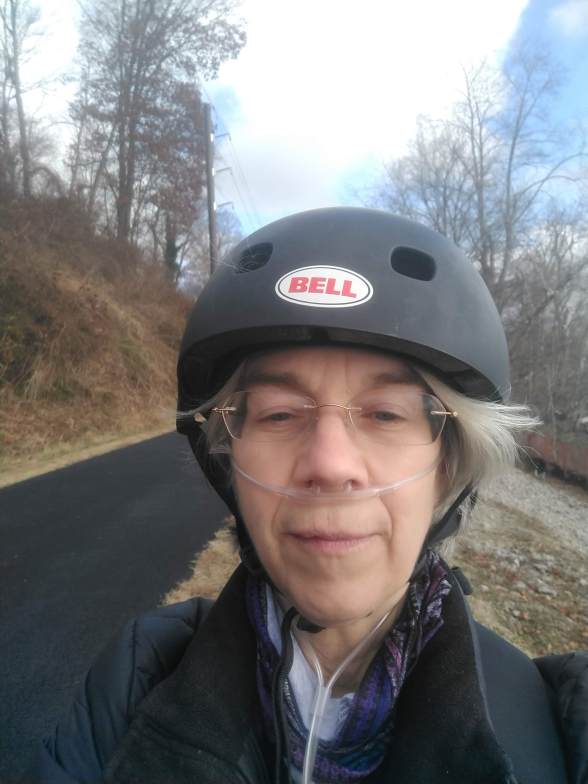
We are riding on a rails to trails path in Northern Virginia. Seven of us and me on oxygen. It’s only my second bike ride since March 2021, when my lungs fell apart. We are all on acoustic bicycles.

I feel pretty strong for most of it, 14.5 miles. It seems flat, though it is a very gentle downgrade, until the last 0.5 mile, which is gently up hill. Oh, my lungs don’t like that bit at all and by now my muscles are saying Why are we doing this? I am relieved when we get to the coffee shop destination. Three of us will stay there, while the other four will ride back and get the cars. I hang out with K-f-A, BfA’s spouse, and their son. Their son examines my phone, asks why it has four camera eyes. I have no idea, so he proceeds to figure it out. We play with the slow motion camera for a while.

We know what a penny farthing is, and safety bicycles and tricycles. The early safety bicycles did not have brakes and had wooden rims and wooden spokes. My brother outlaw has one, from the 1880 or 90s. Another friend collects penny farthings and has one that is entirely of cast iron. It would be a little bumpy and the seat is pretty hard. It is also massively heavy. So now we add acoustic bicycles to the electric ones.

Go, google, spread the word.

________________________________

Dang, others have come up with it too. Traditional bicycle sounds too fogey.
https://www.reddit.com/r/ebikes/comments/hp2l30/can_we_please_stop_calling_traditional_bicycles/
https://www.bikebiz.com/what-shall-we-call-the-non-electrified-bicycle/

small child

You work at healing
For years

You dive in the swamp
Of your psyche
Turn over the mud
Tunnel through it
Breath it
See lilies arise
From the muck

The Beloved is a deer
Dainty hooves
In the swamp

At last you come
To bedrock

So you rest
Bedrock
You think

Until you notice
A chink in the rock
You look away
You avoid it

At last you look
It isn’t going away

The Beloved is a bittern
In the reeds

Fluid leaks
From the chink

Foul black bilious
Acidic
Burning holes in the slanted rock
Again you look away
But not for long

You step forward
Touch the rock

I am present you say
Who is there?

The stream of foul black
Increases
Pours from a widening crack

Beloved is a tiger
Paw against the rock

You see the acid burning
Her paw
But she does not run
She stands guard

Who are you?
You whisper

The rock crumbles

There is a child

Go away” says the child
Ancient

No you say
Beloved and I
Stay present

The black is swirling around you
It’s hard to keep your footing
Beloved, an orca
Steadies you, swimming

No one stays says the child

We stay present you say

I was born I loved I was abandoned When I was afraid

We are present now you say
Swimming by the Beloved
Hand on black fin

I was abandoned When I grieved

We are here now you say

I was abandoned In my despair

We are here you say

You say
You fought
Out of love
You argued
Out of love
You gave
Out of love
Please child
Let us cradle you

The child is silent

The tide is slowing
The rock has crumbled away
A trickle of clear water bubbles

You will stay? says the child

We stay you say

Beloved is a whale
Singing in space
Singing to the stars

Am I lovable? says the child

You and Beloved
Earth and sky
Wind and trees
Moon and stars
Answer yes

Am I loved?

Yes
Yes

8/27/2007