safe enough to have a fence and roses

A friend said that he observed me for a long time before we got to know each other a little.

I asked what he observed. He said, “Thoughtful, deliberate and shy.”

I started laughing and said I am not shy. But….that is not true. I am guarded all the time with people. Even with him, still.

So what am I guarding and what is shy?

I have a little girl self that is very very shy. Hidden for a very long time. Now I have felt safe enough that she can play. I see her as playing in a wild place. Sun and a forest and a stream and a field. Sometimes it rains. She plays alone in the sun with rocks by the stream or runs in the field or climbs the trees.

I think many people have a small child hurt and hidden. I think it’s common. I think sometimes it’s so well hidden they can’t even reach it.

At any rate, my small child can’t be reached by any sort of force or intimidation. She could only be reached by gentleness. Another small child with daisies and even then, trust would take a long time. At first she would run away and hide. And I don’t think it will happen and I have given up, but I can still love her and protect her. And she is happy in her wild place, lonely sometimes, but happy.

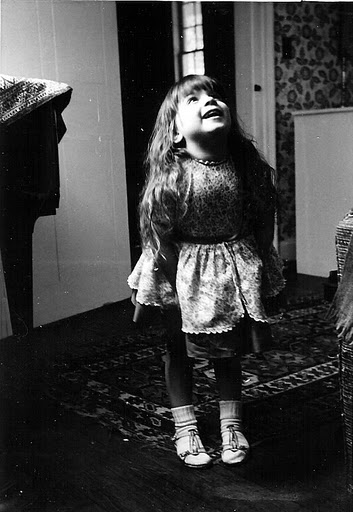
Every time I see the pink soft romantic roses in my front yard I laugh, because those roses are for that little girl part, shy and romantic. She feels safe enough to have a fence and roses.

the photo is from my front yard and the rose is Betty Boop

Causes of Death in the United States in 2012

When I first started doing annual physicals I sat down and looked at the top causes of death and then organized the counseling part of the physical around them: starting with heart disease and working down the list. I think of the annual physical as my opportunity to “MOM” patients and say “STOP DRINKING LIKE A FISH OR YOU GONNA DIE EARLY,” though perhaps with a little more diplomacy. Sometimes without much diplomacy at all.

The top ten causes of death in the United States in 2012 were heart disease, cancer, chronic lower respiratory diseases, stroke, unintentional injuries, Alzheimer’s disease, diabetes, influenza and pneumonia, kidney disease, and suicide.

http://www.cdc.gov/nchs/data/databriefs/db168.htm#which_population

This is 2,543,279 deaths in 2012.

Let’s take the causes one by one.

Heart disease: This is number one. 599,711 deaths. 23.6% of total deaths all ages both sexes in the US in 2012. So that is where I start when I do the counseling part of a physical.

Let’s review heart disease risk factors:
hypertension
high cholesterol
family history
diabetes
kidney failure
lack of exercise
tobacco
alcohol
smoking other things…
illegal drugs
stress
obeisity
As you might guess, this part of the discussion can use up a lot of the visit….

Cancer: All the cancer deaths together are 22.9% of the 2012 total.
We can screen for a few cancers: lung cancer is now the number one killer for both sexes. A chest xray is useless for screening. There is a certain population of current or former heavy smokers where a screening CT is useful. No, I do not recommend a “screening full body CT”, that is crap. Yes, lung cancers do get picked up randomly when we do a chest film for some other reason.
We can screen for breast cancer, colon cancers, look for skin cancers, the prostate cancer screen is a counseling nightmare and I don’t recommend a PSA but will do one if the person wants and other cancers pretty much we have to watch for symptoms….stop smoking, ok? That’s what causes 70% of the lung cancer and breast cancer used to be number one in women but smoking made lung cancer beat it out….
If you want details about any screening test, go to the US Preventative Task Force site:
http://www.uspreventiveservicestaskforce.org/Page/Name/tools-and-resources-for-better-preventive-care

Chronic lower respiratory diseases at 5.6%: ok, smoking again. Emphysema and chronic obstructive pulmonary disease, AKA COPD. Asthma too. This article is fascinating, that third generation children of smokers in a polluted part of California are worse and have inherited genetic modifications than third generation children of non-smokers who live in a less polluted part of California. Lovely. I grew up in a two pack a day camel household and no wonder my lungs are tricky.

Stroke, also called CVA, cerebrovascular accident, at 5.1% and then there are TIAs, transient ischemic accidents, the stroke warning symptom.

What are the risk factors for stroke?
Oh, smoking of course
hypertension
high cholesterol
stress
lack of exercise
obeisity
blocked carotid arteries
blood clots
atrial fibrillation

Unintentional injuries at 5.3%, also known as accidents.

Deaths from prescription medicines taken correctly outstripped deaths by MVAs, motor vehicle accidents and guns in 2007. The CDC declared an epidemic of overdose deaths, but it’s just starting to creep into newspapers and public consciousness.

Here: http://www.cdc.gov/mmwr/preview/mmwrhtml/mm6101a3.htm

The unintentional injury counseling list includes:
wear your seatbelt
don’t drive inebriated
don’t get in the car with inebriated drivers
check your smoke alarms
in the elderly, decrease fall risk. don’t stack stuff on the stairs.
wear a helmet if you bicycle motorcycle ATV rollarblade ski or invent some new way of getting on the Darwin list. Base jump, for example.
don’t take a lot of controlled prescription medicines or combine them with each other or combine them with alcohol: opiates with benzodiazepines with alcohol with ambien or sonata with barbituates and hello, the drug dealer is not your friend and tells lies: they are cutting the methamphetamines here with tricyclic antidepressants and barbituates and my long term cocaine addict patient was getting methamphetamines with benzodiazepines when he was paying for cocaine. Really.

Alzheimer’s at 3%

This is moving up the list. Fast. Everyone dies of something. Alzheimer’s patients live an average of seven years from diagnosis….And the recent article about Human Growth Hormone transmitting not only prions but Alzheimer’s is really interesting, implies an infectious cause.

Here: http://www.nature.com/news/autopsies-reveal-signs-of-alzheimer-s-in-growth-hormone-patients-1.18331

That was HGH from cadavers. I still would not take HGH made in a lab for “anti-aging” either. Nope, nope, nope.

We don’t know how to prevent Alzheimer’s but that is not the only cause of dementia and we’re still naming different kinds. Very frequently a brain CT or MRI says “decreased white matter” or “small vessel disease”, so there is a contribution from all of the heart and stroke risk factors that can do bad things to the brain with the top ones being: tobacco, alcohol, hypertension, high cholesterol, stress, lack of exercise, diabetes, illegal drugs, and so forth. Keep your brain active and busy.

Diabetes at 2.9%
Ok, it can make you more likely to have a heart attack. Also the biggest cause of blindness in US adults and the biggest cause of lower limb, yes, foot or leg amputation and the biggest cause of kidney failure in adults. Also if your legs are numb from uncontrolled diabetes, you don’t feel injuries and are less able to heal infections. And if blood sugar is high, there are lots of bacteria and especially staph and strep that LIKE high sugar.

influenza and pneumonia at 2.1%

Get Your Flu Shot. Really. And if you are 65 or older or you have tricky lungs or you have a tricky heart, get the pneumovax shot. The pneumovax protects against pneumococcal pneumonia ONLY, not all the colds or influenza or hemophilus influenza. And get your Tdap, because that stands for Tetnus, Diptheria, acellular Pertussis. Pertussis is whooping cough. It’s back. We’ve had three outbreaks in our county in five years. It kills babies under six months. They don’t whoop, they just stop breathing, apnea. Other people whoop, but even with antibiotics, they can cough for MONTHS. The flu shot usually gives 80% protection by two weeks after the shot. Only 80%, people say? Well, are you perfect?

Kidney disease at 1.8%

Causes: kidneys get worse as we age, for one thing.
diabetes
supplements and drugs: kidney failure is on the rise! Everything that we absorb and metabolize is metabolized by either the liver or the kidneys. Liver function can be perfect at age 100: that is, if it has not been trashed by alcohol, hepatitis B or C, drugs, supplements, mushrooms, whatever. Kidney function usually drops by age 80 and I am there calculating the function before I choose an antibiotic because you have to use lower doses in the over 80 crowd and the early kidney failure crowd. If you take ANY PILLS you should have a yearly test of your kidneys and liver function.
infection can hurt kidneys
inherited disorders

Suicide at 1.6%
40,600 deaths in the United States in 2013

Risk Factors http://www.cdc.gov/violenceprevention/suicide/riskprotectivefactors.html

Family history of suicide
Family history of child maltreatment
Previous suicide attempt(s)
History of mental disorders, particularly clinical depression
History of alcohol and substance abuse
Feelings of hopelessness
Impulsive or aggressive tendencies
Cultural and religious beliefs (e.g., belief that suicide is noble resolution of a personal dilemma)
Local epidemics of suicide
Isolation, a feeling of being cut off from other people
Barriers to accessing mental health treatment
Loss (relational, social, work, or financial)
Physical illness
Easy access to lethal methods
Unwillingness to seek help because of the stigma attached to mental health and substance abuse disorders or to suicidal thoughts

And for those who want in depth information, 15 leading causes of death by state:
http://www.cdc.gov/nchs/nvss/mortality/lcwk9.htm

Adverse Childhood Experiences 6: Reactivity

I hear people say, “Why is this person so reactive?” “They are suspicious.” “They just aren’t nice. Why can’t they be nice?”

When I get a new patient in clinic who is not friendly and looks suspicious at my questions and is not warm, I do not react. I assume that this person has been hurt and has a past that has a lot of dark in it.

Recently I was talking to a person about chronic pain. We were nearly out of time and I was describing Adverse Childhood Experience scores.

“I have the highest possible score,” he said.

I said, “I believe you.” and waited. He had my attention.

He did not want to tell me about it and he knew we were out of time. “I ran away to live on the streets when I was six.” he said flatly.

I said, “Yes, if things were that bad, I think you would have the highest possible score.”

That was the end of that visit. I gave him the link to the CDC website about ACE scores and studies and set up a follow up.

But think about that. He ran away at age six and lived on the streets. Not with a sibling or a parent or an adult. He was by himself.

He told me a little more on the second visit. I knew he could read. I pictured street classes under bridges. “How did you learn to read?” I asked.

“The authorities kept picking me up. I would run away from foster care as soon as they placed me. Usually the same day. When I was fifteen, a judge said “If you get your GED, I will emancipate you.” It took me a year and three months, but I got my GED.”

So is this your image of a street person? All losers? All crazy? This is a man who left because the street was safer than home and got a GED living on the streets.

He said, “My life has all been like that.”

I said, “Chronic pain is not exactly surprising then, is it?”

There is a song by The Devil Makes Three with this line: “I grew up fast and I grew up mean, there’s a thousand things inside my head I wish I ain’t seen. Now I just wander through a real bad dream, feeling like I’m coming apart at the seams.” That song speaks to me and speaks about the people who view the world with suspicion and fear and whose porcupine defensive spines are quickly raised if they feel threatened. I do well with them because I am the same way and I mostly don’t react to them. I don’t tell them to calm down. I don’t get scared or angry. I stay present and wait. And sometimes they will tell me what happened to them.

How can any of us blame an adult for their fearful terrible childhood? Instead we need to give them space and not reject them out of hand. All that does is reinforce the damage. I think that people can heal, but we must make room for them and behave ourselves and not react.

The photo is my daughter at the Wooden Boat Festival in 2009.

the kind of people

my cousin’s husband said
I wouldn’t want to be around the kind of people who play paintball
which silenced me as I suppose he meant to as I stared at him thinking that since I was telling him that I had taken my son to play paintball as a celebration of my son getting a 4.0 in sixth grade and we were framing it as a celebration rather than a reward so that low grades would not generate in turn a punishment and I was trying to tell my cousin’s husband about the third round of paintball and I was the only woman there and definitely the only mother there and by then the sharpshooters in camouflage had asked why I was there and I had explained upon which one said “you are a good mom” and so in the third round when my son said that he wanted to be on the opposite team as his mother the guys giggled and we were on opposite teams and I am good at hiding in the woods but was having a bit of trouble with trajectory so everyone on his team was shot but him and everyone on my team was shot but me and I was trying to shoot my son with a paintball in a desultory sort of way since he was peppering the tree I was crouched behind when he ran out of ammo and we walked back to the safe area me with the gun held over my head saying “moms rule” and the sharpshooters in camo said we are going to shoot you next time and they certainly did
and I didn’t say any of that to my cousin’s husband
because I am one of the kind of people who play paintball and so is my son and I realized abruptly when my cousin’s husband said that that I really want to love everyone and so I still send love to my cousin’s husband but honestly I have trouble being around people who divide the world into us and them and didn’t Jesus and buddha and Muhammed all say essentially that god is love and Rumi says that the universe is the Beloved and so everyone is Beloved and we are all part of the one and there is no division and if god is love then there can be no hell
and I don’t really visit that cousin any more
and I still wonder why people want us and them and why people talk about that kind of people and I try to work with every kind of people that comes into my clinic that’s why I became a doctor really because I wanted to understand people and understand love and forgive things that happened when I was very little and thought that really, the big people were insane and loving but not trustworthy and obviously this is a fail in the end because I truly don’t understand how anyone could ever make assumptions about anyone else and ever say that they wouldn’t want to be around
the kind of people

let go

For Ronovan’s weekly haiku challenge, the words are hope and luck.

I saw my doctor yesterday, still on half time and it looks like it will stay that way until January or longer. Slow healing. I am finding it hard though I am healing and often people don’t or aren’t or won’t…..

I let go of hope
for love my luck is to be
alone writing love

the picture is from my garden

Not yet adequately adored

I am wandering in the forests of emotion I am comfortable now mostly I don’t talk about it much though occasionally I am irritable I am thinking about love I have had my children going commando could also be going postmenopausal because there is no longer bleeding or if there is I would have to get checked for uterine cancer but it is hot and why wear underwear of course apparently things can still get wet which is a bit of a surprise since so many women complain of less libido once the hormones drop I as usual do everything ass backwards and want sex more than ever but not when I am working hard and tired and cursing the new server laptop printer program and the keyboard is spaced differently and more sensitive all this fucking equipment when what we really want is to be loved as we are I have only seriously dated two people in the last seven years and one said that what I want is to be adored he said he couldn’t and I thought why not and Rumi says the depth of the longing is our depth of longing for the Beloved and really it’s not a forest for me it’s the ocean it’s the deepest part of the ocean those rifts and I dive all the way and don’t care if I run out of air Beloved I am not yet adequately adored

I will go for coffee instead.

the photo is from 2006, one swimmer carrying the younger swimmer

PTSD and The Singing Tree

The Singing Tree by Kate Seredy, 1939, is a children’s book that illustrated PTSD for me long before I went to medical school. The Singing Tree is the sequel to The Good Master, and describes the survival of a Hungarian family and farm during World War I.

The good master is Marton Nagy, and he is called up as a Corporal, leaving the farm to be cared for by his wife, son, niece and workers. The farm suffers because so many men are called up. They are getting behind on the work and then find a diary from Marton, which gives suggestions and instructions for the year round work on the farm. One of the instructions is “to make out an application for Russian prisoners if necessary.”

They do. They apply and take 6 Russian prisoners, homesick farmers, who don’t speak Hungarian. Jansi and his cousin Kate take the chains off them and the prisoners quickly become part of the family. “Comrade, eh? Friend?” says one of the prisoners. And they are. They are also excellent workers and homesick.

As the prisoners are taken home in the wagon, they also take Peter, a deserter from the Hungarian army. He has panicked about his wife and new baby. He is crazy with worry. He is hidden under the six Russians, who sympathize. After seeing the baby he returns to his regiment. But Peter is angry and expresses his rage at Jews, even though it is Uncle Moses, the Jewish shopkeeper, who has helped hide him.

    Mother took Jancsi’s arm then and they left he room. They didn’t speak; what was there to say? Something, somebody had poisoned Peter’s soul against those who had been good to him all his life. Into Jancsi’s mind flashed the words Father had said: “The stampede… the mad whirlwind that sucks in men…and spits out crippled wrecks.” Crippled in body and soul, Jansci thought then, with an understanding far beyond his years.
    “Poor Peter,” he said aloud. Mother pressed his arm. “I knew you would see it that way, Son. I only hope the war ends before this poison has spread too far.” p 163.

Marton is missing and they have not heard from him. Jansci and Kate make the wagon trek to bring back their grandparents, because the front is now too close for them to be safe. Kate and Lily smuggle the cat along. The cat gets “sick” and the girls insist at stopping at a hospital. The sickness is kittens. The nurses laugh at the girls, but then let them help on the wards. Injured soldiers who are healing.

    “Almost an hour passed before all the patients had been fed. “There was only one asleep,” Lily said, coming back with the empty bowls; “he even had the sheet pulled over his face.” The nurse followed Lily’s pointing finger with her eyes. “Oh, the amnesia case. He sleeps most of the time.”

    “Whats am-amnesia?” Kate wanted to know.

    “Loss of memory. They forget who they are and have to begin life all over again; like babies.” “Does it hurt?”
    “No,” smiled the nurse. “It comes from a shock; like a big scare, you know.” She looked toward the bed again. “He is such a nice man too, poor fellow. He tries so hard to remember. if we could find out who he is, find something to remind of his home, he might remember. You wan tto see him?” she asked as Kate kept staring at the bed. “Come on then, but be quiet.”
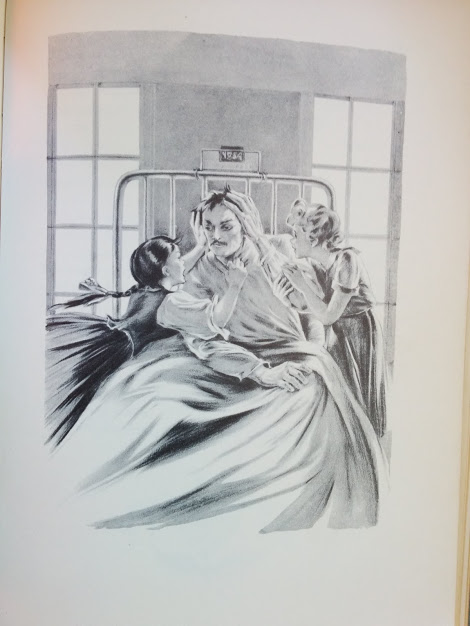
    “No. 54, Amnesia,” was written on the headboard. The nurse gently lifted the sheet. Pandemonium broke loose immediately. Kate, with her famous tin-whistle scream gong at full blast, threw herself on the bed. “UNCLE MARTON! UNCLE MAAARTON! IT’S KATE. Can’t you….? UNCLE MARTO-O-O-ON!”

    Every patient was sitting bolt upright. Doctors and nurses were running in, Lily joined Kate, tugging at Uncle Marton’s hands. “Say something…you know us, don’t you? Say something.”

    “Kate, if you don’t stop that infamous yelling this minute, I’ll take Milky away from…Say! Where am I? Who are these people?” Uncle Marton was looking around dazedly.

    “Never mind them,” sobbed Kate, laughing at the same time. “You know who you are now, don’t you?”

    “Why shouldn’t I? Let me out of this bed!” Uncle Marton cried, trying to peel Kate and Lily off his chest.
    “Take it easy, take it easy,” said a doctor who stepped up. “What is your name?” “Lieutenant Marton Nagy of the Seventh Infantry,” snapped Uncle Marton, glaring at him. “Seventh Infantry… Seventh…oh…”His eyes clouded.
    “Now it all comes back, doesn’t it? You’ll be all right now, Lieutenant Nagy. Don’t think about that now. Tell me who this…this calliope is. That scream was the best I ever heard.” The doctor sat down on the bed, smiling at Kate. “I wish we could produce for each amnesia case we get; we wouldn’t have any.” pp 186-189

He gets to go home.

    “From Corporal to Lieutenant in a year. Pretty good, Lieutenant Nagy,” an officer with a lot of gold braid all over him said to Father. “And a handful of medals to catch up with you, as I heard. What did you do?”
    Father looked him straight in the eye. The muscles in his jaws were working. “I don’t know sir. I would rather not try to remember.”

    The officer sighed. “Go home, Lieutenant. Forget, if you can. I wish I could.”

And will he have to return?

    “Then Father went to report to the hospital and this time Mother and Jansci went with him. The doctors found that in body he was sound, but only time, long months or even years, could make him forget the things he never spoke about.
    “There are none braver than he is,” the doctor told Mother, “but the human mind can stand just so much of horror and no more. We dare not tke the risk of sending him back to war.”
    “Thank God!” Mother had exclaimed, and the doctor smiled very sadly.
    “I hear that every day now. Wives, mothers thanking the Lord for an injury their beloved ones have received. A broken bone, a brave mind darkened with nameless fear, anything that takes a long time to heal, has become a blessing, a gift. They are safe for a little while longer.”

And Jansci talks to one of the Russian prisoners.

    “Big boss come home…maybe war over?” Grigori wanted to know when they had come with Father. Jansci tried to explain and he thought that Grigori didn’t understand because for a long while he didn’t say anything. Then he sighed: “Grigori know. Hear, Jansci. Bad man, stupid man, he go kill and laugh. Good man, man with good heart, good head, no can kill and laugh. He cry inside. Baby cry with big noise. Man cry–no noise, but it hurt very bad. Me know….me know.” p. 203

Death affects the village.

    “More white envelopes were coming to the village now than ever since the war started. The hands of Uncle Moses began to tremble and he seemed to grow smaller, more bent. Aunt Sarah was like a silent little wraith, going from house to house to comfort, to help, or just sit, holding the hand of a woman who would never wait for the mail again because there was no one left to writ to her. Often she and priest met in one of the houses and the priest would bow deeply to her Once he told Father: “She seems to give more comfort, more strength to these poor women than I can.” pp 203-204

I wish that we had the sense expressed in this book about PTSD and the effects of war. When I worked at Madigan Army Hospital, some soldiers were getting ready for their fourth or fifth tour of duty. If we as a country are going to continue these wars, we must take more responsibility and have more care for the damage done. When people talk about “curing” PTSD or keeping it from happening: if we didn’t respond with PTSD as a species with horror for the evils of war, we don’t deserve to survive. We will be the Bad People, the Stupid People, who Kill and Laugh. We need to stop. This book was written in 1939 and clearly they knew the effects of PTSD. It’s been almost 80 years since Kate Seredy’s book was published: and still we question PTSD?

http://www.pdhealth.mil/clinicians/assessment_tools.asp
Civilians too: http://www.mirecc.va.gov/docs/visn6/3_PTSD_CheckList_and_Scoring.pdf

illustration from p. 187

Croup and ipecac in Anne of Green Gables

My daughter has listened to me talk about medicine all her life. And she comes up with brilliant questions.

“Mom, if the three year old in Anne of Green Gables had croup, why did she get better when Anne treated her with ipecac?”

“Hmmmm.” My daughter has learned enough from me talking about croup to know that I don’t use ipecac. I use a dose of steroids, an oxygen tent with cold mist if needed and possibly epinephrine.

“The doctor in the book says that the baby would have died if Anne hadn’t known what to do.”

I reread the passage in Anne of Green Gables. The book was written in 1908 by Lucy Maud Montgomery. Anne is such an imaginative extrovert that my daughter objected the first time we read it. “Mom, no one is like that.” I named two very extroverted girls in her class. “Oh. Ok, yes.” Anne has been a foster child who helped raise three pairs of twins. She is eleven. This is from Chapter 18:

    “Oh, Anne, do come quick,” implored Diana nervously. “Minnie May is awful sickβ€”she’s got croup. Young Mary Joe saysβ€”and Father and Mother are away to town and there’s nobody to go for the doctor. Minnie May is awful bad and Young Mary Joe doesn’t know what to doβ€”and oh, Anne, I’m so scared!”
    Matthew, without a word, reached out for cap and coat, slipped past Diana and away into the darkness of the yard.
    “He’s gone to harness the sorrel mare to go to Carmody for the doctor,” said Anne, who was hurrying on hood and jacket. “I know it as well as if he’d said so. Matthew and I are such kindred spirits I can read his thoughts without words at all.”
    “I don’t believe he’ll find the doctor at Carmody,” sobbed Diana. “I know that Dr. Blair went to town and I guess Dr. Spencer would go too. Young Mary Joe never saw anybody with croup and Mrs. Lynde is away. Oh, Anne!”
    “Don’t cry, Di,” said Anne cheerily. “I know exactly what to do for croup. You forget that Mrs. Hammond had twins three times. When you look after three pairs of twins you naturally get a lot of experience. They all had croup regularly. Just wait till I get the ipecac bottleβ€”you mayn’t have any at your house. Come on now.”
    The two little girls hastened out hand in hand and hurried through Lover’s Lane and across the crusted field beyond, for the snow was too deep to go by the shorter wood way. Anne, although sincerely sorry for Minnie May, was far from being insensible to the romance of the situation and to the sweetness of once more sharing that romance with a kindred spirit.
    The night was clear and frosty, all ebony of shadow and silver of snowy slope; big stars were shining over the silent fields; here and there the dark pointed firs stood up with snow powdering their branches and the wind whistling through them. Anne thought it was truly delightful to go skimming through all this mystery and loveliness with your bosom friend who had been so long estranged.
    Minnie May, aged three, was really very sick. She lay on the kitchen sofa feverish and restless, while her hoarse breathing could be heard all over the house. Young Mary Joe, a buxom, broad-faced French girl from the creek, whom Mrs. Barry had engaged to stay with the children during her absence, was helpless and bewildered, quite incapable of thinking what to do, or doing it if she thought of it.Anne went to work with skill and promptness.
    “Minnie May has croup all right; she’s pretty bad, but I’ve seen them worse. First we must have lots of hot water. I declare, Diana, there isn’t more than a cupful in the kettle! There, I’ve filled it up, and, Mary Joe, you may put some wood in the stove. I don’t want to hurt your feelings but it seems to me you might have thought of this before if you’d any imagination. Now, I’ll undress Minnie May and put her to bed and you try to find some soft flannel cloths, Diana. I’m going to give her a dose of ipecac first of all.”
    Minnie May did not take kindly to the ipecac but Anne had not brought up three pairs of twins for nothing. Down that ipecac went, not only once, but many times during the long, anxious night when the two little girls worked patiently over the suffering Minnie May, and Young Mary Joe, honestly anxious to do all she could, kept up a roaring fire and heated more water than would have been needed for a hospital of croupy babies.
    It was three o’clock when Matthew came with a doctor, for he had been obliged to go all the way to Spencervale for one. But the pressing need for assistance was past. Minnie May was much better and was sleeping soundly.
    “I was awfully near giving up in despair,” explained Anne. “She got worse and worse until she was sicker than ever the Hammond twins were, even the last pair. I actually thought she was going to choke to death. I gave her every drop of ipecac in that bottle and when the last dose went down I said to myselfβ€”not to Diana or Young Mary Joe, because I didn’t want to worry them any more than they were worried, but I had to say it to myself just to relieve my feelingsβ€”’This is the last lingering hope and I fear, tis a vain one.’ But in about three minutes she coughed up the phlegm and began to get better right away. You must just imagine my relief, doctor, because I can’t express it in words. You know there are some things that cannot be expressed in words.”
    “Yes, I know,” nodded the doctor. He looked at Anne as if he were thinking some things about her that couldn’t be expressed in words. Later on, however, he expressed them to Mr. and Mrs. Barry.
    “That little redheaded girl they have over at Cuthbert’s is as smart as they make ’em. I tell you she saved that baby’s life, for it would have been too late by the time I got there. She seems to have a skill and presence of mind perfectly wonderful in a child of her age. I never saw anything like the eyes of her when she was explaining the case to me.”
    Anne had gone home in the wonderful, white-frosted winter morning, heavy eyed from loss of sleep, but still talking unweariedly to Matthew as they crossed the long white field and walked under the glittering fairy arch of the Lover’s Lane maples.
    “Oh, Matthew, isn’t it a wonderful morning? The world looks like something God had just imagined for His own pleasure, doesn’t it? Those trees look as if I could blow them away with a breathβ€”pouf! I’m so glad I live in a world where there are white frosts, aren’t you? And I’m so glad Mrs. Hammond had three pairs of twins after all. If she hadn’t I mightn’t have known what to do for Minnie May. I’m real sorry I was ever cross with Mrs. Hammond for having twins. But, oh, Matthew, I’m so sleepy. I can’t go to school. I just know I couldn’t keep my eyes open and I’d be so stupid. But I hate to stay home, for Gilβ€”some of the others will get head of the class, and it’s so hard to get up againβ€”although of course the harder it is the more satisfaction you have when you do get up, haven’t you?”
    “Well now, I guess you’ll manage all right,” said Matthew, looking at Anne’s white little face and the dark shadows under her eyes. “You just go right to bed and have a good sleep. I’ll do all the chores.”

I finished reading. “I think that the reason ipecac worked is because it wasn’t what we call croup now. I think it was diptheria. With diptheria kids can’t breathe because there is a grey membrane of dead cells that covers the airway and can totally block it. The native americans used spiky seedpods to try to remove it. Vomiting would work too. By making the baby throw up, she was clearing her airway. I have never seen a child with diptheria because of vaccinations. I hope I never do see diptheria because it is much much worse than croup. Croup now is usually a virus like parainfluenza but diptheria is a bacteria and can kill.”

We looked it up on the CDC website. One in two people with diptheria die without treatment. One in ten die with treatment. That little “d” in your tetnus shot, the Td? That is the diptheria part of the vaccination, that you should update every ten years.

“They may have called both “croup” at the time the book was written. That was a really good question.”

My daughter was satisfied that this is a reasonable explanation for the puzzle.

http://www.cdc.gov/diphtheria/about/symptoms.html
http://www.cdc.gov/diphtheria/about/complications.html
http://www.cdc.gov/diphtheria/about/bam-villain-for-kids-fs.html
http://blogs.discovermagazine.com/inkfish/2014/03/25/classic-childrens-books-ruined-modern-medicine/

Also published on everything2.com today. The photo is my niece.

Chronic pain update 2015

As a rural family practice physician, I am in an area with very few specialists. Our county has a 25 bed hospital and we have a urologist, three general surgeons, three orthopedists (except when we were down to none at one point), two part time hematologist oncologists and that’s it. We have a cardiologist who comes one day a week. We have a physicians assistant who worked with an excellent dermatologist for years: hooray! Local derm! Our neurologist retired and then died. We had two psychiatrists but one left. We had one working one half day a week.

I trained in treating opiate addiction with buprenorphine in 2010 and attended telemedicine with the University of Washington nearly weekly for a year and a half. Then life intervened. I attended last week again, but not the addiction medicine group. That is gone. Now there are two telemedicine pain groups.

And what have I learned since my Chronic pain update 2011?

Chronic opiates suck, and especially for “disorders of central pain processing” which includes fibromyalgia, reflex sympathetic dystrophy, TMJ, chronic fatigue, and all of the other pain disorders where the brain pain centers get sensitized. We don’t know what triggers the sensitization, though a high Adverse Childhood Experience score puts a person more at risk. Cumulative trauma? Tired mitochondria? Incorrect gut microbiome? All of them, I suspect.

Jon Kabot Zinn, PhD has been studying mindfulness meditation for over 30 years. He has books, CDs, classes. Opiates at best drop pain levels an average of 30%. His classes drop pain levels an average of 50%. I’ve read two of his books, Full Catastrophe Living and ….. and I used the CD that came with the former to help me sleep after my father and sister died. Worked. Though I used the program where he says, “This is to help you fall more awake, not fall asleep.” Being contrary, it put me to sleep 100% of the time.

Body work is being studied. Massage, physical therapy, accupuncture, touch therapy and so forth. It turns out that when you have new physical input, the brain says, “Hey, turn down the pain fibers, I have to pay attention to the feathers touching my left arm.” So, if you have a body part with screwed up pain fibers, touch it. Touch it a lot, gently, with cold, with hot, with feathers, a washcloth, a spoon, something knobby, plastic. Better yet, have someone else touch it with things with your eyes closed and guess what the things are: your brain may tell the pain centers “Shut up, I’m thinking.” Well, sensing. A study checking hormone blood levels every ten minutes during a massage showed the stress hormone cortisol dropping in half and pain medicating hormones dropping in half. So, massage works. Touch works. Hugs work. Go for it.

There are new medicines. I don’t like pills much. However, the tricyclic antidepressants, old and considered passe, are back. They especially help with the central pain processing disorders. I haven’t learned the current brain pathway theories. The selective serotonin uptake reinhibitors (prozac, paxil, celexa, etc) increase the amount of serotonin in the receptors: chronic pain folks and depressed folks have low serotonin there, so increasing it helps many. As an “old” doc, that is, over 50, I view new medicines with suspicion. They often get pulled off the market in 10 to 20 years. I can wait. I will use them cautiously.

We are less enthused about antiinflammatories. People bleed. The gut bleeds. Also, the body uses inflammation to heal an area. So, does an antiinflammatory help? Very questionable.

Diet can affect pain. When I had systemic strep, I would go into ketosis within a couple of hours of eating as the strep A in my muscles and lungs fed on the carbohydrates in my blood. This did not feel good. However, the instant I was ketotic, my burning strep infected muscles would stop hurting. Completely. I am using a trial diet in clinic for some of my chronic pain patients. I had a woman recently try it for two weeks. She came back and said that her osteoarthritis pain disappeared in her right hip entirely. She then noticed that the muscles ached around her left hip. She has been limping for a while. The muscles are pissed off. She ate a slice of bread after the two weeks and the right hip osteoarthritis pain was back the next day. “Hmmmm.” I said. She and I sat silent for a bit. It’s stunning if we can have major effects on chronic pain with switching from a carb based diet to a ketotic one.

I attended one of the chronic pain telemedicines last week and presented a patient. My question was not about opiates at all, but about ACE scores and PTSD in a veteran. The telemedicine specialists ignored my question. They told me to wean the opiate. He’s on a small dose and I said I would prefer to wean his ambien and his benzodiazepines first. They talked down to me. One told me that when I was “taking a medicine away” I could make the patient feel better by increasing another one. As I weaned the oxycodone, I should increase his gabapentin. I thought, yeah, like my patients don’t know the difference between oxycodone and gabapentin. No wonder patients are angry at allopaths. I didn’t express that. Instead, I said that he’d nearly died of urosepsis two weeks ago, so we were focused on that rather than his back pain at the third visit. All but one physician ignored everything I said: but the doctor from Madigan thanked me for taking on veterans and offered a telepsychiatry link. That may actually be helpful. Maybe.

And that is my chronic pain update for 2015. Blessings to all.

http://www.cdc.gov/violenceprevention/acestudy/

http://www.umassmed.edu/cfm/about-us/people/2-meet-our-faculty/kabat-zinn-profile/

I can’t think of a picture for this. I don’t think it should have a picture.

Augean stable

Here I am
what a load of shit I know heracles did it
with brute strength in the allotted day I too
am assigned a day but I am just a girl you see
and small to boot I lean on the shovel and contemplate
the work what a load of shit has been produced and I
know what I have to do clean and sparkling by morning
I know the goddess to pray to and she shows up with all
her nymphs armed the bows aren’t so useful for shoveling
shit but they can shift it fast we are done long before
morning and all I have to do is pledge myself to her
to virginity like a virgin

all I have to do

my photo is from the 2009 US National Junior Synchronized Swimming Olympics