Croup and ipecac in Anne of Green Gables

My daughter has listened to me talk about medicine all her life. And she comes up with brilliant questions.

“Mom, if the three year old in Anne of Green Gables had croup, why did she get better when Anne treated her with ipecac?”

“Hmmmm.” My daughter has learned enough from me talking about croup to know that I don’t use ipecac. I use a dose of steroids, an oxygen tent with cold mist if needed and possibly epinephrine.

“The doctor in the book says that the baby would have died if Anne hadn’t known what to do.”

I reread the passage in Anne of Green Gables. The book was written in 1908 by Lucy Maud Montgomery. Anne is such an imaginative extrovert that my daughter objected the first time we read it. “Mom, no one is like that.” I named two very extroverted girls in her class. “Oh. Ok, yes.” Anne has been a foster child who helped raise three pairs of twins. She is eleven. This is from Chapter 18:

    “Oh, Anne, do come quick,” implored Diana nervously. “Minnie May is awful sick—she’s got croup. Young Mary Joe says—and Father and Mother are away to town and there’s nobody to go for the doctor. Minnie May is awful bad and Young Mary Joe doesn’t know what to do—and oh, Anne, I’m so scared!”
    Matthew, without a word, reached out for cap and coat, slipped past Diana and away into the darkness of the yard.
    “He’s gone to harness the sorrel mare to go to Carmody for the doctor,” said Anne, who was hurrying on hood and jacket. “I know it as well as if he’d said so. Matthew and I are such kindred spirits I can read his thoughts without words at all.”
    “I don’t believe he’ll find the doctor at Carmody,” sobbed Diana. “I know that Dr. Blair went to town and I guess Dr. Spencer would go too. Young Mary Joe never saw anybody with croup and Mrs. Lynde is away. Oh, Anne!”
    “Don’t cry, Di,” said Anne cheerily. “I know exactly what to do for croup. You forget that Mrs. Hammond had twins three times. When you look after three pairs of twins you naturally get a lot of experience. They all had croup regularly. Just wait till I get the ipecac bottle—you mayn’t have any at your house. Come on now.”
    The two little girls hastened out hand in hand and hurried through Lover’s Lane and across the crusted field beyond, for the snow was too deep to go by the shorter wood way. Anne, although sincerely sorry for Minnie May, was far from being insensible to the romance of the situation and to the sweetness of once more sharing that romance with a kindred spirit.
    The night was clear and frosty, all ebony of shadow and silver of snowy slope; big stars were shining over the silent fields; here and there the dark pointed firs stood up with snow powdering their branches and the wind whistling through them. Anne thought it was truly delightful to go skimming through all this mystery and loveliness with your bosom friend who had been so long estranged.
    Minnie May, aged three, was really very sick. She lay on the kitchen sofa feverish and restless, while her hoarse breathing could be heard all over the house. Young Mary Joe, a buxom, broad-faced French girl from the creek, whom Mrs. Barry had engaged to stay with the children during her absence, was helpless and bewildered, quite incapable of thinking what to do, or doing it if she thought of it.Anne went to work with skill and promptness.
    “Minnie May has croup all right; she’s pretty bad, but I’ve seen them worse. First we must have lots of hot water. I declare, Diana, there isn’t more than a cupful in the kettle! There, I’ve filled it up, and, Mary Joe, you may put some wood in the stove. I don’t want to hurt your feelings but it seems to me you might have thought of this before if you’d any imagination. Now, I’ll undress Minnie May and put her to bed and you try to find some soft flannel cloths, Diana. I’m going to give her a dose of ipecac first of all.”
    Minnie May did not take kindly to the ipecac but Anne had not brought up three pairs of twins for nothing. Down that ipecac went, not only once, but many times during the long, anxious night when the two little girls worked patiently over the suffering Minnie May, and Young Mary Joe, honestly anxious to do all she could, kept up a roaring fire and heated more water than would have been needed for a hospital of croupy babies.
    It was three o’clock when Matthew came with a doctor, for he had been obliged to go all the way to Spencervale for one. But the pressing need for assistance was past. Minnie May was much better and was sleeping soundly.
    “I was awfully near giving up in despair,” explained Anne. “She got worse and worse until she was sicker than ever the Hammond twins were, even the last pair. I actually thought she was going to choke to death. I gave her every drop of ipecac in that bottle and when the last dose went down I said to myself—not to Diana or Young Mary Joe, because I didn’t want to worry them any more than they were worried, but I had to say it to myself just to relieve my feelings—’This is the last lingering hope and I fear, tis a vain one.’ But in about three minutes she coughed up the phlegm and began to get better right away. You must just imagine my relief, doctor, because I can’t express it in words. You know there are some things that cannot be expressed in words.”
    “Yes, I know,” nodded the doctor. He looked at Anne as if he were thinking some things about her that couldn’t be expressed in words. Later on, however, he expressed them to Mr. and Mrs. Barry.
    “That little redheaded girl they have over at Cuthbert’s is as smart as they make ’em. I tell you she saved that baby’s life, for it would have been too late by the time I got there. She seems to have a skill and presence of mind perfectly wonderful in a child of her age. I never saw anything like the eyes of her when she was explaining the case to me.”
    Anne had gone home in the wonderful, white-frosted winter morning, heavy eyed from loss of sleep, but still talking unweariedly to Matthew as they crossed the long white field and walked under the glittering fairy arch of the Lover’s Lane maples.
    “Oh, Matthew, isn’t it a wonderful morning? The world looks like something God had just imagined for His own pleasure, doesn’t it? Those trees look as if I could blow them away with a breath—pouf! I’m so glad I live in a world where there are white frosts, aren’t you? And I’m so glad Mrs. Hammond had three pairs of twins after all. If she hadn’t I mightn’t have known what to do for Minnie May. I’m real sorry I was ever cross with Mrs. Hammond for having twins. But, oh, Matthew, I’m so sleepy. I can’t go to school. I just know I couldn’t keep my eyes open and I’d be so stupid. But I hate to stay home, for Gil—some of the others will get head of the class, and it’s so hard to get up again—although of course the harder it is the more satisfaction you have when you do get up, haven’t you?”
    “Well now, I guess you’ll manage all right,” said Matthew, looking at Anne’s white little face and the dark shadows under her eyes. “You just go right to bed and have a good sleep. I’ll do all the chores.”

I finished reading. “I think that the reason ipecac worked is because it wasn’t what we call croup now. I think it was diptheria. With diptheria kids can’t breathe because there is a grey membrane of dead cells that covers the airway and can totally block it. The native americans used spiky seedpods to try to remove it. Vomiting would work too. By making the baby throw up, she was clearing her airway. I have never seen a child with diptheria because of vaccinations. I hope I never do see diptheria because it is much much worse than croup. Croup now is usually a virus like parainfluenza but diptheria is a bacteria and can kill.”

We looked it up on the CDC website. One in two people with diptheria die without treatment. One in ten die with treatment. That little “d” in your tetnus shot, the Td? That is the diptheria part of the vaccination, that you should update every ten years.

“They may have called both “croup” at the time the book was written. That was a really good question.”

My daughter was satisfied that this is a reasonable explanation for the puzzle.

http://www.cdc.gov/diphtheria/about/symptoms.html
http://www.cdc.gov/diphtheria/about/complications.html
http://www.cdc.gov/diphtheria/about/bam-villain-for-kids-fs.html
http://blogs.discovermagazine.com/inkfish/2014/03/25/classic-childrens-books-ruined-modern-medicine/

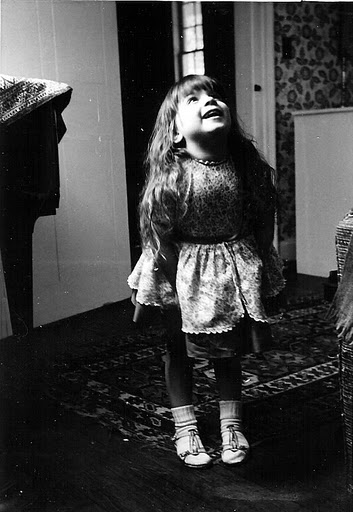
Also published on everything2.com today. The photo is my niece.
Chronic pain update 2015

As a rural family practice physician, I am in an area with very few specialists. Our county has a 25 bed hospital and we have a urologist, three general surgeons, three orthopedists (except when we were down to none at one point), two part time hematologist oncologists and that’s it. We have a cardiologist who comes one day a week. We have a physicians assistant who worked with an excellent dermatologist for years: hooray! Local derm! Our neurologist retired and then died. We had two psychiatrists but one left. We had one working one half day a week.

I trained in treating opiate addiction with buprenorphine in 2010 and attended telemedicine with the University of Washington nearly weekly for a year and a half. Then life intervened. I attended last week again, but not the addiction medicine group. That is gone. Now there are two telemedicine pain groups.

And what have I learned since my Chronic pain update 2011?

Chronic opiates suck, and especially for “disorders of central pain processing” which includes fibromyalgia, reflex sympathetic dystrophy, TMJ, chronic fatigue, and all of the other pain disorders where the brain pain centers get sensitized. We don’t know what triggers the sensitization, though a high Adverse Childhood Experience score puts a person more at risk. Cumulative trauma? Tired mitochondria? Incorrect gut microbiome? All of them, I suspect.

Jon Kabot Zinn, PhD has been studying mindfulness meditation for over 30 years. He has books, CDs, classes. Opiates at best drop pain levels an average of 30%. His classes drop pain levels an average of 50%. I’ve read two of his books, Full Catastrophe Living and ….. and I used the CD that came with the former to help me sleep after my father and sister died. Worked. Though I used the program where he says, “This is to help you fall more awake, not fall asleep.” Being contrary, it put me to sleep 100% of the time.

Body work is being studied. Massage, physical therapy, accupuncture, touch therapy and so forth. It turns out that when you have new physical input, the brain says, “Hey, turn down the pain fibers, I have to pay attention to the feathers touching my left arm.” So, if you have a body part with screwed up pain fibers, touch it. Touch it a lot, gently, with cold, with hot, with feathers, a washcloth, a spoon, something knobby, plastic. Better yet, have someone else touch it with things with your eyes closed and guess what the things are: your brain may tell the pain centers “Shut up, I’m thinking.” Well, sensing. A study checking hormone blood levels every ten minutes during a massage showed the stress hormone cortisol dropping in half and pain medicating hormones dropping in half. So, massage works. Touch works. Hugs work. Go for it.

There are new medicines. I don’t like pills much. However, the tricyclic antidepressants, old and considered passe, are back. They especially help with the central pain processing disorders. I haven’t learned the current brain pathway theories. The selective serotonin uptake reinhibitors (prozac, paxil, celexa, etc) increase the amount of serotonin in the receptors: chronic pain folks and depressed folks have low serotonin there, so increasing it helps many. As an “old” doc, that is, over 50, I view new medicines with suspicion. They often get pulled off the market in 10 to 20 years. I can wait. I will use them cautiously.

We are less enthused about antiinflammatories. People bleed. The gut bleeds. Also, the body uses inflammation to heal an area. So, does an antiinflammatory help? Very questionable.

Diet can affect pain. When I had systemic strep, I would go into ketosis within a couple of hours of eating as the strep A in my muscles and lungs fed on the carbohydrates in my blood. This did not feel good. However, the instant I was ketotic, my burning strep infected muscles would stop hurting. Completely. I am using a trial diet in clinic for some of my chronic pain patients. I had a woman recently try it for two weeks. She came back and said that her osteoarthritis pain disappeared in her right hip entirely. She then noticed that the muscles ached around her left hip. She has been limping for a while. The muscles are pissed off. She ate a slice of bread after the two weeks and the right hip osteoarthritis pain was back the next day. “Hmmmm.” I said. She and I sat silent for a bit. It’s stunning if we can have major effects on chronic pain with switching from a carb based diet to a ketotic one.

I attended one of the chronic pain telemedicines last week and presented a patient. My question was not about opiates at all, but about ACE scores and PTSD in a veteran. The telemedicine specialists ignored my question. They told me to wean the opiate. He’s on a small dose and I said I would prefer to wean his ambien and his benzodiazepines first. They talked down to me. One told me that when I was “taking a medicine away” I could make the patient feel better by increasing another one. As I weaned the oxycodone, I should increase his gabapentin. I thought, yeah, like my patients don’t know the difference between oxycodone and gabapentin. No wonder patients are angry at allopaths. I didn’t express that. Instead, I said that he’d nearly died of urosepsis two weeks ago, so we were focused on that rather than his back pain at the third visit. All but one physician ignored everything I said: but the doctor from Madigan thanked me for taking on veterans and offered a telepsychiatry link. That may actually be helpful. Maybe.

And that is my chronic pain update for 2015. Blessings to all.

http://www.cdc.gov/violenceprevention/acestudy/

http://www.umassmed.edu/cfm/about-us/people/2-meet-our-faculty/kabat-zinn-profile/

I can’t think of a picture for this. I don’t think it should have a picture.

Augean stable

Here I am
what a load of shit I know heracles did it
with brute strength in the allotted day I too
am assigned a day but I am just a girl you see
and small to boot I lean on the shovel and contemplate
the work what a load of shit has been produced and I
know what I have to do clean and sparkling by morning
I know the goddess to pray to and she shows up with all
her nymphs armed the bows aren’t so useful for shoveling
shit but they can shift it fast we are done long before
morning and all I have to do is pledge myself to her
to virginity like a virgin

all I have to do

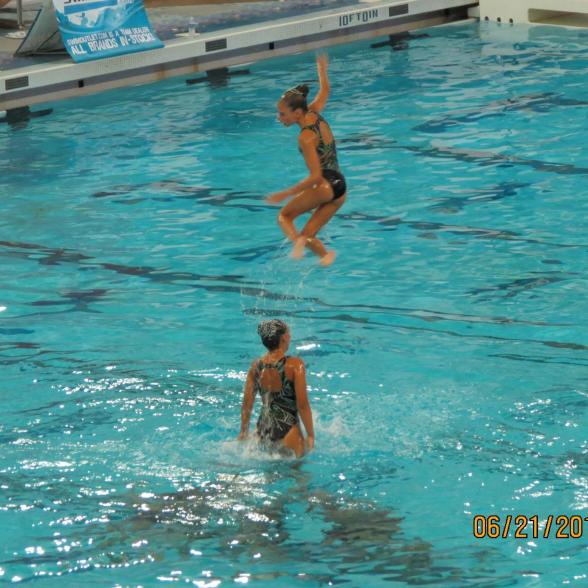
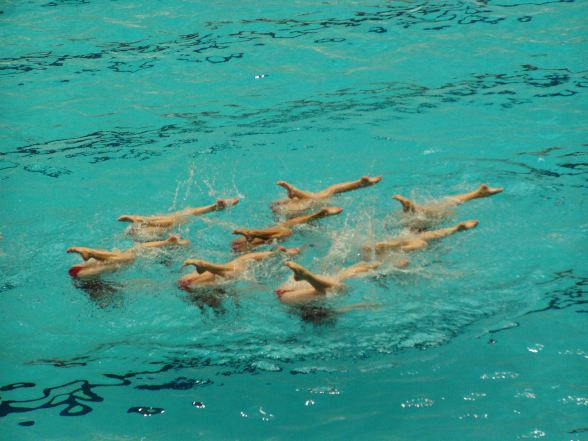
my photo is from the 2009 US National Junior Synchronized Swimming Olympics

Harden

harden my broken heart, please, Beloved
not against you I am openopenopen evermore
I have no enemies nor none to hate
openopenopen transparent like glass they step
on my heart glass it shatters again ow shards
pierce through me all over it takes time for each
clear piece to work its way to the surface I need a
harder heart then glass how do the bodhisattvas do it I
don’t know, oh, Beloved, yet I want to remain
openopenopen even if glass is the only heart I have
I pull the shard from my bleeding chest and back and
this is not a job for sewing or ribbon or lace my
friend gave me tape with a spine printed on it I tape
my heart with boneshards it doesn’t matter anyhow no matter
how I wail and tear my clothes it is all longing

for you, Beloved

my photo from the 2012 US Synchronized Swimming Nationals

remember, the lifts are entirely swimming: no one touches bottom

submitting to Ronavon’s beWOW

Chronic pain and antidepressants

Continue reading →

Good girl

Qia works hard. She enjoys most of her work and she enjoys time off too. She enjoys many activities.

She wakes one day and she is in a space. It is not inside: no ceiling. It is not outside: no clouds or sky or sun or moon.

She is standing in a box. There are more boxes for as far as she can see. They are made of wood. Some are plain and some are ornate. Some are inlaid or carved. Some have rare wood.

She steps from box to box. They are up to her thighs. She is careful. Some are beautiful.

A male voice says “You need to pick a box.”

Some are square, a triangle, octagonal. All shapes.

“You need to pick a box.”

“I am looking.” says Qia. She doesn’t want to pick one. She wants to look at them and examine them. She could spend years looking.

“You need to pick one and stay.” Says the voice. “Sit down.”

Qia starts to sit but feels panicky instantly. “It’s too small.” she says.

“If you sit down and put your head to the side, you will fit.” says the male voice.

Qia has a vision of someone nailing a lid on the box. She is not going to obey. Who is this male voice telling her what to do?

Qia wakes laughing at the dream. But she thinks about it.

Qia tells a few people about her dream.

Her massage person says, “Maybe you need to kick a box.” Her kicking muscles are very very tight this week.

She laughs, but she does go home and kick a box. It helps some, but the male in the dream is a part of herself.

One woman says,”That dream would mean that I needed to pick a box.”

Qia doesn’t like that idea. But she considers it as she continues working. The boxes are too small and claustrophobic and yet, the male voice is part of her. How can she satisfy everyone including herself?

Qia thinks carefully.

Qia is happy. A solution appears, when a third person comments.

Qia is at work. The woods are there. Deer, grass, birds. Roses are there. The ocean is there too and the Beloved, in the shape of a dolphin or a horse or a deer or an orca. She works, happy.

Men come. If she doesn’t see them first, they might see a bird or deer or the ocean. As soon as she sees the man, she calls the box. As she sits, it is there.

“What are you doing?” says the man, if he sees her first and sees the woods or the orca.

Qia looks up at the man from her seat in the box. If the man likes women to smile, she smiles. Some men like her to look frightened; she can do that too. Some men want dull or mean or subservient.

When she sees the men first, they see a good girl, sitting in a box.

When the men see her first, they are upset for a moment. They saw a bird, an orca, the ocean. But then they see a good girl, in a box. Some shake their heads and think that they had too much to drink or smoked too much the night before. But Qia is a good girl.

A few, a very few men, don’t trigger a box. She sees them. They see her. They see the deer or the orca. They have animals and forests or mountains or stars with them. They don’t say much.

Qia thought at first that she would have to change for each man. Change into energy, into a star, to fly as fast as light, to the box appropriate to that man. But then she thought, no, she could just move the boxes. And the men have stopped hammering lids down, mostly. When they used to seal women in, the women were not available for cooking or housework or admiring the men or sex. They often died, suffocated or killed themselves. So most boxes have no bottom and have straps for the woman’s shoulders, so that she can do the housework while she wears the box. The consequence, of course, is that many women escape, running like rabbits into the woods. Or they switch from box to box, almost like Qia. But many women do not feel safe unless they are wearing one of the wooden boxes.

Qia is happy. She wears wooden boxes for the men when she has to. She is a good girl. But the box she has chosen is the universe.

Magical childhood

Let’s keep the children
safe and warm
cuddled close
and free from harm

No, but what monster
hides underneath the bed
let’s find and name
the monsters all instead

we are wired not for safety
but for truth
don’t hide grief and fear
from the youth

a child survives by attunement to
your heart
they listen deeply from
their start

long before they understand
your words
they sense the world’s
monsters as a herd

a disney childhood is
a lie
the heartfelt child
wonders why

name your sorrows and
your pain
then your child will know
they have a name

no monsters hide beneath
my childrens’ bed
they know I hold them
close and dear instead

also published on everything2.com

Veracity

V for veracity in the Blogging from A to Z challenge.

I am thinking about veracity and my father. Veracity is truth, faithfulness, accuracy, correctness.

I was frustrated about how someone was reacting to something and asked my father about it.

My father said, “Most people don’t want reality.”

“What do you mean?” I said.

“Most people work hard to avoid reality. They have a set of ideas and a world view and they get upset if something does not fit in it or if it is questioned.”

I have been thinking about a song that I learned as a kid. It falls into one of the “Dead Girl” songs, as my sister called them. I think of them as teaching songs. I am taking guitar lessons and my teacher says that he won’t sing those songs.

I will. I like the dark songs. And I am very ambivalent about this song:

There was a wee cooper wha lived in Fife,
Nickety, nackety, noo, noo, noo;
And he had married a gentle wife,
Hey, willy, wallacky, ho John Dougle
Alane, quo rushity roo, roo, roo.

She would na bake nor would she brew,
For spilin’ o’ her comely hue.

she would na caird nor would she spin,
For shamin’ o’ her gentle kin.

The cooper has gone to his wool pack,
And he’s laid a sheep’s skin on his wife’s back.

“I’ll no be shamin’ your gentle kin,
But I will skelp my ain sheepskin.”

“O I will bake and I will brew,
And think nae mair o’ my comely hue.”

“O I will wash and I will spin,
And think nae mair o’ my gentle kin.”

A’ ye what hae gotten a gentle wife,
Send ye for the wee cooper o’ Fife.

This is Child Ballad number 277 and has been recorded by Burl Ives and others.

Ambivalence. It’s a song about wife beating, I don’t approve. But it’s also a song about surviving. A cooper builds barrels. The job division was that the wife would bake and brew, card wool and spin. However, this wife is “gentle” as in gentleman, of “good birth” and rejects the work as beneath her. Does she expect to be served? In the stories of happily ever after, we are happy when the poor underdog poor person wins the love and admiration of the other person, but we don’t see what happens when they go home. In Disney movies, the girls are poor and win a prince. Or Aladdin becomes a prince.

Skelp is defined as “hit, beat, slap”. The song doesn’t say whether the cooper does beat the sheepskin tied to his wife’s back or only threatens to do so.

I love word play so I like the “alane, quo rushity roo, roo, roo.” Nonsense words delight me aside from the topic of the song and I like the tune.

I think that our culture has years of men dominating women and expecting women to obey. I dislike that intensely. At the same time, I don’t like it when people won’t contribute and when they avoid work, so I also have some sympathy for the wee cooper. And our culture spends too much time thinking “happily ever after”, trying to find just the right person. We do not enough time actually asking each other what “happily ever after” would look like. And anyhow, it doesn’t exist. For richer, for poorer, in sickness and health: that is the veracity. We all will have challenges and everyone will have illness and hopefully good times too.

I am thinking of the many people lost in the recent earthquake. Lost: killed suddenly. Enjoy each day and be kind to yourself and others. We never know when grief will strike.

Under covers

U is for under covers in the Blogging from A to Z Challenge.

Under covers I had this dream:

I am in a large space, no walls. No grass or sky or sun either. There are boxes everywhere.

A male voice is telling me to get in a box.

“Which one?” I say.

“You may pick.” says the voice.

I look at the boxes. They are all next to each other, all different shapes. Square, octagonal, pentagon. They are made of wood and carved or inlaid. There are many beautiful designs, all different. I step from box to box.

“They are too small.” I say.

“If you sit down and tilt your head to the side, you fit.”

“That isn’t comfortable.” I say, after trying to sit. “It’s too small.”

“Pick a box.” the voice insists.

No, I think. I won’t. They are too small.

“Why do I need to be in a box?” I ask.

I wake up.