Welcome home

Two friends texted welcome home and a third picked me up. I was in the east, visiting a friend who has known me since birth. I had a good trip. She is twenty years older than me.

It was very much an adventure traveling on oxygen, but it worked. It’s like having a cell phone that weighs ten pounds, plugs into your nose, the batteries are the size of my hand, my carry on weighs 50 pounds (batteries, oxygen concentrator, camera, flute, laptop and phone) (also a book, I’m retro) AND you still have your phone AND you can’t breathe if you leave part of it at home….. So why can’t I have ONE wire to charge all of these stupid electronics instead of a cord for the phone and a cord for the oxygen concentrators and a car charger and a cord for the laptop and a cord and charger for the camera. Hello Electronic Hell.

Anyhow, made it there and back, double masked on the plane and taxi and ferry and…. the number of people who were ignoring the “you must wear a mask” on the ferry was impressive. About half. Well, fifty percent of people are dumber than the other 49%, right? Right now I can pick them out in a crowd really easily. Hey, I am on oxygen, I really do not want covid-19 or strep A or flu or whatever else you are coughing into the air.

Top ten causes of death: US 2020

Top ten causes of death US 2020, according to JAMA, here.

Total deaths: 3,358.814
Contrast total deaths in 2019, at 2,854,838. That number had been on a very slow rise since 2015 (2,712,630) to 2019 (2,854,838). That increase over four years is 142,208 people. Then the death rate suddenly jumps 503,976 people in one year. Ouch. I cannot say that I understand vaccine refusal.

1. Coronary artery disease: 690,882
Heart disease still wins. And it went up 4.8%. It is suspected that people were afraid to go to doctors and hospitals. I saw one man early on in the pandemic for “constipation”. He had acute appendicitis. I sent him to the ER and his appendix was removed that day. He thanked me for seeing him in person. Might have missed that one over zoom.

2. Cancer deaths: 598,932
This is cancer deaths, not all of the cancers.

3. Covid-19: 345,342
I have had various people complain that covid-19 is listed as the cause of death when the person has a lot of other problems: heart disease, cancer, heart failure. The death certificate allows for more than one cause but we are supposed to list the final straw first. I cannot list old age, for example. I have to list: renal failure (kidneys stopped working) due to anorexia (stopped eating) due to dementia. That patient was 104 and had had dementia for years. But dementia is not listed as the final cause. So if the person is 92, in a nursing home for dementia and congestive heart failure, gets covid-19 and dies, covid-19 is listed first, and then the others.

4. Unintentional injuries: 192,176
Accidents went up, not down, which is interesting since lots of people were not in their cars. However, remember that the top of the list for unintentional injuries is overdose death, more by legal than illicit drugs. If there is no note, it’s considered unintentional. Well, unless there is a really high blood level of opioids and benzos and alcohol. Then it becomes intentional. They do not always check, especially if the person is elderly. The number rose 11.1%, which seems like a lot of people.

5. Stroke: 159,050
This rose too.

6. Chronic lower respiratory diseases: 151,637
This went down a little. This is mostly COPD and emphysema. So why would it go down? Well, I think bad lung disease people were dying of covid-19, right?

7. Alzheimer’s: 133,182
This seems to belie me putting renal failure due to anorexia due to Alzheimer’s. I think they actually read the forms and would put that as Alzheimer’s rather than renal failure, because it is not chronic renal disease.

8. Diabetes: 101,106
This rose too. 15.4%, again, probably partly because people avoided going to clinic visits. Also perhaps some stress eating. Carbohydrate comfort.

9. Influenza and pneumonia: 53,495
So this went up too in spite of a lot less influenza. Other pneumonias, presumably.

10. Kidney disease: 52,260
This went up.

And what fell out of the top ten, to be replaced by covid-19?

11. Suicide: 44,834
This actually went down a little. What will it do in 2021?

So what will 2021 look like? I don’t know. It depends what the variants of covid-19 do, depends on what sort of influenza year we have, depends on whether we are open or closed, depends if we bloody well help the rest of the world get vaccinated so that there is not a huge continuing wave of variants.

Today the Johns Hopkins covid-19 map says that deaths in the US stand at 608,818 from covid-19. If we subtract the 2020 covid-19 deaths, we stand at 263,495 deaths from covid-19 so far this year. Will we have more deaths in the US from covid-19 than in 2020? It is looking like yes, unless more people get immunized fast.

Take care.

Vaccine Adverse Event Reporting System (VAERS)

Anyone can report to the VAERS system.

Doctors may be a bit nervous about reporting covid-19 reactions. Doesn’t matter. You can report on your own.

That being said, I don’t recommend reporting if you feel like crap for a couple of days after the second shot. If it is severe, you need an ambulance or it goes on for more than say, five days, report.

The first shot is about 80% effective. So, 4 out of 5 people are protected, and 1 in 5 doesn’t take. After the second shot, about 95% are protected. That means 1:20 is not.

So if you responded to the first shot, you will have an antibody response to the second shot. I ran a fever of 102 for an hours and cancelled my day of work and the next day. You could have fever, chills, muscle aches, joint aches, whatever. Take a hot bath or sauna or hot tube, because you can sweat the antibodies out.

I would report reactions that last more than two days or are severe. You can fill the form out yourself online and send it to the CDC.

For the folks refusing the vaccine: Hello. Are you going to have covid-19 parties to infect each other? If you do and you get covid-19, I can tell you that I am glad I am not your doctor. Also I don’t want you in my house. I don’t want to be around you at the Farmer’s Market either. And I think that once everyone has had the opportunity to get the vaccine, if you refuse and get covid, you might have to pay your own doctor and hospital bill. Yeah, that is what I think. And if it bankrupts you: well, you had the opportunity to get the vaccine. Why should insurance have to pay? Or you might die. Death rate for world is holding at 2 out of 100. In the US it’s “only” 1.78 out of 100. That is a fungkload. It’s a lot of people. Choose not to get your vaccine and you could be one of them. I just found out this week that a friend from medical school died in November: age 59. Do not tell me it’s all 80 year old “who would have died anyway”. Each of us will die anyway and I don’t want to die of covid-19.

I took the photograph in medical school: it’s my fellow doctor who was found to have covid-19 after he died suddenly, age 59.

Influenza 2016

No influenza cases so far this year in my clinic.

I watch the flu map faithfully each week, as I try to get my stubborn patients to get their influenza vaccine. It takes up to two weeks to get them immune, if it works. It works most years about 80% f the time. When it doesn’t work, it’s because either their immune system didn’t respond or because the influenza virus has traded genes enough that the guess six months before on which way it will evolve, is wrong.

Here is the CDC weekly influenza update link: http://www.cdc.gov/flu/weekly/fluactivitysurv.htm.

If you click on the FluView Weekly Influenza Surveillance Report, scroll down. My favorite to show patients are the Outpatient Illness Surveillance, which maps this year’s rise in influenza in the US each week, compared with past years. We are having a late year.

My other favorite is the next one down: ILIState Activity Indicator Map. It changes color each week by state as the influenza reports come in. Arizona turned red this year about a month ago, after Puerto Rico. Red is high activity level. The rest of the country was dark green, low, or light green, but has steadily been turning yellow green, yellow, orange…. Washington State is still green. But now only a few states are green and it’s still on the rise. If we continue to have unseasonably warm sunny days, like the last four days, we might avoid the influenza. But if it gets wet and cold again: boom. Like a sneeze, spreading. This is the first week we’ve had seven red states. I have been wearing a mask in clinic every time I see someone coughing. And I got a cold anyhow, but it is not influenza and I don’t think it’s strep A, thank goodness.

I said influenza is airborne but it isn’t. Or there is controversy. It is at least droplet spread, but sneezes count. Apparently influenza can get to people 6 feet away. Wear your space suit with the oxygen filter to the grocery store. http://www.cdc.gov/flu/about/disease/spread.htm — lots of information about the influenza virus. Is all of it 100% correct? Don’t be silly, this is science, not a religious text: science changes, just like the flu virus.

This year, a CDC alert was faxed to clinic on February 1: http://emergency.cdc.gov/han/han00387.asp. It is all very calm and clinical, with this sentence in the second paragraph: “CDC has received recent reports of severe respiratory illness among young- to middle-aged adults with H1N1pdm09 virus infection, some of whom required intensive care unit (ICU) admission; fatalities have been reported.” I called my son and said, “Get your flu shot now.” If you read the rest, it says ages 20-50 as the “young” and “middle-aged” adults. Not the group that we expect influenza to hit, but that is the group that got hit in the 1918-1919 influenza.

Get your flu shot… be careful out there.


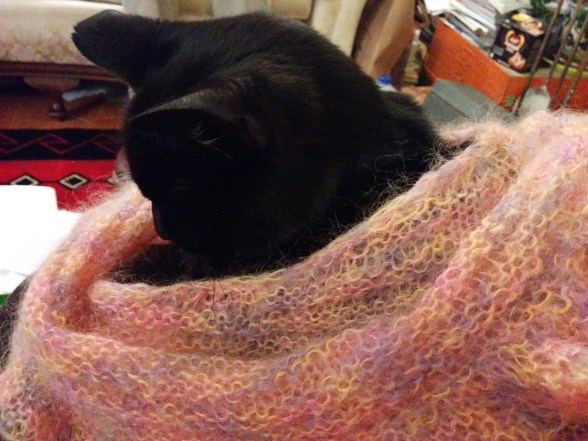
I took the photograph two days ago with my phone: Boa was on my lap and I wrapped her in the shawl I’d knit, and she was so relaxed…. that’s how we need to take care of everyone with influenza.


Taking care of Ebola is hard

“We may never know exactly how [transmission] happened, but the bottom line is that the guidelines didn’t work for that hospital,” said Frieden. “Dallas shows that taking care of Ebola is hard.”

From the Huffington Post: http://www.huffingtonpost.com/2014/10/20/ebola-hospitals-us_n_6018372.html

And for me, a lowly rural Family Practice physician, from the American Academy of Family Practice: “The first steps in preparing your office for a possible Ebola case are to make sure you have all referral contact information ready to go and that you educate each staff member on his or her role should a case present.”

There is only me and a receptionist. We don’t have hazmat suits. Actually I’ve been off sick, lung and vocal cord problems, for all of October.

We have masks, gloves, I do have a white coat that I almost never wear.

Also from the AAFP:”Appointment clerks and front-desk personnel taking calls for appointments should inquire about African travel history in patients calling for appointments for fever, headache, weakness, diarrhea, vomiting, muscle aches or bleeding,” said Mahoney. “Anyone with a positive travel history should be contacted by a provider to gather additional history and determine if public health authorities need to be involved before a patient even presents to the physician office.”

http://www.aafp.org/news/health-of-the-public/20141017eboladisprep.html

We are both going to get our influenza shots this week. Please get your influenza shot. There is a lot more influenza around than risk of ebola in the United States, and influenza kills many many people every year. And even if you “never get colds” and “have a strong immune system”, you might get a mild case of influenza and pass it on to someone who then dies of it. If you tell me “I got flu the last time I got the shot”, excuse me, but that is hooey. First of all, it takes two weeks for your immune system to respond to the shot, so if you got symptoms the next day it could be influenza but not from the shot. Maybe from being exposed to someone with influenza at the grocery store or your doctor’s office. Secondly, people say “flu” and often they mean stomach flu. Stomach flu is not influenza. Third, influenza changes all the time, so about 80% of the vaccinated people are protected most years. That’s right: two weeks after my influenza shot, I am about 80% protected. Not 100%.

Why are we getting vaccinated? For one thing, we are health care workers and we get exposed. And for another, the initial symptoms of influenza are the same as the initial symptoms of ebola. Actually the United States is really rather lucky that the ebola case happened before influenza really hit, because they look too much the same initially. Suppose that three of the quarentined people had come down with influenza….. confusion and panic initially.

So please get your influenza vaccine, because you not only help to protect yourself, but protect others and prevent panic.

Blessings!