Ludwig’s Monday window.
Downtown Port Townsend, taken last week.

Ludwig’s Monday window.
Downtown Port Townsend, taken last week.

Two skills needed in primary care are tenacity and listening. That is a combination that can make a diagnosis. Here is an example.
In residency, many years ago, I have a patient with developmental delay. He lives in a group home. He can’t talk though makes some noises. The group home staff bring him to me. His head is misshapen because his mother had measles in her pregnancy.
The staff says, “We think his head hurts. He just isn’t behaving right.”
“Did he fall?”
“We don’t think so.”
“Fever? Nasal congestion? Cough?”
“No.”
“How long?”
“Over the last week.”
I do an exam. I really can’t see his tympanic membranes because of his skull shape.
“Maybe he has an ear infection. I can’t see. We’ll try antibiotics, but if he is not improving, bring him back. In five days.”
They bring him back. “He’s no better.”
I get on the phone. I need a CT scan of his head and the group home say he won’t stay still. I need anesthesia to sedate him for the CT scan. It takes two tries and quite a bit of phone explaining with both the anesthesia department and the radiology department. Persistence. I am looking for a subdural bleed in his head from a fall, or a sinus infection, or something.
It is done and I get a call. Not from radiology or anesthesia but from the ear, nose and throat surgical resident. He is very excited. “Your patient!”
“Yes,” I say.
“He has a pseudocyst! In his sinuses! He has abnormally large sinuses and this is the biggest pseudocyst anyone here has ever seen!”
“Um, ok.” Honestly, I’ve never heard of a pseudocyst. It turns out to be packed nasal drainage in the sinus. Bad ones can erode through bone into the brain. Certainly that seems like the cause of the headache!
“We are taking him to surgery!”
Residency can be pretty weird, when someone gets really excited about a rare disease or interesting trauma case or whatever. I found that I was entirely happy just doing health maintenance exams and encouraging people to quit smoking and exercise and drink less. However, I was also good at finding weird things.
The ear, nose and throat surgeons in training were very happy about the surgery. The group home staff were happy too. “He’s back to his old self. Thank you!”
It took tenacity to set up the head CT. It’s important to listen to the families and caregivers too, because they know the person better than I do. They were right: his head hurt. And we found out why and were able to treat it.
For the Ragtag Daily Prompt: tenacity.
Water is tenacious too, wearing down stone and wood and glass.


Some of our rhododendrons have burst into bloom. Others are getting ready.
For Cee’s Flower of the Day.

This morning the angled polarized light was just amazing. No photoshopping done.
For Cee’s Flower of the Day.

Death from memory loss is a mixed bag for families.
In the past, the average time to death from Alzheimer’s was 8 years. I don’t find a number on the CDC website, CDC Alzheimer’s. I find these statistics:
The site also says that the number of people with Alzheimer’s doubles every five years after age 65. Sigh. Those numbers are the same ones that they taught me years ago, in a different format. 6% at age 60, then 2% more every year. By 70, 26%, by 80, 46%, by 90 66%. Like hypertension, if you live long enough, you may well get it. And yet, I have had patients over 100 years old with intact memories.
The death of a family member with memory loss can have complicated grief. On the one hand, loss and grief. On the other, a burden is lifted. If the person is in memory care, the cost may be very heavy. In our town, the memory care facility costs $7000 per month. That is a heavy burden to carry when the person no longer recognizes the family or speaks. The family may feel hugely relieved when their person passes and at the same time, feel guilty. This is someone that they love and loved. And yet, they are relieved by death. I think of it as a patient of mine described it: “The grief group at the hospital said that my husband isn’t gone. I said, yes he is, he just left his body.” It is very very hard for a family to watch their loved one deteriorate, lose skills, become confused and/or frightened and/or paranoid and the process can happen for years. With an average death at 8 years, some people live beyond 8. Maybe 12 years. It is very hard.
Blessings on those who care for the memory loss people and the families who do their best for them. Alzheimer’s is one sort of dementia, but we now have many. Pick’s disease, frontotemporal dementia, Parkinson’s dementia, multi stroke dementia, alcohol induced dementia, illegal drug dementia, primary progressive supranuclear palsy, and others.
The spirit has already taken wing and let the body follow.
For the Ragtag Daily Prompt: wing.
My son took the photograph while he was visiting.
Here is the top ten causes of death in 2022: https://www.cdc.gov/nchs/data/databriefs/db492.pdf.
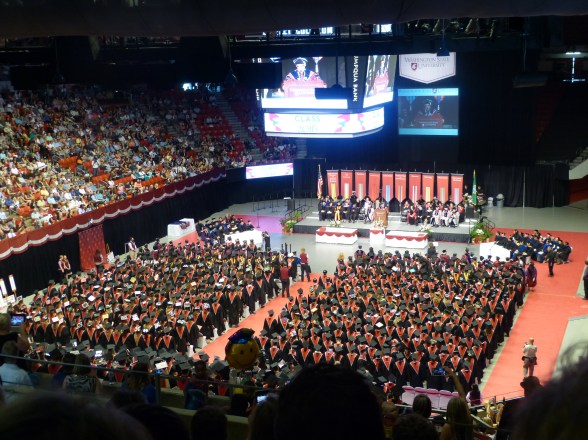
All of these graduates at Washington State University, done, finished. Perhaps they were truants here and there, slept in, skipped a class, were out sick, learned from the book or on line. But they are done!
Taken in 2017.
For the Ragtag Daily Prompt: truant.

For Cee’s Flower of the Day.

I have one tulip blooming among the iris and squill. Yellow on green and blue, a color feast.
For Cee’s Flower of the Day.

Just what the camera recorded, no computer changes. My daughter and I were camping and I was photographing the sunrise in 2014.
For the Ragtag Daily Prompt: lemon.

BLIND WILDERNESS
in front of the garden gate - JezzieG
Discover and re-discover Mexico’s cuisine, culture and history through the recipes, backyard stories and other interesting findings of an expatriate in Canada
Or not, depending on my mood
All those moments will be lost in time, like tears in rain!
An onion has many layers. So have I!
Exploring the great outdoors one step at a time
Some of the creative paths that escaped from my brain!
Books, reading and more ... with an Australian focus ... written on Ngunnawal Country
Engaging in some lyrical athletics whilst painting pictures with words and pounding the pavement. I run; blog; write poetry; chase after my kids & drink coffee.
Coast-to-coast US bike tour
Generative AI
Climbing, Outdoors, Life!
imperfect pictures
Refugees welcome - Flüchtlinge willkommen I am teaching German to refugees. Ich unterrichte geflüchtete Menschen in der deutschen Sprache. I am writing this blog in English and German because my friends speak English and German. Ich schreibe auf Deutsch und Englisch, weil meine Freunde Deutsch und Englisch sprechen.
En fotoblogg
Books by author Diana Coombes
NEW FLOWERY JOURNEYS
in search of a better us
Personal Blog
Raku pottery, vases, and gifts
𝖠𝗇𝗈𝗍𝗁𝖾𝗋 𝖶𝗈𝗋𝖽𝖯𝗋𝖾𝗌𝗌.𝖼𝗈𝗆 𝗌𝗂𝗍𝖾.
Taking the camera for a walk!!!
From the Existential to the Mundane - From Poetry to Prose
1 Man and His Bloody Dog
Homepage Engaging the World, Hearing the World and speaking for the World.
Anne M Bray's art blog, and then some.
My Personal Rants, Ravings, & Ruminations
 KO Rural Mad As Hell Blog
You must be logged in to post a comment.