Long Covid fatigue and overdoing

I’ve been reading journal articles about Long Covid. The three primary symptoms are fatigue, shortness of breath and brain symptoms. Mostly brain fog. Then there is a long long list of other symptoms.

For the fatigue, the journals are recommended graded increase in activity “without triggering a fatigue crash”.

Now, that is all well and good, except it’s a moving target. The amount of activity one can do is NOT static.

I have something that caused CFS-ME. My fast twitch muscles came back on line sometime between Christmas and New Years. GREAT! Then I was helping a sick friend until January ninth. I flew home and then there is all the unpacking and bills and catching up and sweeping up catfur dust elephants. Finally I got to exercise. I walked a couple miles on the beach one day and then around town with a friend the next.

Which crashed me. The third day I spent lying on the couch. My muscles basically were ALL hurting and saying, “We hate you.”

The fast twitch are back on line but they are weak as newborn kittens. For the first two days I felt strong and normal. The third day I felt like a steamroller had gone over me.

So did I do the wrong thing? Well, no. I won’t know what I can and can’t do it unless I do it, right? After four rounds (or more) of pneumonia with muscle weirdness, I can tell when it’s improving. Then I have to rebuild the working muscles. Also my slow twitch posture muscles are frankly pissed off and have been doing all the work and are not very interested in working with the fast twitch when they first come on line. “Where have YOU been? We’ve been doing YOUR work AND OURS.” I have to learn to walk again.

I was doing well with pulmonary rehab in the fall, building up on the treadmill twice a week, until I got my flu shot and then my Covid booster. Well, they are supposed to raise antibodies. Unfortunately they raised the ones that make my fast twitch muscles not work. Muscle blocker antibodies. I am just glad that my slow twitch work, because I sympathize hugely with the people who end up lying in bed. It’s still inconvenient, difficult to explain and annoying.

At any rate, gentle graded increase in activity is all very well as advice. But do you control everything that happens in your life? I don’t. Someone gets sick, the mail goes awry, a billing company changed their address and I didn’t get the memo. It all takes energy. Some days I am going to overdo, especially when I feel better. And it rather sucks to lie around the next day, but it is ok.

Over the last week I had a friend up from Portland. We walked three days running. On the third day we walked paths from my house to the lighthouse and back. About 5-6 miles. I was not quite limping when I got home, but I knew I could rest the next day. My muscles got HUNGRY and are continuing to improve.

So when your doctor tells you “graded activity to avoid fatigue crashes”, remember that it is not wholly controllable because life is not wholly controllable. Some days you will do great and others, well, hmmm. That was too much.

Blessings.

https://www.aafp.org/pubs/afp/issues/2022/1100/long-covid.html

https://www.cdc.gov/coronavirus/2019-ncov/long-term-effects/index.html

PANS/PANDAS and diet

I have been thinking about PANS and diet.

When I am sick with pneumonia, I have to keep my carbohydrate intake as low as possible, or I get much much worse. I am attributing this to the lysoganglioside antibody. I have been puzzling about the lysogangilosides because a conference last year says that in some children with PANS/PANDAS, the antibodies cross the blood brain barrier and then macrophages appear to be killing ganglion brain cells. They described a truly awful case. I completely understand children refusing to eat or only eating one or two things when they are having a flare. And everyone may have different food issues because we all make different antibodies. This makes it darned tricky to sort out.

But back to ganglion cells. These are the “nerve” cells. They make up the brain but there are also nerve cells all over the body. And more recently we have started calling the gut, the digestive system, as second “brain”. This is because the gut turns out to have tons of ganglion cells.

So, my lysoganglioside antibodies do not appear to attack my brain. But something attacks my gut. It could be any or all of the antibodies, actually. Ganglion cells in the gut would have receptors for dopamine, the gut has smooth muscle that is powered by tubulin and my understanding of lysogangliosides is that they clean up dead or damaged ganglion cells and should not bother healthy ones. Studies of patients with lyme disease are showing the same four antibodies with a rising baseline for people who have more infections, so my guess is that my baseline has risen enough that I do not tolerate gluten. I may try it again, because my good news is that my muscles feel normal again. No more tubulin blocking antibodies, so I have fast twitch muscles again. They are weak but functional. I am starting to exercise them. Hoorah! If I am super lucky, whichever antibody screws up gluten for me has also dropped, but it may not have. The antibodies do not all do the same thing at the same time. This flare started for me when I had my influenza vaccine and then 5 days later, my fourth Covid-19 vaccine. The shots SHOULD get an antibody response but it was annoying to have the muscle dysfunction again. I managed to avoid getting pneumonia, so the response is shortened, about two months. I had very little of the dopamine 1 and 2 effects, so it was a relatively mild effect. The annoying bit was that I was improving in exercise at pulmonary rehab and the vaccines knocked me back down.

When I have pneumonia, eating carbohydrates makes my breathing worse. That’s weird. Well, not really. This fourth go around I realized that I could mitigate the effect of rising blood sugar as I improved by drinking bicarb with each meal. Sodium bicarbonate, baking soda in water. Why did that help?

Bicarbonate is a base. If it helped the symptoms, then it was balancing out an acid. Rising blood sugar was making me acidotic. When we are acidotic, our bodies will try to increase bicarbonate by speeding our breathing. If I have pneumonia and am hypoxic anyhow, then additional pressure on breathing is definitely not a good thing. So adding a glass of water with a teaspoon of baking soda reduced the acidosis. Then food did not affect my breathing.

Would this help all children with a pandas flare? Again, everyone has different antibodies, so the answer is probably NO. I think it is enormously important to listen to children with a PANDAS/PANS flare and give them an assortment of simple foods to choose from. No pressure for a balanced diet at the height of a flare, because some food or food group may make them feel terribly ill and actually may affect their acid/base balance and MAKE them more ill. I would offer something mostly fat: avocado or bacon or a high fat salami or cheese. Some steamed or raw vegetables, ranging from the high carbohydrate to low. Peas are high, kale is low. No sauces or dressing. Some protein sources, chicken breast or meat or beans. A grain or grain source. Offer fruit but do not push. Let the child figure out what they can eat and roll with it. Try to find more things in that food group. Remember that the main food groups are fats, proteins and carbohydrates. There are a bunch of different carbohydrates, which are sugars. Glucose, fructose (in fruit and corn syrup), lactose (in dairy), maltose, dextrose and others. I would avoid junk food and anything prepared. When I am sick I do fine with lactose, but all of the other carbohydrates make me feel very very ill and mess up my breathing. This is individual and will differ from person to person. If eating makes you feel very very ill, it’s easy to understand why some children stop eating. The obsessive compulsive traits are understandable too: if you suddenly don’t tolerate the foods you love and you do not understand what is happening (and your adults don’t either), you might try to behave in ways to bring back the good old days. Do everything the one right way and maybe things will return to normal. It’s a terrifying illness for children and for parents, but I have hope that my experience will help other people.

Blessings.

Hopes rise

Our Christmas plans are busily crashing and burning. I felt ill and tested covid positive two days before my daughter was due from her city. ALERT, ALERT, DIVERT! I called friends who agreed to pick her up at the airport and let her stay for the five days of isolation. I stay out of the car so the germs will die. I call her after her work on Friday. She takes it calmly and calls a friend to pick her up. I miss her, darn it, but well, I am not on a ventilator or dead. Doing well, right?

She stays with her friend. She plans to join me yesterday but then snow. School is canceled. She and her friend sensibly leave my car at the entrance to the ridge road the friend lives on. She has to use the chains anyhow because someone has slithered off the road right in front of my car. Still grateful, because they did not hit my car.

She makes it to my house, chains on. She heads downtown to Christmas shop but the store she wants is closed. I ordered her a present that needs to be picked up, but the pick up is Tuesday to Saturday. They don’t list a phone. I ordered it on Sunday and they had emailed “Pick up now” even though it’s not “open” on Sunday. I email back, “Can’t, covid!” Now I email again and say would they contact my daughter or me so she can pick up. They do, but well after she is home. Still grateful, because they are open today. Maybe we’ll get it!

My daughter has been looking forward to time with friends but the snow has screwed this up. Maybe to time with mom, too, but mom has Covid. I am eating upstairs, she is eating in the basement, and same with sleeping. We are both masking and everyone is sick of that. It’s cold outside and the band she wants to dance to cancels. She misses meeting a friend downtown because of chains and needing gasoline. I am still grateful. Not dead yet, right?

Now I have email from our flight saying, well, maybe we’ll go. We are supposed to fly later this week. It looks like the big storm will hit Chicago and Buffalo and Boston. Cross fingers as we head for Dulles. Might make it. We discuss going to Sea-Tac a day early but that would mean sleeping in the same hotel room and no, we aren’t going to do that. Friends say they CAN get us to the airport. Super grateful for those friends!

When things are going all awry and life seems like rather a mess, we do Happy Things. That is a check in at the end of the day where we list three Happy Things each. My son was having a miserable half way through the year first grade move when we started this. The thing is, they do not have to be VERY happy. They can be more along the lines of “No one has poured boiling oil over me today.” or “Not dead yet.” It’s complaining reframed and it can be very very funny. In first grade one of his Happy Things was “We did not have the pizza that tastes like cardboard for school lunch today.”

So my Happy Things yesterday were: “I am not on a ventilator! I am not dead! We have super nice friends who will take us two hours to the airport!” If you start low enough on the Happy Things scale, there is no where to go but up.

And a Happy Thing for today: “I think the sun will rise!”

Happy Solstice.

_____________

The photograph is Emerald, one of the Anna’s Hummingbirds, all fluffed up in the cold and guarding her feeder. There is a bird photobombing the background. I think it is a song sparrow but it was very early and the light is not great.

For the Ragtag Daily Prompt: rise.

In the box

Wednesday was interesting and frustrating and part was beautiful.

The beautiful part was arriving at the Kingston, Washington ferry dock early. I took photographs of the quite gorgeous light display while I waited for the 6:25 ferry.

On the other side, I drove to Swedish Hospital, Cherry Hill. There I had another set of pulmonary function tests. The technician was very good. She said that since I have a normal forced vital capacity it does not look like asthma. However, a ratio was at 64% of normal, which is related to small airways.

“Have you had allergy testing?” she asks, “And a methacholine challenge?”

“Yes,” I say. “Both. In 2014. No allergies at all and the methacholine was negative.”

“Hmmmm.” she says.

Afterwards we call pulmonary. I have an appointment on this next Wednesday but we call and ask if there is a cancellation and I can get seen today, since I am two hours from home already.

Yes, there is, but I have to hurry to Issaquah, Washington.

There is an accident on the I90 bridge, so I do not think I will make it. But I am there by ten and the pulmonologist will see me. I check in, fill out paperwork, wait, go in the room, a medical assistant asks questions.

The pulmonologist comes in. He is nice and is able to pull up the chest CT from 2012, two of them since the first one “couldn’t rule out cancer”. Since I am referred for hypoxia without a clear cause, he questions me about my heart. Echocardiogram, zio patch (2), bubble study, yeah, it has all been normal. I describe getting sick and tachycardic and hypoxic and coughing.

“Do you cough anything up?”

“No.”

“Do you cough now?”

“Yes, if I exercise or get tired.”

He is like many physician specialists that I have seen. He has a number of pulmonary diagnoses, or boxes. Emphysema, COPD, lung cancer, bronchiectasis, chronic bronchitis, the progressive muscular disorders. All of those are ruled out in the past. So he puts me in the asthma box.

“I thought asthma was ruled out with the methacholine.” I say.

“Well, you have SOMETHING going on in the lower airways, and it was present in the 2021 and the 2012 pulmonary function tests. Maybe an asthma medicine will help.”

I mention ME-CFS and my muscles not working right, but he only deals with lungs. He won’t say a word about those disorders.

Sigh. I do not get the improvement with albuterol that diagnoses asthma on the pfts and never have. The formal reading of the pfts is that I do not meet criteria for asthma but there is something in the lower airways.

Monsters, maybe? I’ll try the inhaler, though with skepticism. Antibodies seem like a better guess, but antibodies are outside this pulmonologist’s set of boxes.

________________________

The photograph is from Swedish, Cherry Hill, bird’s eye view from the balcony.

Methacholine test.

pulmonary rehabilitation

I am fractious and grumpy when I first go to pulmonary rehabilitation at my local hospital.

This is because I have local hospital PTSD because of past treatment. However, there is only one hospital in my county.

I am anxious and tachycardic when I first arrive. I have sent patients to cardiac rehabilitation and to pulmonary rehabilitation, but it’s the first time I’ve gone. My doctor did not refer me until I ask her. I thought it up while I was talking to my insurance company’s chronic care person. You know you are desperate when you call your insurance company for ideas. The insurance company is motivated to pay for pulmonary rehabilitation because I am expensive. I have had loads of tests this year and cost a bunch of money. They would like me well. Me too. So yes, I qualify for pulmonary rehab by virtue of four pneumonias in nineteen years and this time a year on oxygen continuously and still part time now.

I have two people to help me. One is a respiratory therapist and the other a physical therapist. I am an unusual referral. Many of their patients have chronic obstructive pulmonary disease and/or emphysema, usually from cigaretes, but also from things like asbestos or alpha-1-antitrypsin disorder or progressive muscular disorders.

They explain. There are 24 visits, over 12 weeks. I come in twice a week. I am weighed, they ask about symptoms, and we go to the small gym. It has three treadmills, three stationary bikes and three of those semi-horizontal not really a bike things. I pick the treadmill. After I describe my lung weirdness, that a fast heart rate preceeds hypoxia, they put a wrist pulse oximeter on me. Unlike the little finger ones, it can pick up heart rate and oxygen rate even when I am walking on the treadmill. My blood pressure and pulse is checked and I start the treadmill. I go slowly the first time. My heartrate is over 100 to start with, but that’s partly the PTSD reaction. I can slow my heart rate just by slowing my breathing and not talking, into the 80s.

Here is how I looked the first time:

https://www.reddit.com/r/FunnyAnimals/comments/zadptv/this_is_whats_happened_in_gym/

Ok, not really. I start walking on the treadmill and go for 30 minutes. Blood pressure and heart rate are checked mid way through. The only time I drop my oxygen level is when I walk AND talk and then I drop it to 87. I stop talking.

After the treadmill, there is another 15-20 minutes of “patient education” about the lungs. This is usually a video, discussion and handouts. They can have up to 3 people simultaneously. At first there is another woman, but she finishes her 12 weeks. She is still on oxygen. I am doing the treadmill without oxygen. “What is your goal?” asks the respiratory therapist. “I want to ski this winter.” I say. She blinks.

The patient education alternates with lifting hand weights. The physical therapist does that with me. There is a stretching session each time too. The weights are slow twitch muscles so that is easier for me to push.

On the third day on the treadmill, I start pushing myself. My heart rate before starting was 81. I get to 120. “Um, don’t push it further than that.” says the therapist.

“Why not?” I say.

“Well, the guidelines are that we’re supposed to not have the person exercising at a heart rate of more than 30 over their baseline.”

“Oh,” I say. I am at 40 over. I slow down a little, aiming for a heart rate of 115. My blood pressure is between 90 and 115 systolic to start with, even anxious, and goes up to the 140s or 150s in the middle of exercising. If I talk too much while I am on the treadmill, my oxygen level starts to drop. It drops the third time down below 88 and the therapist says, “Shall I get oxygen?” “No,” I say. “I just need to shut up.” I do and my oxygen level recovers.

I steadily improve on the treadmill. I can enter my weight and it will measure “METS”. I start out at only a few mets. My goal is as high as I can go. By week 8 I am pleased to be alternating walking and running and I am averaging over 8 mets. Bicycling takes 7-9 mets, and more if you race. I want to return to bicycling.

Then I get my flu vaccine. I feel terrible the next day and cancel my rehab. I see my doctor for a routine visit the next Tuesday and she gives me the covid booster. That hammers me. I go back to being tachycardic much more easily and my fast twitch muscles are not working again. I contact my cardiologist and primary, do I put pulmonary rehabilitation on hold?

I decide to go and I do not drop my oxygen. However, I get tachycardic much more quickly, I can’t get up to over 8 mets, and it feels truly terrible. And my muscles give me hell and hurt horribly for the next two days. I put pulmonary rehab on hold and wait and do slow twitch exercises. The working theory is that there are antibodies to my fast twitch muscles, so the vaccines have activated my immune system. Not just antibodies to influenza and covid, but also the ones that make my muscles not work and hurt. A fibromyalgia/chronic fatigue flare. I start sleeping 12 hours a day again, as I did when I got sick over a year ago. I am really anxious at first but there are no signs of pneumonia, I am not hypoxic, and it’s mostly muscles and fatigue.

After three weeks I return and do my last four pulmonary rehab visits. It hurts way more than the first 8 weeks and it is way more exhausting. I don’t like sleeping 12 hours a night. It could be worse, though. Some people have chronic fatigue where they have to lie in bed most of the time. I don’t have that, so I consider myself lucky. Mine is fast twitch muscles only. Presumably theirs is fast and slow twitch muscles. I have an annoying but relatively mild version of chronic fatigue.

I graduate from pulmonary rehabilitation. Many thanks for the help with my muscles! I want a wrist pulse oximeter, but they cost $700 and I dont’ really need it. By now I can tell when I have a fast heart rate and I can tell when I am getting hypoxic. It makes me goofy and silly, though I normally have that anyhow.

Many thanks to Jefferson Healthcare’s Pulmonary Rehabilitation Department. And if you have had pneumonia more than once or long Covid, consider asking your doctor to refer you. It makes me much more confident about exercising and pushing myself and what is safe. And eventually these stupid antibodies will fall off the receptors again. I hope.

________________

For the Ragtag Daily Prompt: fractious.

PS: The Rehabilitation Department was closed then open then closed then open during the last two years. They did not have many people when I was there. Get in soon, because there are limited spaces!


Conspiracy is easier than vulnerability and grief

“Our culture faces a flood of conspiracism” says the Atlantic Monthly.

My great Uncle forwards an article that says we are tracking along stages as we did to WWII.

I write back. No, I say, we are tracking towards WWI.

Because of Covid-19.

The problem with the pandemic is vulnerability and grief. It is difficult to be mature enough to accept vulnerability and grief. It is easier to find someone to blame and go after them. We can’t burn a virus, we can’t hang it in effigy, we can’t take it to court and give it the death penalty. Many people are terrified and do not want to feel vulnerable and do not want to grieve. So they fall into conspiracies: it is safer to believe that the pandemic is a lie, that alien lizards have taken over the US Government, that it is the fault of a country making it on purpose, or a race, or a religion. It is easier to believe that nanocomputers are being injected with the vaccine than to think about the number of dead. It is easier not to think about the number of dead, the terrifying randomness, to believe that this only affects people with preexisting conditions, or people who God wants to smite, or people the lizard aliens hate. Or that the whole thing is a lie.

We are mimicing the late 19 teens and early 1920s very well. A world pandemic. We have a war, that is not a world war. This time we have bombs capable of destroying current life on earth. We’d be left with tardigrades and those bacteria who live in the deep trenches in boiling water where the earth’s crust is thin. At least one of my friends thinks this might be a good thing.

We have just reached 8 billion people.

In London, the Black Death had a 50% kill rate in the 1400s. Half the people that got it died. It changed the world. Pandemics change the world. In this pandemic the death rate is about 1% or a little more. However, 10% to 30% of the people with Covid-19 have Long Covid. Today, Johns Hopkins says we are at 635 million people who have gotten Covid-19. 6.6 million or more are dead from it. Then we have between 65 million and 195 million people with Long Covid in the world.

We don’t know how long Long Covid lasts. We don’t know how to cure it. We do not know if we can cure it or if people will get better. We do not know, we do not know, we do not know.

Which is also terrifying. So the conspiracy and someone to hate or some group to hate or someone to fight is safer for many people.

Do not go there. We must grieve. We must help each other. We must face fear and not give in to it. We must not fall into the trap of the charismatic leader who will give us villains, who will lead us into a World War to distract us from our grief.

And from there into a world depression. Remember, the Roaring Twenties end with the worst depression the world has seen so far. Let us not repeat it, let us not beat it.

Peace you and blessings.

Long Covid and fatigue

Sometimes medical articles are SO IRRITATING! Like this:

Symptomatic Long COVID May Be Tied To Decreased Exercise Capacity On Cardiopulmonary Exercise Testing Up To Three Months After Initial SARS-COV-2 Infection

Healio (10/18, Buzby) reports a 38-study systematic review and meta-analysis “suggested with low confidence that symptomatic long COVID was associated with decreased exercise capacity on cardiopulmonary exercise testing up to 3 months after initial SARS-COV-2 infection.” According to the findings published in JAMA Network Open, “underlying mechanisms may include but are not limited to deconditioning, peripheral mechanisms, hyperventilation, chronotropic incompetence, preload failure and autonomic and endothelial dysfunction.”

Wouldn’t it be nice if they believed the patients?

Let’s break this down. What does it all mean? Ok, the “low confidence” irritates me because it implies that the physicians can’t believe the patients who say “hey, I am short of breath and have a fast heart rate and get really fatigued if I try to do anything!”

I have had my fourth bout of pneumonia with shortness of breath and tachycardia. This time, since I am older, I had hypoxia bad enough to need oxygen. This is the FIRST TIME that some physicians have actually believed me. They believed the pulse oximeter dropping down to 87% and below, with a heart rate in the 140s, but they did not believe me and some accused me of malingering, for the last 19 years. Can you tell that I am a little tiny bit annoyed? If my eyes shot lasers, there would be some dead local physicians. And I AM a local physician, disbelieved by my supposed peers.

Let us simplify this gobbdygook: “underlying mechanisms may include but are not limited to deconditioning, peripheral mechanisms, hyperventilation, chronotropic incompetence, preload failure and autonomic and endothelial dysfunction.” The way I think of it is that sometimes a pneumonia will cause lung tissue swelling. Ok, think of the air space in your lungs as a large balloon. Now the wall of the balloon swells inwards and suddenly there is half as much air space. Guess how your body takes up the slack? The heart goes faster and you have tachycardia. This is a very simple way to think about it. I have tested patients who complain of bad fatigue after an upper respiratory infection with a very simple walk test. 1. I test them at rest, heart rate and oxygen saturation. 2. I walk them up and down a short hallway three times. 3. I sit them back down, and watch the heart rate and oxygen saturation. I watch until they are back to their seated baseline.

A friend tested recently and his resting heart rate was 62. After walking, his heart rate is in the 90s. H does not have a pulse oximeter, but his oxygen level is probably fine. However, that is a big jump. He has had “a terrible cold” for 8 days. I would bet money that his heart rate normally doesn’t jump that much. He still needs recovery time and rest.

In clinic, I had people who were ok at rest but needed oxygen when they walked. We would get them oxygen. More often, they did not need oxygen, but they were tachycardic. When they walked, their heart rate would jump, over 100. Normal is 60-100 beats per minute. If they jumped 30 beats or jumped over 100, I would forbid them to return to work until their heart rate would stay under 100 when they walked. If they went back to work they would be exhausted, it would slow healing, and they might catch a second bacteria or virus and then they could die.

Patients did not need a pulse oximeter. I would teach them to take their own pulse. The heart rate is the number of beats in 60 seconds. I have trouble feeling my own wrist, so I take mine at my neck. It’s a bit trickier if someone has atrial fibrillation but the pulse oximeters aren’t very good with afib either.

When I have pneumonia, my resting heart rate went to 100 the first time and my walking heart rate was in the 140s. I had influenza and felt terrible. My physician and I were mystified. It was a full two months before my heart rate came down to normal. I was out of shape by then and had to build back up. If I tried to walk around with my heart at 140, I was exhausted very quickly and it also felt terrible. The body does NOT like a continuous fast heart rate and says “LIE DOWN” in a VERY FIRM LOUD VOICE. So, I lay down. Until I recovered. For a while I was not sure if I would recover, but I did. This time it was a year before I could go to part time oxygen.

The fatigue follows the heart rate. Tachycardia is not good for you long term. If the heart is making up for reduced air space in the lungs, it doesn’t make sense to slow the heart rate with drugs. You NEED the heart to make up for the lungs. You need to rest, too!

Blessings and peace you.

The photograph is Elwha, helping me knit socks. With the bad air from the fires and my still recovering lungs, I am staying indoors and knitting socks .

Red sun

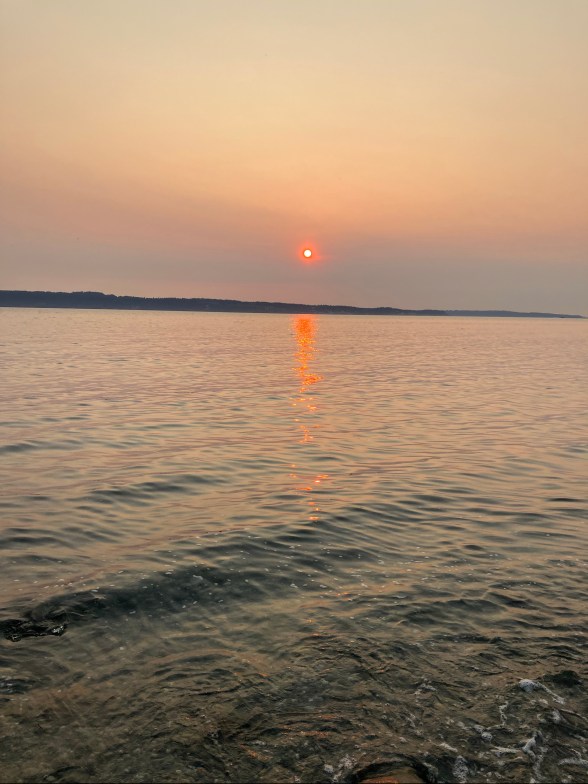
This is a sunrise, not a sunset, two days ago on Marrowstone Island. The air quality was deteriorating and I am mostly staying indoors today. We are at high particulate matter and high fine particulate matter, coming from the fires to the east. The recommendation is to mask outside, keep windows closed, use an air filter and mask outside. Also to not exercise heavily outside.

It looks sunny out now, but the air looks wrong. Dirty. My lungs don’t like it at all, not surprisingly. I hope people are taking care of themselves. Stay in, take it easy, mask. Our air is supposed to improve tomorrow.

Blessings and peace you.

Real time air quality map here.

Practicing Conflict II

Practicing conflict II

In Practicing conflict, I wrote about practicing conflict by arguing different sides of a topic inside my head. I wrote that I don’t fear conflict and have learned to enjoy arguing with myself. I am a physician and physicians argue all the time.

What? No they don’t. Well, the doctor persona does not argue with the patient much. Some doctors give orders to patients, others try to negotiate, some try to convince. But behind the scenes, doctors are more like the Whacky Racer Car with the Cave Guys, running with their feet and hitting each other with clubs.

In residency in Family Practice at OHSU in Portland, Oregon, I start on General Surgery during internship. This is in the early 1990s and there was not much in the way of “disruptive physician” rules. I have to cover Trauma and Plastic Surgery and General Surgery at night on call. The resident is present but I get paged first for patients on the floor. I learn that I should go to all Trauma pages in the emergency room. If I know what is happening with the new Trauma patient, it’s a lot easier to handle the phone calls for more drugs and so forth. Also, the resident is less mean to me.

We attend the Trauma “Grand Rounds”. These are unreassuring to a new intern. A resident presents a trauma patient, giving the history in the accepted formal order. The Faculty Trauma Surgeons interrupt, disagree with management of the patient and yell. They yell at the resident and at each other. The upper level residents yell too, being well trained. The Trauma Surgeons do not agree with each other. They are inflammatory and rude. I am shocked initially: medicine is not a cookbook, is not simple and it appears that it is a controversial mess. It turns out that medicine IS a controversial mess.

There is not as much yelling on the next rotation. At that time Trauma Surgeons yelled more than any other set of doctors that I ran across. They yelled in the ER, at each other, at the staff, at the nurses, at the residents. The culture has changed, I suspect, but that’s how it was then.

I take Advanced Trauma Life Support as a third year resident. The Trauma Surgeons at OHSU helped write the course. They don’t agree with it. On some questions the teaching Surgeon says, “The answer to this question is (c), “ followed by muttering loudly, “though I totally don’t agree with that and I would do (b).” Another Trauma resident or surgeon then might start arguing with him, but they moved on pretty quickly, to teach the current agreed best practices in the book. Which change every few years. Great.

Years later (2009) I join the Mad as Hell Doctors, to go across the US talking about single payer. They are a group from Oregon. Physicians for a National Healthcare Program are a bit cautious with us the first year: we might be whackos. We have an RV with our logo and we have a small fleet of cars and what do you think we do in the cars? We argue. Or discuss. Or whatever you want to call it. We spend the driving dissecting issues and how to present things best and tearing apart the last presentation and rebuilding our ideas. The group does 36 presentations in 24 days. Each presentation takes an hour to set up, two hours to do and another hour to break down and debrief. We get more and more exhausted and cranky and um, well, argumentative, as the trip proceeds. Even though I think of the Whacky Racer Cave Guys running with their feet and bonking each other with clubs, this is the most wonderful group of doctors I have ever been with. A common goal that we all want to get to, discussing and disagreeing on strategy all the way! I feel closer to those physicians in a week then I feel to any of the physicians that I’ve worked with for the last 9 years in my small town. Conflict with a common goal.

Doctors are TRAINED to argue, even with themselves, to document every decision in the chart with reasons why they have reached that decision. And that they have thought about all of the reasons for say, a low potassium, thought of every possible cause and worked their way through testing. The testing always has two strands. One strand is rule out the things that could kill the person NOW, even if rare. The other strand is what is common? You have to think about both at the same time, always. And argue with yourself about which tests should be done, in what order, what is most important, how do you treat the person while awaiting results, and have I missed anything? And if we aren’t sure, we call another doctor, run it by them, wait for them to shoot holes in our logic or to say, no, I can’t think of anything else.

We can deal with conflict. We must deal with conflict. The world is too small not to deal with conflict, with disagreements, with different viewpoints and positions and ideas. If doctors can do it every single day at work, then everyone else can too. Trying to see all the positions and possible diagnoses saves lives in medicine. We need to extrapolate that to everything else. Try to see other positions, try to understand them, to respect them. We can and we must.

Blessings.

Here are the Whacky Racers:

And Madashell Doctors blog: http://madashelldoctors.com/category/uncategorized/page/3/

For the Ragtag Daily Prompt: discuss.

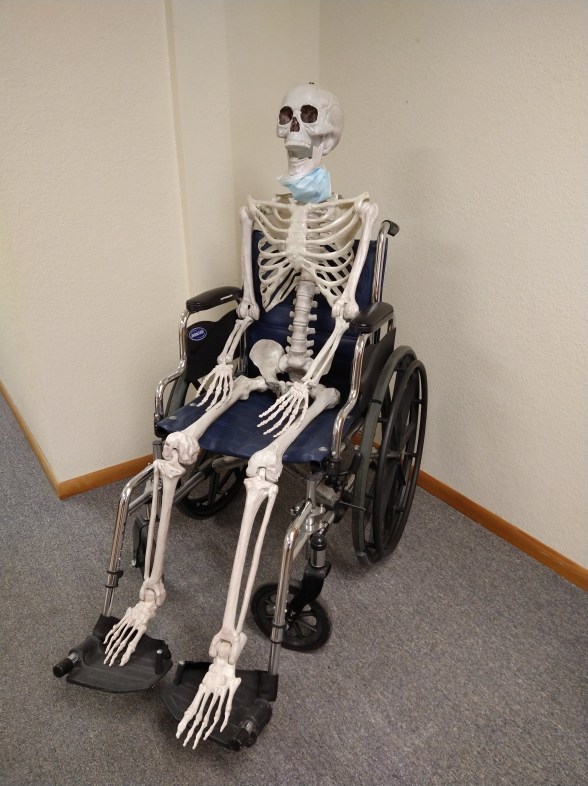
The photograph is from my clinic once we had stopped seeing patients and were selling everything. Mordechai was our clinic skeleton, made of plastic, from China. This was in January 2021.

On meditation and breathing

In college at the University of Wisconsin, I dated a gentleman who was following the Zen Buddhist tradition.

He meditated daily, for forty minutes, facing a wall.

I was quite intrigued. I did not think I could do that. I am a fidgety person and can’t sit still. I promptly tried it.

Forty minutes is a long time facing a wall at age 19.

I would fall asleep. I would start tilting to one side or the other on my zafu and jerk back up. I knew I was not supposed to follow thoughts, but I couldn’t not think. It is more subtle than that: I slowly figured out that I can let the thoughts pop up from the toaster brain, but try not to follow them. Wave at the thought. Let it go.

One day there was a small hole in the wall when I faced it. A tiny spider came out and went back in. I was very happy about the spider.

The next day the spider came out and waved one leg at me. Then it went back in the hole. The end of the 40 minutes is signaled by a chime. I got suspicious afterwards and went back to the wall. Not only was there no spider, but there was no hole, either. I did not see any more holes or spiders.

I meditated regularly daily for two years. After that I would return to practice intermittently. Meditation trained my breathing: my breathing slows way down during meditation.

I use that breathing when I have pneumonia. In the worst episode, I was in the hospital and disbelieved. I slowed my breath way way down to calm myself and so that I could think. Eight counts in, eight counts out. Then ten, then twelve. I needed to focus and figure out what was causing sepsis symptoms. And I did figure it out. The provider sent me home that morning, septic and 6 liters behind on fluid, but I was able to survive.

Now the pain clinics are teaching slow breathing. Five seconds in and five seconds out. Start with a few minutes and work up to twenty minutes. “Almost everyone goes from high sympathetic nervous system fight or flight state to the parasympathetic relaxed nervous system state.” I think we need more of that, don’t you? This is being taught for anxiety, for chronic pain, for fear and depression. I asked a veteran to try it. His response: “I hate to admit it but it works.” Also, “I’m not used to being relaxed. It feels weird.” I laughed and said, “I think it might be good if you get used to it.” He reluctantly agreed and continued the practice.

Peace you, peace me.