Every day

Every day
I am thankful for clean water
water to drink
water to wash
I am blessed
by clean water

Every day
I am thankful for food
Good food
to cook
to eat
to share
I am blessed
by good food

Every day
I am thankful that I can stand
that I can walk
that I can carry things
up and down stairs
I am blessed
that I can stand

Every day
I am thankful that I can hear
voices of friends
voices of my family
all the music
my cat and birds
I am blessed
that I can hear

Every day
I am thankful that I can see
all the faces
all the smiles
the trees, the ocean, the birds
the ever changing sky
I am blessed
that I can see

Every day
I am thankful that I can touch
my cat purring
a vegetable for lunch
clothes and doors
friends to hug
I am blessed
that I can touch

Every day
I think of those
who cannot touch
who cannot see
who cannot hear
who cannot walk
who do not have food
who have no clean water
and some of them
are children

Every day
I am thankful
and grieving
at the same time

And I try to do a little
it’s not enough
yet

Some day I will be gone
or we will all have done enough

And every day I am still

thankful

________________

For the Ragtag Daily Prompt: warning.

If eggs aren’t available, why can we still buy chicken?

I note this article this week: https://apnews.com/article/usda-firings-doge-bird-flu-trump-fdd6495cbe44c96d471ae8c6cf4dd0a8. That version says that the Trump Administration is trying to rehire bird flu experts that got fired. Most of the news outlets frame it differently: https://www.nbcnews.com/politics/doge/usda-accidentally-fired-officials-bird-flu-rehire-rcna192716. Suddenly it is the USDA at fault not the Trump administration’s chainsaw fool.

Should we worry about bird flu? Oh, yes, I think so. I have been wondering why we still have chicken to eat and chicken in the stores, if millions of chickens are being wiped out to try to prevent H5N1 bird influenza from moving into humans. This article explains in unreassuring detail how factory farms, packing chickens together, and killing them at 6 weeks old for meat, puts pressure on the virus to become more deadly and kill the host. In wild birds the influenza virus wants to spread, so it’s better not to kill the host fast. That is not true on our national and international big factory farms.

Firing the people working the track the H5N1 bird influenza and trying to stop it if it starts going human to human, well. Is that injustice or arrogance or stupidity? Or all three? And who wants to work for the government now? It is being treated as a corporation, but it isn’t a corporation. Public service often pays less. Good luck hiring the best and brightest who want to serve our country and humanity.

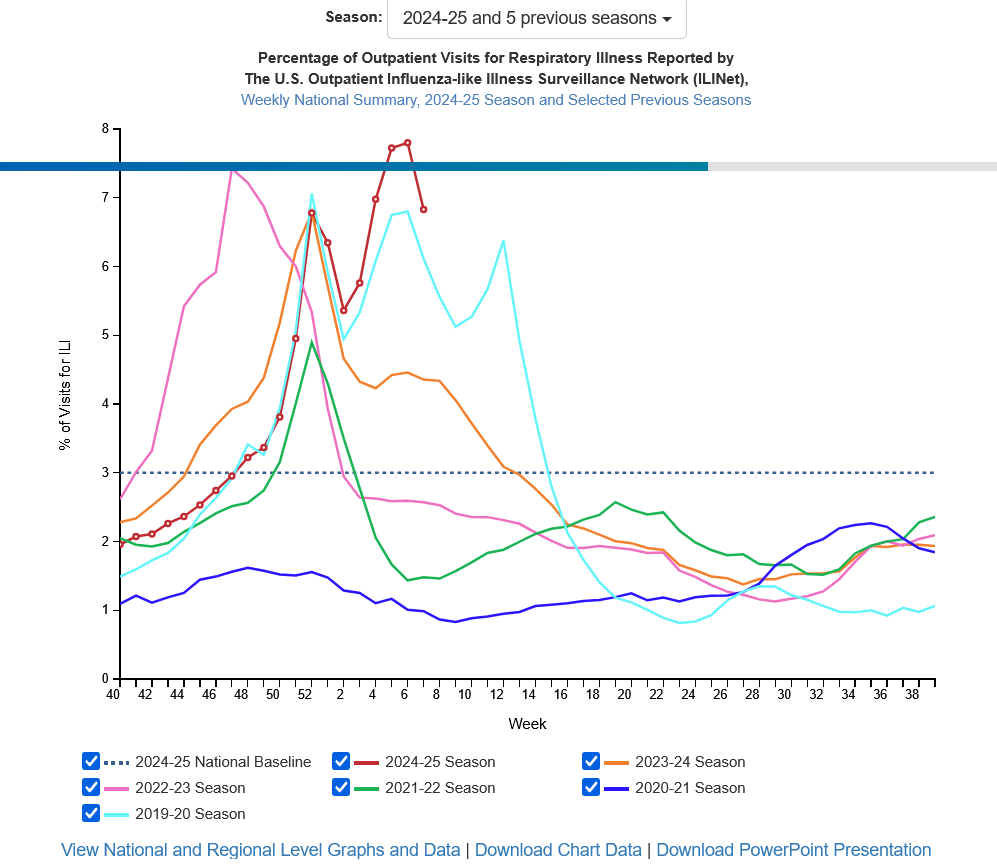
This is the worst year in the US for influenza since 2017-2018 so far. That is without the H5N1 bird influenza really getting in to people. Here is the graph for the week ending February 15th from the CDC. I keep an eye on it all through influenza season.

The article on H5N1 bird influenza is the best argument I’ve ever read for choosing not to eat meat. I like meat, but the factory farming is going to more countries. It may produce more eggs and more chickens, but if it is also the perfect breeding ground for lethal influenza, that changes my viewpoint. We cannot go on. We will have another pandemic.

Why are humans such fools?

For the Ragtag Daily Prompt: injustice.

Sesame Street Soup

We did not have a television until I was nine and my little sister was the excuse for watching Sesame Street. We watched this sequence and asked my mother if we could make Sesame Street Soup. We wrote down the recipe and it was delicious.

The soup in my picture is not Sesame Street Soup. It is a Thai influenced soup, with lemon grass and coconut milk and fresh basil and fresh corn, from September 2023.

Sesame Street Soup is here.

For the Ragtag Daily Prompt: soup.

My Monday is Tuesday

I am a slacker on Tuesday’s Ragtag Daily Prompt! Not really, it’s just that that is my back to work day and I am getting ready in the morning and I think, “I will do it later.” Last night I cooked a pork tenderloin with peaches, kale and green beans, but then afterwards I fell asleep by 7:30. I guess Tuesday particularly tires me out. I met the new doctor yesterday and I had two patients who took nearly an hour each.

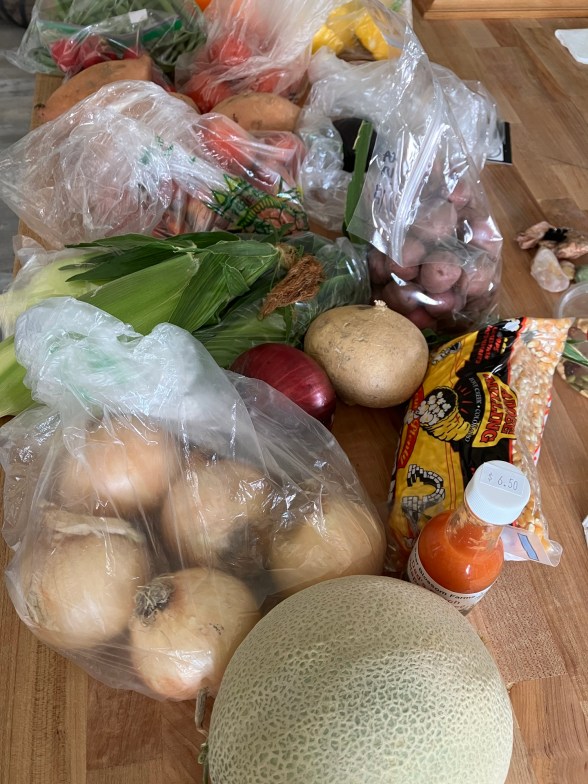
I found another farm stand this weekend and bought tons of vegetables and some fruit. I am still trying to do half vegetables at each meal. It takes time. I bought more pattypan squash to roast, it turns sweet and delicious. Quick, while the summer squash is available!

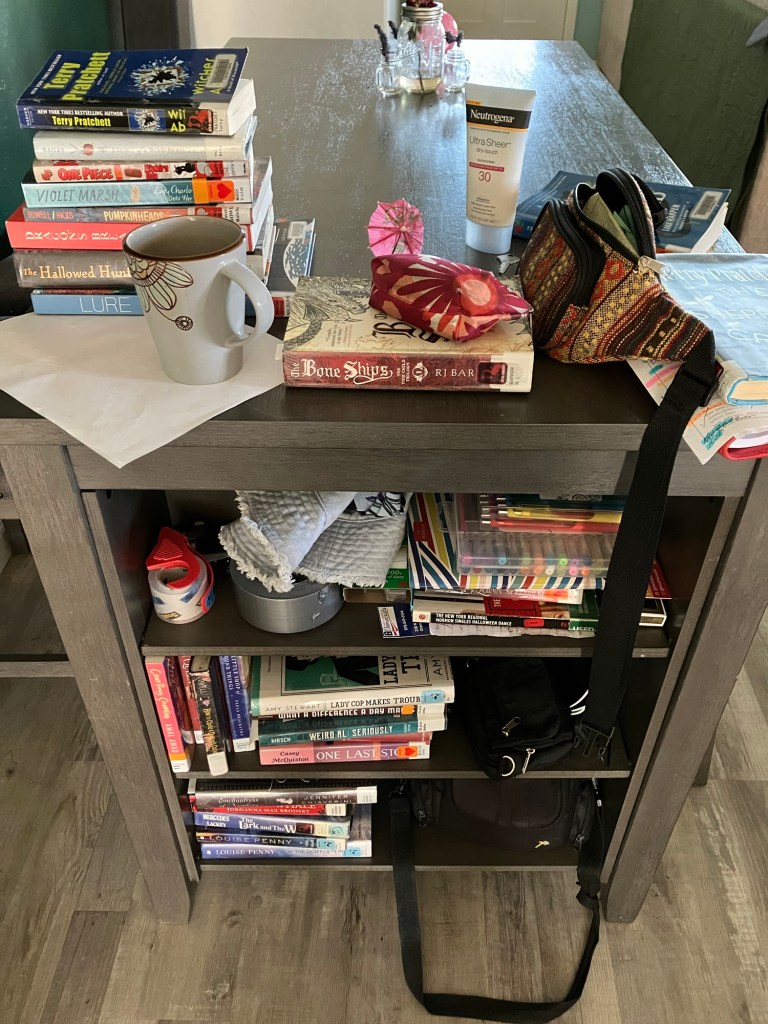
I also took four books to the library and took out eight more. I switched cookbooks because I did not like the one I had. This one looks much better. And a smattering of nonfiction, science fiction and fiction and silly romances or fantasy romance for when my brain is tired. I avoid the horror aisle, there’s enough of that in the news.

Shelves with many library books

For the Ragtag Daily Prompt: science fiction.

Food, food, food

When I get pneumonia, I drop ten pounds the first week. Since I had influenza viral pneumonia in 2003, I don’t run a fever. I just have a fast heart rate resting and get short of breath walking across the room. With Covid, I needed oxygen.

Each time, it takes longer to gain the weight back. Then I go over my normal weight and eventually have to rebuild muscle. This time I did not gain any weight back for over a year. But now it’s been three years and I am in the muscle rebuilding and weight loss section.

It does get harder as I get more mature. Older and wiser, right? Well, maybe. At any rate, I am trying to lose weight without any drugs or injectables or herbs. I am trying to eat the way the diabetic educators tell us to: half the meal should be vegetables. Every meal. A small grain and a small protein and not too much fat and vegetables. Corn really falls into the grains.

In clinic I often do a diet history of the day before. What did the person eat? I think about half of the histories come back with almost no vegetables. Pizza is NOT a vegetable, it’s mostly in the grain department. Grains are plants, I agree, but they send blood sugar up a lot more than celery and kale and collards.

Meanwhile, where is CHOCOLATE on that plate half covered with vegetables? Darn. My dessert could be a small piece of chocolate with a carrot on the side? Chocolate dipped carrots? I honestly do not like celery. Celeriac yes, celery no, though I have it in the curried chicken salad I made yesterday. That chicken salad is not half vegetables. It has some celery for crunch but it also has grapes. So, I ate it last night with an equal amount of mixed lettuce and sugar snap peas from the Farmer’s Market.

I do not have diabetes, but if I am recommending a dietary change, I think I should be able to do it too. We shall see. I think right now my diet is about 1/3 vegetables. Fruit does not count as a vegetable for this.

The other thing about vegetables is you have to cut them up. Ok, wash them too. And it’s not like one doesn’t have to cook beans or rice or meat, but vegetables do take time. If I have a person with low blood sugar or who is feeling awful, saying make half the meal vegetables may not be realistic. When someone is really frail or ill, it may be that getting out of bed, washed and dressed and to the table is overwhelming. Cut up vegetables? Cook from scratch? Maybe not.

For the Ragtag Daily Prompt: lunch.

Giant rolls?

Do these look like giant delicious rolls?

Or maybe the front one is the Starship Enterprise and the back one is an enormous rabbit chasing it.

I do miss bakeries. I still go in with my daughter and sniff all of the delicious aromas, but I can only eat the things without gluten. Never mind, I could eat whatever I wanted for half my life.

For the Ragtag Daily Prompt: bakery.

G6PD deficiency and diabetes

Today I follow an online trail to this article on diabetes from Nature Medicine here.

It is talking about a genetic variant that is found in people with African-American heritage called G6PDdef. This genetic pattern makes the HgbA1C test inaccurate. It will look low and “in control” even when blood sugars are high. Since the blood sugars are NOT in control, complications from diabetes can happen: damage to vision, to kidneys, to nerves in the hands and feet.

I have been reading articles about current and changing guidelines about diabetes. The current guidelines say that checking blood sugars at home doesn’t make a difference. I REALLY disagree with this and at the same time, I don’t think that physicians are approaching blood sugars in a practical manner.

I saw a man recently who is diagnosed with “insulin resistance”. His HgbA1C is in between 5.6 and 6.0. Normal is 4.5 to 5.6. Over 6.5 is diabetes. He has prediabetes. He has not checked blood sugars at all, but he is on metformin.

There is evidence that metformin is helpful, and still, I think it is putting the cart before the horse. I ask my people to go buy an over the counter glucometer. Ask for the one that has cheap strips, 6 for a dollar instead of a dollar apiece. Then we go over the normal and abnormal blood sugar ranges and I ask them to start checking blood sugars. If I give them a medicine right away, they don’t learn how to control their blood sugar with diet. ALL of my patients can figure out how to bring their blood sugars down with diet. If we can’t get to a good range, then we will add metformin. I do explain that the guidelines say use a medicine right away, but I ask, “Would you like to see if you can control your blood sugars with diet?” The answer is overwhelmingly “YES!” I have never had someone say no. If we do not give them the chance and explain the goals, why would they even try?

Also, I read the dietician handouts for diabetes yesterday and I am not satisfied. I do not think they explain carbohydrates well. Foods have fats, proteins, and carbohydrates, and anything that isn’t fat or protein has carbohydrates. I think of carbohydrates as a line, from ones with high fiber that do not send the blood sugar up fast, to ones that shoot it way high. At the low end is kale and lettuce and chard and celery. Then the green and yellow and red vegetables that are not sweet. Then beets and sweet peas. Next come the fruits, from blueberries up to much sweeter ones. Fruits overlap with grains: bread and pasta and potatoes and rice. The whole grains have more fiber and are slower to digest. Candy then sweet drinks (sodas are evil) and sugar.

Sugar has 15 grams of carbohydrate in a tablespoon. Kale has 7 grams of carbohydrate in a cup. That’s a pretty huge difference. A small apple has about 15 grams of carbohydrate and a large one 30 grams. Read labels for grains. There is a lot of carbohydrate in a small amount. The issue with fruit juice is that most of the fiber is gone, so the sugars are broken down and absorbed much faster. A 12 oz coke has 32 grams of carbohydrate and a Starbucks mocha has 62! I quit drinking the latter when I looked it up.

Most people with diabetes are supposed to stay at 30 grams of carbohydrate per meal, or 45 if it is a big person or if someone is doing heavy labor. Snacks are 15 grams.

Avocados are weird. They have about 17 grams of carbohydrate in a whole one, but they also have a lot of fat. They do have a lot of fiber, which surprises me.

Diet control takes a combination of paying attention to what is on the plate and serving amounts. Three servings of pasta is not going to work, unless you are out fighting forest fires or are on the swim team. Fire fighters are allotted 6000 calories a day, but most of us do not get that much exercise.

At the same time that articles are telling me that home blood sugars are not useful with a glucometer, everyone is pushing the continuous glucose monitors. I think we like technology. And other articles say that diabetes can be reversed with major lifestyle changes.

Articles: about not using home glucose checks, here. Starting metformin, here. Starting with one of the newer medicines, here.

I think people feel a lot more successful if they get a glucometer and can bring their blood sugar down by messing about with diet. I tell them to check after what they think is a “good” meal and after a “bad” one. How much difference is there? Contrast that with being handed a pill to control it, while someone talks about diet and says all the same stuff that we’ve heard for years. Nearly all of my people want to avoid more pills and are willing to try a glucometer to see if they can avoid a pill. People who have been on diabetes medicine for a while are less willing to try, but sometimes they do too. And sometimes they are surprised that some meals do not do good things for their blood sugar.

This is all type II diabetes. For type I, we have to have insulin. If type II has been out of control for a long time, sometimes those people have to have insulin too. Right now insurances will usually cover continuous glucose monitors for people with diabetes who are on insulin, both type I and II. I do hope that they really make a huge difference for those people!

The spectrum from the low carbohydrate vegetable, the green and yellow and orange ones, up to the really high simple sugar ones is also called the glycemic index. There are lists of low to high glycemic index foods. Perhaps some people with diabetes find that helpful, but I think it’s simpler to say, ok, the stuff that doesn’t taste sweet will send the blood sugar up less. Also, since we are all genetically different and then our gut bacteria and microbiome are all different, it is individualized care to say how does this person at this time respond to this food? We change over time!

There are other examples of the HgbA1C not working to track diabetes. A resident and I looked over a person with diabetes and spherocytosis. The HgbA1C was nearly normal but the blood sugars were in the 300 range. Spherocytosis is a genetic blood cell abnormality, and the red blood cells don’t live as long. People with a past bone marrow transplant also have red cells that live for a shorter time. The G6PD deficiency is thought to help people survive malaria, so persists in the population, like sickle cell anemia. Isn’t genetics fascinating?

Lie low and flow

We have fight or flight for the sympathetic nervous system state, when we are ramped up, aggressive, go getters, all that stuff. We need a term for the parasympathetic nervous system state, the relaxed one. So far I’ve come up with lie low and flow. Other suggestions? I welcome them! We need more lie low and flow and glow and say no and ho, ho, ho in the world. What puts you in that state? Knitting? Stupid cat videos? Bugs Bunny? A bubblebath? Watching toddlers? What makes you laugh and yawn and relax and lets all the tension flow out and sink or float away?

In clinic I am seeing a wide age range. Most of the younger ones, say, under 60, look a bit shell shocked. I think this is still from the pandemic and wars and political nastiness. The over 60 crowd seems to not care as much. They’ve been through it, they know people die, they know bad stuff happens.

A friend and I were talking about pandemics and he pointed out that HIV and AIDS was a pandemic too. So we are on track for two pandemics per century. The younger folk do not remember the HIV and AIDS pandemic and how frightening it was. Right before that started, some doctors proclaimed that infectious disease had been conquered by medicine. Um, RONG RONG RONG! Boy did they eat THOSE words. And early in that pandemic, no one knew what to believe, what was happening, how to stay safe, and the communication from the medical establishment changed very fast. I wonder if the people who were young adults and older in the 1980s were less surprised by the Covid-19 Pandemic and all the rumors and confusion. Yep, seen it before.

I am not sure how to help the younger shell shocked looking folks. Colorado is a bit tough and manly and consequently there is not a huge amount of resources for emotional health. Yesterday I asked if we have anyone who does neuropsychiatric testing and the answer I got was “I don’t know.” I will dig around today but did not find it on the internet. I have found neuropsych testing hugely helpful for traumatic brain injuries, post brain surgery, and to sort out unusual learning and memory styles. One woman had a brain tumor removed. Her memory was affected. She could remember things that she wrote down and read, but not things that she only heard. No one had given her the report to read. They only told her, so she did not remember it. At least, that was the story. I gave her the report and said, “Read it. And tell your family. And if you are on the phone, take notes.”

Ok, now I should get ready for work, though I want to lie low and watch a silly cat video.

For the Ragtag Daily Prompt: yawn.