
A weight loss drug complication

People are ordering versions related to semaglutide (ozempic) and dulaglutide (trulicity) from compounding pharmacies for various reasons. Their insurance may not cover the prescription or they may actually not qualify by their weight and complications. Here are the guidelines from the American Gastroenterological Association: https://www.aafp.org/pubs/afp/issues/2023/1000/practice-guidelines-medications-weight-loss.html. Those criteria: a body mass index (BMI) greater than 30 kg per m2 or BMI of 27 kg per m2 or greater with associated complications (e.g., hypertension, diabetes mellitus, and hyperlipidemia).

I have already had requests in clinic for a prescription sent to compounding pharmacy. I am refusing to send prescriptions out of state or to compounding pharmacies, because of the FDA warning. Here: https://www.fda.gov/drugs/postmarket-drug-safety-information-patients-and-providers/fdas-concerns-unapproved-glp-1-drugs-used-weight-loss. There are a bunch of issues: some compounding pharmacies are not using the FDA approved medicines, they are using something similar, but not the same. Also, the medicine does not come in the pen that injects a controlled amount. People have to draw the drug up and inject it. Some have injected ten times the amount that they should and have been hospitalized. It’s also worrisome that the compounding pharmacies, unlike state-licensed pharmacies, do not have to report complications.

A recent patient has deteriorating kidney function, with his creatinine jumping from 1.10 to 1.58. Creatinine is produced as a waste product by our cells and the kidneys need to clear it. His 1.10 was normal but the 1.58 is high, indicating the his kidneys aren’t clearing well, and that was only a six month interval. He is taking compounded semaglutide and compounded testosterone, with some online approval. That is, he did not get a prescription from our clinic. He started the semaglutide five months ago. The testosterone has been for years. “Stop the semaglutide and we will recheck your kidney function in a month.” His creatinine drops back to 1.10. Acute renal failure is listed as an uncommon side effect of the FDA approved semaglutide, but we don’t know if that is what he’s getting. I tell him the good news about his kidney function and say, “I think you should stay off the compounded drug.” I have not seen the same thing with the FDA approved semaglutide.

It’s complicated, isn’t it? We picked up the problem because he is on other medications and I do yearly labs on people who are on prescription medicines, to check whether their kidney or liver function is deteriorating. Almost all drugs, prescription or over the counter or supplements, are metabolized by either the liver or the kidneys. I only know of two that are not absorbed and not metabolized.

For the Ragtag Daily Prompt: pristine. I would like a pristine pill free body for as long as possible. Ok, I took one tylenol last week and I’d be dead three times over it wasn’t for penicillin.

Honey

Work is being a bit of a difficult place. I think that if a clinic is has two new providers with one new medical assistant, there should be some formal support in place. Not the manager of multiple offices sticking their head in the room with the three of us at computers and saying, “Everyone happy?” Um, no. This came to a head two days ago. Then yesterday I am asked to write up what I said to the manager.

No. I don’t think that is appropriate. If they have formal evaluation forms, fine. If they want a biweekly formal meeting, fine. If I ran the zoo, I would be sitting down biweekly with the job description to say, “This area is going well, this part needs some more attention. What is going well from your perspective and how can we communicate better to help each other and the patients?”

In fact, in my very first practice in 1996, I asked for a meeting with my receptionist. They had one for each pod of 2-3 providers. She was so freaked out by it that she brought the office manager, much to my surprise. I didn’t care and just said, “What is going well, what isn’t, where are the communication gaps, how do we fix them?” The receptionist looked at the office manager, said she had been scared that I was going to yell at her, but since I wasn’t, she let the office manager leave. We were fine after that. I just want a well functioning team and I am happy to help build it.

So, after thought, I am going to refuse this write up and ask what their HR process is and say that I am not satisfied with the office support and that it is quite unreasonable to leave two providers new to the clinic to guide and train a new medical assistant.

The Ragtag Daily Prompt is honey pot. That bring up this delicious and quite naughty Taj Mahal song, ooooooo. As my mother would say, you catch more flies with honey than vinegar.

Busy clinic

Clinic has been hopping. I have been at the present site now for six weeks, so I am starting to know a few of the patients. That is, the ones that are sick and I am worrying about. It is best if your doctor’s pupils don’t dilate when they hear your name.

I have been getting helpful calls back from specialists. I have a person who has high liver tests where hepatitis and overweight and alcohol don’t seem to be the cause, so I needed an updated list of what labs to send for some of the less common liver problems. Thyroid disease, hemochromatosis, alpha one antitrypsin deficiency, smooth muscle antibodies, various other antibody disorders. The list is quite a bit longer than in the past. I warn my patient that some will come back right away and some may take a week or two. The patient is anxious and wanted to go right to the emergency room, but I ask them to wait: I get a call back from gastroenterology within 24 hours to set up the current laboratory order list.

For liver tests, we ask about alcohol intake first. Then look at weight: a high body mass index can cause fatty liver disease. Unfortunately, that can lead to cirrhosis and liver failure, so it is not trivial. We check for hepatitis A, B and C. Then we start looking for the less common causes. My person is relatively young, but that is with me taking care of age 18 and up. I tell my person not to take any supplements, I look at any prescribed medicines. No alcohol for now.

The list of tests changes quickly. If I have not worked this up recently, it’s good to check in with the specialist. The gastroenterologist may not be up to date on ankle sprains, but they are tracking the changes in their specialty. My specialty is everything, so sometimes I need a current update. Most of the specialists are just fine with this phone call.

Occasionally I do this by message. I have a new diabetic who has a cardiologist already. Diabetics are usually put on either an ace inhibitor or an angiotensin receptor blocker to protect kidney function. I message the cardiologist and get a fast answer. Start an angiotensin receptor blocker and the suggested dose. Also very helpful.

A patient tells me on the phone that I get an “A” for the day. I called them to check on them two days after changing a medicine dose and to say that the other specialist wants even MORE laboratory tests. The patient says she has not gotten a call from a doctor before. The “A” made me laugh, but it did feel good.

I am learning the local medical pathways and how to get things done in this particular medical system. The functional bits, the dysfunctional bits, and how to work around them.

For the Ragtag Daily Prompt: functional.

Sol Duc really likes staying in her pillow fort. Sometimes I want to hide in a pillow fort too. So much for being “grown up”.

Strep A and Covid

In clinic we are seeing Strep A and Covid in the last two months, quite a lot.

Covid is all over the map with symptoms. One person had been traveling, did not feel well, but the main symptom was dry lips. Positive covid. Another was vomiting, with no upper respiratory symptoms. Some have diarrhea and upper respiratory symptoms. It interests me that flying home to Washington last month, only about three of us on the planes wore masks. I was one of them. I know people who have taken flights knowing that they have Covid, a day or two after diagnosed, so I can’t say that I trust the other people on airplanes. We are testing for Covid for almost any symptom or just feeling sick.

We are seeing Strep A as well. I saw a small child vomiting. I asked if her nose hurt: no. Throat: yes. Tummy: yes. Toes: no. She had strep A. The oldest person with strep A this week was ninety. She said, “How did I GET it?” Streptococcus is in the environment, including our throats. We may just carry it around, but then if we get overtired or stressed (good or bad stress) or have something happen, the strep can invade. We treat strep A mostly to prevent rheumatic fever, which is where our own antibodies to strep A attack us. I have seen three cases of rheumatic fever in my career. That is called a “pseudo autoimmune” disease. The strep A has cell surface markers that sometimes are close enough to ours that our own antibodies attack our body parts.

One person in the last month has a positive strep A. I write for penicillin and send her home. We call her later because the Covid/influenza/RSV test takes longer. She also has Covid! That seems like a bit much, rather unfair, but we can have two things. An initial infection can lower our immune defenses and another virus or bacteria gets hold.

Another person had tested negative for Covid, but that was four days before. Friday afternoon, so I would not get the results at home. I asked her to retest at home. Positive.

Here is the CDC page about Strep A. https://www.cdc.gov/group-a-strep/index.html

There are Strep B and C and D and so forth. Sometimes we pick them up on throat cultures. I treat if the person is still sick and symptomatic while the culture is in the laboratory.

I am wearing a mask in airports and on airplanes. I just don’t want to pick anything up, or at least do what I can to avoid it.

The photograph is Elwha in May 2023. I figure that you would rather see his tongue than mine.

For the Ragtag Daily Prompt: strep.

I think the song might be off topic. I don’t care. Beautiful.

Is this a tree?

Is this a tree?

I would not call this a tree. I would call it a cone. It contains seeds. It is not a tree.

A pregnancy is called an embryo until 8 weeks after conception and then a fetus until birth. It is not a baby, any more than a seed is a tree. Here is a link to a picture of the embryo developing:

https://en.wikipedia.org/wiki/Human_embryonic_development#/media/File:HumanEmbryogenesis.svg

It’s a bit difficult to call the embryo a baby.

After 8 weeks (10 weeks from the last menstrual period) the developing pregnancy is called a fetus. It cannot survive outside the womb. A term pregnancy is 37 weeks, and the due date is at 40 weeks. The earliest survival, certainly not natural, is around 24 weeks. This takes heavy intervention and technology, a premature infant on a ventilator for months. There is risk of damage to the eyes from high oxygen and risk of spontaneous brain bleed and cerebral palsy, because the newborn can weigh half a pound. Once born, the fetus is termed a baby.

This is important from a medical standpoint and pounded into us as physicians. WHY? Because in a trauma situation, the life of the mother comes first. In Obstetrics and Family Medicine, the life of the mother comes first. In Oncology, the life of the mother comes first. My sister was diagnosed with stage IIIB ductal breast cancer at age 41. She was engaged and it turned out that she was pregnant. She wrote this essay on her blog, Butterfly Soup:

The hardest loss of breast cancer.

She had an abortion and chose chemotherapy, because it was her or the fetus. If she had chemotherapy pregnant, at that time she was told that it would probably kill the fetus or cause terrible birth defects. If she held off on chemotherapy for seven months, her oncologist thought she would die. She had a very very aggressive cancer and she already had a daughter who needed her.

She lived until age 49, with multiple rounds of chemotherapy, radiation, gamma knife radiation, whole brain radiation. And she lived until her daughter was 13. Without the abortion, her physicians thought she would have died when her daughter was 7.

My ethics in medicine are that patients have autonomy. I would NOT have wanted my sister to choose to refuse chemo and try to bring a baby to term while dying of breast cancer. However, it was HER CHOICE, not mine. It was private and no one else’s business and how dare people make moral judgements about another person’s medical choices. I give my patients CHOICES. They can choose not to treat cancer and go into hospice. They can choose surgery or refuse it. They can choose to treat opioid addiction or refuse. They may die of a heroin overdose and I grieve. I try to convince them to go to treatment and I give them nalaxone to try to reverse overdoses. I refuse a medication or treatment that I think will harm my patients, but my patients have autonomy and choices. That extends to women and pregnancy as well.

It is NOT a baby in the womb, however emotionally attached people are to this image. It is an embryo first and then a fetus. And in a car wreck, the woman comes first and the fetus second.

For the Ragtag Daily Prompt: explain.

Covid-19: Approach to Long Haul

Covid-19: Approach to Long Haul

This is written primarily for physicians, but is for anyone to read. This is a working theory.

I am very interested in Long Haul because I was diagnosed with PANS by an older psychiatrist who worked exclusively with physicians in 2012. That was during my third flare. The evidence is mounting that Long Haul is an autoimmune disorder like PANS. I am sharing my approach to Long Haul based on both my clinic and personal experience.

Step 1. Validate the patient. Patients are terrified, understandably, to have something “like” chronic fatigue, fibromyalgia, or are worrying that they are “crazy”. Evidence is appearing that Long Haul, chronic fatigue and fibromyalgia are all complex autoimmune disorders with multiple antibodies. We do not yet have vast antibody tests. So the first step is to say that we believe patients and also that we can help. This is a very new and evolving field. I tell patients that it will change fast over the next few years. What I tell them today may change within a year as we get new information. If this makes them anxious, remind them of the Women’s Health Initiative and how that changed hormone therapy, and that cancer treatments keep improving.

Step 2. Lower stress and antibody levels. When we are high stress, cortisol and adrenaline go up and impair the immune system. The immune system is fired up and looking for something to do. Bacteria like strep A have evolved with us and have surface proteins that “look like us”. Our bodies make antibodies to the Strep A or Covid-19 and sometimes those antibodies attack us too, because our own proteins look the same. One way of lowering the antibody level is sweating. Hot bath or shower, sauna, hot tub, exercise. Support these and explain. A second way to lower the antibody level is to quiet the sympathetic nervous system and activate the parasympathetic nervous system. The parasympathetic is the quiet, relaxed and laughing one. Where does the patient feel safe, relaxed, quiet? After my father died, leaving a complicated and messy estate with an out of date will, I did a Sudoku daily for a year. I realized that the Sudoku relaxed me because I could not solve the estate quickly, but I could nearly always solve the Sudoku. Stupid cat videos, rocking chairs, knitting, gentle walk in the neighborhood if it feels safe, a walk in a mall (without one’s purse if overspending is an issue) — how does this particular person relax? Teach the slow breathing: in for a slow count of five and out for a slow count of five. Or square breathing: in for five, hold five, out five, in five. Twenty minutes of slow breathing supposedly moves almost everyone from sympathetic to parasympathetic. It may take practice and feel unfamiliar: I have had a veteran say that it felt very very weird to relax and he was not used to it. He kept at it.

Step 3. Symptom picture. At present I am basing this on my own experience with PANS. This is my working theory. Antibodies can block receptors or “turn the key” and activate receptors. Buprenorphine does BOTH (though it is not an antibody): at lower levels it turns the key and at higher levels it blocks. I would ask specifically about five fields. You many well be able to come up with more.

a. Brain function. In my PANS, I have antibodies to dopamine that turn dopamine on very high. Other physicians assume that I am manic. I am not quite manic, but it certainly feels awful. I feel like I have been shot out of a cannon when I wake up, with the morning cortisol rise. For me, the caffeine in coffee calms me, and my assumption is that it displaces the anti-dopamine antibodies. Tea does not work. I quit coffee for seven years until the latest flare. Albuterol doesn’t work. Terbutaline does work. I don’t know about theophylline or adderall, I have not tried them. If someone has “brain fog”, I assume that they have blocker antibodies OR be sure to ask if they were different in the first 4-6 months of the illness. For me, the antibodies rise for about 2-3 months and then take 2-3 months to drop. I have a lot of fatigue when they finally leave and this time I could tell the day that the last antibodies “fell off” or dropped to my “normal” level.
For blocked people, does caffeine help? How about albuterol? Adderall, theophylline, SSRIs. Every person will have different antibodies. Treatment needs to be tailored.

b. Muscle function. My anti-tubulin antibody (I have PANS, remember?) shuts down my “fast twitch” but not my “slow twitch” muscles. Tubulin is what makes the lung cilia function, so presumably mine are paralyzed during a flare and that is why I get pneumonia. I am tachycardic, resting heart rate 100 and walking slowly or talking heart rate 135, so I get very short of breath. Both the lung dysfunction and antibodies that upregulate my dopamine receptors make me tachycardic. I think that the people who can barely get out of bed with chronic fatigue have both fast and slow twitch muscles blocked. They need validation and lower stress. With support, perhaps the antibody level can be lowered enough that they can function again. I also found that my muscles hurt when my blood sugar was up and that if I keep it low, I have minimal muscle pain. I do not know if this is true for other people.

c. Gut function. In PANS, there appears to be an antibody to lysoganglioside. I don’t understand it but when I am sick, I cut carbohydrates way back or I am horribly ill. I tolerate lactose but not fructose, sucrose or gluten. One year after getting my last flare, I can eat everything except gluten. With this round I figured out that rising blood sugar when I am sick makes me acidic. This in turn worsens lung function more, as my body automatically slows my breathing to balance the acidity. I found that taking bicarb before a meal helped tremendously. In the worst/highest antibody part of the flare, I eat fats, because anything else makes me ill. SO: what can the patient eat or not eat and support them. Food intolerances are on the rise. Ask if there are foods that they cannot eat and support them not eating them. They can go to a very restricted diet that works for them and wait three weeks. After three weeks, food antibody levels are supposed to drop. They can start adding foods back in, one every three days. I do not know if this will work in a bad flare, the antibodies may be too high.

d. Lungs: do a resting heart rate and oxygen saturation. Do a walking heart rate and sat. Then do a LOADED heart rate and sat, with the person carrying the equivalent of two bags of groceries or their toddler. If they are young, they may hold their sats, but if their heart rate jumps to 135, that is like running a continuous marathon. Try oxygen and see if the heart rate comes down. Sleep apnea testing is also highly recommended. If they are tachycardic with daily activities, of course they have fatigue! Rest. Patients can learn to check a pulse or have a pulse ox, but fingers and second hand are cheap.

d. Other. I am reading that the main complaints in Long Haul are fatigue, brain issues, tachycardia and shortness of breath. What else really bothers the person? Sound sensitivity, loss of the sense of smell. The first step in helping with this is to listen and validate.

covid 19 two

From November 20th, 2020:

My ex called Saturday. Early, which unusual. I thought he was calling to say his mother died.

Nope.

He is an RN at a nursing home. “We’ve gone from one Covid 19 patient to 55 in the nursing home in one week. And they installed a new computer program on Tuesday that makes everything take twice as long. I quit.”

Actually he gave two weeks notice.

He called our kids yesterday. He has Covid 19. However, they are so short of staff that he is working. On the Covid 19 ward of the nursing home.

____________________

In my clinic, we are struggling with watching people travel for Thanksgiving. We have decided. If someone travels or has Thanksgiving with other households, we will offer a zoom visit or a reschedule in two weeks. We do not want them to expose others in clinic. And if we get it or are exposed, we are closed for a minimum of two weeks.

____________________

He called me. Today 60 out of the 70 nursing home patients have it. All of the staff have it. The staff are working anyhow because there is no one else.

Why is she really here?

For the Ragtag Daily Prompt: object. I strenuously and loudly object to medicine meaning pills.

During my three months temp job at a nearby Army Hospital in 2010, I wanted to work with residents, Family Practice doctors in training. I finished residency in 1996 and have worked in rural clinics and hospitals for 14 years. I want more rural family practice doctors and I agitated to work with the residents in training.

The Family Practice Department had actually hired me to do clinic. They are swamped and trying to hire temporary and permanent providers as quickly as they can. Six different temp companies called me about the same job, so the word is definitely out.

Initially the department head explained that I was there to do clinic, but she changed her mind. I was cheerful about the electronic medical records. Learning a new electronic medical record is awful, but I was happy to be there, excited about working with residents and in a hospital more than 16 times as big as my usual small town hospital. Most importantly, I was patient with the computer. I have finally realized that computers don’t actually speak English. They speak computer and they are dumb as rocks and they make no effort to understand what I am saying. They don’t care. So it is no use getting mad at the dumb thing when it crashes or when it doesn’t do what I want: I have to go find someone who knows the exact language that the stupid machine will understand.

Since I was cheerful, my department head let me do what I want. I was on the clinic schedule every day, but it was empty. I would arrive and see walk-in active duty people from 6:30 to 8:00. At the same time, I would email the department head and ask what I was doing that day. Half the time, a physician was sick or had a family crisis, so she would move people around and put me with the residents. If not, I would open clinic.

I enjoyed the “Attending Room” duty. Family Practice Residents have their MD but then go through three years of training. The first year residents must precept every clinic patient. That is, they see the person and then come discuss the case with the faculty. Second year residents were required to precept two patients per half day and third year residents had to do one; and all obstetric cases were precepted.

Back when I was in residency and the dinosaurs roamed the earth, no one ever read any of my notes. This has changed. Every note that is precepted must be read by the attending and co-signed. After three years hating the electronic medical record that my small hospital bought, it was very interesting to see a different system. In some ways it was better and in some worse.

We had one or two “Attendings” in the faculty room, no more than three residents per attending. One case stands out, more because of the resident than the patient. He was a first year.

He described an elderly woman in her 80s, there for headaches. Two weeks of headaches, getting a bit worse. History of present illness, past medical history, medicines, allergies, family history, social history and the physical exam. He said, “She’s tried tylonol and ibuprofen, but they aren’t helping that much.” He frowned. “She doesn’t seem to want another medicine.”

“No?” I said.

“No.” he said. “I started to talk about medicines. It doesn’t sound like migraines and she doesn’t have anything that’s really worrisome for a tumor……but she doesn’t seem to want a headache medicine.”

“Why is she really here?”

He looked more confused. “What do you mean?”

“Why is she really here?”

“I don’t know.”

“You already said why. Think about the history.” He frowned. I said, “Ok, you said that she was worried that she was going to have a stroke. Are these headaches likely to be a precursor of a stroke?”

“No.”

“Right. But that is why she’s here, because that is what she’s worried about. Look at her blood pressure, see what her last cholesterol was, talk to her about what symptoms ARE worrisome for strokes. Find out if a family member or friend has had a recent stroke. She doesn’t need a medicine. She is here for reassurance.”

“Oh.” he said. He left and came back.

“How did it go?”

“She was happy. She didn’t want a medicine. Her blood pressure is great, her cholesterol is great, we talked about strokes and she left.”

“That’s real medicine. Forget the diagnosis if the visit seems confusing. Ask yourself what is your patient worried about? What are they afraid of? Don’t focus on giving people medicine all the time. Ask yourself, why are they really here?”

And that is why I wanted to work with residents. It’s not all diagnosis and treatment. It is people and thinking about what they want and what they are worried about.

Why is she really here?

__________________________________

previously published on everything2.com
According to dictionary.com, precept is a noun. Medical school and residency have verbed it. Hey, get updated, dictionary.com!

Mordechai on fleek

For the Ragtag Daily Prompt: fleek.

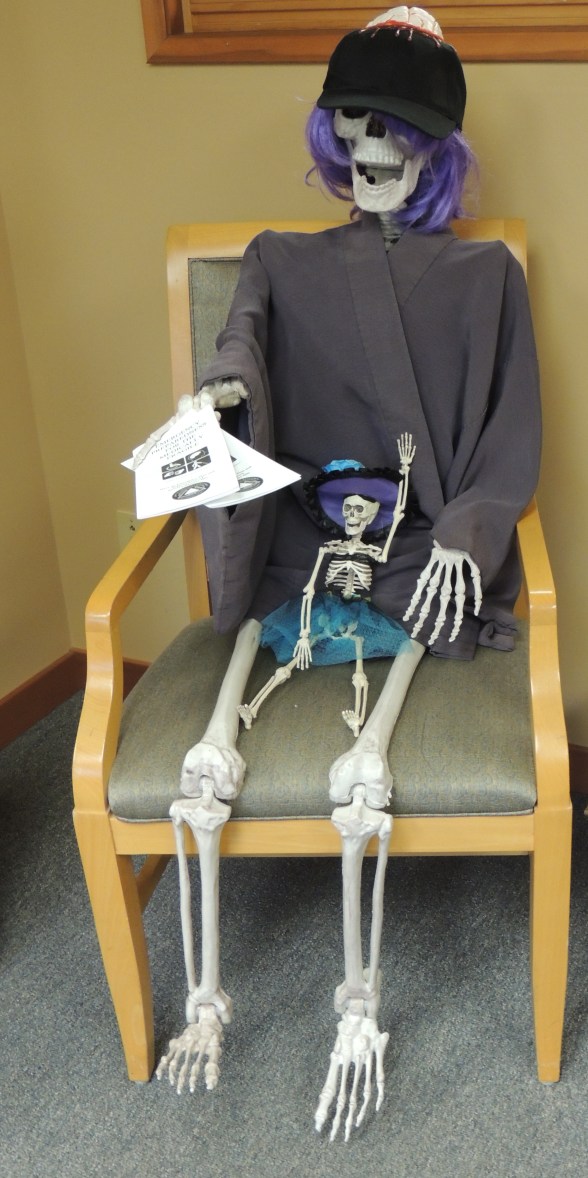
In October, Mordechai the plastic skeleton hangs out in the Quimper Family Medicine waiting room. She changes outfits. We had a 10 year old visitor who rearranged everything and now Mordechai is on fleek. She is holding out emergency preparedness pamphlets.

DSCN4262.JPG


small mother

I was already a mother when I became a mother. Long before I had my son. I just didn’t know it.

I became a mother at three. My mother had tuberculosis when I was born. Luckily she coughed blood a month before, otherwise I would not be here. I was born in a tuberculosis sanatorium, the first baby there in 25 years. My mother said that the staff was hugely excited about a baby. She was drugged to the gills while reading about the French Revolution and hallucinated Marie-Antonette’s head on a pole and the guillotine. She joked that she could never read about the French Revolution again. I was born, she kissed me, and I was swept away so that I would not get tuberculosis.

I was with my father and father’s family and then with my maternal grandparents. I came home to my parents at nine months. Adults kept handing me to other adults. I concluded that they were loving but stupid and couldn’t be trusted for a moment.

My sister was born five days before I turned three. My mother said that I met guests at the door and said, “Come see my baby.” Mine, because these adults don’t understand the needs of a baby, and I want her to feel loved and safe. No one will give my baby away!

Later my mother would tell a story about my sister worrying about Kindergarten. My mother could not reassure her. Neither could my father. I spoke up: “All you learn is colors, numbers and ABC and you already know those. I taught you.” My mother claimed that my sister was instantly reassured. I don’t remember: these are my mother’s stories and she is gone. But I have collected mother daughter pictures and small statues, just a few, all my life. And I wanted to have children. I liked surgery and obstetrics, but I chose family medicine, because I want to have children and to see them and be a mother too.

Health and joy and safety and comfort to all mothers and fathers and children everywhere.