Neurogognitive effects of Long Covid I

Here is the first part of my notes from this lecture: May 24, 2023 Neurocognitive effects of Long Covid (International) part 2, by Dr. Struminger PhD, neuropsychologist.

I am trying to make this fairly clear to almost anyone. Some words may be unfamiliar to start with, but I will bet that you can sort it out. I would be happy to try to clarify any part if needed. These are my notes from the first half of this lecture, fleshed out to be clearer.

This is the Schmidt Initiative for Long Covid Global in English with real time translation into Arabic, French, Spanish, Portuguese and closed captions. Session recordings: https://app.box.com/s/onh1ma57ttjpi2c19qqxvmdao0kd2nsr

Dr. Struminger said that 1/4 to 1/3 of Long Covid patients have cognitive symptoms. A study comparing Long Covid patients with people who never got Covid-19 shows the Long Covid people to be three times more likely to have attention deficits or confusion. Part of the barrier to treatments is to define the problem, figure out the mechanisms and then start studying treatments. She said that she would share a few proposed mechanisms for cognitive impairment in Long Covid, but that it is probably multifactorial and it’s a rat’s nest. (Ok, I said rat’s nest. Dr. Struminger did not use that term.)

There are two main phenotypes of Long Covid brain problems: Hypoxic/anoxic and Frontal/subcortical. In hypoxic/anoxic certain brain functions are intact: Attention, visuospatial, cognitive fluency and memory encoding. There is impairment in problem solving and memory retention. This pattern is associated with the people who were hospitalized, deathly ill, on ventilators, or heart/lung bypass machines.

Frontal/subcortical is more common in the people who were never hospitalized and were not on a ventilator or ECMO machine. It can show up even in people who seemed to have mild Covid-19. The impairment is in attention, cognitive fluency and memory encoding, while the intact functions are visuospatial, memory retention and problem-solving.

Here are those lists in a table, HA for hypoxic/anoxic and FS for Frontal/subcortical.

Attention: HA intact, FS impaired
Visuospatial skills: HA intact, FS intact
Cognitive fluency: HA Intact, FS impaired
Memory Encoding: HA intact, FS impaired
Memory retention: HA impaired, FS intact
Problem-Solving: HA impaired, FS intact

The two types probably have different mechanisms and the super sick are more often the hypoxic anoxic. And there can be a mixed or both presentation.

Neuropsychologists test people to see what parts of the brain are working. Testing locally usually takes about four hours or more. Some brain functions have been mapped to parts of the brain but others are still mysterious. Efforts continue to match function to neuroanatomy. Going through each of the brain functions, some are mapped and others are not.

Attention is mapped and mediated by the frontal lobes. Attention is impacted by physical fatigue, dysautonomia, pain, shortness of breath, further impacted by emotional symptoms. It is REALLY easy to get stuck in a vicious cycle where physical symptoms or pain or hypoxia decrease attention function, which in turn makes physical symptoms worse. For example, hypoxia can decrease attention, which makes the person anxious and tachycardic, which in turn affects attention more.

The frontal lobes are very sensitive to hypoxic damage and to inflammation. Any inflammation in the body messes with them. The frontal lobes need oxygen and glucose. If a person can’t breathe, this messes up attention; if they are dizzy, it messes up attention.

Cognitive fluency. The anatomical correlates are less clear. Probably frontal and temporal, vulnerable to hypoxia and broad networks in the brain, vulnerable to physiological and mood disturbance. So vulnerable to the same things as the frontal lobes.

Learning and memory: Map to the hippocampi – sensitive to hypoxia and can be injured while the rest of the brain is comparatively unscathed. People have difficulty with retention of new information and not just attention/encoding problems. Neuropsychology distinguishes between attention/encoding and retention/recall problems. Those are different. In alzheimer’s, there is trouble retaining new information, even though people can encode it. In the frontal/subcortical long covid brain fog, there is more difficulty with attention/encoding. That is, if the person is tachycardic or in pain or dizzy or short of breath, it is more difficult to pay attention and encode information into memory.

Executive functioning. Frontal lobe: sensitive to hypoxia and metabolic dysregulation, significantly impacted by physical symptoms and mood disturbance.

The hypoxic/anoxic pattern has effects more like Alzheimer’s or a dementia. The frontal/subcortical is more like a concussion or traumatic brain injury. Neither sounds great, but there is more healing from the second than the first. Treatments for now are coming from the Alzheimer’s/dementia established treatments or from the concussion/traumatic brain injury established treatments. The first part of treatment is rest, rest, rest, and try to keep the brain from getting overwhelmed. I will write more about the ongoing changing recommendations.

More at: https://hsc.unm.edu/echo/partner-portal/echos-initiatives/long-covid-global-echo.html

The photograph is a screen shot of the brain from below from one of the conferences. There were over 300 people attending this zoom lecture, which is encouraging and hopeful.

For the Ragtag Daily Prompt: covert. The covert damage from Covid-19 is being sorted out.

Breathe

I was trying to think of a debacle. Oh. Getting my fourth pneumonia, March 21, 2021, Covid-19. This is the first pneumonia that put me on oxygen. The fast heart rate, dropping ten pounds, and feeling anxious were familiar from the other three. This photograph was from December 2021, visiting Maryland. We did a bike ride. I was pretty happy that I was able to do it, though the last mile had a sloping uphill that made me think I was not very strong. Oxygen helped.

And Covid-19 is a debacle that we are still trying to understand and absorb and avoid and heal and recover from. I am reading an article that entirely denies viruses existing. I guess it’s like porn on the internet: they say if there is a story, there is a porn version. Every possible idea of what has happened over the last three years is out there, though this article doesn’t make any sense at all.

I don’t remember who took the photograph of me. It may be a steathie. I needed oxygen at night and whenever I was being active, but not at rest. Ok, at rest talking.

Things and people were lost and found and lost during Covid-19. I spent a lot of time on our beaches. I am so grateful for the beaches.

For the Ragtag Daily Prompt: debacle.

Brain thoughts

The attendees of the conference are all excited and hopeful at the fleshment of our understanding of Covid-19’s effects on the brain.

I am still absorbing the information, getting ready to write about it.

For the Ragtag Daily Prompt: fleshment.

Frame

What is the tree and where is it?

I am still thinking about the Inflammatory Brain Disorder Conference.

The researchers and physicians are talking about the immune system as if it is broken in Long Covid and ME/CFS and the other illnesses, but I am not sure I agree. Maybe the immune system knows what it is doing. Maybe Covid-19 is a really really nasty infection and the immune system sends out antibodies to make us stay down, stay in bed, rest and keep from catching something else. Maybe an antibody that suddenly makes you weird will make you isolate and hide and not interact with the other potentially infectious humans.

Ok, the inflammatory brain disorders that destroy the brain, those are not adaptive. However, I’ve thought that MC/CFS was a “repair mode” since residency.

When I had my third pneumonia in 2014, I refused to admit to myself that I had chronic fatigue. It was sort of obvious. I went back to work six months after I got sick and seeing just four or five patients left me exhausted. I would come home and sleep on the couch. I also skipped breakfast, because I would go to sleep as soon as I ate. My blood sugar was fine and it was not a food allergy. It felt as if my body wanted to do repair work and wanted me to sleep while it was doing the repairs. I would sleep after lunch. For the next six months of work, I slept twelve hours a day and hoped that I would not have more than five patients. Also that I would not get sick.

We had everyone who had upper respiratory symptoms or a cough wear a mask and I wore one too, hoping to not get another pneumonia. That worked. I only got sick when I went to work in another hospital clinic system. I kept walking into rooms with patients with their masks off. I got Covid-19 in a mere five weeks there, after going a year at my clinic without getting it.

I spoke to a friend yesterday. She was talking about her damaged immune system. I said I didn’t think of it as damaged. With enough stress and infection, I think the immune system gets primed. And then it is as if it has PTSD: the immune system says, “Enough already! We are not going to LET you overdo and get sick again! We are putting you DOWN to sleep if you overdo!” It is an extreme version of “listen to your body”, as if the body is shouting. The immune system is hyperalert and goes all out if there is any threat or suspected threat.

Maybe we need to be more gentle with ourselves and each other. The US culture is so oriented to production and work and money as success. But is that really success, if we work 20 hours a day and drive our immune system to desperate measures?

Maybe we need to learn to relax. To take time off. To breathe.

And the talk about Mast Cell Activation Disorder said exactly that. We need to teach how to go from the sympathetic fight or flight crazy to the quiet, relaxed, parasympathetic state. That quiets the immune system down very nicely.

It won’t fix everything, I am not saying that. But it is something everyone can learn. Slow breathe, in five and out five. Practice.

Breathe.

______________________________

The tree is a Redwood and it’s in the Chimacum Woods Rhododendron Nursery. Not just rhodys and on the Olympic Peninsula.

BRAINS

On Thursday and Friday I spent six hours daily glued to zoom, for the Inflammatory Brain Disorders Conference. Speakers, both physicians and scientists and physician-scientists, from all over the world, spoke. The research is intensive and ongoing. They spoke about Long Covid, both the immune response and “brain fog”. They spoke about anti-NMDA antibody disorder (the book Brain on Fire) and now there have been over 500 people identified with that disorder and a whole bunch more antibody-to-brain disorders! They talked about PANS and PANDAS and chronic fatigue and Mast Cell Activation Disorder and about the immune system over and over. The new information is amazing and I need to reread all my notes. Psychiatry and Neurology and Immunology are all overlapping in research, along with Rheumatology, since these disorders overlap all four.

It is a medical revolution in the making.

Best news was that 96% of Long Covid patients are better by 2 years from getting sick. That is tremendously reassuring, though the number may change. And the definition of Long Covid is still being sorted out and we do not know if people relapse.

I felt that MY brain was MELTED by the end, but I managed to enjoy the Rhododendron Parade on Saturday and just puttered around the house on Sunday.

Medical conditions

I am reading the list of medical conditions that put people at high risk from Covid-19.

I can nearly say that being a live human “bean”, as Walk Kelly would say, puts one at high risk from Covid-19.

My intuition studies medical conditions
alcohol, overweight, diabetes, drugs
it doesn’t say much about auto emissions
or the healthy power of genuine hugs
hypertension, asthma, bad livers or hearts
Covid could get you if you don’t watch out
I wonder if risks include noxious farts
I’m in denial and not a bit stout
dementia, disability, HIV or depression
check off the ones you don’t have, think positive!
I eat an ice cream bar while secretly confessing
that eating and drinking might be causative
Happy or sad or pie in the sky
There is a daily risk that I could die

__________________________________

https://www.cdc.gov/coronavirus/2019-ncov/need-extra-precautions/people-with-medical-conditions.html

Really, that list contains nearly everyone.

Working theory

I attended two Zoom one hour programs on Long Covid this week.

Thursday from the University of Arizona, 330 people logged on, hard science with thirty minutes of information about Mast Cell Activation Syndrome. They said 17% of the population, which is huge, if it’s correct. This is not mastocytosis, the cancer. This is the immune system going rather batshit. Though I would frame it differently, as the immune system fighting a really difficult battle.

Friday from the University of Washington. I don’t know how many were logged on. This was at a much more aimed right at the physicians level. People sent in questions and they collated and gave answers. They promised to answer some of the questions later on. My question was whether a high Adverse Childhood Experience Score predisposed to Mast Cell Activation and they did not address that.

So mast cells apparently can produce over 1000 different signals: cytokines, histamines, proteases and I don’t know what all. They are all over our bodies (are you creeped out? I am a little.) near the boundaries: skin, nose, gastrointestinal tract, genitals. They produce different signals depending on what is happening. The Thursday researcher basically said that they could affect nearly any system in the body.

I’ve heard of mastocytosis and even had a patient with it, but Mast Cell Activation Syndrome was barely on my radar. I am not sure if 17% of the population is at risk or has it. It is tricky to diagnose, because the best lab test is a rather tricky and rare one, and it is sort of an orphan illness: few doctors know about it and it does not fit neatly into any specialties. Patients have seen an average of ten specialists before they get diagnosed. Hmmm. Sounds familiar.

This researcher has a ton of papers out, that I have not started reading yet. MCAS is implicated in Ehlers-Danlos, a connective tissue disease and in ME/CFS (myalgic encephalomyelitis/chronic fatigue syndrome) as well as POTS (postural orthostatic tachycardia syndrome) and can get triggered by Covid-19. Well.

The good thing is that treatment is quieting the sympathetic nervous system to let the parasympathetic take over. The sympathetic is the fight or flight hyper one. Parasympathetic is the rest, relax, mellow out, slow heart rate, blood pressure down, digestion and quiet one. I think United States culture is crazy fight or flight most of the time (We’re number one!– so what?) and the pandemic has put the whole world into fight or flight mode. Crazy.

Back in Family Medicine residency, 1993-96, I had a number of ME/CFS, chronic fatigue patients. They tended to be hyper sensitive to medicines and have all sorts of symptoms which were fluid and changable and difficult to pin down. What I noticed though is that many of them had been super high acheivers or working multiple jobs or crazy high stress, until they hit some sort of wall. Often an infection but not always. The ones I saw wanted to go back to working 18 hours a day. I said, “Um, that’s how you got this, I do not think that is a good goal.” This often pissed people off. Even back then, I thought that chronic fatigue was a body reset, where the body rebels, some sort of switch is thrown, and people rest whether they want to or not. Some do recover but it can take ages. The Thursday speaker seems to think it’s the mast cells doing this.

The UW speakers were careful. They said we do not know how long Long Covid lasts. One said they do not like to diagnose POTS, because POTS is usually permanent and the Long Covid tachycardia usually resolves. They are seeing people who got sick 2-3 years ago and are still sick, but they also have people who have recovered in 9-12 months. They do not know if patients are entirely recovered or whether there will be other problems later. They also aren’t sure that the chronic fatigue like symptoms are the same as the rest of the ME/CFS. Remember when dementia was Alzheimer’s? Now there are all sorts of different dementia diagnoses, Lewy body, frontotemporal, Huntington’s, stroke dementia, alcoholic dementia, Parkinson’s, Alzheimer’s, and others. When I was in residency, we had hepatitis A, hepatitis B and non A non B. Now we are up to G or beyond. Medicine changes and it’s moving as fast as possible for both acute Covid-19 and Long Covid.

The mast cell reasearcher talked about getting the sympathetic and parasympathetic nervous systems back in balance. I think maybe we ALL need that. Every person in the whole world. One way to quiet the sympathetic nervous system is to slow your breathing. Try it. For five minutes, or three minutes. Slow breath in for a count of four or five and slow breath out for a count of five. Let your brain roam around and fuss, but let go of each thought as it passes by and return to counting and breathing.

Slow in, slow out.

Practice and heal.

_____________________

The musicians are Johnathan Doyle and a friend. They were fabulous, last Tuesday at the Bishop Hotel.

.

Long Covid and post pneumonia update

I was up above 5000 feet last week and did not need oxygen.

This is wonderful! I was on oxygen continuously from March of 2021 for a year and a half. I was really getting better and then had my Covid booster in early October. I crashed again. Do I regret the shot? No, because the crash is because antibodies went back up. Only some of them, though. My muscles and lungs were not working well again, but brain was fine (ok, some people do not like my brain, but they are idiots) and aside from having to avoid gluten, no digestive stuff.

About a month ago I really started feeling my fast twitch muscles work again. It was two years in March since this fourth pneumonia and I’ve had something Long Covid like after each one. Recovery took 2 months in 2003, 2 months in 2012 and 6 months off in 2014 and then an ongoing mild chronic fatigue, so I worked about half of a regular family medicine schedule. I saw 7-10 people per day instead of 16-22. I was also a single parent running a business with two children, so that has a lot of energy draw as well.

On the second morning there, my pulse was 61 and oxygen level 98% on room air. HOORAY! I am back to baseline from 2014. Since it took 2 years to recover, I really do not want to do this again. No more pneumonia. I have had two more rounds of Covid, but apparently the super high antibody level made it really really mild. An immunologist tested the antibodies since I keep getting pneumonia. He said I have the highest Covid antibody level he’s ever seen. Protective was over 50 and mine was 25,000. I seem to be darn good at making antibodies.

Now what? I have felt better for the last month. I still get tired and have about a half day of the energy level from my 20s or 30s, which was high. I am hiking, up to 6 miles in a day twice two weeks ago. Now to start biking and maybe running. I don’t like to run but it’s good training. I want to ski next winter at least one day. Maybe I will swim too. I used to swim a mile twice a week, but it’s been a long time. Also my swim team daughter expressed scorn for my freestyle stroke. Sigh, children are born to humble us, which sucks.

I am still trying to see if I can work with Long Covid patients. I have rather too much experience with something very like it. But I think I would like to enjoy feeling well for a month or two, first!

Hooray! I hope other Long Covid folks are working their way out of the woods too.

Xeno or infection phobic?

So is Xenophobia a pathological fear of strangers or foreigners? Like agoraphobia or arachnophobia? The Mayo Clinic site has a listing for agoraphobia but not for arachnophobia or xenophobia. Perhaps agoraphobia is more disabling. Though with our world having more and more people, xenophobia might be terribly dangerous as well.

Current world population: https://www.worldometers.info/world-population/.

Number of people with Long Covid: at least 65,000,000, though the talk I attended yesterday say that’s a low estimate. Nearly one percent of the world population.

This article in Nature: https://www.nature.com/articles/s41579-022-00846-2 is about Long Covid, the research to date and the areas that need research. This is a very fast moving target with information exploding from multiple labs.

I attended an on line continuing medical education about Long Covid yesterday: https://hsc.unm.edu/echo/partner-portal/echos-initiatives/long-covid-fatiguing-illness-recovery/. This is a global monthly teaching session about Long Covid and current research and diagnosis and treatment. Yesterday’s talk was about immune cell abnormalities that persist and evidence is showing up that they are causing some of the problems. However, as one researcher said, the problems are multifactorial and any system in the body can be affected in more than one way.

Essentially some of the immune cells are puffy, sticky and enlarged. The suspicion is that the postexertional malaise is related to these puffy sticky cells. During exercise, or for some people normal activity, the muscles need more blood flow and more oxygen. The puffy sticky cells are stiff and won’t slide through capillaries easily. The muscles send a panic “I need oxygen!” message to the brain and the muscles do not work. The recovery can take a day or two days because of the food/oxygen deprivation. The researcher said that the same mechanism is suspected in ME-CFS (myalgic encephalopathy-chronic fatigue syndrome).

My muscles are feeling normal. My chronic fatigue is comparatively mild and happens with bad infections or with a vaccine that raises antibody levels, as it is supposed to. That’s how immunizations work. Do I have antibodies that shut down my muscles or do I have puffy cells? I would postulate the former but I can’t be sure right now. My home science kit is not quite up to that study.

When my fast twitch muscles are not working, are affected, it is very weird. They DO NOT WORK RIGHT. It is hard to describe: it is sort of pain, but it’s more of a very very strong STOP EXERCISING NOW message. And then I am exhausted for 1-2 days. In contrast, my muscles are a bit sore after a four mile beach walk 2 days ago and then an intense physical therapy session, but I am not exhausted. No naps the last two days. I have returned to my normal sleep patterns, less hours.

One of the researchers presented new technology that can make a movie of the microscopic cells going though a space with a narrowing like a capillary. Video electron microscopy. They are describing the cell shapes and whether they go through a capillary diameter normally or stick, for people with no Covid, diabetics, acute Covid and Long Covid. All are different. It is fascinating new technology.

I think I am more infection phobic than xenophobic. People all have the same basic blood cells inside, even with lots of different genetic patterns. So far infection phobia has not led me to agoraphobia, but the talk yesterday sure makes me want to keep my mask on.

There were over 350 attendees yesterday from all over the world. Lay people can sign up as well and the videos are stored for anyone to watch. I will watch yesterday’s a second time because five different scientists presented in 30 minutes and I ignored the chat which was going full speed with references to look up. Homework. And progress is being made.

Blessings.

______________

For the Ragtag Daily Prompt: xenophobia.

______________

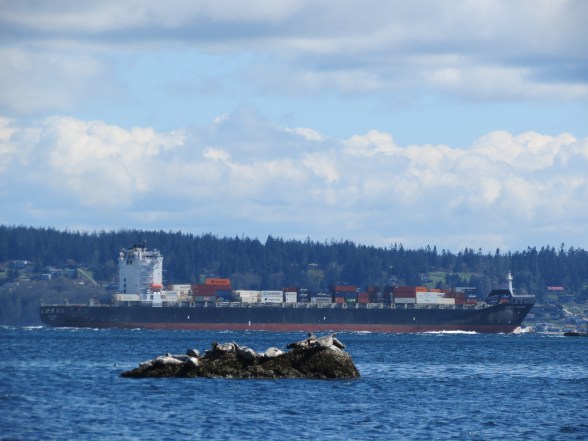
I took the photograph two days ago from East Beach on Marrowstone Island. The distance between the sea lions and the container ship is much further than it appears, and this is taken with a Canon PowerShot SX40HS zoomed most of the way out.

Covid for Christmas

Muscles aching all month then are worse
two more days I ignore the pain
one night I get chills and want to curse
morning testing confirms fears from my brain
sniffles and headache, muscles ache more
text the clinic and call when they’re open
plans upset, friends go to the store
daughter diverted, not what I was hoping
the days count down, I have enough time
glad to get notice before she came here
might as well try to tell it in rhyme
isolate my estate appetite queer
it’s covid for Christmas, not what I’d planned
but women can flex and can’t be unmanned