I was out very early on a Sunday before the coffee shops were open, wandering a bit. And took this.
Home town view

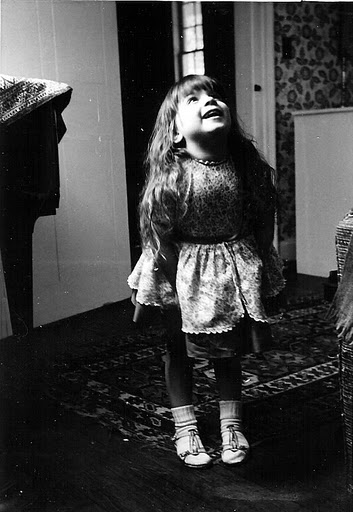
I was out very early on a Sunday before the coffee shops were open, wandering a bit. And took this.

Hello, this is for photrablogger’s Mundane Monday Challenge. His theme is minimal touch. I am not sure the photo fits the theme but I love this photo….from this last week….and it does fit. The framing is everything in this photo and how the dock is reaching towards the light area in the sky…..
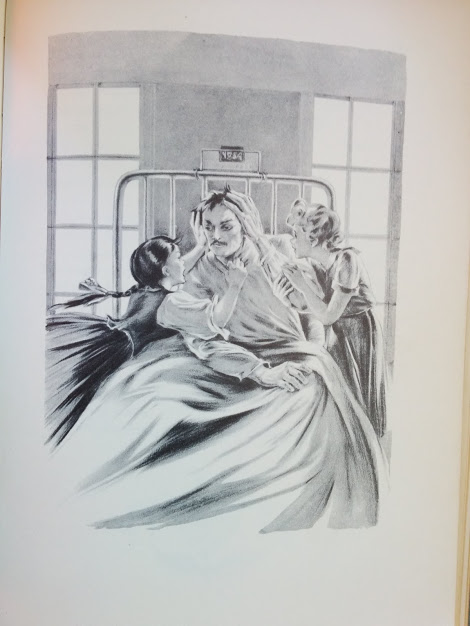
The Singing Tree by Kate Seredy, 1939, is a children’s book that illustrated PTSD for me long before I went to medical school. The Singing Tree is the sequel to The Good Master, and describes the survival of a Hungarian family and farm during World War I.
The good master is Marton Nagy, and he is called up as a Corporal, leaving the farm to be cared for by his wife, son, niece and workers. The farm suffers because so many men are called up. They are getting behind on the work and then find a diary from Marton, which gives suggestions and instructions for the year round work on the farm. One of the instructions is “to make out an application for Russian prisoners if necessary.”
They do. They apply and take 6 Russian prisoners, homesick farmers, who don’t speak Hungarian. Jansi and his cousin Kate take the chains off them and the prisoners quickly become part of the family. “Comrade, eh? Friend?” says one of the prisoners. And they are. They are also excellent workers and homesick.
As the prisoners are taken home in the wagon, they also take Peter, a deserter from the Hungarian army. He has panicked about his wife and new baby. He is crazy with worry. He is hidden under the six Russians, who sympathize. After seeing the baby he returns to his regiment. But Peter is angry and expresses his rage at Jews, even though it is Uncle Moses, the Jewish shopkeeper, who has helped hide him.
Marton is missing and they have not heard from him. Jansci and Kate make the wagon trek to bring back their grandparents, because the front is now too close for them to be safe. Kate and Lily smuggle the cat along. The cat gets “sick” and the girls insist at stopping at a hospital. The sickness is kittens. The nurses laugh at the girls, but then let them help on the wards. Injured soldiers who are healing.
“Whats am-amnesia?” Kate wanted to know.
Every patient was sitting bolt upright. Doctors and nurses were running in, Lily joined Kate, tugging at Uncle Marton’s hands. “Say something…you know us, don’t you? Say something.”
“Kate, if you don’t stop that infamous yelling this minute, I’ll take Milky away from…Say! Where am I? Who are these people?” Uncle Marton was looking around dazedly.
“Never mind them,” sobbed Kate, laughing at the same time. “You know who you are now, don’t you?”
He gets to go home.
The officer sighed. “Go home, Lieutenant. Forget, if you can. I wish I could.”
And will he have to return?
And Jansci talks to one of the Russian prisoners.
Death affects the village.
I wish that we had the sense expressed in this book about PTSD and the effects of war. When I worked at Madigan Army Hospital, some soldiers were getting ready for their fourth or fifth tour of duty. If we as a country are going to continue these wars, we must take more responsibility and have more care for the damage done. When people talk about “curing” PTSD or keeping it from happening: if we didn’t respond with PTSD as a species with horror for the evils of war, we don’t deserve to survive. We will be the Bad People, the Stupid People, who Kill and Laugh. We need to stop. This book was written in 1939 and clearly they knew the effects of PTSD. It’s been almost 80 years since Kate Seredy’s book was published: and still we question PTSD?
http://www.pdhealth.mil/clinicians/assessment_tools.asp
Civilians too: http://www.mirecc.va.gov/docs/visn6/3_PTSD_CheckList_and_Scoring.pdf
illustration from p. 187

My daughter has listened to me talk about medicine all her life. And she comes up with brilliant questions.
“Mom, if the three year old in Anne of Green Gables had croup, why did she get better when Anne treated her with ipecac?”
“Hmmmm.” My daughter has learned enough from me talking about croup to know that I don’t use ipecac. I use a dose of steroids, an oxygen tent with cold mist if needed and possibly epinephrine.
“The doctor in the book says that the baby would have died if Anne hadn’t known what to do.”
I reread the passage in Anne of Green Gables. The book was written in 1908 by Lucy Maud Montgomery. Anne is such an imaginative extrovert that my daughter objected the first time we read it. “Mom, no one is like that.” I named two very extroverted girls in her class. “Oh. Ok, yes.” Anne has been a foster child who helped raise three pairs of twins. She is eleven. This is from Chapter 18:
I finished reading. “I think that the reason ipecac worked is because it wasn’t what we call croup now. I think it was diptheria. With diptheria kids can’t breathe because there is a grey membrane of dead cells that covers the airway and can totally block it. The native americans used spiky seedpods to try to remove it. Vomiting would work too. By making the baby throw up, she was clearing her airway. I have never seen a child with diptheria because of vaccinations. I hope I never do see diptheria because it is much much worse than croup. Croup now is usually a virus like parainfluenza but diptheria is a bacteria and can kill.”
We looked it up on the CDC website. One in two people with diptheria die without treatment. One in ten die with treatment. That little “d” in your tetnus shot, the Td? That is the diptheria part of the vaccination, that you should update every ten years.
“They may have called both “croup” at the time the book was written. That was a really good question.”
My daughter was satisfied that this is a reasonable explanation for the puzzle.
http://www.cdc.gov/diphtheria/about/symptoms.html
http://www.cdc.gov/diphtheria/about/complications.html
http://www.cdc.gov/diphtheria/about/bam-villain-for-kids-fs.html
http://blogs.discovermagazine.com/inkfish/2014/03/25/classic-childrens-books-ruined-modern-medicine/
Also published on everything2.com today. The photo is my niece.
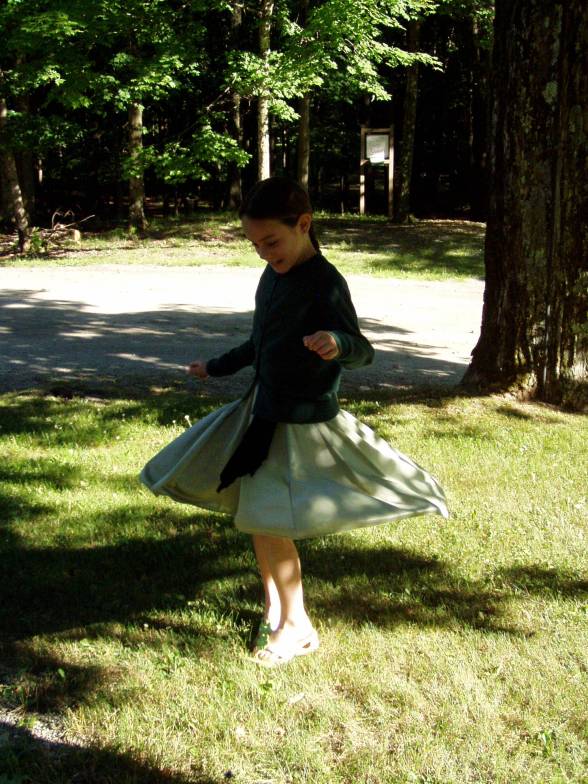
My daughter in 2007 at a wedding in Massachusets. She was twirling and playing with her skirt. She is so contained and happy just by herself, playing. A picture of joy…..

This is for Ronovan’s weekly haiku prompt. The words this week are guide and mad.
Beloved guide me
through red mad anger open
heart to shores of love
The picture is my son and daughter on the shore of Lake Crescent, Washington in 2004. We stopped driving for a rest. My son has just skipped a rock and I love the curve of his body and physical joy expressed. He’s trying to influence what the rock does with his body language. How can we all stay that fluid and joyful?
I stole the title from here: http://everything2.com/title/Guide+to+determining+if+you+are+constantly+being+mauled+by+bears

This is for Photrablogger’s Mundane Monday Challenge #14, different elements in the frame and colors. I took this on the train on the way back from Chicago to Spokane, WA. This was in North Dakota. The train was moving, thus the blurry foreground. I like how different the colors and mood are are from Jithin’s.
As a rural family practice physician, I am in an area with very few specialists. Our county has a 25 bed hospital and we have a urologist, three general surgeons, three orthopedists (except when we were down to none at one point), two part time hematologist oncologists and that’s it. We have a cardiologist who comes one day a week. We have a physicians assistant who worked with an excellent dermatologist for years: hooray! Local derm! Our neurologist retired and then died. We had two psychiatrists but one left. We had one working one half day a week.
I trained in treating opiate addiction with buprenorphine in 2010 and attended telemedicine with the University of Washington nearly weekly for a year and a half. Then life intervened. I attended last week again, but not the addiction medicine group. That is gone. Now there are two telemedicine pain groups.
And what have I learned since my Chronic pain update 2011?
Chronic opiates suck, and especially for “disorders of central pain processing” which includes fibromyalgia, reflex sympathetic dystrophy, TMJ, chronic fatigue, and all of the other pain disorders where the brain pain centers get sensitized. We don’t know what triggers the sensitization, though a high Adverse Childhood Experience score puts a person more at risk. Cumulative trauma? Tired mitochondria? Incorrect gut microbiome? All of them, I suspect.
Jon Kabot Zinn, PhD has been studying mindfulness meditation for over 30 years. He has books, CDs, classes. Opiates at best drop pain levels an average of 30%. His classes drop pain levels an average of 50%. I’ve read two of his books, Full Catastrophe Living and ….. and I used the CD that came with the former to help me sleep after my father and sister died. Worked. Though I used the program where he says, “This is to help you fall more awake, not fall asleep.” Being contrary, it put me to sleep 100% of the time.
Body work is being studied. Massage, physical therapy, accupuncture, touch therapy and so forth. It turns out that when you have new physical input, the brain says, “Hey, turn down the pain fibers, I have to pay attention to the feathers touching my left arm.” So, if you have a body part with screwed up pain fibers, touch it. Touch it a lot, gently, with cold, with hot, with feathers, a washcloth, a spoon, something knobby, plastic. Better yet, have someone else touch it with things with your eyes closed and guess what the things are: your brain may tell the pain centers “Shut up, I’m thinking.” Well, sensing. A study checking hormone blood levels every ten minutes during a massage showed the stress hormone cortisol dropping in half and pain medicating hormones dropping in half. So, massage works. Touch works. Hugs work. Go for it.
There are new medicines. I don’t like pills much. However, the tricyclic antidepressants, old and considered passe, are back. They especially help with the central pain processing disorders. I haven’t learned the current brain pathway theories. The selective serotonin uptake reinhibitors (prozac, paxil, celexa, etc) increase the amount of serotonin in the receptors: chronic pain folks and depressed folks have low serotonin there, so increasing it helps many. As an “old” doc, that is, over 50, I view new medicines with suspicion. They often get pulled off the market in 10 to 20 years. I can wait. I will use them cautiously.
We are less enthused about antiinflammatories. People bleed. The gut bleeds. Also, the body uses inflammation to heal an area. So, does an antiinflammatory help? Very questionable.
Diet can affect pain. When I had systemic strep, I would go into ketosis within a couple of hours of eating as the strep A in my muscles and lungs fed on the carbohydrates in my blood. This did not feel good. However, the instant I was ketotic, my burning strep infected muscles would stop hurting. Completely. I am using a trial diet in clinic for some of my chronic pain patients. I had a woman recently try it for two weeks. She came back and said that her osteoarthritis pain disappeared in her right hip entirely. She then noticed that the muscles ached around her left hip. She has been limping for a while. The muscles are pissed off. She ate a slice of bread after the two weeks and the right hip osteoarthritis pain was back the next day. “Hmmmm.” I said. She and I sat silent for a bit. It’s stunning if we can have major effects on chronic pain with switching from a carb based diet to a ketotic one.
I attended one of the chronic pain telemedicines last week and presented a patient. My question was not about opiates at all, but about ACE scores and PTSD in a veteran. The telemedicine specialists ignored my question. They told me to wean the opiate. He’s on a small dose and I said I would prefer to wean his ambien and his benzodiazepines first. They talked down to me. One told me that when I was “taking a medicine away” I could make the patient feel better by increasing another one. As I weaned the oxycodone, I should increase his gabapentin. I thought, yeah, like my patients don’t know the difference between oxycodone and gabapentin. No wonder patients are angry at allopaths. I didn’t express that. Instead, I said that he’d nearly died of urosepsis two weeks ago, so we were focused on that rather than his back pain at the third visit. All but one physician ignored everything I said: but the doctor from Madigan thanked me for taking on veterans and offered a telepsychiatry link. That may actually be helpful. Maybe.
And that is my chronic pain update for 2015. Blessings to all.
http://www.cdc.gov/violenceprevention/acestudy/
http://www.umassmed.edu/cfm/about-us/people/2-meet-our-faculty/kabat-zinn-profile/
I can’t think of a picture for this. I don’t think it should have a picture.

This is for photrablogger’s Mundane Monday Challenge: a different angle.
I was visiting friends in Michigan and met their grandchildren for the first time. We spent much of one day with cardboard boxes, markers and colored duct tape, getting an angle on it all.
Here I am
what a load of shit I know heracles did it
with brute strength in the allotted day I too
am assigned a day but I am just a girl you see
and small to boot I lean on the shovel and contemplate
the work what a load of shit has been produced and I
know what I have to do clean and sparkling by morning
I know the goddess to pray to and she shows up with all
her nymphs armed the bows aren’t so useful for shoveling
shit but they can shift it fast we are done long before
morning and all I have to do is pledge myself to her
to virginity like a virgin
all I have to do
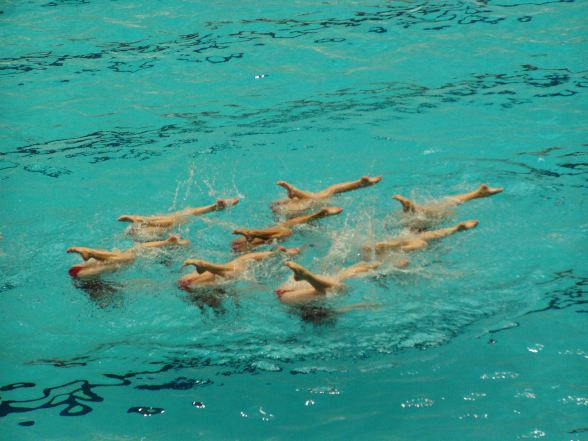
my photo is from the 2009 US National Junior Synchronized Swimming Olympics
BLIND WILDERNESS
in front of the garden gate - JezzieG
Discover and re-discover Mexico’s cuisine, culture and history through the recipes, backyard stories and other interesting findings of an expatriate in Canada
Or not, depending on my mood
All those moments will be lost in time, like tears in rain!
An onion has many layers. So have I!
Exploring the great outdoors one step at a time
Some of the creative paths that escaped from my brain!
Books, reading and more ... with an Australian focus ... written on Ngunnawal Country
Engaging in some lyrical athletics whilst painting pictures with words and pounding the pavement. I run; blog; write poetry; chase after my kids & drink coffee.
Coast-to-coast US bike tour
Generative AI
Climbing, Outdoors, Life!
imperfect pictures
Refugees welcome - Flüchtlinge willkommen I am teaching German to refugees. Ich unterrichte geflüchtete Menschen in der deutschen Sprache. I am writing this blog in English and German because my friends speak English and German. Ich schreibe auf Deutsch und Englisch, weil meine Freunde Deutsch und Englisch sprechen.
En fotoblogg
Books by author Diana Coombes
NEW FLOWERY JOURNEYS
in search of a better us
Personal Blog
Art from the Earth
𝖠𝗇𝗈𝗍𝗁𝖾𝗋 𝖶𝗈𝗋𝖽𝖯𝗋𝖾𝗌𝗌.𝖼𝗈𝗆 𝗌𝗂𝗍𝖾.
Taking the camera for a walk!!!
From the Existential to the Mundane - From Poetry to Prose
1 Man and His Bloody Dog
Homepage Engaging the World, Hearing the World and speaking for the World.
Anne M Bray's art blog, and then some.
My Personal Rants, Ravings, & Ruminations
 KO Rural Mad As Hell Blog
You must be logged in to post a comment.