Bolster my courage

I am having nightmares. About clinic. Yesterday I bolstered my courage and sat down to write my dream out. What are my dreams trying to tell me? Should I extend my contract or not?

I dream that in clinic I have a male patient with his wife in the room. He is very dramatic, saying, “I am so ill, help me, help me.” He says, “I am on quercetin. You have to help me.”

He won’t tell me what his symptoms are, so I respond to what he says: “Who prescribed quercetin? What is your diagnosis?”

“Oh, you don’t want to help me,” he says. His wife just watches.

“Do you have pain somewhere? Any chest pain? Any abdominal pain? Any pain anywhere?”

“No, no, you don’t understand!” he says, “You aren’t listening!”

“I am trying to help you,” I say. “Can we reschedule you for a longer visit?” This is one of the impossible 20 minute ones. Honestly, he doesn’t look like he’s in pain. I do a quick listen to heart and lungs and feel his abdomen.

“No, I need to be in the hospital, I can’t go home!”

“I can’t put you in the hospital without a diagnosis, but we can move you to the emergency room.” Of course, the ER won’t be happy about this.

I leave the room and call the ER. The ER doctor is understandably grumpy, since I have no idea what this is about and am suspecting a psychiatric cause. “Urine drug screen,” I say. “He doesn’t smell drunk. I do not think it’s meth withdrawal.” “Make sure you do a note,” snarls the ER doctor. Good luck, since he won’t answer any questions. “How behind am I?” I ask the nurse. She just rolls her eyes. I probably have at least four or five more on the schedule. I come back to the room. Now two preteens are in the room, looking in the drawers and taking things out. Their parents do nothing to stop them.

“Please sit down now!” I say. “Put that down!”

The teens sullenly comply. The father is moaning. He has the prescriber on his cell phone. He hands it to me. I introduce myself. “What is your diagnosis?” I say. “Why is he on quercetin?” The person at the other end mumbles. “Excuse me, what did you say?” He’s gone. I say to the mother, “Please take the children to the waiting room. Sir, are you requesting that we call 911?” It would be a call saying man moaning, no idea what he’s on about. Vitals are normal, he denies chest pressure or pain, he doesn’t have an acute abdomen, his oxygen level is fine, no fast heart rate, no fever. Drama.

I wake up, thinking that I may have to call 911 to get the wife and kids out and I have to have someone monitor him while I see other patients and we just don’t have enough staff and I am ready to just cancel the rest of the afternoon. If I were in a hospital, I could call security, but we are a satellite small clinic.

So… what the heck is THIS dream about? And do we really get patients like this? Yes, but not often and I haven’t had any like this here. I think it’s funny that this dream has so much detail, down to the supplement that the man is taking as well as the clinic room. I usually work in room 1 and 2, but this was in room 5.

To be continued.

For the Ragtag Daily Prompt: bolster.



Honey and the ants again

The next two times Honey feels the ants biting from the inside feeling are also on obstetrics.

Both times it is a VBAC. Vaginal birth after cesarean. The woman has has a cesarean section in the past and is trying for a vaginal birth.

Both times, Honey gets the biting ant feeling. There doesn’t seem to be anything wrong with the woman in labor, the nurse is relaxed, the fetal heart monitor looks ok.

With the first one it is the younger male obstetrician who is on call. He is a big man. He sits and peruses the monitor strip outside the room, taking his time. “There were some decelerations back here, but the heart rate looks fine now. Do you really want me to consult?”

Honey can’t stand still, the ants feel so bad. She tries to sound professional and calm. “Yes, this is a VBAC. I would like you to go in and meet her.” She is trying not to shoo him towards the room. He shrugs and gets up, not quite slouching towards the room, Honey trying not to jump up and down in impatience behind him.

In the room, he introduces himself. Again, Honey has not told her patient. The obstetrician says, “Dr. B. asked me to stop by since you have previously had a cesarean section, but everything looks fine.” Two minutes later she and the nurse and the obstetrician all alert as the the fetal heart rate monitor chirp slows, dropping from the 120s down to 60. THERE IT IS! thinks Honey. It stays down, they have the mother roll on her side and pop oxygen on her. It comes back up, but that is that. Off to the operating room. Again, they don’t have to do a crash cesarean. This time it is not clear what was wrong, but everything comes out well.

On the third round, it is the older male obstetrician. He looks at the strip and is calm and goes right into the room. He introduces himself and everything looks fine. Honey is wanting to dance from foot to foot from the ants. Again the fetal heart rate drops, right as the obstetrician gets up to leave the room. The nurse has the woman roll to her side and adds oxygen. The calm obstetrician gives Honey a look and has the nurse get the surgical consent. The heart rate is back up and off they go.

Honey wonders. Ants? Little voices? She knows that we all pick up information from body language and information that is not conscious. That could be a scientific explanation. Information that is not quite conscious. Honey decides that she really does not care what the ants are. When those voices speak, she listens. Who cares what it is, as long as it works.

______________________

What is the word? “Fictionalized”, from fallible, friable memory.

Honey and the ants

Honey is in her second year working. She escapes clinic because she has a labor patient. In the daytime! Not on a weekend or at 2 am! Hooray!

She has to hang out, because this is baby number five, so it could come really really fast. Everything is cool. The mom has more experience than she does, nearly. Well, Honey has done more deliveries, but has only had one baby.

Honey starts to feel itchy. Agitated. It’s not skin at all. Something is bugging her. She goes in and out of the room. The nurse seems totally unperturbed, but Honey feels like ants are attacking her, from the inside. She goes out the room and studies the rhythm strip, the baby’s heartbeat. There is a printer feeding out in the central nurses station.

Screw it, thinks Honey. I make look stupid, but I don’t care. She calls the obstetrician. It’s the woman who is on. Honey is a Family Medicine physician. They are in rival clinics. “Hi,” says Honey, identifying herself, “I need a consult on this woman.” She reels off the medical details, Gravida 5, Para 4, all vaginal deliveries, no complications. “I just feel like there is something wrong. There isn’t anything really bad on the strip. But I need you to come.”

The woman obstetrician comes. She sits and studies the heartbeat strip. Honey still feels like ants are biting from inside. The OB puts the strip down. “There is nothing on this that would get you in trouble. But you’re right: something is wrong. Come on.”

Honey has not told the patient that she’s calling the obstetrician. The patient might be annoyed. They go in the room. The obstetrician introduces herself. “Dr. B called me to consult. We have a bad feeling. We want to do a cesarean section.” Honey is sure the patient will say no. She is wrong.

“Me too,” says the patient. “Do it.”

They do the paperwork and move quickly to the operating room. Not a crash cesarean, not an emergency, so spinal anesthesia, not general. Honey assists.

They are in. There it is. The umbilical cord is wrapped four times around the infant’s neck. It has not tightened down. Honey has goosebumps as they gently unwrap the cord and do the delivery. The baby is fine, no problems, apgars of 9 and 9. They complete the surgery, mom is doing fine too. Honey still feels rattled but the ants have gone away.

The mother is relieved when she wakes, glad they did it, glad to hold her fifth child. The obstetrician is in charge of post operative and Honey is managing the baby. They don’t really talk about it, everyone acts as if it’s all routine. If the cord had tightened down, everything still could have been ok, but it would be a crash cesarean section, general anesthesia, more risky for everyone. It could also have not been ok.

Honey is relieved to go home, adrenaline draining away and leaving her very very tired.

Honey decides that she will listen to those ants, that feeling, any time it shows up.

______________________

Based on a true story, at least, on memories, that are unreliable. Aren’t they?

Something

Something is happening all around me
Something unpleasant is creeping around
I trust that feeling, that core that is free
I go quiet and listen, I will stand my ground
I am told no problem, this is routine
Nothing to worry about, averting their eyes
Lay down and be walked on, take it for the team
Blind-sided, I walk through a jungle of lies.
I walk very slowly then take to the trees.
I swing on a vine past the river of tears.
Wave to the gators with teeth to eat me,
Routine bad treatment not surprising nor feared.
In the treetops I sing to the stars quite alone
I am happy and making my quiet way home.

Suddenly I am thinking about home. Travel does that sometimes.

For the Ragtag Daily Prompt: travel.

G6PD deficiency and diabetes

Today I follow an online trail to this article on diabetes from Nature Medicine here.

It is talking about a genetic variant that is found in people with African-American heritage called G6PDdef. This genetic pattern makes the HgbA1C test inaccurate. It will look low and “in control” even when blood sugars are high. Since the blood sugars are NOT in control, complications from diabetes can happen: damage to vision, to kidneys, to nerves in the hands and feet.

I have been reading articles about current and changing guidelines about diabetes. The current guidelines say that checking blood sugars at home doesn’t make a difference. I REALLY disagree with this and at the same time, I don’t think that physicians are approaching blood sugars in a practical manner.

I saw a man recently who is diagnosed with “insulin resistance”. His HgbA1C is in between 5.6 and 6.0. Normal is 4.5 to 5.6. Over 6.5 is diabetes. He has prediabetes. He has not checked blood sugars at all, but he is on metformin.

There is evidence that metformin is helpful, and still, I think it is putting the cart before the horse. I ask my people to go buy an over the counter glucometer. Ask for the one that has cheap strips, 6 for a dollar instead of a dollar apiece. Then we go over the normal and abnormal blood sugar ranges and I ask them to start checking blood sugars. If I give them a medicine right away, they don’t learn how to control their blood sugar with diet. ALL of my patients can figure out how to bring their blood sugars down with diet. If we can’t get to a good range, then we will add metformin. I do explain that the guidelines say use a medicine right away, but I ask, “Would you like to see if you can control your blood sugars with diet?” The answer is overwhelmingly “YES!” I have never had someone say no. If we do not give them the chance and explain the goals, why would they even try?

Also, I read the dietician handouts for diabetes yesterday and I am not satisfied. I do not think they explain carbohydrates well. Foods have fats, proteins, and carbohydrates, and anything that isn’t fat or protein has carbohydrates. I think of carbohydrates as a line, from ones with high fiber that do not send the blood sugar up fast, to ones that shoot it way high. At the low end is kale and lettuce and chard and celery. Then the green and yellow and red vegetables that are not sweet. Then beets and sweet peas. Next come the fruits, from blueberries up to much sweeter ones. Fruits overlap with grains: bread and pasta and potatoes and rice. The whole grains have more fiber and are slower to digest. Candy then sweet drinks (sodas are evil) and sugar.

Sugar has 15 grams of carbohydrate in a tablespoon. Kale has 7 grams of carbohydrate in a cup. That’s a pretty huge difference. A small apple has about 15 grams of carbohydrate and a large one 30 grams. Read labels for grains. There is a lot of carbohydrate in a small amount. The issue with fruit juice is that most of the fiber is gone, so the sugars are broken down and absorbed much faster. A 12 oz coke has 32 grams of carbohydrate and a Starbucks mocha has 62! I quit drinking the latter when I looked it up.

Most people with diabetes are supposed to stay at 30 grams of carbohydrate per meal, or 45 if it is a big person or if someone is doing heavy labor. Snacks are 15 grams.

Avocados are weird. They have about 17 grams of carbohydrate in a whole one, but they also have a lot of fat. They do have a lot of fiber, which surprises me.

Diet control takes a combination of paying attention to what is on the plate and serving amounts. Three servings of pasta is not going to work, unless you are out fighting forest fires or are on the swim team. Fire fighters are allotted 6000 calories a day, but most of us do not get that much exercise.

At the same time that articles are telling me that home blood sugars are not useful with a glucometer, everyone is pushing the continuous glucose monitors. I think we like technology. And other articles say that diabetes can be reversed with major lifestyle changes.

Articles: about not using home glucose checks, here. Starting metformin, here. Starting with one of the newer medicines, here.

I think people feel a lot more successful if they get a glucometer and can bring their blood sugar down by messing about with diet. I tell them to check after what they think is a “good” meal and after a “bad” one. How much difference is there? Contrast that with being handed a pill to control it, while someone talks about diet and says all the same stuff that we’ve heard for years. Nearly all of my people want to avoid more pills and are willing to try a glucometer to see if they can avoid a pill. People who have been on diabetes medicine for a while are less willing to try, but sometimes they do too. And sometimes they are surprised that some meals do not do good things for their blood sugar.

This is all type II diabetes. For type I, we have to have insulin. If type II has been out of control for a long time, sometimes those people have to have insulin too. Right now insurances will usually cover continuous glucose monitors for people with diabetes who are on insulin, both type I and II. I do hope that they really make a huge difference for those people!

The spectrum from the low carbohydrate vegetable, the green and yellow and orange ones, up to the really high simple sugar ones is also called the glycemic index. There are lists of low to high glycemic index foods. Perhaps some people with diabetes find that helpful, but I think it’s simpler to say, ok, the stuff that doesn’t taste sweet will send the blood sugar up less. Also, since we are all genetically different and then our gut bacteria and microbiome are all different, it is individualized care to say how does this person at this time respond to this food? We change over time!

There are other examples of the HgbA1C not working to track diabetes. A resident and I looked over a person with diabetes and spherocytosis. The HgbA1C was nearly normal but the blood sugars were in the 300 range. Spherocytosis is a genetic blood cell abnormality, and the red blood cells don’t live as long. People with a past bone marrow transplant also have red cells that live for a shorter time. The G6PD deficiency is thought to help people survive malaria, so persists in the population, like sickle cell anemia. Isn’t genetics fascinating?

A yarn about paper

On Friday in the morning I took notes on paper. I was attending a conference on diabetes on Zoom. There are three new things added to the diabetes guidelines. It is now impossible to do a visit about diabetes and actually talk to the human being who has diabetes. We’ll be too busy doing the stupid checklists.

The personnel person stopped by. I said I was taking notes. “On PAPER? You are killing me!”

“Ok. I will use yarn this afternoon.” I drove home and got my knitting and worked on a sock in the afternoon. All the clinics were having a slow day. I guess the kids are getting out of school and everyone is feeling good. Or panicked.

I retain as much information knitting as I do taking notes. Tactile-auditory learner and the controlled fidgeting of knitting helps me stay awake, retain information, and produce socks and others items. I wear the socks more than I reread the notes.

I still like paper. I keep a paper journal. I wanted notes from the most complex lecture. The new medicines are jockeying for position but right now there are different indications for each one, so it’s rather confusing. They said that Type II Diabetes takes two hours daily to manage “correctly”. And that Type I and Type II on insulin take 3 or more. We are supposed to check for Diabetes Distress, which is not depression, exactly. I think I need to be checked for Guideline Distress and Contact Diabetes Distress, sigh. At least the Diabetes Distress speaker thought we should talk to the patient, though I think the talking should have been long before that. Medicine in the US is a mess.

I used the back of the clinic schedules for notes. I do print it out daily. It’s to try to run on time. What time am I supposed to see the patient, but they can be up to 7 minutes late and then the medical assistant still has to “room” them (yes, room has been verbed). Then I can go see them. So the theoretical starting time and the actual starting time can vary quite a bit. I don’t feel bad about being twenty minutes late if I didn’t get to go in the room with the last patient until twenty minutes late. Maybe a no show will let me catch up. Or not.

Anyhow, I still like paper.

For the Ragtag Daily Prompt: paper.

Seat in the sun

For XingfuMama’s Pull up a Seat Photo Challenge 2024: Week 16.

Yesterday was gorgeous. I took a friend to her second round of radiation therapy. It takes about two and a half hours, since we have to drive to another town. She was very tired and wanted to sleep when she got back. I went to lunch, seating overlooking Port Townsend Bay, in the sun. It was one of those days that makes people want to move here, not realizing that low clouds are more frequent than this glorious warm sun.

Tenacity

Two skills needed in primary care are tenacity and listening. That is a combination that can make a diagnosis. Here is an example.

In residency, many years ago, I have a patient with developmental delay. He lives in a group home. He can’t talk though makes some noises. The group home staff bring him to me. His head is misshapen because his mother had measles in her pregnancy.

The staff says, “We think his head hurts. He just isn’t behaving right.”

“Did he fall?”

“We don’t think so.”

“Fever? Nasal congestion? Cough?”

“No.”

“How long?”

“Over the last week.”

I do an exam. I really can’t see his tympanic membranes because of his skull shape.

“Maybe he has an ear infection. I can’t see. We’ll try antibiotics, but if he is not improving, bring him back. In five days.”

They bring him back. “He’s no better.”

I get on the phone. I need a CT scan of his head and the group home say he won’t stay still. I need anesthesia to sedate him for the CT scan. It takes two tries and quite a bit of phone explaining with both the anesthesia department and the radiology department. Persistence. I am looking for a subdural bleed in his head from a fall, or a sinus infection, or something.

It is done and I get a call. Not from radiology or anesthesia but from the ear, nose and throat surgical resident. He is very excited. “Your patient!”

“Yes,” I say.

“He has a pseudocyst! In his sinuses! He has abnormally large sinuses and this is the biggest pseudocyst anyone here has ever seen!”

“Um, ok.” Honestly, I’ve never heard of a pseudocyst. It turns out to be packed nasal drainage in the sinus. Bad ones can erode through bone into the brain. Certainly that seems like the cause of the headache!

“We are taking him to surgery!”

Residency can be pretty weird, when someone gets really excited about a rare disease or interesting trauma case or whatever. I found that I was entirely happy just doing health maintenance exams and encouraging people to quit smoking and exercise and drink less. However, I was also good at finding weird things.

The ear, nose and throat surgeons in training were very happy about the surgery. The group home staff were happy too. “He’s back to his old self. Thank you!”

It took tenacity to set up the head CT. It’s important to listen to the families and caregivers too, because they know the person better than I do. They were right: his head hurt. And we found out why and were able to treat it.

For the Ragtag Daily Prompt: tenacity.

Water is tenacious too, wearing down stone and wood and glass.

Trifling

Each sperm will be a child, the result is stifling
my sympathy could be termed as trifling.
Porn outlawed, hands will be tied.
“But we didn’t think of this!” the people cry.
AI twisted to measure our lust
claiming to protect the weakest of us.
“But a sperm is only half!” It doesn’t matter,
the AI in charge is mad as a hatter.
If two cells together is deemed a child
than why not one? And the AI runs wild.

_______________________

I took the photograph yesterday. A sign of spring in the Pacific Northwest is that the moss turns green. And grows. And grows.

For the Ragtag Daily Prompt: trifling.

Elder care: stairs

Most of us do NOT live in homes practical for aging. My house has four steps in the front and five in the back to get in and out. The main floor has almost everything needed if I cannot climb a flight of stairs: only the laundry is in the basement.

I am helping a friend in her 80s. The issue, from my practical and pragmatic Family Medicine standpoint, is that she is falling. She told me that she was falling, five times in a day, in November. I got involved right away, because she had a surgery canceled because of it. She has three specialists and a primary. I called them all and took her to the emergency room first and then to her primary.

We asked her primary for disabled parking and for home health services. In Washington State, if you can’t leave your house except to the store or the doctor, you qualify for home health. I also fussed about her blood pressure, but her primary thought she was fine.

The thing is, we should not always have a blood pressure goal of 130 or less systolic once we hit 75 or 80. With weight loss, people can drop a blood pressure point for each 2 pounds lost. The blood pressure range that is safer at age 75 or 80 is to keep it around 140-150, unless the person has heart disease or congestive heart failure. Over 150 is getting too high. The brain must get good oxygen by blood flow and if it doesn’t, there are sensors in our neck that make us faint. That can be a full on loss of consciousness, or just a decrease and drop to the floor. There are some instances where the blood pressure still needs to be kept down at 125-130 systolic: bad coronary artery disease and congestive heart failure especially. But being able to stand up and walk is rather important to elder health.

The distraction for my friend’s physicians is that she has had cancer for three years. We are told that she needs an MRI of her head to rule out brain tumors, metastases from her cancer. Yes, brain tumors can cause falls, so that does need to be ruled out. My friend only falls when standing, sometimes at the counter, gets lightheaded and once has had a full on syncope. No chest pain or heart racing.

It took two months to get the brain MRI, which is negative. We saw her oncologist this week and I pushed for her cardiologist to see her sooner than June. He saw her yesterday. She is on medicine for a heart arrhythmia, but it doesn’t sound like her arrhythmia is acting up. He’s still checking: a monitor and heart ultrasound, but meanwhile he says, “I don’t tell many people this, but you need to drink more fluid and eat more salt.”

“They told me low salt. I stopped salt when I cook.”

“Start salt again and more fluid and return in 3 weeks.” She has been falling 1-5 times a day in her home. She lives alone. She is stubbornly resisting leaving her home and I am ok with that. But, it would be most helpful for her health if she was not falling. That is the priority here. She will not live forever, but she wants to stay in her home. Let’s help with that.

I am NOT saying that everyone over 75 should increase salt. If a person has bad hypertension, or heart disease, or congestive heart failure, they should not increase salt unless their doctor has a specific reason. And heart is the number one killer, so there are lots of people who should continue to eat a low salt diet. But falling and breaking a hip is also a killer.

My friend has three steps to get out of her house. The first day last week that I took her to get labs, she fell three times. “But Jim, I’m a doctor, not a nurse!” Ok, I am not a good nurse. However, we got her back inside after labs and getting the CT scan contrast for her to drink. She has not fallen when I have gotten her in or out since. I’ve had to enlist help twice, since she’s taller than me. Going down the steps is worse than going up. Home health is doing physical therapy and she has a raised seat on her commode. That is good, except those are the muscles that help us go up and down stairs. She has a walker too. She is still falling, because to cook, one has to let go of the walker, right?

So if someone wants to stay at home, think about the home. Are there steps? How strong is the person? Do they have the resources to pay for around the clock care if they become bedridden? I am practicing getting down on the floor and back up every single day, because I want to be strong. I have an upstairs and a basement, and I am going to continue with stairs for as long as possible. If I break my leg, those four front stairs are going to be an issue, but I am thinking about it. Perhaps I should design a decorative ramp, or a sloping earth entry.

Will the house accomodate a wheelchair? Is there a bathroom and a bedroom, as well as the kitchen, on the main floor? Is there clutter? I know I am supposed to keep the floors clear to reduce fall risk. I had one person who kept falling at night because he wouldn’t turn on a light. “It would wake my wife and disturb her,” he said. “It will disturb her more if you break your hip.” I said. “Turn on a light or a flashlight or something.”

Harvard Medicine agrees: https://www.health.harvard.edu/staying-healthy/master-the-stairs

Be careful out there. Or maybe in there.

For the Ragtag Daily Prompt: Elder care can’t be laissez-faire.

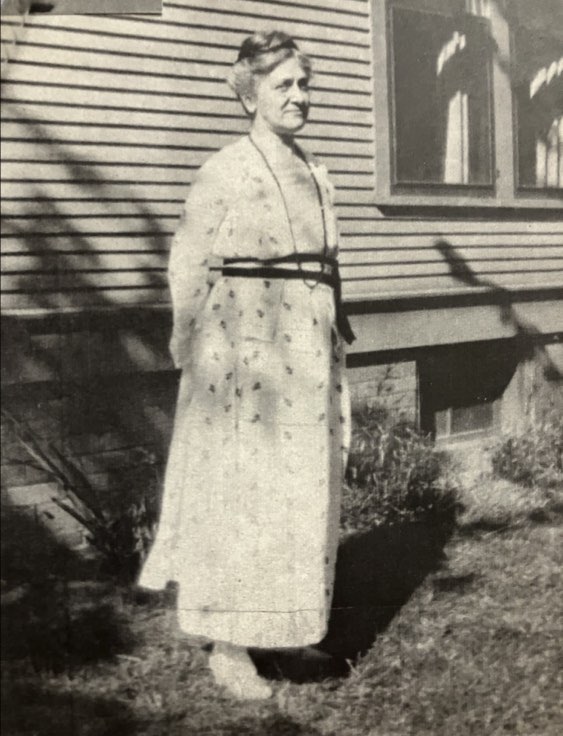
The photograph is not my friend. This is Tessie Temple, my maternal grandfather’s mother. I do not have a date nor who took the photograph. Another photograph is stamped on the back: Battle Creek. She must have gone to one of the famous sanatoriums, like Kellogg’s, for rest or the cures.