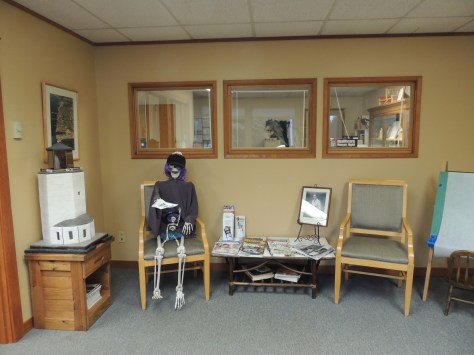
Mordechai on fleek

For the Ragtag Daily Prompt: fleek.

In October, Mordechai the plastic skeleton hangs out in the Quimper Family Medicine waiting room. She changes outfits. We had a 10 year old visitor who rearranged everything and now Mordechai is on fleek. She is holding out emergency preparedness pamphlets.

DSCN4262.JPG


The chances of a poet reaching us are slim

I wrote this after working at Madigan Army Hospital in 2009 for three months as a temporary doctor. I am posting it here because Shoreacres sent me this link about poetry and medicine.

____________________

I would pray if I could. It seems ludicrous to pray for a poet, but there it is.

It started with two soldiers. The Army was embedding a behavioral health specialists (the new politically correct term for mental health specialists) in units starting before 2010. Soldiers were trained in suicide prevention, instructed to stay with a buddy if they made any comments about suicide. A soldier was to walk his or her buddy directly to the behavioral health specialist or to to higher rank. As soldiers went on their fourth and fifth tours, post traumatic stress disorder, depression and traumatic brain injuries were rampant. Unfortunately, psychologists basically felt like they were putting Power Ranger band-aids on hemorrhaging brain arteries. It wasn’t working.

A soldier was accompanying a convoy in Iraq when an IED went off. Right through the bottom of a convoy truck. The driver died screaming from an arterial groin bleed. Two of the eight soldiers were killed. The truck was abandoned and the rest of the convoy got back to the safe (mostly) zone. That soldier had the glassed ghost look in her eyes and got quiet. The usual response was to avoid someone’s eyes and hope for the best, but another soldier wouldn’t let her alone. She kept asking, “Tell me. What happened?”

The first soldier finally snarled out part of the story.

The second soldier pinned a poem to her pillow, describing the event. Our first soldier came in screaming and threw the crumpled ball of paper at her chest. “That’s not what happened! That’s not how I felt! Not even close!”

“Well, what DID happen!” The rest of the unit tried to hide in plain sight or disappeared to the bathroom or got really interested in books or watching the same video over and over, but the two of them stood face to face and went at it. Words, not fists. The crumpled paper was retrieved, the poem rewritten. It took two weeks before soldier one suddenly said, “That’s it. That’s pretty good. For a poem.” But she was back, her gruff foul mouthed efficient self.

Of course it wouldn’t have gone anywhere if the behavioral health specialist hadn’t joked about it to his superiors. The Army was really desperate. In spite of all the work, the suicide rate was still challenging the combat death rate, and there just weren’t enough people to deploy.

The Army went looking for poets. Four were promptly deployed into units. Two of them turned out to be pretty useless, but the other two: the units thrived. Word started getting around. The poets were swamped with people from other units.

The recruiting campaign: “We want you, yes we do, poet show your heart so true!” was painful, but the Army did not care. And poets stepped forward from within the ranks! Don’t ask, don’t tell turned on it’s head. In spite of the medical community’s cries for waiting until more scientific studies were done, and the press and cartoonists drawing pictures recruiters welcoming wimpy pale asthenic writers with open arms, the Army embedded a poet in every unit, right beside the behavioral health specialist. Oh, of course they tried prose too. The academics had a field day fighting about why prose didn’t work. But it didn’t.

It’s the height of irony that we’re cut off with everything we need, except a poet. A water source, food, ammunition. We’re holding our position. Our back up poet is dead ten days ago, but our main poet got an IED blast. Traumatic brain injury, two weeks ago. We can’t get him out, of course. You would think someone would bleed if they were that bad, but he just can’t hold on to any memory. The soldiers tell him their stories, he struggles and tries, but he can barely hold on to one line. Can’t read, though he can write. Can’t see very well either.

The whole unit is starting to look glass-eyed and haunted. Smith asked to go in the jail yesterday and for the door to be closed. He promptly started screaming. It got quiet after a while so they went in. He was sitting on bunk. “Ok.” he said. “I might come back tomorrow.” Some soldiers are writing their own limericks or free verse. It’s ironic that it hurts morale so much, knowing there’s help available. Knowing the chances of a poet reaching us in time are very slim.

________________________

I will use this for the Ragtag Daily Prompt: comeback.

Speaking up

For yesterday’s Ragtag Daily Prompt: justice.

I keep hearing “Why didn’t she speak up sooner?”

I spoke up. I was 7. The abuser was a neighbor. Nothing was done. I thought it was my fault, that I was not a virgin, and that at age 7 I was pregnant. I did not understand puberty. I spoke up to my mother, who dismissed it.

So I did the only thing I could: I tried to protect myself and my four year old sister. I told her never ever to go near that neighbor. And I never went near him again.

I was taken for a well child check a month or two later. I didn’t say anything but I thought that surely the doctor would have noticed if I was pregnant, so I must not be.

I grieved on the school bus, thinking that I was the only girl who was not a virgin. I was wrong about the not a virgin, but I also was probably wrong about being the only girl.

I didn’t even realize that hello, I was seven, it was not my fault, I didn’t even understand what was happening. I didn’t understand until I was in college and heard a radio program about how women who are raped feel guilty. Here is a poem about that realization: The bacon burning.

So do you think I spoke up after that? Why would I? No one helped me and I was silenced. I learned this lesson: no one will help and I am on my own. I did speak up in medical school: Make a difference.

Where is justice? And do you really want us ALL to speak up now? About ALL of it?

When I was in my early teens, a friend of my parents french kissed me. He said, “I wanted to be your first french kiss.” Hello, I avoided him after that and did I want a french kiss from an old friend of my parents? He had a PhD but no boundaries, no emotional intelligence and poor ethics.

Shall I go on? In college I worked in two labs: both fruit fly labs. In one the graduate student was professional, courteous and quickly gave me a raise. In the other, I never saw the professor again and I was ignored. I went to resign from the second. The PhD professor said, “What do you plan to do after college?”

“What do you mean?” I asked.

“Do you plan to get married and become some man’s cow?”

Oh, really? Do you Mr. PhD professor refer to all married women as men’s cows? Would you have the same conversation with a male student? I quit. I don’t like you or your lab and that sort of comment reinforces my dislike.

In medical school we had two female physicians on the faculty. One was married but no children. Residents joked about her, that she had the balls in the family, because they were both physicians. The other was not married, an OB-gyn. We asked her to speak to our Women in Medicine group about children and career.

“If you want to be taken seriously as a physician, you should not have children.” she said.

I asked, “What if we have a house husband?”

“No man’s ego could stand up to that,” she replied.

I have children and a career.

I had worked in a clinic for a year and another provider talked to me. “Do you know that they are paying the other physician (male) twice what they are paying you?”

Oh, really? I set up a meeting with the administration.

“Oh, the male physician is the clinic director, that’s why we pay him more.”

This was a lie. I had been in the clinic for a year and there had never been one word that he was clinic director. The next year they standardized paying us by RVUs: his salary went down and mine went up. And so justice was done, right? No, the male physicians are given jobs such as head of hospice or medical director and extra money. Do they work harder? The jobs are not offered to the women physicians.

A male physician at the hospital was made chief of staff. He asks me in the hall, “Do women physicians just quit because they want to stay at home with children?”

“Do you want a serious answer?” I said. He looked surprised. We went to an office and I discussed that almost all the hospital staff were women at that time and that they have a different relationship with female physicians than male physicians. Most of the administrators were male, white males.

So really, do you want all the women in the US to speak up? Maybe we all should. The above is not anywhere near an exhaustive list, it is a start. This is just from thinking about it for two days. I can fill pages…..



stay or go?

For the Ragtag Daily Prompt: migration.

I took this on a beach walk with my aunt and uncle on Sunday. They were visiting from Virginia. They’ve flown back now.

This is taken with the zoom all the way out. I recognized the great blue heron, but in the first picture I can’t tell what the geese are. With a face in profile in this second photograph it’s clear that they are Canada geese.

The geese are migrating but the great blue heron stays and winters over. Most of our hummingbirds migrate, but the Anna’s can winter over. And I have been asked: stay or go? My landlord asks if I will renew my lease for my clinic in February.

I reply that I am waiting on the US Congress. My clinic is more than half medicare patients. 48% are over age 65. Congress is discussing paying a flat fee for medicare visits: about $43.00 dollars. At the moment I do not see how I could keep my small solo clinic open if that goes through. Stay or go? It is stressful. I want to stay. But I may have to migrate like the geese….

I think a frightening number of physicians would either migrate or stop taking medicare patients, opt out of medicare, if Congress passes this bill. The AAFP is fighting it. I contact Congress too, but I am tired of fighting for single payer, medicare for all. Patients spend more on their dogs’ health than their own. How can I do good care and feel valued for $43.00 per clinic visit?

I thought the thing most likely to close my clinic is the cost of my own health insurance. But Congress may close me down by dropping my payments from 48% of what I bill, to less than 25%. Yet they say they want good care for our country….

Message me if you contact Congress to say do not do this. And thank you so much if you do.

The proposal for medicare changes is 1472 pages. So I am supposed to find time to read that and comment on it in addition to taking care of my patients? What sort of insanity is this?

admit deny

For mindlovemisery’s prompt: opposing forces. The prompts are admit/deny and presence/absence.

The pairs bring up my current sadness right away. I am struggling with the realization that we have a pervasive legal substance that works at the opiate receptor, is all over the US, and I have to send out urine tests for ALL of my chronic pain and opiate overuse and anyone on any controlled substance. You say, “but it’s legal”. I say, “Overdose and death risk. I can’t ignore it.” Here is the resulting poem.

admit deny

admit to yourself you deny your addiction
the presence of the drug means the absence of the one I love


Container dream

I dream I am at a concert in a park. Or some very big event. With my significant other. It is a beautiful day, the sun is shining, the grass is green, there are rolling hills and trees. People are arriving.

There is a gasp of horror. There is a large box, like the hold of a ship. We hurry to look in: there are three open containers down inside, tops removed. They are full of children. Smuggled? Immigrants? The containers are surrounded by water. My significant other and I drop our things and climb down the long hold ladder into the water, which is cold, filthy, and comes up to my thighs. I’ve kicked off my sandals. We are wading to the containers. An ICE agent in a black uniform, bullet proof vest, belt with tools and guns, and riot helmet, blocks me and says, “You have to be wearing shoes to help.” He is handing out plastic stretchers. He can’t see my feet. Yes, I know it’s dangerous and my feet could get cut, but this is probably sewage and dangerous even with shoes. We should really be in hazmat gear but the kids could be dying. I just look at him, silent, and he hands me a stretcher.

Enough people have come forward, into the water, that all the kids have been placed in one of the containers. None of them are dead. They are being lifted out one by one, to ambulances. Now the hold is surrounded by rubberneckers. I climb out and find my purse and camera and shoes. I am grateful no opportunist has stolen them. The ICE agents are telling people to back off and give them room to work. The news crews are there and a Washington State politician says, “This is Washington State, we will take care of these children, we will not see them separated and incarcerated, I will see that they are returned to their parents.” Good luck, I think, but at least there are tons of witnesses and cameras and news crews.

I need to find somewhere to scrub my legs down with soap and to find my significant other. It’s getting more crowded.

I wake up.

And what I notice is that the water did not stink and was not full of lumps of floating excrement. As I wake I hope that I won’t catch something horrible and die….usually my dreams have full sound, color and smells too. I wonder where the children were from, and why, and whether they had some sort of sanitation….

Tobacco Use Disorder

With the DSM-V, there is no longer a separate diagnosis of Opioid Dependence and Opioid Addiction. The two are combined into Opioid Use Disorder. Opioid Use disorder can be mild, moderate or severe. And all of the addictive substances have the same list. So here is Tobacco Use Disorder.

According to the DSM-5, there are three Criterion with 15 sub features, and four specifiers to diagnose Tobacco Use disorder. Use of tobacco products over one year has resulted in at least two of the following sub features:

A, Larger quantities of tobacco over a longer period then intended are consumed.

1. Unsuccessful efforts to quit or reduce intake of tobacco

2. Inordinate amount of time acquiring or using tobacco products

3. Cravings for tobacco

4. Failure to attend to responsibilities and obligations due to tobacco use

5. Continued use despite adverse social or interpersonal consequences

6, Forfeiture of social, occupational or recreational activities in favor of tobacco use

7. Tobacco use in hazardous situations

8. Continued use despite awareness of physical or psychological problems directly attributed to tobacco use

B. Tolerance for nicotine, as indicated by:

9. Need for increasingly larger doses of nicotine in order to obtain the desired effect

A noticeably diminished effect from using the same amounts of nicotine

C. Withdrawal symptoms upon cessation of use as indicated by

10. The onset of typical nicotine associated withdrawal symptoms is present

11. More nicotine or a substituted drug is taken to alleviate withdrawal symptoms

Additional specifiers indicate the level of severity of Tobacco use disorder

1. 305.1 (Z72.0) Mild: two or three symptoms are present.

2. 305.1 (F17.200) Moderate: four or five symptoms are present.

3. 305.1 (F17.200) Severe: Six or more Symptoms are present

(American Psychiatric Association, 2013).

from: https://www.theravive.com/therapedia/tobacco-use-disorder-dsm–5-305.1-(z72.0)-(f17.200)

We have much more stigma attached to Opioid Use Disorder, but list for Tobacco Use Disorder is the same. Most chronic pain patients on long term opioids qualify for at least mild Opioid Use Disorder. UW Telepain says that if they only have withdrawal and tolerance, then it is questionable if they qualify. They also have said that “we don’t know what to do with patients with mild opioid use disorder”.

I find our culture peculiar. People get accolades for saying “I am quitting smoking.” or “I am a recovering alcoholic.” But it’s not ok to say “I am a recovering opioid addict.” People will shun you. Demonize. Gossip. It’s all addiction, so we should stop the demonization and stigmatization and help people and each other.

The photograph is not a brain. I took this about a month ago: it’s a brain size mushroom that was in the church lawn…

Why can’t I just call for a referral?

Why, you say, do you need to SEE your doctor for a referral? It’s so stupid!

Multiple reasons:
1. Triage.
2. Scarce resources.
3. Your primary care may be able to handle it.
4. The specialist only wants to see people that they can help.
5. You may think that you and Dr. Google have it figured out, but Dr. Google sucks.
6. For physical and occupational therapy, it has to do with caution and malpractice insurance.

Let’s go through them backwards.

6. People call for a referral to physical therapy. I say I need to see them. No, I can’t make a diagnosis through the phone. Arm hurts is rather vague. The person says their insurance does not need a referral. But then the physical therapist wants one: why? Well, my malpractice outranks the physical therapists, so to speak. If the therapist sees you without your doctor examining you and something happens… yes, things have happened.

5. Dr. Google. You’ve read extensively and you know exactly what is going on and you just need the referral. No, you have not gone to medical school or residency. Every quack who can say anything even faintly convincing now has a website. Dr. Google sucks. There are very very rare exceptions to that…

4. The gastroenterologist does not want to see your bladder problem. The neurosurgeons hate seeing the people that will not benefit from back surgery, but they have to because the back pain patient doesn’t believe me, so the patient has to hear it from the surgeon. The patient thinks I am “gate keeping” them from the specialist. I’m not.

3. Primary care learns to handle a lot of things. One frequent referral is a postnasal drip, to the Ear Nose and Throat specialist. I recommend trying an acid blocker first. The person doesn’t believe me. “I don’t have heartburn.” I sigh, and do the referral. $450.00 later, the ENT has put the scope through their nose and put them on an acid blocker.

2. Scarce resources: We had 8 neurologists on the Olympic Peninsula for about 450,000 people. We are down to two. I called one for a complex stroke-that-wasn’t and had to do a series of MRI/MRA studies looking for specific things. It was a vertebral arterial bleed. Rare. I called the neurologist back and he said, “Send them to the other one. I am swamped.” He is in the larger population area and two others quit. The rule is sickest is seen first…

1. Triage. What is wrong, what are we worrying about and how sick is this person? If they are really sick I will call the specialist to ask for recommendations, or which test to do, or see if they need to be seen within a short time. I am not going to interrupt the specialist unless I think it’s really necessary! That would burn through my carefully built credit with them! And I have had a person come in for a new patient visit for a “lung problem”. I call the specialist, get him seen and he has a heart bypass….

0. And I am a specialist too. I am a Family Practice physician, board certified and board eligible, three year residency. The internist, the pediatrician, we are all specialists and all special.