bust

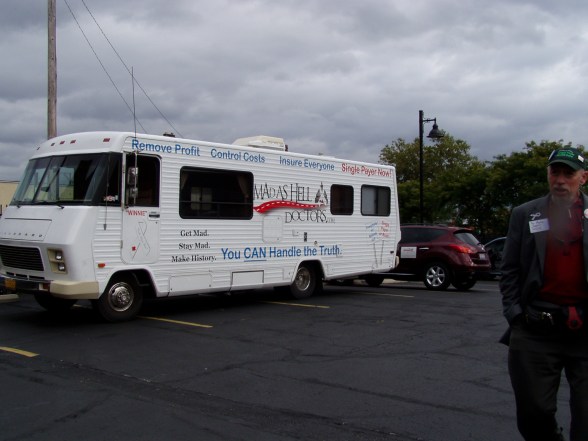
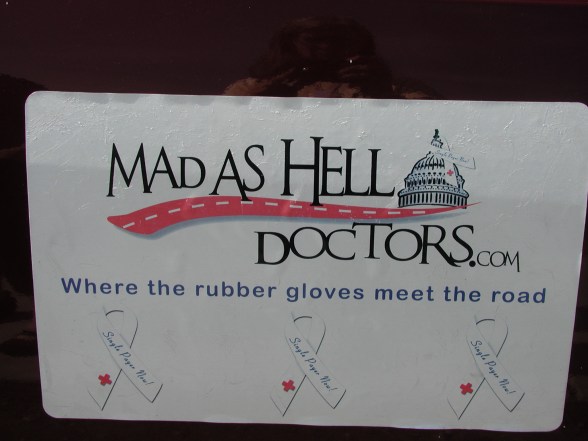
I took this in 2011, as a Mad as Hell Doctor, traveling around California talking about single payer.

We are losing more and more physicians. Our three counties, 450,000 people, are down from 8 neurologists ten years ago, to 2. The last one standing in the county of 350,000 says that he is really tired.

Single payer, medicare for all….. because I dream of other countries, civilized countries, countries where there is one set of rules, I can take care of any person who comes to me, I know what is covered and what is not, and I actually get paid….


primary care medicine: schedule

I see patients from 8:30 or 8:00 am until 2:00 pm.

We have people say, “You are off after 2:00.”

Well, no. Most days I work for 2-3 hours beyond the patient contact time. Sometimes I come in early and sometimes it is from 2pm to 5pm and sometimes it is the weekend or into the evening.

So what am I doing?

  1. returning phone calls
  2. doing refills. To do a refill I check when the patient was last seen and whether they are due for laboratory.
  3. reading specialist notes and updating medicine lists, diagnoses and contacting patients to get tests or follow up that the specialist has recommended
  4. reviewing lab results and sending a letter or signing to be scanned and to be available at the follow up visit or calling the patient
  5. reading emergency room notes and hospital discharge summaries and setting those patients up for follow up, updating medicine lists and adding to diagnosis lists.
  6. dealing with multiple stupid letters from insurance companies questioning the medication that I have prescribed. Mostly I mail these to patients.
  7. running my small business: long term planning, short term planning, advertising, commercial insurance
  8. 50 hours of continuing medical education yearly
  9.  Updating my medical license, medical specialty board eligibility, business license, CAQH, DEA number, Clia lab waiver, medicare’s shifting rules, medicaid’s shifting rules, tricare’s rules, and 1300 insurance company’s shifting rules and medicine rejections and prior authorizations even for a medicine a person has been on for 20 years.
  10. Worrying about small business costs as reimbursement costs drop: health insurance. Retirement. L&I. Employees. Malpractice insurance, small business insurance, the lease, staff costs.
  11.  Discussing and updating medical supplies and equipment, office supplies and equipment
  12. Updating clinic policies and paperwork per the change in laws. Have you read the Obamacare Law? Over 3000 pages. HIPAA. The DEA. Recommendations from the CDC, federal laws, state laws, internet security, patient financial and social security security.
  13. Trying to track what we collect. That is, say I bill $200.00. Since I accept insurance, the insurer will tell me what is the “allowed” amount per me contracting as a “preferred” provider. The “allowed” amount is really the contracted amount. Then the insurance company either pays it or says that the patient has a deductible. This could be $150 per year or $5000.00 per year. With medicare I then have to bill a secondary if the person has it and then anything left is billed to the patient. Oh, don’t forget copays, if they don’t pay that we have to bill it. So to get paid the complete contracted amount, aka “allowed” we may have to submit bills to two or even three insurances and the patient. We might be done two months after the patient is seen.
  14. Trying to convince recalcitrant computers and printers and equipment that indeed, it doesn’t have a virus, oh, or maybe it does, and fixing them.

My goals are to give excellent care AND to work 40 hours a week. Half of my patients are over 65 and many are complicated, with multiple chronic illnesses.  When I saw patients 4 days a week for 8 hours, with an hour hospital clinic meeting every day, I also spent at least an additional 8 hours and more trying to keep up with most of those things above. The average family practice physician makes more money than I do. But they also report working 60-70 hours a week on average. I do not think this is good for patients or doctors or doctors’ families or their spouses or children. The primary care burn out report rose from 40% to 50% of the doctors surveyed.

We need change, we need it now, and we need to be realistic about how much work is healthy.

When I was still delivering babies, women would ask if I could guarantee doing the delivery. I would explain: “We do call for up to 72 hours. If you go into labor at the end of that, you would rather have a physician who is awake and rested and has good judgement. Besides, I’m a bit grumpy after 72 hours. ” And they agreed that they really don’t want an exhausted burned out physician.

I took the photograph of Mordechai, our skeleton, today. She is genuine plastic. I wish she would do some of the paperwork, but at least she lightens things by making us laugh. She gets various wigs and outfits and sometimes comes out to show a patient a hip joint.

I am NOT attracted to paperwork. I think I am repelled. For the Daily Prompt: magnetic.


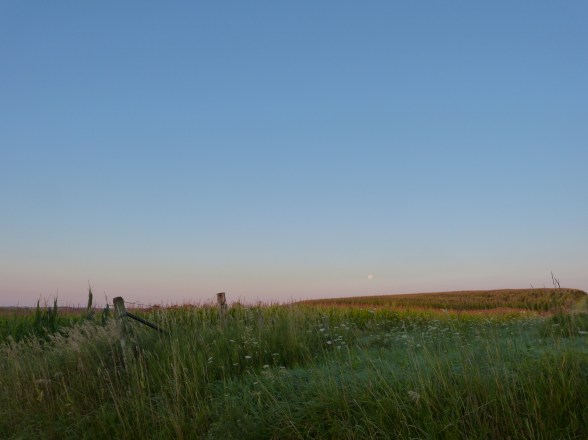
moon in morning

For the weekly Photo Prompt: Ohh, Shiny!

But, you say, it isn’t shiny.

No, it isn’t. Because even shiny things today are not distracting me from my grief about our country, the lack of ethical morals in our government and twitterpated tweets going out daily.

And here is the moon watching as the sun rises and light and warmth fall over the earth. The mood matches mine: quiet and still thinking of the dark and of love and of hatred and of grief.

Moon in mourning.


solitary tree and thought

Sunrise in Wisconsin last week.

My solitary thought this morning is about ethics. It does not matter what the other person has done, we still must be true to our ethical values. This means that a contractor can’t refuse to pay a worker. I am thinking of my own behavior but I am also thinking of the White House. I want an ethical president, a president who takes responsibility, a president who does not blame others, a president who stands up for what is right. A president who put ethical values first. Not money. Not predation. Not fake news. Not lies. Not corporations over citizens. Citizens are people. A corporation is not a person.

I want an ethical president who will not lie.


But I don’t want to pay for the obese smoking couch potato

I wrote this in 2010 and I am posting it again. It’s TIME, Congress, time for single payer, medicare for all! Lots of Senators are all talk about repealing Obamacare. One part of that law is that your health insurance company can ONLY keep 20% of each dollar for profit. The other 80% must be spent on health care. Before that, health insurance companies kept 30% of every health dollar. So tell me, US citizens, WHY do you want to repeal that? So health insurance corporation owners can go back to keeping 30% of every premium? Call you Senator and say NO.

And by the way, Senators who want to repeal Obamacare. You could have been writing a new bill with transparency and honesty for the last seven years, but all you’ve done is say “We will repeal Obamacare.” Saying “We can do better,” is boasting: you haven’t done the work. Stop hiding behind closed doors. I am submitting this to the Daily Prompt: hidden.

From 2010:

I went on the Mad as Hell Doctor’s tour for a week. I went from Seattle to Denver with stops for town halls one to three times a day. We are talking about single payer, HR676.

One question or objection to a single payer system was: Why should my money go to pay for some obese person who drinks and smokes, doesn’t exercise and doesn’t eat right?

Three answers to start with:

1. You already pay for them.

2. Put out the fire.

3. People want to change.

First: You already pay for them. As a society, we have agreed that people who show up in an emergency room get care. Suppose we have a 53 year old man, laid off, lost his insurance, not exercising, not eating right, smokes, drinks some and he starts having chest pain. Suppose that he lives in my small town.

He calls an ambulance. They take him to our rural emergency room. Oh, yes, he is having a heart attack, so they call a helicopter to life flight him from small town hospital to a big one in Seattle. This alone costs somewhere between $7000 and $12000. Now, do you know how many clinic visits he could have had for $7000? To see me, a lowly rural specialist in Family Practice where I would have looked at his blood pressure and nagged, that is, encouraged him to stop smoking. We would have talked about alcohol and depression. And who is paying for the helicopter meanwhile? All of us. The hospital has to pass on the costs of the uninsured to the rest of the community, the government is paying us extra, with a rural hospital designation. 60% of health care dollars already flow through the government. One estimate of the money freed from administrative costs by changing to a single payer system is $500 million.

Taking care of people only when they have their big heart attack is ridiculously expensive. It is a bit like driving a car and never ever doing maintenance until suddenly it dies on the highway. No oil, tires flat, transmission shot and ran into a tree in the rain because the windshield wiper fluid had been gone for a while. I get to take care of Uncle Alfred. He is 80 and has not seen a doctor for 30 years and is now in the hospital. “But he’s been fine,” says the family. Nope. He has had high blood pressure for years, that has led to heart failure, he has moderate kidney failure, his lungs are shot from smoking, turns out he developed diabetes sometime in the last 30 years and he’s going blind. Can’t hear much either. We have a minor celebration in the ICU because he doesn’t drink, so his liver actually works. He goes home on 8 new medicines.

Secondly: Put out the fire. When someone’s house is burning down, as a society we do not say, well, she didn’t store her paint thinner right or trim her topiary enough and she has too many newspapers stacked up. We go put out the fire. Putting out the fire helps us as a society: it keeps the fire from spreading to other houses. It saves lives and is compassionate. We think firemen and women are heros and heroines. And they are.

In the past, a homeowner would have to pay for fire service and would have a sign on their home. If the house was on fire and a different company was going by, that company wouldn’t put out the fire. We have the equivalent with health insurance right now. It would be much more efficient and less costly to have a single payer. Medicare has a 3-4% overhead: it is a public fund paying private doctors and hospitals. For private insurers the administrative costs are 30% or greater. That is, 1/3 of every dollar of your premium goes to administration, not health care. The VA is a socialized system, with the hospitals owned by the government and the medical personnel paid by them.

When someone asks why they should help someone else, I also know that they haven’t been hit yet. They have not gotten rheumatoid arthritis at age 32 or had another driver run in to them and broken bones or had another unexpected surprise illness or injury that happened in spite of the fact that they don’t smoke, don’t drink, eat right and exercise. Everyone has a health challenge at sometime in their life.

Third: people want to get better. Really. In clinic I do not see anyone who doesn’t hope a little that their life could change, that they could lose weight, stop smoking. True, there are some drinkers who are in denial, but I will never forget taking the time to tell a patient why he would die of liver failure if he didn’t stop drinking. He came back 6 weeks later sober. I said, “You are sober!” (We don’t see that response very frequently.) He looked at me in surprise: “You said I’d die if I didn’t stop.” He never drank again. It made it really hard to be totally cynical about alcohol and I can’t do it. People change and there is hope for change. I feel completely blessed to support change in clinic and watch people do it. They are amazing. But they need support and they need someone to listen and they need a place to take their fears and their confusion. Primary care is, in a sense, a job of nagging. But it is also a job of celebration because people do get better.

We are already paying, in an expensive, inefficient and dysfunctional way. It saves money to put out the fire. People want to get better. Winston Churchill said, “Americans always do the right thing after they have exhausted all other possibilities.” It is time to do the right thing. Single payer. The current bill is HR676. We can and we will.

Patients or profit?

We can choose single payer, medicare for all, with overhead of 3-4 percent. That means 96-97 cents out of every dollar goes to HEALTH CARE, not PROFIT.

Or we can choose PROFIT:  the current law says that the private insurance companies have to spend 80 cents of every dollar on health care. 20 cents to PROFIT.

The insurance companies’ goal is to earn money, PROFIT, not give health care.  They are posting BILLIONS in profit.

The person on the phone who says your medicine or care is not covered? I think the insurance companies say that is health care. They are paying the person to refuse your care. They send us weekly updates on what has changed in the 1300 different insurance companies and I don’t know how many insurance plans because they all have more than one. You ask me, your doctor, if something is covered and I say, “I have no idea. It was covered last month. It should be covered. I don’t know.” The insurance companies pay people to write an individual website for every insurance company: 1300 websites. Can YOU keep track of 1300 log ons and 1300 passwords? And I think the insurance companies say that the money paid to set up the website is health care. I don’t think it’s health care, do you?

I want my health care dollar to go to HEALTH CARE not PROFIT.

Stop the bill. Stop the insanity. Stop putting INSURANCE COMPANY PROFITS in front of HEALTH CARE. We the people of the United States can decide and can tell Congress what we want.

Medicare for all, one set of rules, 3-4% overhead, we are one nation, under God, indivisible.

And we do not put profit first.

Physicians for a National Health Program: http://www.pnhp.org/

March for people

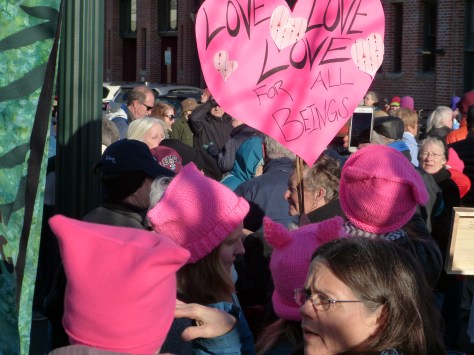
My daughter and I marched yesterday.

She decided to come home from college for the weekend, planning to leave Saturday night. I decided not to go to the Seattle Womxn’s march, but do the Port Townsend one and asked her to join me.

We went out to breakfast and then to our small downtown. I no longer have television and look at news sites daily though a bit erratically, so neither of us had a pink hat. I wore my Mad As Hell Doctors t-shirt, my lab coat from working at the National Institutes of Health with the National Cancer Institute Patch, my Rotary name badge and pins gathered from going across the country trying to get medicare for all, single payer health care, from 2009 until now.

to womxn'smarch 089.JPG

Four bus loads went from our county to the Seattle march. We heard that the Bainbridge ferry was FULL. That is, they couldn’t not take any more walk on people. Another thirty people or more flew to the Washington DC march. And in Port Townsend, my guess is that we still had 200-300 people, women, men and children, people in wheelchairs, babies, gay, lesbian, straight, bi, trans, that marched from a small park downtown to the Haller Fountain. Galetea, naked statue at the fountain, sported a pussy hat.

to womxn'smarch 104.JPG

Our local organizer spoke and our House Representative, Derek Kilmer.

to-womxnsmarch-139

Older women spoke about demonstrating over and over in their lives. A friend of mine called me up to help her sing Holly Near’s Singing for Our Lives, making up new verses on the fly. They invited people to speak.

to womxn'smarch 152.JPG

I spoke: “I am one of your local doctors. I want to be able to treat anyone who comes to my clinic. We are one nation: health care for all. No discrimination: medicare for all.”

to womxn'smarch 157.JPG

to womxn'smarch 114.JPG

to womxn'smarch 150.JPG

Home then, and tired. My daughter has decided she wants to learn guitar, to play while people sing. I taught her basic chords and basic strumming. We sang Jamaica Farewell. She picks it up immediately, after all of those years of viola. And she will take one of my father’s guitars back to college.

And this is amazing: https://www.nytimes.com/interactive/2017/01/21/world/womens-march-pictures.html?smid=fb-share

Blessings all around.

Physicians for a National Health Care Program: http://www.pnhp.org/

https://dailypost.wordpress.com/prompts/successful/

Bruise, muscle and bone

I asked an older patient recently, “What is a bruise?”

She thought about it and said, “I don’t know.”

A bruise is blood, bleeding. Old blood changes color and is reabsorbed by the body as it heals. But where does that blood come from?

Any tissue in the body can bleed. Even a tooth, if broken into the center.

So what is bleeding for MOST bruises?

Muscle. Muscle, muscle, muscle, tendon, ligament, fascia, occasionally bone if broken and internal organs can bleed as well.

Somehow we entirely fail to teach this, at least in the US.

If you fall, or like my mountain biking daughter, hit something, your body will bleed. I tried to train the mountain bike team to carry an ace wrap and use it any time they hit something hard with an extremity. I pretty much failed. Why do I want an ace wrap and why use it immediately?

Trauma or hitting something hard causes bleeding. The more the muscle and tissue bleeds, the more swollen it gets. Usually the peak of bleeding and swelling is at about 48 hours after the injury. By then the body is sending immune system cells and repair cells to fix the trauma. It is swollen, red, hot, inflamed and painful! If we ace wrap our ankle or foot or elbow immediately, the bleeding stops faster. Wrap it, ice and elevate to keep the bleeding down. The torn muscles are held in their normal position, the bleeding stops more quickly, there is less swelling, less redness, inflammation and pain!

Our acronym is RICE:
Rest
Ice
Compression
Elevation

There are things that you can’t ace wrap: don’t ace wrap your neck or ribs and if it’s bad trauma to the head, neck, chest or abdomon, go to the emergency room! But even then, ice and compression help. First check airway, breathing and circulation, that the heart is beating if you happen on a trauma. But then try to use pressure on bleeding.

Do not put heat on a bruise for that first 48 hours. Why? It bleeds more and swells more. The exception may be if you do much more exercise than usual without a localized injury: hydrate, stay away from alcohol and a hot tub or hot bath may help. The hydration and hot water help the muscles relax and wash out the CK, creatine kinase, the protein from tiny muscle traumas that make us “stiff”.

The I in RICE used to mean ibuprofen as well. However, ibuprofen and aspirin and naprosyn are all blood thinners, so they may help with pain and inflammation, but may make the bruising worse. Acetominophen is not a blood thinner and also doesn’t do as much for inflammation, but it may be a better choice. It does help with pain.

In her third year of mountain bike racing, the Introverted Thinker had a quarter size bruise on her knee after a race.

“Are you going to do anything about that bruise?” I asked.

“No, it’s small.” she said.

“Ok.”

Two hours later: “Mom? Would you look at my knee?” Now the bruise is the size of an orange.

“Hmmm. What are you going to do about that?”

“I think I might ace wrap it and ice it and put it up for a while. Where is the ace wrap?”

Good plan. It didn’t get any bigger.

I see the handouts from the emergency room given for back pain and they are terribly misleading. It shows the spine and talks about the discs. 99% of the back pain I see is NOT a disc: it is the six layers of back muscles, and complex web of tendons, muscles and ligaments that hold the spine together and let us move in very complex ways. I pull my Netter Anatomy out daily in clinic and show people the six layers of back muscles.

What happens after a muscle is torn and bruised and bleeding? The muscle cramps up to stop the bleeding and attempt to keep from being torn more. No, I don’t like muscle relaxers much as medicines and they are useless long term. For sleep only right after injury. I am not talking about major trauma, but back pain and injuries.

If the muscle heals in the cramped position, it won’t work right any more. It can form scar tissue. It takes about six weeks for a muscle or ligament or tendon tear to heal and during that time we need to gently stretch the muscles without tearing them, so that they heal in the right position. Once they are healed in a scarred position, it’s more work to rehabilitate them, but it can be done. Physical therapy, massage therapy, chiropractor, acupuncture, but the most important work is done BY the patient, not TO them. I can’t fix it with pills. Yes, it is work.

You can bruise bone too. Ow. The surface of the bone is living cells and the bones are continually torn down by osteoclasts and rebuilt by osteoblasts. The bone can be bruised without breaking. Again, 6 weeks to heal, little kids faster and 90 year olds kind of slow.

Take care of your muscles, ligaments and tendons, and they will take care of you.


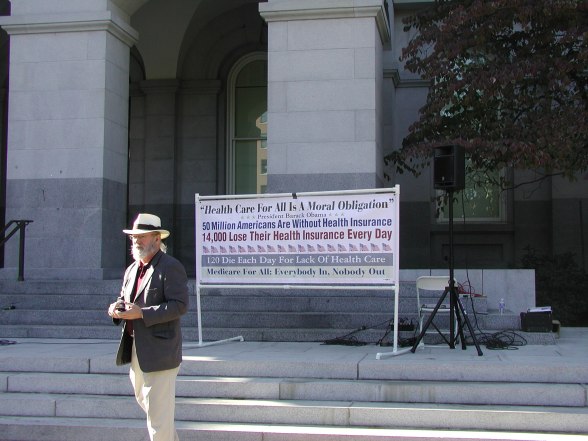
I took the photograph on the first Mad as Hell Doctors tour for health care for all in 2009. I will be marching again today:  WE ARE ONE NATION! HEALTH CARE FOR ALL! NO DISCRIMINATION!  MEDICARE FOR ALL!


Update on marijuana 2016

I attended the Swedish Hospital Update on Chronic Pain in Seattle two weeks ago on the stormy Friday. The power went out and we were without slides from about noon on.

The first two hours and three lectures were about marijuana. Including medical marijuana and one speaker for and one against. So here are some of my notes.

In 1960 and 1970, the marijuana had about 4% THC. Now some strains have 30% THC, so long term there is no data about what 30% THC will do to a person rather than 4%. THC in strains ranges from 0% to 30% and CBD from 0 to 3.5%. However, those two are not the only active ingredients, so to speak. 537 constituents have been identified that work at the cannabinoid receptor…. that is impressive. I think it might take a while to sort out what they do.

At any rate, we don’t know what smoking 30% THC will do, because it’s new. 4% had pretty minimal psychotropic effects. 30% has a lot more. The average now is 12%. Hashish is closer to 66% and hash oil 81% THC. A patient recently told me that she fainted within the last year. She got butter from the fridge at a friend’s and buttered her toast. Turned out it was THC infused butter and she was taken by surprise on a walk 30-60 minutes later. Luckily someone was with her and she was not hurt.

Recent data is showing that there is not much tolerance smoking 12% THC regularly. However, higher doses show tolerance in about 2 weeks in a study of HIV patients with dronabinol, which is 40% THC. Another study of multiple sclerosis patients with 15/15% CBD:THC reduced pain, reduced spasticity and did not show tolerance.

There is anecdotal evidence about seizures, but no study yet. There is some evidence that CBD reduces THC induced paranoia and/or hallucinations. THC side effects from dronabinol include drowsiness, unsteady gait, delusions, hallucinations, mood change and confusion.

The growers are being very creative in names and marketing. This is re recreational pot.
There are hundreds of names and hundreds of varieties and they make interesting claims as to effects. For example:

AK47 with 36.6% THC and 0.3% CBD ….. creative, euphoric and hungry
sage with 27.5% THC and 0.7% CBD ….. attentive
flow with 23.2 % THC and 0.6% CBD ….. happy, relaxed, alert
Super Sour Diesel 22.7 % THC and 0.8% CBD ….. attentive, giggly, hungry
707 Headband with 22.1% THC and 0.7% CBD ….. euphoric, lazy, inspired

How amazing the difference less than a percent of THC makes… oh, wait. There aren’t clinical trials on this, hon, this is MARKETING.

Onset for oral is 30-90 minutes
peak in 2-4 hours
half life 8-12 hours but sometimes 20 hours

sublingual tincture
onset 30-45 minutes
peak 60 minutes
half life 3-5 hours

Smoked onset quicker and I did not get those numbers.

The emergency rooms in Colorado saw lots of people who were “trying it” but if they had only tried smoking marijuana in the 1970s, a strain with a much higher percentage made many people sick or hallucinate or frightened. The gummi bears look just like the ones for kids, so kids got sick. More sick people with edibles, as some eat too much.

People using THC before age 25 who have risk factors for schizophrenia are more likely to develop it. Family history, other hallucinatory drugs, mental health problems. The age 21 limit should be taken very seriously.

In Arizona re medical marijuana, 90% of the prescriptions were from only 24 physicians. In Colorado, 94% of the patients applying for medical marijuana did so for “severe pain”. Two of my friends in their early 20s  got medical marijuana permits in California for “back pain”, um, ok, hooey. Some people DO have severe chronic pain….

The history of medical marijuana is that Eli Lilly produced a medical version from 1850-1940 for pain. It was removed in 1942. In 1970 it became a schedule one, that is, illegal, drug. There are a few randomized clinical trials for pain, the best ones with high CBD/low THC treatments. Marijuana smoke alone has not been proven to cause lung cancer, but combined with tobacco or other smoke, the evidence is that it is synergistic and makes things worse faster. Dependence can occur, an increase in antisocial personality disorders and there is a withdrawal syndrome for dependent folks. For the small number of people I have had working hard to stop, sleep is the most difficult issue. Anxiety as well.

If people state that they use pot a small amount a couple of times a week, their urine sample should clear after a week. If it’s not clear they 1. couldn’t stop and/or 2. were using quite a bit more.

As far as Washington state law, it was described as a mess. Physicians can’t prescribe, they can only “attest” that the person has a problem treatable by medical marijuana. To attest, the physician has to sign a document saying that they are sure that not only has the patient READ the law chapter 69.51A RCW but also “understands the requirements of being a patient”. There are 24 sections. The physician doing this part of the talk said that he would only prescribe to non-driving MS patients in wheelchairs. Because he finds it hard to read the law himself, so the signing that the patient has read and understood it…. well, the driving legality issue is huge. And the provider, including NDs (naturopaths) and ODs (Doctor of Optometry) in Washington can attest. They are then immune in Washington but not at the federal level.

Every marijuana store is legally obliged to have a medical marijuana consultant present at all times that they are open. The medical marijuana consultant has 20 hours of training to get certified. Patients that are certified with an attestation can grow 6 to 15 plants but ONLY after they have been entered into a database which includes the person who signed the attestation and a photo of the patient. If they grow without being entered, they are breaking the law.

Use of THC long term, the risk of addiction is 25-50%. 17% of the addicted folks started during adolescence. Addiction is currently estimated at 9% of people who have tried it overall. About 30% of users have “problem use” and starting before age 18 increases the problem use 4-7 times. The DSM-V has diagnostic criteria for “marijuana overuse syndrome”, including not being able to stop even though the person wants to. Risk factors for addiction and problem use include early use, family history, PTSD (especially sexual abuse), bipolar diagnosis, ADHD, conduct disorder, oppositional defiant disorder. Mediating factors include parental disapproval, parental supervision, academic competence, higher perceived risk and availability.

And am I attesting? No. My MS patients get the attestation from the neurologist if they want it….

Medical marijuana consultant training: http://www.doh.wa.gov/YouandYourFamily/Marijuana/MedicalMarijuana/RulesinProgress/MedicalMarijuanaConsultantCertification
Washington State Medical Marijuana attestation form: http://www.doh.wa.gov/Portals/1/Documents/Pubs/630123.pdf
WA law: http://app.leg.wa.gov/RCW/default.aspx?cite=69.51A
And pain clinics getting closed down: http://www.seattletimes.com/seattle-news/health/pain-patients-scramble-for-care-after-clinic-crackdown/

The tree trunk is a bonsai from the Lan Su Chinese Garden in Portland. I like the thorns…..