Eeeeeee

My theme is happy things, though sometimes they are things where I am trying to find the perspective to love what is happening.

When my son was little, I had Dr. Suess’s ABCs memorized: Ear, egg, elephant, E, e, e!

My words today are everybody, embody and evening.

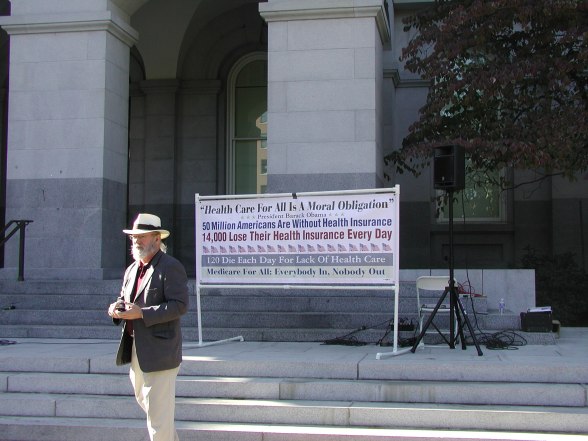
E for Everybody. Everybody in, nobody out! This is one of the calls for Healthcare for all, and I am still a Mad as Hell Doctor, working for single payer.

Our state representative was here a year ago and said that there is not a mandate for healthcare for all. I said, “I politely disagree. We already have a law in place that emergency rooms cannot turn anyone away. They cannot refuse to treat a person. This is a mandate for care. Unfortunately, the emergency room is the most expensive and inefficient care, unless you are about to die. The emergency room cannot do chronic care: it cannot help people stop smoking, help lower blood pressure, help people with chronic illness such as diabetes, do preventative care like pap smears and checking kidney function to stave off renal failure. We have the mandate: now we need the political will to change to a single payer system that gives good care. A patient can see me in my family practice clinic a dozen times for the cost of one emergency room visit.” S o, everybody in, nobody out. The law that insurance companies can ONLY keep 20 cents of every dollar does not comfort me: I want my dollar to go to health care for everyone and not 1/5 to profit!

Embody: what do I embody? What do you embody? Do you treat your body well? Do you thank it? What is it carrying?

I see people so fixed on success and progress and getting goals, that sometimes we don’t pay any attention to our bodies. We treat the body like a tool, like a hammer or a wrench, use and abuse it, try to make it conform to some idea of external beauty, get angry when it breaks down. Fix me back to where I was three years ago, when I could work 12 hours a day and never ever paid attention to my body. Bad food, tobacco, alcohol, marijuana, gallons of caffeine, energy drinks, sugar, illegal drugs, no exercise… and then we are surprised when it breaks down? Even exercise is seen as an inconvenient and necessary job, like buying new tires for the car. When people say get me back to where I was, I ask, “Back to working the 12 hours a day that caused this damage? Do you think that is a good idea?

And I include myself in that! I have had pneumonia with sepsis symptoms twice. The second time I thought, how dumb I am! My father died and I did not take any time off. I just kept working and added executor to my jobs and cried daily. Is it any surprise that after a year of that I became ill? Now my goal is to not do medicine for more than forty hours a week and to listen to my body and to take breaks!

Evening: the sunset. I am so grateful for the day, for the night, for the light changing and the world turning, for the stars and the moon and the sun and the glorious, gorgeous, generous world.

E

This is an evening photograph from Mauna Loa last week.

Make America sick again: diabetes

The trend in diabetes treatment is clear: keep Americans sick.

The guidelines say that as soon as we diagnose type II diabetes, we should start a medicine. Usually metformin.

A recent study says that teaching patients to use a glucometer and to check home blood sugars is useless. The key word here is teach, because when I get a diabetic transferring into my clinic, the vast majority have not been taught much of anything.

What is the goal for your blood sugar? They don’t know.

What is normal fasting? What is normal after you eat? What is the difference between checking in the morning and when should you check it after a meal? What is a carbohydrate? What is basic carbohydrate counting?

I think that the real problem is that the US medical system assumes that patients are stupid and doesn’t even attempt to teach them. And patients just give up.

New patient recently, diabetes diagnosed four years ago, on metformin for two years, and has no idea what the normal ranges of fasting and postprandial (after eating) are. Has never had a glucometer.

When I have a new type II diabetic, I call them. I schedule a visit.

At the visit I draw a diagram. Normal fasting glucose is 70-100. Borderline 110 to 125. Two measurements fasting over 125 means diabetes.

After eating: normal is 70-140. Borderline 140-200. Over 200 means diabetes.

Some researchers are calling Alzheimer’s “Type IV diabetes”. The evidence is saying that a glucose over 155 causes damage: to eyes, brain, kidneys, small vessels and peripheral nerves.

Ok, so: what is the goal? To have blood sugars mostly under 155. That isn’t rocket science. People understand that.

Next I talk about carbohydrates. Carbohydrates are any food that isn’t fat or protein. Carbohydrates range from simple sugars: glucose and fructose, to long chain complicated sugars. Whole fruits and vegetables have longer chain carbohydrates, are absorbed slowly, the body breaks them down slowly and the blood sugar rises more slowly. Eat green, yellow, orange vegetables. A big apple is 30 grams of carbohydrate, a small one is 15, more or less. A tablespoon of sugar is 15 grams too. A coke has 30 grams and a Starbuck’s 12 ounce mocha has 62. DO NOT DRINK SWEETENED DRINKS THEY ARE EVIL AND TOOLS OF THE DEVIL. The evidence is saying that the fake sugars cause diabetes too.

Meals: half the small plate should be green, yellow or orange vegetables. A deck of card size “white” food: grains, potatoes, pasta, whole wheat bread, a roll, whatever. A deck of card size protein. Beans and rice, yes, but not too much rice.

For most diabetics, they get 3 meals and 3 snacks a day. A meal can have up to 30 grams of carbohydrate and the snacks, 15 grams.

Next I tell them to get a glucometer. Check with their pharmacy first. The expensive part is the testing strips, so find the cheapest brand. We have a pharmacy that will give the person a glucometer and the strips for it are around 4 for a dollar. Many machines have strips that cost over a dollar each.

I set the patient up with the diabetic educator. The insurance will usually cover classes with the educator and the nutritionist but only in the first year after diagnosis. So don’t put it off.

For type II diabetes, the insurance will usually only cover once a day glucose testing. So alternate. Test 3 days fasting. Test 1-2 hours after a meal on the other days. Test after a meal that you think is “good”. Also after a meal that you think is “bad”. I have had long term diabetics come in and say gleefully “I found a dessert that I can eat!” The numbers are not always what people expect. And there are sneaky sources of carbohydrate. Coffeemate and the coffee flavorings, oooo, those are REALLY BAD.

For most of my patients, the motivated ones, they have played with the glucometer for at least a week by the time they see the diabetic educator. I have had a person whose glucose was at 350 in the glucose testing. The diabetic educator called and scolded me for not starting metformin yet. The diabetic educator called me again a week later. “The patient brought their blood sugars down!” she said. “She’s under 200 after eating now! Maybe she doesn’t need the metformin, not yet!” Ah, that is my thought. If we don’t give people information and a tool to track themselves, then why would they bother? They eat the dessert and figure that the medicine will fix it or they can always get more medicine.

Type I diabetes has to have insulin. If a type II diabetic is out of control, high sugars, for long enough, they too will need insulin. The cells in the pancreas that make insulin are killed by prolonged high blood sugars.

I went to a lunch conference, paid for by a pharmaceutical company, at the AAFP conference in September. The drug company said start people on metformin at diagnosis and if they are not in control in 3 months, start a second medicine, the drug company’s new and improved and better and beastly expensive medicine!!!

Yeah, I don’t think so. All of my patients are smart and they all can figure it out. Some get discouraged and some are already on insulin, but they are still all smart.

Fight back against the moronization of US citizens. Keep America healthy, wealthy and wise.

bust

I took this in 2011, as a Mad as Hell Doctor, traveling around California talking about single payer.

We are losing more and more physicians. Our three counties, 450,000 people, are down from 8 neurologists ten years ago, to 2. The last one standing in the county of 350,000 says that he is really tired.

Single payer, medicare for all….. because I dream of other countries, civilized countries, countries where there is one set of rules, I can take care of any person who comes to me, I know what is covered and what is not, and I actually get paid….


Too long without touch

walk daily

without earbuds
without phone
without bluetooth

in the wild

walk daily

without family
without friends
without lovers

in the wild

no wild
you say

oh, the wild is here
there
everywhere

find a tree
find a park
find a path

dirt
ground
earth

walk daily

without earbuds
without phone
without bluetooth

in the wild

walk daily

without family
without friends
without lovers

in the wild

walk slowly

slow
each
step

in the park
in the trees
on the path

listen
to the trees
to the grasses
to the ocean
to the lake
to the desert

look up
at the birds

look down
at the insect
at the woolybear
at the mouse

walk daily

without earbuds
without phone
without bluetooth

reconnect

dirt
ground
earth

sky
fire
water
wood

walk daily

reality

connect


I wrote the poem this morning before the daily prompt: enlighten.

I am not enlightening you. I am enlightening ME. I need the touch of the dirt, the earth, grounding, daily.

Blessings. And this is playing:Β https://www.youtube.com/watch?v=u-wt7pRxWuw&index=12&list=RDTH5rqOjYAiM


primary care medicine: schedule

I see patients from 8:30 or 8:00 am until 2:00 pm.

We have people say, “You are off after 2:00.”

Well, no. Most days I work for 2-3 hours beyond the patient contact time. Sometimes I come in early and sometimes it is from 2pm to 5pm and sometimes it is the weekend or into the evening.

So what am I doing?

  1. returning phone calls
  2. doing refills. To do a refill I check when the patient was last seen and whether they are due for laboratory.
  3. reading specialist notes and updating medicine lists, diagnoses and contacting patients to get tests or follow up that the specialist has recommended
  4. reviewing lab results and sending a letter or signing to be scanned and to be available at the follow up visit or calling the patient
  5. reading emergency room notes and hospital discharge summaries and setting those patients up for follow up, updating medicine lists and adding to diagnosis lists.
  6. dealing with multiple stupid letters from insurance companies questioning the medication that I have prescribed. Mostly I mail these to patients.
  7. running my small business: long term planning, short term planning, advertising, commercial insurance
  8. 50 hours of continuing medical education yearly
  9. Β Updating my medical license, medical specialty board eligibility, business license, CAQH, DEA number, Clia lab waiver, medicare’s shifting rules, medicaid’s shifting rules, tricare’s rules, and 1300 insurance company’s shifting rules and medicine rejections and prior authorizations even for a medicine a person has been on for 20 years.
  10. Worrying about small business costs as reimbursement costs drop: health insurance. Retirement. L&I. Employees. Malpractice insurance, small business insurance, the lease, staff costs.
  11. Β Discussing and updating medical supplies and equipment, office supplies and equipment
  12. Updating clinic policies and paperwork per the change in laws. Have you read the Obamacare Law? Over 3000 pages. HIPAA. The DEA. Recommendations from the CDC, federal laws, state laws, internet security, patient financial and social security security.
  13. Trying to track what we collect. That is, say I bill $200.00. Since I accept insurance, the insurer will tell me what is the “allowed” amount per me contracting as a “preferred” provider. The “allowed” amount is really the contracted amount. Then the insurance company either pays it or says that the patient has a deductible. This could be $150 per year or $5000.00 per year. With medicare I then have to bill a secondary if the person has it and then anything left is billed to the patient. Oh, don’t forget copays, if they don’t pay that we have to bill it. So to get paid the complete contracted amount, aka “allowed” we may have to submit bills to two or even three insurances and the patient. We might be done two months after the patient is seen.
  14. Trying to convince recalcitrant computers and printers and equipment that indeed, it doesn’t have a virus, oh, or maybe it does, and fixing them.

My goals are to give excellent care AND to work 40 hours a week. Half of my patients are over 65 and many are complicated, with multiple chronic illnesses.Β  When I saw patients 4 days a week for 8 hours, with an hour hospital clinic meeting every day, I also spent at least an additional 8 hours and more trying to keep up with most of those things above. The average family practice physician makes more money than I do. But they also report working 60-70 hours a week on average. I do not think this is good for patients or doctors or doctors’ families or their spouses or children. The primary care burn out report rose from 40% to 50% of the doctors surveyed.

We need change, we need it now, and we need to be realistic about how much work is healthy.

When I was still delivering babies, women would ask if I could guarantee doing the delivery. I would explain: “We do call for up to 72 hours. If you go into labor at the end of that, you would rather have a physician who is awake and rested and has good judgement. Besides, I’m a bit grumpy after 72 hours. ” And they agreed that they really don’t want an exhausted burned out physician.

I took the photograph of Mordechai, our skeleton, today. She is genuine plastic. I wish she would do some of the paperwork, but at least she lightens things by making us laugh. She gets various wigs and outfits and sometimes comes out to show a patient a hip joint.

I am NOT attracted to paperwork. I think I am repelled. For the Daily Prompt: magnetic.


Health and teeth

For the Daily Prompt: toothbrush.

Here is a young rabbit. Their front teeth grow and get worn down eating. Their nails keep growing too and need to be worn down or clipped if they are pets.

In my county there are no dentists who take the state Medicaid for dental. And in some states Medicaid covers orthodontia for children but not in mine. Teeth are not covered on Washing ton State for my Medicare or Medicaid. And there are still battles going on about covering mental health including addiction. Is mental health not part of health? Are teeth not part of health? Why do we put health insurance profitable before basic life saving health coverage that covers all of us?

Health care should be like a toothbrush. We all need it. We all should have it.


Substandard

What comes to mind for today’s Daily Prompt: substandard?

As a rural Family Practice Physician, what comes to mind is the United States current health care system.

There is nothing substandard about our health insurance system: it does what it is supposed to, which is earn money for owners and investors. But it is frankly terrible at delivering health care, health care is not the goal, and we spend twice as much per US citizen as the next most expensive health care system in the world. And we do not have universal health care for our citizens and we rank below 30th in health care measures.

Wake up, US citizens. Let’s buy health care with our dollars, not health insurance. Single payer, one system, low overhead, clear rules and coverage and everyone in, no one out.


sunrise

JoyΒ  today. I am so deeply thankful that this health insurance bill has been voted down. Health insurance because it was not going to improve health care. It would have increased profits and worsened citizens’ health.

Our chorus performed last night and the music is still playing in my head… from a Shawn Kirchner piece. “It shall be well with you…..”

I took this in 2012.

But I don’t want to pay for the obese smoking couch potato

I wrote this in 2010 and I am posting it again. It’s TIME, Congress, time for single payer, medicare for all! Lots of Senators are all talk about repealing Obamacare. One part of that law is that your health insurance company can ONLY keep 20% of each dollar for profit. The other 80% must be spent on health care. Before that, health insurance companies kept 30% of every health dollar. So tell me, US citizens, WHY do you want to repeal that? So health insurance corporation owners can go back to keeping 30% of every premium? Call you Senator and say NO.

And by the way, Senators who want to repeal Obamacare. You could have been writing a new bill with transparency and honesty for the last seven years, but all you’ve done is say “We will repeal Obamacare.” Saying “We can do better,” is boasting: you haven’t done the work. Stop hiding behind closed doors. I am submitting this to the Daily Prompt: hidden.

From 2010:

I went on the Mad as Hell Doctor’s tour for a week. I went from Seattle to Denver with stops for town halls one to three times a day. We are talking about single payer, HR676.

One question or objection to a single payer system was: Why should my money go to pay for some obese person who drinks and smokes, doesn’t exercise and doesn’t eat right?

Three answers to start with:

1. You already pay for them.

2. Put out the fire.

3. People want to change.

First: You already pay for them. As a society, we have agreed that people who show up in an emergency room get care. Suppose we have a 53 year old man, laid off, lost his insurance, not exercising, not eating right, smokes, drinks some and he starts having chest pain. Suppose that he lives in my small town.

He calls an ambulance. They take him to our rural emergency room. Oh, yes, he is having a heart attack, so they call a helicopter to life flight him from small town hospital to a big one in Seattle. This alone costs somewhere between $7000 and $12000. Now, do you know how many clinic visits he could have had for $7000? To see me, a lowly rural specialist in Family Practice where I would have looked at his blood pressure and nagged, that is, encouraged him to stop smoking. We would have talked about alcohol and depression. And who is paying for the helicopter meanwhile? All of us. The hospital has to pass on the costs of the uninsured to the rest of the community, the government is paying us extra, with a rural hospital designation. 60% of health care dollars already flow through the government. One estimate of the money freed from administrative costs by changing to a single payer system is $500 million.

Taking care of people only when they have their big heart attack is ridiculously expensive. It is a bit like driving a car and never ever doing maintenance until suddenly it dies on the highway. No oil, tires flat, transmission shot and ran into a tree in the rain because the windshield wiper fluid had been gone for a while. I get to take care of Uncle Alfred. He is 80 and has not seen a doctor for 30 years and is now in the hospital. “But he’s been fine,” says the family. Nope. He has had high blood pressure for years, that has led to heart failure, he has moderate kidney failure, his lungs are shot from smoking, turns out he developed diabetes sometime in the last 30 years and he’s going blind. Can’t hear much either. We have a minor celebration in the ICU because he doesn’t drink, so his liver actually works. He goes home on 8 new medicines.

Secondly: Put out the fire. When someone’s house is burning down, as a society we do not say, well, she didn’t store her paint thinner right or trim her topiary enough and she has too many newspapers stacked up. We go put out the fire. Putting out the fire helps us as a society: it keeps the fire from spreading to other houses. It saves lives and is compassionate. We think firemen and women are heros and heroines. And they are.

In the past, a homeowner would have to pay for fire service and would have a sign on their home. If the house was on fire and a different company was going by, that company wouldn’t put out the fire. We have the equivalent with health insurance right now. It would be much more efficient and less costly to have a single payer. Medicare has a 3-4% overhead: it is a public fund paying private doctors and hospitals. For private insurers the administrative costs are 30% or greater. That is, 1/3 of every dollar of your premium goes to administration, not health care. The VA is a socialized system, with the hospitals owned by the government and the medical personnel paid by them.

When someone asks why they should help someone else, I also know that they haven’t been hit yet. They have not gotten rheumatoid arthritis at age 32 or had another driver run in to them and broken bones or had another unexpected surprise illness or injury that happened in spite of the fact that they don’t smoke, don’t drink, eat right and exercise. Everyone has a health challenge at sometime in their life.

Third: people want to get better. Really. In clinic I do not see anyone who doesn’t hope a little that their life could change, that they could lose weight, stop smoking. True, there are some drinkers who are in denial, but I will never forget taking the time to tell a patient why he would die of liver failure if he didn’t stop drinking. He came back 6 weeks later sober. I said, “You are sober!” (We don’t see that response very frequently.) He looked at me in surprise: “You said I’d die if I didn’t stop.” He never drank again. It made it really hard to be totally cynical about alcohol and I can’t do it. People change and there is hope for change. I feel completely blessed to support change in clinic and watch people do it. They are amazing. But they need support and they need someone to listen and they need a place to take their fears and their confusion. Primary care is, in a sense, a job of nagging. But it is also a job of celebration because people do get better.

We are already paying, in an expensive, inefficient and dysfunctional way. It saves money to put out the fire. People want to get better. Winston Churchill said, “Americans always do the right thing after they have exhausted all other possibilities.” It is time to do the right thing. Single payer. The current bill is HR676. We can and we will.