I will fight no more

I am tired of fighting
I am tired of fighting for justice
I am tired of fighting discrimination
I am tired of fighting for health care for all

I am tired of fighting insurance companies
I am tired of fighting medicare’s contractee
I am tired of fighting for prior authorization
I am tired

I will fight no more forever

I heal
I am a healer
I am trying to heal patients
I am trying to help patients heal

I am a healer
I help heal cancer
I help heal heart disease
I help heal PTSD
I help

heal cancer
heal heart disease
heal PTSD
heal addiction

I am a healer

heal the insurance company
heal the medicare contractor
heal the pharmaceutical company
heal

heal anxiety
heal depression
heal addiction

I will fight no more forever

I heal

The legs in the photograph don’t look delicate, do they? They are strong and beautiful and powerful. I took this at the National Junior Synchronized Swimming Competition in 2009. Those girls on the edge of being women are strong, they are a team, they work and play together. They have the skills and the strength to lift their bodies out of the water that far using their arms… think about the practice and strength needed to do that. We all want to heal and create fun and play and beauty. Let’s work as a team.

also on everything2.com

Through storm and fear

This is for photrablogger’s Mundane Monday #34.

I was downtown in the early morning for coffee and a walk. I walked out to Port Hudson. The wind was blowing very hard and the rigging was singing that eerie whistle wail. There are giant cleats out as both seats and advertising. I put one of my earrings on the cleat and took the picture. The earrings were my mother’s. After she died I looked at her jewelry. She loved little boxes and I was trying to understand the organization of the earrings. It was not by value, since plastic and gold were all mixed together. She was an artist and organized the earrings by color. These little plastic eiffel towers were in the box with red and pink earrings of all sorts. They are probably at least 30 years old. The tower looks so small against the black cleat with the rainwater. I hope that we can all care for each other through storms and fear.

Why care for addicts?

Why care for addicts?

Children. If we do addiction medicine and help and treat addicts, we are helping children and their parents and our elderly patients’ children. We are helping families, and that is why I chose Family Practice as my specialty.

Stop thinking of addiction as the evil person who chooses to buy drugs instead of paying their bills. Instead, think of it as a disease where the drug takes over. Essentially, we have trouble with addicts because they lie about using drugs. But I think of it as the drug takes over: when the addict is out of control, the drug has control. The drug is not just lying to the doctor, the spouse, the parents, the family, the police: the drug is lying to the patient too.

The drug says: just a little. You feel so sick. You will feel so much better. Just a tiny bit and you can stop then. No one will know. You are smart. You can do it. You have control. You can just use a tiny bit, just today and then you can stop. They say they are helping you, but they aren’t. Look how horrible you feel! And you need to get the shopping done and you can’t because you are so sick…. just a little. I won’t hurt you. I am your best friend.

I think of drug and alcohol addiction as a loss of boundaries and a loss of control. I treat opiate overuse patients and I explain: you are here to be treated because you have lost your boundaries with this drug. Therefore it is my job to help you rebuild those boundaries. We both know that if the drug takes control, it will lie. So I have to do urine drug tests and hold you to your appointments and refuse to alter MY boundaries to help keep you safe. If the drug is taking over, I will have you come for more frequent visits. You have to keep your part of the contract: going to AA, to NA, to your treatment group, giving urine specimens. These things rebuild your internal boundaries. Meanwhile you and I and drug treatment are the external boundaries. If that fails, I will offer to help you go to inpatient treatment. Some people refuse and go back to the drug. I feel sad but I hope that they will have another chance. Some people die from the drug and are lost.

Addiction is a family illness. The loved one is controlled by the drug and lies. The family WANTS to believe their loved one and often the family “enables” by helping the loved one cover up the illness. Telling the boss that the loved one is sick, procuring them alcohol or giving them their pills, telling the children and the grandparents that everything is ok. Everything is NOT ok and the children are frightened. One parent behaves horribly when they are high or drunk and the other parent is anxious, distracted, stressed and denies the problem. Or BOTH are using and imagine if you are a child in that. Terror and confusion.

Children from addiction homes are more likely to be addicts themselves or marry addicts. They have grown up in confusing lonely dysfunction and exactly how are they supposed to learn to act “normally” or to heal themselves? The parents may have covered well enough that the community tells them how wonderful their father was or how charming their mother was at the funeral. What does the adult child say to that, if they have memories of terror and horror? The children learn to numb the feelings in order to survive the household and they learn to keep their mouths shut: it’s safer. It is very hard to unlearn as an adult.

I have people with opiate overuse syndrome who come to see me with their children. I have drawings by children that have a doctor and a nurse and the words “heroes” underneath and “thank you”. I  have had a young pregnant patient thank me for doing a urine drug screen as routine early in pregnancy. “My friend used meth the whole pregnancy and they never checked,” she said, “Now her baby is messed up.”

Addiction medicine is complicated because we think people should tell the truth. But it is a disease precisely because it’s the loss of control and loss of boundaries that cause the lying. We should be angry at the drug, not the person: love the person and help them change their behavior. We need to stop stigmatizing and demeaning addiction and help people. For them, for their families, for their children and for ourselves.

I took the photo of my daughter on Easter years ago.

Under covers

U is for under covers in the Blogging from A to Z Challenge.

Under covers I had this dream:

I am in a large space, no walls. No grass or sky or sun either. There are boxes everywhere.

A male voice is telling me to get in a box.

“Which one?” I say.

“You may pick.” says the voice.

I look at the boxes. They are all next to each other, all different shapes. Square, octagonal, pentagon. They are made of wood and carved or inlaid. There are many beautiful designs, all different. I step from box to box.

“They are too small.” I say.

“If you sit down and tilt your head to the side, you fit.”

“That isn’t comfortable.” I say, after trying to sit. “It’s too small.”

“Pick a box.” the voice insists.

No, I think. I won’t. They are too small.

“Why do I need to be in a box?” I ask.

I wake up.

Adverse Childhood Experiences 5: Love your brain

L for Love your brain, in the Blogging from A to Z Challenge.

I have just been to another conference and met a woman neurologist. She is studying traumatic brain injury patients. She is applying for a grant to study adverse childhood experience scores in traumatic brain injury patients because they have noted that the people with fairly awful or very awful childhoods tend to cope better than the people with a nice childhood. She wants to do a formal study to see if this observation holds up.

Why would people who have had major trauma during childhood do better after a traumatic brain injury than those with a good childhood?

The suspicion is that their brains are wired differently. The high ACE score people have “crisis” wiring. They have brain wiring for survival in difficult circumstances. They have already used this wiring in childhood and have survived something or survived many things. When they have a catastrophic injury, the wiring kicks right in: ah, back to this, well, I can survive.

The brain is especially plastic as a child. We want to see all children treated well and loved and cared for, but it may be necessary as a species to have a survival back up. What if there is a disaster or a tsunami or a war? How do we adapt? Who survives? What becomes necessary that was unthinkable previously? Children are still growing up in the midst of wars and disasters and the crisis wiring is put in place to help them survive.

Children growing to adults in difficult circumstances work hard to survive and continue to work hard as adults. Dr. Clarke, from the OHSU primary care review, says that the personality characteristics of responsibility and hard work described in my last essay “produce a strong positive response from the world. Over time (sometimes a long time) this tends to overcome the poor self-esteem and eventually produces a major shift in how a person views him or herself. This major shift can be summarized as “I DESERVE BETTER.”

a. Often the individual will decide that they deserve a better partner or a better work environment.

b. Often they will no longer tolerate being treated disrespectfully.

c. Often there is the idea that the individual deserved better treatment when they were children.

d. The first relationship with a supportive, respectful partner may occur at this time. This, too, can be stressful because it is such a change from the past.

e. Resentment or anger about how the individual was treated as a child may be generated at this time though it may not be consciously acknowledged. It is common for the anger to be suppressed because it is an unpleasant emotion, because childhood stress survivors spent years learning how to control emotion and because the anger is often directed at people about who there is still some caring. When there is enough of this anger present it can cause physical symptoms that can be mild or severe or anywhere in between. Many people are unaware of how much anger they have. Highly educated people often have the most difficulty comprehending their level of anger.

f. Imagination techniques to uncover anger: pretending that you are watching a child you care about endure the same environment you did; pretend you are overhearing a conversation between a child you don’t know who suffers as you did and the child’s parent.

g. Often it is during this time of significant change in self-image that physical illness occurs.”*

My hope is that as we learn more about how the brain is wired in childhood and how versatile and adaptable it is, we will also gain understanding of the differences among adults. That we will grow in tolerance and in ability to support growth and healing, rather than judging and rejecting.

*Dr. Clarke has kindly given me permission to quote from his work. This is from his handout at the 46th Annual OHSU Primary Care Review.

Further reading, that I am looking forward to:
They can’t find anything wrong!, by David Clarke, MD. See also http://www.stressillness.com/


Just, Justice, Juxtaposition

J in the Blogging from A to Z.

Just, Justice, Juxtaposition

It is funny

R says that I should not
associate with J
leave the wrong
impression
everyone watches
judges in a small town

I am committed
to J

J wants more
pushes

I can’t tell
if J thinks
I’m joking
or just
is pushing me
past my limits

I don’t know

but it is funny

because J and R
are alike
passionate
idealistic
madmen

ethical
committed

R does money
J does improv

yet alike

and R is the joker
and J is the taskmaster

and everyone
is not
what they seem

and my reputation
is shards
anyhow
in the surf
my X
told all
that I wasn’t
putting out

before
we were X

one
in the surf
was my office manager’s
daughter
and my office manager
asked me
next day
couldn’t
I control
the X

I laughed

someday
I want to bring
J to R
or
R to J
and watch

them
circle
like cats
antipathy
or recognize
the heart
that stands open

which is why
I love them both

previously published on everything2.com

The future of medicine

we recognize the true embodied mind
we stop the stigma of the many beaten down
the damage done in childhood caught in time
hearts open and lift the broken off the ground

we learn that diagnoses are a crutch
drugs plaster over deep and seeping wounds
mental labels hurt the patients oh so much
we learn to listen: broken hearts sing grieving tunes

cruel medicines and thoughts are shelved for good
gentle boundaries surround hearts to keep them safe
we rise as friends and families and doctors really should
the angry monster revealed as longing waif

damage done in childhood to the brain
lays survival pathways that we no longer call insane

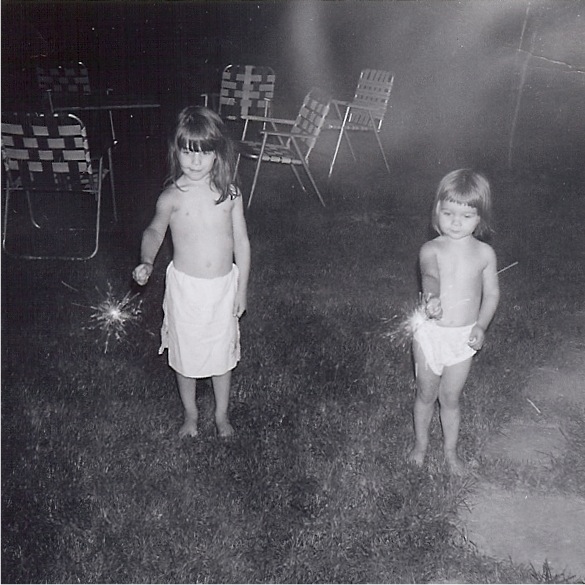
The photo is me and my sister Chris. I do not know who took it, but I think it was at my maternal grandparents. They are deceased, my parents are deceased, my sister is deceased. I don’t know who to credit.