If they whisper from one end to the other, does it get garbled before it reaches the other end?
Isn’t gossip a sin?
For the Ragtag Daily Prompt: chaos.
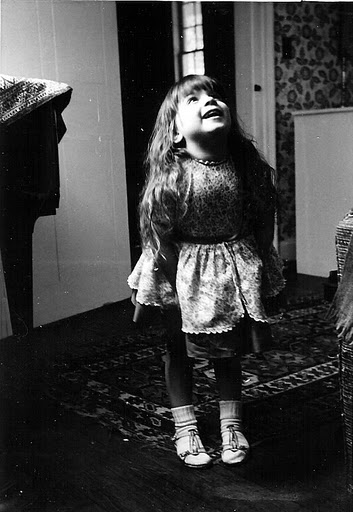

If they whisper from one end to the other, does it get garbled before it reaches the other end?
Isn’t gossip a sin?
For the Ragtag Daily Prompt: chaos.
I am taking a writing class and our next book is on cultural appropriation.
This interests me. I tend to be a little gender blind and race blind when I meet people. I am using my super skill instead. My skill is developed from a really scary childhood: I read the stuffed emotions. The stuff people are hiding.
No way, you say. Oh, yes, I say.
My sister described coming home from high school and stopping when she walked into the house. She was trying to sense what was going on. Were our parents fighting? Was our father drunk? Yes, he was drunk, but which stage?
We talked about the stages and which we hated most.
Stage goofy/silly was annoying but not toxic. We said we had homework.
Stage asleep in a fetal ball in the upstairs hallway. My sister said she would step over him to get to her room.
Stage maudlin. We both agreed this was the worst. He would cry and say, “You can tell me anything.” Once he caught me in that stage and I was in tears by the time my mother got home. I left the room. The next morning mother said, “He said you two were discussing the cat’s disappearance.” I didn’t answer. We never said a word about the cat. I didn’t know if he was lying or was too drunk to remember it the next day, so made it up. Don’t care. Avoid.
He was never physically abusive. He and my mother would scream at each other at 1 or 2 am through most of high school. Reading her diaries, she writes that she drinks too much. I think they were both alcoholics, thought the family story is that he was the bad one. But I can’t imagine yelling with a drunk at 1 or 2 am for an hour. What is the point? They are drunk. So either she was drunk too or needed to fight.
Emotionally abusive, yes, both parents. My mother would take any show of fear or grief and tell it as a very very funny story to every person she ran into. Is it any surprise that I had to go into therapy after she died to learn to feel fear or grief? My sister would say, “She’s got her stone face on,” about me. Um, yeah, I am NOT going to let my family see my emotions…
Anyhow, that is what I read in people when I first meet them. It’s not the suit, the clothes, the make up, the race, the gender. I pretty much ignore those. I was fashion blind in junior high, a girl geek, could not read the code and did not care. I had given up on socializing with my fellow students. I was hopelessly bad at it. I did a lot better with the adults around my parents. I could have actual conversations with them.
I had one patient who was transgender where I couldn’t remember which direction. I didn’t care, either. That was a really angry person. Anger is always covering other emotions, so I avoided pronouns and tried to be as gentle as possible.
I complained to a counselor once that I can’t turn this “off”. And that it’s fine in clinic with patients, but it screws with my relationships with my peer doctors. They do not like it if I “read” them.
It took me years, but I finally realized that I have to use my clinic skills with everyone. I can’t turn off “reading” any more than you turn off your eyes when you meet a new person. But I can be as gentle with everyone as I am in clinic. I realized that as I started on a trip and the trip was amazing, everyone was so nice.
This reading is a product of a high ACE Score: Adverse Childhood Experiences. I score about a 5. One of my patients set off my ACE alarms on the first visit. I asked if he had had a rough childhood and gave a very short explanation of ACE scores. “Oh, I am a ten out of ten,” he said. He was, too. Ran away from home at age 6 or 8.
The ACE scores of all the children are rising from the last two years. The war will raise them even more, worse for the children there and the kids trying not to starve in Afganistan and Syria and world wide.
It will be interesting to read about cultural appropriation. But I don’t care much: I don’t “see” those things when I meet someone.
Hugs and blessings.
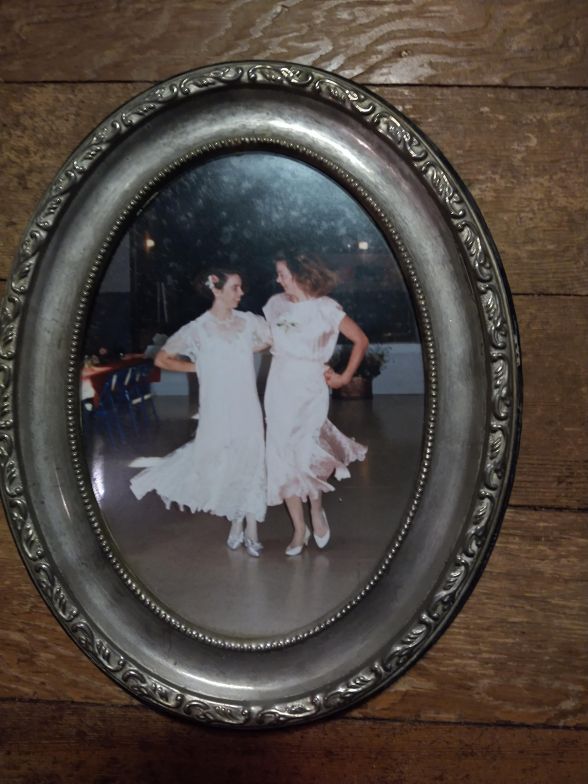
The photograph is me and my sister Chris in 1987, before my wedding. We were dancing before the wedding. She died in 2012 after 7 years of breast cancer.
Doctors and nurses and hospital staff are the last caregivers for the elderly alcoholics and addicts who are alone, whose families have finally cut them off. I think this song illustrates their pain. We try to take care of them.

Recent experiments on mice are giving us interesting information on addiction, and suggesting that l-dopa may be able to control/mitigate addiction. This lecture about how dopamine works in addiction using a mouse model (poor mice) blew me away. The mice fell into two categories: maintenance users and vulnerable addict rats. The study of the dopamine postulates a reason for the difference.
20th Annual Drug Conference Washington State from 2019
Notes from lecture 3: Paul Phillips PhD
Dopamine Neurotransmission in Substance Use Disorders: from Preclinical studies
For a long time there were no agreed upon animal models: rats don’t steal money from other rats to buy drugs. However, rats do get addicted and this can be studied.
There are features in rats, rat behavior and rat brains that might translate to humans.
1. Basic discoveries about dopamine neurotransmission in substance use disorders is discussed.
A neurotransmitter study checking every ten minutes in brain examines two areas: dorsal and ventral striatum. Dopamine is increased in the area between cells from the administration of substances “first time use” in animal models: cocaine, alcohol, methadone, cannabinoids, nicotine, amphetamine, morphine. This is the first clue re addictive drugs, whether there is an increase in dopamine intraneuronally. The endpoint is that direct effect on dopamine receptors, which has a different brain mechanism for each drug. Cocaine blocks the receptor that reuptakes the drug into the neuron. Methamphetamines and amphetamines reverse the reuptake pump, makes the receptor spit it out. Gaba neurons act to inhibit dopamine neurons, normally mu receptors on the gaba interneurons and the opioids block those. Ethanol has another mechanism of action. It changes inhibitory activity, lowering the inhibition of the gaba interneurons. Nicotine REALLY messes with multiple receptors and multiple cells, but main effect is increase of dopamine in the striatum.
Increased dopamine in human brain relates to the feeling of being high: brain PET scans show amphetamine and dopamine bound less, reduction in the binding. Subjects were substance abusers. Subjective questioning of how high they felt correlated with the amount of dopamine released on the PET scan. Methylphenidate was used in that study. Canada study: cocaine increases dopamine in human brain by PET scan.
Addiction does lead to changes in the brain, on both PET scans and functional MRIs.
PET scans measuring dopamine binding in the brain show that the baseline in brains of substance abusers differs from non-abusers. The levels of dopamine receptors is lower in the substance overuses and there is lower binding than controls: heroin, alcohol, meth, cocaine (and obesity and ADHD…..). (This has been known for opioid overuse and chronic use for a while: the brain cells withdraw receptors, so the same dose does not reduce pain because there are less receptors. The change in receptors appears to vary in different subjects. Recovery is very slow.)
The role of dopamine has been confusing. It is known that it is involved in the cue evoking cocaine “craving”, but is also involved with — satiety. This has been confusing and contradictory — what does dopamine do but also the dynamic structural signaling.
2. The animal studies demonstrate that the dopamine signals are phasic.
Rat studies measure changes in dopamine minute to minute electrochemistry for sub-second dopamine detection in vivo, which means we can measure changes in dopamine in real time. There is an identified output signature for dopamine levels, measure in 8.5 millisecond, ten measures per second.
The rats were voluntarily taking cocaine. The cocaine was available in a liquid with a light that would come on when it was available, for two hours daily. The animal presses a lever when the light cue is on and gets an infusion of drug. With the ten measures per second, the first and smaller dopamine response in the brain is before the lever is pressed. That is, there is a rise in dopamine BEFORE the rat presses the lever. If stimulated dopamine, the animal would go press the lever. Then there is a larger reward dopamine signal when the drug hits.
Dopamine is the chicken and the egg: signal to USE and signal that has ARRIVED.
3. Changes that take place with drug use
There is a signal change over time that correlation with features of addiction.
The mice had an implanted brain electrode, tinier than human hair, 7 microns, biocompatability — don’t make the brain attack it as a foreign object so rat brain keeps working. The study involves tyrosine hydroxylase, a precursor of dopamine. A food pellet response of the tyrosine remains the same at 1, 2, 6 months so can monitor substance abuse brain changes. These are cocaine addicted rats. They get cocaine via a nose poke of a button when it lights up. Pellets, not iv (they learn that faster). There are 2 ports to nose poke: active and inactive. The signal that cocaine is available and the pellet is active: a light comes on for 20s and then drug arrives. Can take again after 20sec. The rats titrate cocaine use: not continuous. They pace cocaine use, wait for it to wear off. Over time, drug use 1 hour access daily… slow increase, relatively stable.
When the access is bumped up to 6 hours access daily… rats do increase use — first of 6 hours, escalation of drug use faster — in humans development of tolerance.
With 1 hour cocaine availability, the dopamine response to the cocaine in the rat brain is lower by the 2nd and 3rd week, slowly decreases, then with 6 hours of access the loss of dopamine is very robust, happens faster, dopamine signal gets smaller every time.
Rats long access: were there individual differences? Yes, metric, nonescalated vs escalated groups so like humans. 60 escalated 40 didn’t and stayed stable. So essentially I named these “Vulnerable addict rats” and “Maintenance rats”.
Which group most motivated to take cocaine? The study ups the price of cocaine for rats, how many times are you willing to receive the drug? The escalating animals made more responses, “worked harder” for the drug. The escalator brains, Vulnerable Addict Rats, had just about a complete loss of dopamine signal by three weeks.
The nonescalators had more stable dopamine responses, retained some dopamine brain function.
The greater the loss of dopamine, the more the animal escalates the drug use.
The Vulnerable Addict rats would use cocaine to the exclusion of food, water, sex and sleep and died early.
This is a feedback loop. The rats get a success signal when the drug is taken — but over time don’t get the success signal because dopamine receptors are gone — so take more. In the Vulnerable Addict escalators, the dopamine signal of anticipation goes down in response to the cue, the drug effect takes a little longer but the pharmacological response to drug actually remains.
They tried giving l-dopa, a parkinson’s drug and if treat, the rats get a restoration of the dopamine cue — pharmacological response didn’t change — how does this affect behavior? A daily shot of l-dopa and the animals on the l-dopa have less escalation. (wow!) The l-dopa didn’t affect the nonescalators/maintenance rats. When they remove the l-dopa in the vulnerable addict rats, the animals jump to higher use and so the brain changes are happening even when it is masked by the l-dopa but does not stop the brain changes.
They ask the question: can you reverse escalation? With the the l-dopa, they use less.
Dopamine signaling to take drugs (the anticipation cue when the light goes on) decreases in animals that escalate drug taking, but does not change in animals with stable drug taking.
Restoring dopamine signaling with l-dopa can prevent or reverse escalated drug taking.
This dopamine signaling….
4. Mechanisms — drug cue elicits dopamine.
So this is about triggers. This is a paired drug cue: the light signals that the drug is available. If a non-contingent drug given to animal, the light still elicits drug seeking. Using a naive animal: pair reward with cue, over time the cue will increase dopamine.
(hmm. Facebook. blogging. Instagram. “You have mail”. )
The initial addiction has a short access time. One hour out of 24. When this is changed to long access, some animals escalate vs non escalation — as take more and more drug, the response to the drug taking cue gets larger in the escalators/Vulnerable Addicts. Presentation of cue — by investigator vs animal:
If elicits drug seeking than the dopamine response gets larger to the cue over time.
If the cue is given but other choices of liquid, then the dopamine response gets smaller in some rats — so terminating drug seeking. The Vulnerable Addict Rats had a larger and larger dopamine craving cue spike, the longer they were off the drug. The the increase in the cue drives craving and decrease drives seeking — so both bad.
The conclusion in the rats is that craving for drug, related to cues, is dependent to length of time off drug. The longer the rats were off the drug, the larger the dopamine spike when the cue light comes on. The measure of cue behavior gets worse …. 60 day study in rats, this is not physiological withdrawal, is prolonged way beyond the withdrawal.
1. noncontingent
wait a day or wait a month
work harder to get drug, harder a month out
reaction to drug cue presentation, enhanced over time
at start of drug small signal to drug cue
long access then cue gets bigger
same a day after stop drug
but huge in a month after no drug — huge dopamine response
(my thought was then swearing. how do we treat this?)
In chronic drug use the cue signal shrinks which reinforces drug use AND stopping increases the cue response which ALSO reinforces.
5. Implications for treatment
treating rats
They discuss a virus with promotor that affects dopamine cells, light activated ion channel, cells release dopamine when light stimulated
only activates release of dopamine, to understand mechanisms.
For the self administered nose cue …. In the nonescalator maintenence rats, dopamine cue response stays fairly robust, stimulate those cells and no change.
In the escalator/vulnerable addict rats… if do a virus stimulation of dopamine in the brain, more dopamine to cue boosted, so they use less cocaine and look like the non-escalators.
5th cue less dopamine than 1st cue: if put dopamine back then maintains the drug seeking.
What underlies the decrease in dopamine release?
When the animals use cocaine, dynorphin goes up (kappa antagonist).
They injected a kappa receptor blocker — animal no longer escalate (not in humans at this time, don’t understand well enough) treating animals that are escalating, so the bad addict/vulnerable rats.
Most animals don’t escalate — but pretty serious amounts of drug cocaine so not abstinent.
For future
Dopamine diametric changes: dopamine may reduce consumption but might increase craving, so it is difficult to treat.
l-dopa — treatment — some studies, looking for abstinence, does NOT produce abstinence. Does not make abstinence worse. Says that promise seen relates to the status of the subject — helps with people who are still using (some) but doesn’t help increase or prolong abstinence. So could reduce harm but not abstinent….politically unpopular. Happier with turning alcoholic into a social alcohol user, but that idea is less popular/politically ok with cocaine/opioids (and especially meth).
They are studying mouse nosepokes for alcohol — reduced intake when the rats are on l-dopa.
There is a functional agonist for kappa receptors == buprenorphine, might have effects on drug consumption, speculation across different drugs.
Dynorphin is a stress related peptide, so does that signaling produce escalation of drug taking? So other stress drugs — like corisol, CRF, plan for more studies.
Question: Stress related hormones– babies in stress in utero and in stressful childhood have less dopamine receptors and need more dopamine for pleasure, susceptibility to drug addiction (ACE scores) so is still really early studying neurotransmitters.
Dr. Question: why do people do better with agonist therapy than abstinence in opioids vs other drugs? Answer: we don’t know….. yet.
further information:
https://www.ncbi.nlm.nih.gov/pmc/articles/PMC1920543/
https://www.ncbi.nlm.nih.gov/pmc/articles/PMC80880/
https://archives.drugabuse.gov/news-events/nida-notes/2017/03/impacts-drugs-neurotransmission
https://nida.nih.gov/

I am raised by a family of triangulating enablers and enablees.
The enablers are my mother and two uncles. They are very very smart. Let me qualify that: they are very very smart intellectually. Emotionally, not so much.
The two uncles have PhDs and are professors. They marry wives that are lessor in their view. One tells my mother that he wants a woman who is not as bright as he is. I don’t know if she is less bright, but she is a hella better athlete. I also have the impression that she had a time where she drank too much.
The other uncle marries a woman who tends to be a hypochondriac. He takes her to India, where she gets polio while pregnant. She is then a sick hypochondriac, which is very difficult. The ill can control their families by planning things and then getting sick at the last moment. On the other hand, chronic fatigue and fibromyalgia are very real and we are on the edge of figuring them out. That uncle divorces his wife and I instantly like both of them better. They stop being a weird unit and are suddenly individuals.
My mother tells me, when I am in college, “I wondered if your father was an alcoholic when I married him.” I want to hit her. She won’t leave him, she won’t stop enabling him, they scream at each other at 2 am often. Now I wonder about that and conclude that either screaming at someone was something she needed or she was an alchoholic too.
After my mother dies, I ask my uncle, what about his parents? After all, the three of them learned enabling somewhere and it pretty much has to be at home.
My uncle tells me his parents had a PERFECT marriage and that my grandmother LOVED being the wife of a physician and professor.
Um, so, then, why did she pay my tuition to medical school, uncle?
And I think about my mother’s stories. Once, she says, your Uncle Jim bet his friend Dick that Dick was too chicken to shoot a cigarette out of Jim’s mother’s mouth. Ooooo. With a rubber band shooter. Yes, my grandmother. Bob took the bet and succeeded. My grandmother roared with anger and the two boys ran like hell and hid.
And someone in the family tells me: your grandfather helped your grandmother control her temper.
There it is. The enabler/enablee.
The enablers die first. My grandfather of cancer at 79, my mother of cancer at 62. The cousins are all angry at me because I won’t follow the family rules and triangulate in a satisfactory manner, and I don’t care any more. I am ignoring them. I got my father’s banjo back and I am done. The two cousins I own land with jointly are not the worst triangulators.
I have to remind myself: for them, this is love. For some people, controlling or being controlled is what functions as love and intimacy. Fighting and tears when person A talks to person C about person B and person C then lets person B know, that is how they feel close. It is not only families, but communities. Clay Shirky’s description of a group being it’s own worst enemy describes the same patterns: identify an enemy inside or outside the group and then everyone comes together against the enemy. The enemy says the wrong thing, doesn’t worship the right god/desses, wears different clothes, looks different. And the group feels safer once the scapegoat has been killed, the guy has been burned. It would be nice if we could burn a ritual guy instead of torching each other.
The real anger is in the enabler. They control it by having the enablee express it. Then it is not “theirs”. They can feel superior to the enablee who is out of control. Sadly, the problem is only fixed temporarily and they will need their anger expressed again and again and again.
The cycle can be broken. It is a lot of work.
Blessings.
______________________________________________

What are your mad skills?
My maddest baddest skill, shared with my younger sister, is reading hidden emotions. Children of alcoholics and addicts learn that one young. Or die. Or start drinking/drugging to numb young.
Our culture is bloody weird. Emotions are stuffed like turkeys until people are near bursting. I swear that half my clinic time was letting people talk about emotions and then saying, well, those seem like pretty reasonable feelings in view of the insanity going on in your family. There would be a silence while the person thought about the horrible terrible feelings being reasonable and then I would say, “You said you want an antidepressant. Do you want to discuss that?”
Often people put it off. Once the feelings are OUT and present and looked at instead of stuffed/contained/terrifying, the person would say, “I don’t know. I don’t know if I need it.”
“Do you want to schedule to come back in two weeks?”
Sometimes yes, sometimes no. If they wanted to start an antidepressant, I would caution that the recommendation was to stay on it for six months minimum if tolerated. Also, if they were starting it in June, I would say, “Don’t stop it in January. Wait until the sun is back. Here that can be July 4th. At least wait until spring.”
The plants are all thinking about spring now. My magnolia would like three more days of sun and then it will burst into bloom. The plums are budding and close to exploding. My camellia is usually first, but I trimmed it at the wrong time of year and so it is not blooming. It looks healthy, though. It is sort of sulking for a season. I would like to sulk for a season too.
Why is our culture, the US, so terrified of emotion? We think everything should be about logic. Emotions are both hormonally and electrically mediated through nerves and blood and they are INFORMATION about our environment and each other. We should let emotions roll through us like waves, and not worry about them so much. I think of myself as an ocean. The emotions are the weather. They roll through. Ok, big storm. Then rain, and lightening. Then low clouds and some fog. Then sun and a beautiful day to sail with a light breeze. But the deeper currents change slowly and the weather is not really that important. I reside in the depths.
The furor over rising prices seems ridiculous to me. The roaring twenties has begun already in housing and buying stuff on Amazon. I have bought two things from Amazon in the last two years. I like to buy local. One order was for my future daughter in law’s wish list. I think people are buying so that they do not have to feel. It is cultural mania. Everyone is rushing around trying to make money instead of grieving. Yesterday I thought, if this keeps up, we WILL have a depression like 1929.
Don’t do it. Don’t buy stuff to avoid the stuff inside. Sit still twice a day, for at least five minutes, and just listen. Try to listen to the depths.
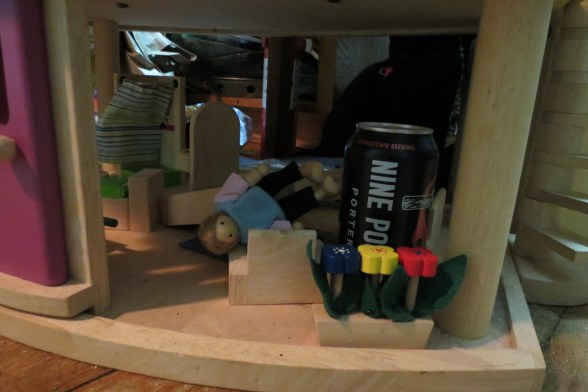
When mom leaves in the car with the kids, dad gets trashed on beer and destroys the living room. Yes, there is an enormous black panther in the background. Will it eat dad? Maybe it will wait until some of the alcohol wears off. He won’t taste as good drunk.
_______________________________
For the Ragtag Daily Prompt: Tiger.
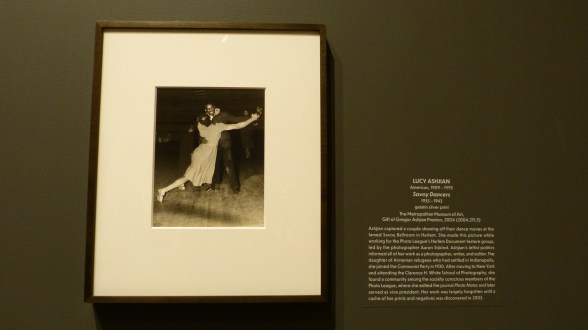
I am thinking about the roaring twenties a lot. I think people went a little nuts, not because of the war, but because they had difficulty being emotionally honest about the influenza pandemic. I think we humans will do it again to forget the deaths, to go into denial, to refuse to grieve.
Yes, that is my prediction.
Be very quiet, I am hunting wabbits.
Be careful in our future roaring twenties. Money will flow like honey and people will go nuts. Hold fast, hunker down, don’t go out without your macintosh, wear clean underwear. Remember what your mother told you, remember what your father tells you. Because that was followed by the Depression and that is one risk.
I don’t know if it will start this spring or next spring. Ok, I AM hoping that my son and future daughter-in-law can get married in early May, since they’ve put it off for two years. But. The 1918-19 influenza was really three years, not two. It tailed off. Half the people in the world got it. In Samoa, half the adults died, or was it 70%? They had little exposure to infection but a ship brought it. They KNEW they were high risk, but a sailor didn’t know he was sick yet.
Why a roaring twenties? Because we want to forget this pandemic, as the last one was forgotten. Our history books say that the Roaring Twenties was about the end of World War I. We teach lots about that. We barely mention the influenza world pandemic. I am reading a book about the 1918-19 influenza pandemic published in 2018. The author says that it is only now, 100 years later, that we are starting to really tell the stories of that pandemic. She gathers stories from all over the world, including stores of different infection control strategies in two cities. One guessed right and one guessed wrong, and in the wrong one, way more people died.
I read about that 1918-19 pandemic after influenza nearly killed me in 2003. I was 42, healthy, a physician, a mother, an athlete. I had NO risk factors except stress. Now it looks like it was a PANS reaction, but at the time, neither my doctor nor I could figure out why I was short of breath and tachycardic walking across a room for two months. Fatigue, chest pain, tachycardia, shortness of breath. Hmmm, what does that sound like? My partners thought I was faking and I was so sick that I could barely communicate. The stresses were my mother dying of ovarian cancer in May 2000 and my marriage being pretty on the rocks and me working way too hard. My psychiatrist said I should take time off. I said, I can’t. He said, you’d better. Then I got flu. “See?” he said. The body decides, not the conscious brain. He was correct, damn him.
The book I read in 2004 looked dry and medical from the outside. It had pages and pages of footnotes. It had photographs of Los Angeles. They knew the influenza was coming towards them like a wave and they tried to get ready. Bodies under sheets were stacked five deep in the hallways of the hospitals. It hit that fast. People, usually age 20-50, turned blue and fell over dead. WHY? It was the immune response. The 20-50 year olds had a better immune response than the 50 and older and their lungs would swell until there was no airspace left. Even then, that pandemic death rate was only 1-2 % in the US. But it was so fast and spread so quickly that everything was disrupted because it was the workers that were deathly ill and at home and there was no one to work.
People wore masks in public, except for the mask refusers, but not in their homes. So entire families would get ill. I don’t think they had figured out viral loads yet. If you are the last one standing, and you are trying to take care of a spouse and six children, you were high risk from viral load and exhaustion.
The Roaring Twenties WAS a way to grieve, it’s just a dysfunctional one. The stages of grief: denial, bargaining, anger, grief and acceptance. My sister said that acting out and revenge ought to be added as stages of grief. She died of breast cancer after fighting it for 8 years. Roaring is denial and bargaining and acting out and revenge, all at once. Everyone grieves differently, remember that. There is not an order to the stages of grief and you don’t do them once. You do them over and over and over.
I am a Cheerful Charlie, right?
War is one way to forget/deny/act out. Let’s not do that. Let’s not have a civil war of forgetfulness and denial.
Let us remember clearly and lean on each other.
I think this fits the Ragtag Daily Prompt: inflammable.
My sister’s blog: https://e2grundoon.blogspot.com/2009/01/chemo-not-in-vain.html . She died on March 29, 2012. The start of the blog is here: https://e2grundoon.blogspot.com/2002/02/ .
Blessings.
______________
I got Cheerful Charlie from Pogo comics: read the Albert Alligator section. https://comicstrips.fandom.com/wiki/List_of_Pogo_characters
More recently, Downton Abby used Cheerful Charlie. https://downtonabbey.fandom.com/wiki/The_Cheerful_Charlies
Is oppositional defiance running YOUR life?
I am oppositional defiant. I have been for as long as I can remember. I ALWAYS want to argue when someone tells me to do something or gives me advice. BUT, I have learned to work with it.
I work with it by arguing with myself.
Give me a topic. Or advice. I will promptly argue the opposite, internally or externally. Then I will argue the original side. Then my demon fights my angel until they are both tired and decide to go have a beer. Somewhere along the way I will make a decision and also I will laugh, because it’s funny.
B has figured this out. “You argue with EVERYTHING.” he says.
“Yes, and if there is no one around, I argue with myself. All the time.”
However, he is also oppositional defiant. He is smart too, and doing some self examination.
“I am thinking about my life. I think ALL of my important decisions were oppositional defiant ones.”
“Someone told you you couldn’t do that?
“Yes.”
He’s chewing on that. Heh. He accuses ME of overthinking. I replied that I am making up for his underthinking, heh. He suggests that I STOP overthinking and I say, “You want to DESTROY the SOURCE of my poetry?” Double heh.
The point is, some of us are oppositional defiant, but really, we don’t want that to run our lives EITHER. We don’t want ANYTHING or ANYONE to tell us what to do.
B says, “I think that everyone refusing the vaccine is oppositional defiant.” He has a lot of friends, both liberal and conservative.
“That is interesting.” I say. And I wonder if it is worth dying for, to be oppositional defiant. Not if it’s running your life, right? I don’t want ANYTHING to run my life except ME.
So then I spend a bunch of time arguing with myself about the causes of refusing the vaccine. And I have not reached a conclusion. Yet.
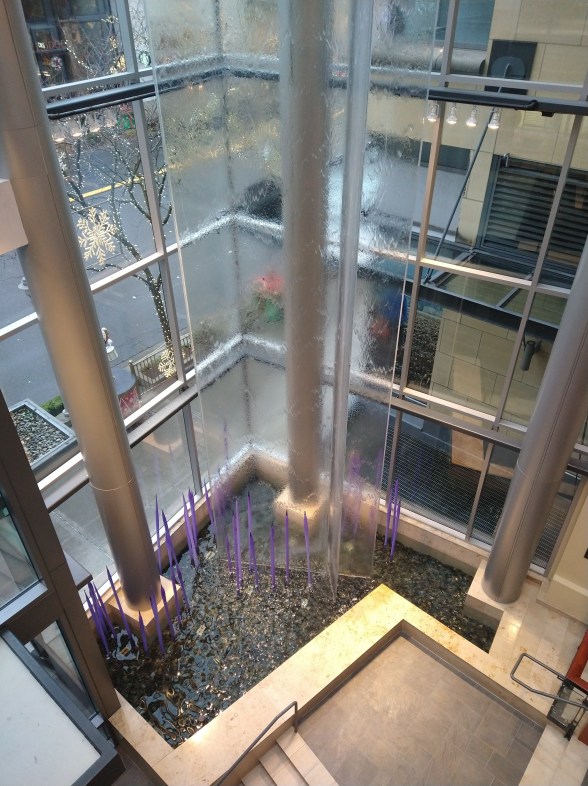
I took the photograph at the Bellevue Mall on Monday. A three story waterfall. Really? Isn’t there enough rain in Seattle? We should have a three story sun instead.

Care for your family and friends and community. Mask up and do the best you can not to get nor give Covid-19 this season. The winter is dark but the sun will start returning to us soon. Like the seeds in the ground and the trees with no leaves, we can get through this dark season caring for each other.

All right.
I am thinking about tubulin blocker antibodies. How would they work?
About 2 weeks ago, I had trouble walking down the stairs because my quadriceps just did not want to bend. In fact, all of my muscles felt awake and grumpy. As if I were Sleeping Beauty, now awake. Of course, if I was Sleeping Beauty and some jerk kissed me awake, I’d punch his lights out. Hands off!
Anyhow, I concluded that my tubulin antibodies had released. Was I better?
Well, no. It’s been weird. In me it’s the voluntary fast twitch muscles that don’t work when I have a PANS/PANDAS reaction, so they are back on line. The grumpy muscles are the slow twitch ones who essentially are screaming “WHERE HAVE YOU BEEN, I’VE BEEN DOING ALL YOUR WORK SINCE MARCH!” Nine months. The fast twitch muscles are weak, the slow twitch muscles don’t trust them and I am having trouble getting it all to work together.
My balance is fine. It just all hurts and is a bit unreliable.
I was in Michigan for Thanksgiving, staying with old friends. My oldest friend there is 80 and does not have wi-fi or any internet. That made doing any blogging quite a challenge and many thanks to everyone who pointed creative spelling. I would go to her son’s house daily and try to put up the work I’d done at her house. Not the way I usually do it and three kids distracting me, which I enjoyed.
It is bowling that makes me realize how weird my muscles are right now. I went bowling with the middle (15) and younger (11) child. Mom watching all of us. My role is Weird Aunt, more or less. I have bowled maybe 12 times in my life. I guttered the first three balls, a 9 pound orange beauty. My muscles all started screaming at me at once in my upper and middle back. Oh, I thought. So I slowed way down and tried to slow bowl. Next was a strike. I ended up bowling 100, which I guess is not so bad for someone who really has no idea what they are doing. My muscles were grumpy but slow was ok and I didn’t pull anything badly. Next morning I am quite stiff.
I am trying to figure out how to rehabilitate the muscles. Do I exercise? Slowly? It’s as if half a team has been missing for 9 months and is now back. The remaining team members are tired, pissed off, and have figured out how to work without them. They aren’t very pleased about relinquishing control and they don’t trust the part of the team that’s been missing. I would go to my doctor and ask to see a neurologist or ask for physical therapy, except that since PANS/PANDAS is barely believed in in children, there are only a few doctors that work with adults and other doctors seem to think they are quacks. One writes articles for Psychology Today. I’ve thought about contacting him, but he’s a psychiatrist. How much do psychiatrists know about muscles?
Let’s extrapolate this too, to the people with really bad chronic fatigue. Presumably they have antibodies to tubulin that affects more muscles, fast and slow twitch. No wonder they lie in bed. I would presume that they are hypoxic too, if they could walk, but they barely can. The Functional Medicine doctors are treating folks with hyperbaric oxygen and I think it might help with these muscles that don’t work and can’t move. It is sneaky. It’s not that the muscle can’t move at all, it isn’t paralyzed, it’s just that the exhaustion and fatigue that comes after moving it is terrible. The body says very very clearly : “DON’T DO THAT.” And we are still in the infancy of looking at antibodies, so we aren’t measuring them. I was going to say we can’t type them, but that’s not true. We are using monoclonal antibodies to treat cancer, so there are ways to isolate and type them. Medical science may explode with this and can’t you see the potential for misuse? Imagine an army affected by a tubulin blocker antibody, against an army with a tubulin augmenting antibody. Holy moly. It has the potential to be really really horrific, which is why I am putting all this up on everything2. Keep it in mind, ok? Nothing like making information public to prevent secrets from screwing us over.
And that’s the news from me. “Har det godt!” which is Danish for “Have it good!” or have a really good day.
BLIND WILDERNESS
in front of the garden gate - JezzieG
Discover and re-discover Mexico’s cuisine, culture and history through the recipes, backyard stories and other interesting findings of an expatriate in Canada
Or not, depending on my mood
All those moments will be lost in time, like tears in rain!
An onion has many layers. So have I!
Exploring the great outdoors one step at a time
Some of the creative paths that escaped from my brain!
Books, reading and more ... with an Australian focus ... written on Ngunnawal Country
Engaging in some lyrical athletics whilst painting pictures with words and pounding the pavement. I run; blog; write poetry; chase after my kids & drink coffee.
Coast-to-coast US bike tour
Generative AI
Climbing, Outdoors, Life!
imperfect pictures
Refugees welcome - Flüchtlinge willkommen I am teaching German to refugees. Ich unterrichte geflüchtete Menschen in der deutschen Sprache. I am writing this blog in English and German because my friends speak English and German. Ich schreibe auf Deutsch und Englisch, weil meine Freunde Deutsch und Englisch sprechen.
En fotoblogg
Books by author Diana Coombes
NEW FLOWERY JOURNEYS
in search of a better us
Personal Blog
Art from the Earth
𝖠𝗇𝗈𝗍𝗁𝖾𝗋 𝖶𝗈𝗋𝖽𝖯𝗋𝖾𝗌𝗌.𝖼𝗈𝗆 𝗌𝗂𝗍𝖾.
Taking the camera for a walk!!!
From the Existential to the Mundane - From Poetry to Prose
1 Man and His Bloody Dog
Homepage Engaging the World, Hearing the World and speaking for the World.
Anne M Bray's art blog, and then some.
My Personal Rants, Ravings, & Ruminations
 KO Rural Mad As Hell Blog
You must be logged in to post a comment.