Hungry

Each time I’ve gotten pneumonia, I drop ten pounds in a week. The weight stays off, each time for longer. Then I gain it back and go past my “normal” weight. It takes work to get that extra weight off.

I have been trying to lose that extra weight since the start of the year. At first I just tried to increase my vegetable intake. The green, yellow and orange vegetables have the lowest calories and carbohydrates. The grains and rice and potatoes and bread are all more dense and have more calories and carbohydrates. I tried to go easier on them.

I did not make much progress. The climbing gym has been building muscle and clothes fitting better, but the scale did not move much.

I started having conversations with my stomach. I would eat. My stomach would demand more. “HUNGRY! WANT MORE!” This is not real hunger, as the people in occupied territories are having. This is my stomach or hindbrain fussing. It was easiest to control at lunch. I would fill half my container with spinach or mixed greens and then add more vegetables or tuna salad or egg salad or humus and vegetables. I would take a piece of fruit. Once that was done, we were done. “HUNGRY!” my stomach would complain. “That’s ok,” I would tell myself, “It’s ok to be a little bit hungry. We’ve had enough food. Stop fussing.”

My stomach fussed a lot at first. Now it is more of a query: “Hungry?” “No,” I reply, “we’ve had enough.” It seems to quiet down much more quickly. I think I am losing weight but I have no scale here and haven’t remembered to weigh myself in the last 3 weeks at work. Never mind. I have more muscle, at any rate, which is denser than flab. Muscle burns 9 kcal/gram and fat burns 4 kcal/gram. I climbed yesterday at the gym and might again this afternoon. It did take weeks or a couple months for my stomach to quiet down. Changing habits is not easy.

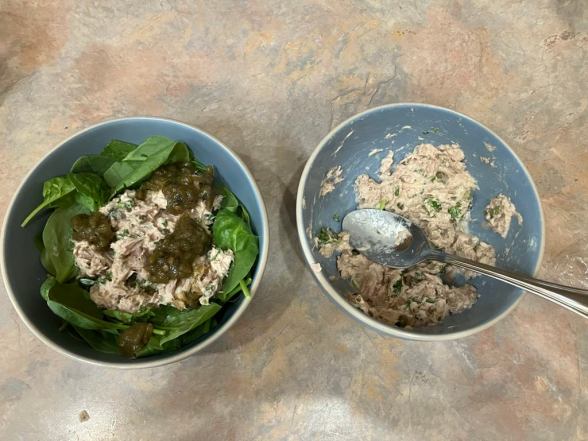
The tuna salad and spinach and green chili dish was my breakfast this am. I don’t think my stomach complained at all after it. It was distracted by packing and clearing out the refrigerator and cleaning. Sol Duc knows I am packing but is pretty sure she is going with me. I have been putting her toys in the carrier and she’s gone in and out to suss out the situation.

I hope all the people who are suffering from hunger get fed, today and tomorrow and the next day.

For the Ragtag Daily Prompt: hungry.

Pneumonia makes me slenderize

Pneumonia makes me slenderize
I feel like I’ve been blenderized
Steals my breath and appetite
Work to breathe both day and night
My heart goes fast, trials one to four
I’d rather not have any more
Ten pounds down, gone like smoke
Carbohydrates make me choke
The legacy of my fourth round
I can’t eat gluten, ounce nor pound
And yet I still come out ahead
Since I am alive and still not dead

_____________________________________

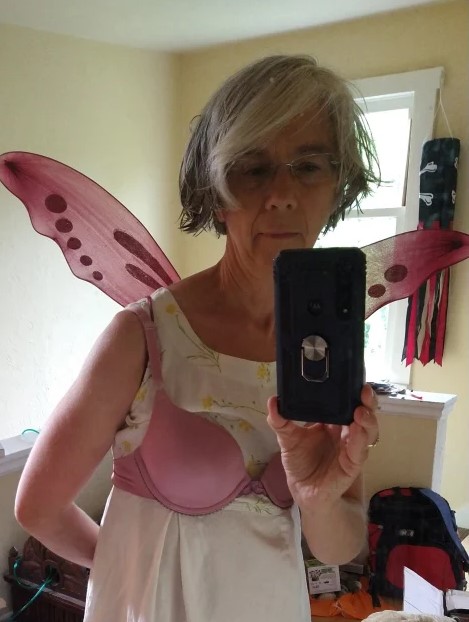
Four pneumonias in 24 years. I have an antibody response, which peaks about six weeks after the infection. Colds don’t trigger it. This photograph is two months in to my 2021 round. I drop ten pounds in the first week and eating is always difficult. I do not recommend this method of weight loss.

For the Ragtag Daily Prompt: slenderize.

Fun in hell

Even when I go through hell on earth
mother dies, marriage crumbles
sister cancer, father cries
divorce, sister dies
pneumonia, pneumonia, pneumonia
can’t breathe and still have to defend myself
when accused of crazy and reported
Bitch is not a psychiatric disorder
hypoxia is not a psychiatric disorder
my cousin helps my niece to sue me
I never thought my family would have lawsuits
never
yet my sister sets them to explode
after she dies

I don’t quite die
though it is pretty rough
and grief tears at my throat
like a wolf, like a lion
like a hyena,
piranhas
I have two children and I stay
because they do not deserve this mess
I guard and fight and stay present

And there is laughter
even in hell
I time a comment and my daughter
snorts milk out her nose
I tell my children I shouldn’t handle knives
because of a meeting at work
“Five against one?” says my son
“Yes,” I say
“Well, they didn’t have enough people, did they?”
And I laugh and we go out to dinner.

Is this my fault?
Is it something I did?
The marriage was me, yes,
I do two years of counseling
trying to understand
I can’t change it
but maybe I can understand

A sort of a friend
ok
a false friend
a liar
says he never changes.
I say I always try to learn
I want to know
I want to grow
how can he not grow?
how can he refuse to learn?

he doesn’t talk to me any more
he stops speaking to people forever
but
there is no forever
there is now and the Beloved
and the dark and the light are united
after death
will you be a proton
or an electron
or gravity?

There are hells on earth
worse than mine
prayers
I send prayers
for the innocents
everyone was newborn
and innocent
once

Work dream

Last night I dream that I am back at work.

I get called to do an emergency surgery. I am a Family Practice Physician. I assisted in surgery, C-sections, and did minor repairs of lacerations (yeah, we don’t use small words like cut) and biopsy of skin lesions (lumps, right?). In the dream I do the surgery, but it worries me. I am not a surgeon. I talk to Dr. L. afterwards. He is a surgeon and has worked here for longer than me, and I’ve been here for 23 years. We get along well.

“I shouldn’t be in the surgical call schedule.” I say.

“Don’t you have the certificate for appendectomies?” he says. Now, that isn’t really a thing. My brain made it up.

“No.” I say.

“Oh.” he says. “I thought you did. Great job on that surgery. We need you.”

“But I am not a surgeon, I would need more training.” I say.

“Oh, we’ll figure it out.” he says. I am worried that I’ll be called for an appendectomy. Or something way worse.

I wake up with a very stiff neck. It has relaxed now, but clearly some part of me is not totally on board with work. I need to be careful what I am getting in to. I am not sure, what if I get pneumonia number five? We are short on physicians though. I can argue with myself very easily. Ok, ok, says the part of me that really wants to return to work: we won’t do appendectomies.

The head of our Legion says that some of his people wish I were working again. I really got along well with my veterans and liked them almost always. They could be really gruff and growly and I would growl back. Then they’d be cheerful. Another person at an outside dance said he missed visits with me and appreciated the time I took. Last night a third person asks how they will know if I start a Long Covid clinic. They have two friends who may have it.

I don’t know. I am mostly absent from medicine right now, but still doing my continuing medical education. I have about 30 hours on Long Covid now, which means I have a lot of strategies to improve things but I can’t cure it. May the research will get there eventually. I am maintaining all of the certifications: medical license, board certification, DEA, membership in the American Academy of Family Medicine. But I also listen to dreams.

For the RDP: absent.

Eating his words

After today’s international zoom on Cardiovascular Complications of Long Covid, I am thinking about one of my former partners. An ex-partner.

I got influenza in 2003. I was working full time plus all the call, had two small children, my mother had died two years before of cancer, and I was worrying about my marriage. Quite a stress load. I got influenza, running a temperature of 104 for a week and tachycardic. My heart rate was 100 at rest instead of my normal 62, and when I walked across the room slowly, it went up to the 130s or above and I got short of breath. I did not figure that out the fast heart rate immediately.

I tried to go back to work a week after I was out. By lunch time I thought, I feel like I’m dying. I stuck the pulse oximeter on my finger. My heart rate standing was 135. Oh. Normal is 60-100 and 135 is not ok. It’s exhausting. My office manager chose that moment to call me into her office and scold me for missing work. I was so freaked out by my heart rate that I did not show ANYONE in my clinic. I left and went to my physician, upstairs in the same building.

The tachycardia continued for two months.

I didn’t understand it, my Family Practice doctor didn’t understand it, and my partners accused me of malingering and were pissed. My instinct was to lie on the couch, so that’s what I did. Rest and wait. That level of tachycardia makes a person anxious, so my communication skills were challenged. After six weeks, I had an echocardiogram, which was normal EXCEPT for a fast heart rate. After two months, it went away. I staggered back to work, still frail and tired, and still down ten pounds.

One of my partners said, “I could understand you being out two months for heart disease or cancer, but not for influenza.”

At the time I didn’t say anything. That comment really, really hurt. I told myself that I should TRY to be a nice person and not wish that he would get a bad case of pneumonia with tachycardia. That took some major effort on my part.

Now with all the people with a fast heart rate after Covid-19, he can eat his words.

Long Covid imaging

In the last Long Covid talk that I attended and wrote about (here: Pulmonary Manifestations of Long Covid), the pulmonologist and intensivist says that one problem with Long Covid is that we do not have imaging that can “see” it.

That is, the chest x-ray looks normal, the echocardiogram may look normal (heart ultrasound), the chest CT scan may look normal, a brain CT or MRI may look normal, but the patient may still be tachycardic, feel exhausted, feel brain fog and have multiple other symptoms.

That pulmonologist listed five of the top mechanisms that are prolonged in the immune system. Most of the scientists and physicians are framing this as “immune system dysfunction”. I am not. I am framing it as “you were really really sick and your immune system is still on high alert and trying to protect you so you can recover”. Now wait, you say, how could chronic fatigue like symptoms protect me? Well, if you are exhausted, you can’t go to work and you’ll stay quiet at home most of the time and less exposure chance. But what about brain fog? Again, this will slow your interaction with other people and force you to rest and heal. But, you say, I don’t like it. Well, yeah. Patience. We call grumpy patients that are recovering “convalescents”. It is a good sign when they are grumpy and over it and just want to be better. That doesn’t mean I can make myself or anyone else heal faster.

The pulmonologist says that the best test is the six minute walk test. This is usually done by a respiratory therapist. The person walks in a circle for six minutes wearing a pulse ox, with the respiratory therapist doing regular checks. This distinguishes between the people who have primarily a lung issue from all the other issues. If the person is tachycardic (fast heart rate) but not hypoxic (oxygen level dropping), then it’s not primarily lungs though blood clots to the lungs sometimes have to be ruled out. One of the mechanisms in the immune system is microclots and an increased risk of blood clots. That can mean heart attack, stroke, or pulmonary embolus, a clot in the lungs. The microclots are suspected of causing some of the muscle fatigue and exercise intolerance, by clogging capillaries and reducing oxygen flow to muscle cells. Muscle cells do not like this at all.

I have done my own quick walk test with patients since 2003, when I had terrible influenza. About a week after my influenza started, with the temperature of 104 and heart rate at 100 at rest and 135 walking, my temperature came down. However, the fast heart rate continued. Normal heart rate is 70-100 and 135 walking will make you feel exhausted. I lay on the couch and could barely make my kids dinner for two months. It resolved then. I read a book about influenza and thought that I had “influenza viral pneumonia” where there is lung tissue swelling, reducing the air spaces, after influenza.

My quick walk test in clinic is to check a sitting oxygen level and heart rate and then have the person walk. I would have them walk up and down a short hall three times then sit down. When they sat, I watched the pulse oximeter recovery. Some people would jump from a resting heart rate of 62 to a walking heart rate of over 100, say 120. Their oxygen level could stay normal or it could drop. If they dropped below 88, I would get home oxygen and forbid them to return to work. If their oxygen level held, then they needed to rest until their walking heart rate stayed under 100 and they were no longer exhausted by gentle or normal activity. If they return to work with a walking heart rate of 120, they will be exhausted and are more likely to get a secondary pneumonia or have other problems. The heart does not like to run at 120 all the time. You can see why a person who already has some coronary artery blockage would be more likely to have a heart attack if they get pneumonia from influenza or Covid-19.

The conferences I am attending are talking about “targets” in the immune system. That is, new drugs. I think the science is wonderful and amazing, but I also think we need to step back and say, this is a really really bad infection and some people need a lot of support and reassurance and time to heal. Reassure them that even though they have not yet returned to normal, the immune system is working hard to protect them from other infections and it is saying very very loudly that they need to rest. Rest, recuperate and trust the immune system. Some things need immediate treatment, especially blood clots, heart attacks and strokes, but once those are ruled out, we need to support people through their convalescence and healing.

______________

The photograph is from April 2021, a few days after I was put on oxygen. A selfie.

Pulmonary Manifestations of Long Covid

Today’s Zoom lecture was about pulmonary manifestations of Long Covid, and this is from the Schmidt Initiative for Long Covid Global ECHO Webinar Series, out of the U of New Mexico.

First of all, the talk is brilliant. The speaker is Lekshmi Santhosh, MD, MAEd, Asso Prof Med, Pulm Critical Care Med, UCSF, Intensive Care.

Two things to start with: she stressed the six minute walk test for patients, to distinguish oxygen desaturation (dropping) from the people who have terrible tachycardia (fast heart rate) only. The oxygen drop indicates that the person needs lung studies and may need oxygen, while tachycardia alone means either a heart problem, chronic fatigue/ME pattern or dysautonomia, where the heart goes fast when the person sits or stands up. Her point was that it’s a simple test and that Long Covid presents in multiple different patterns.

The second point is that there are least five main mechanisms that Long Covid can mess us up and people can have one or many. There is a review article in Nature last month (I need a copy!) and it talks about these five: immune system problems, gut microbiome problems, autoimmune responses, blood clotting/microclotting/endothelial problems and dysfunctional neurological signalling. SO: this is a MESS. She says that patient care needs to be individualized depending on which mechanism(s) are predominant and it can be more than one. This Covid-19 is a hella bad virus.

So: “The underlying biological mechanism may not be the same in each patient.” That is the understatement of the year.

She reiterates that the current diagnostic criteria, subject to change, is symptoms that last longer than 12 weeks after Covid-19 and two months past that. She states that the symptoms can wax and wane and that we need to listen to and believe patients.

In JAMA this month, there is an article that uses big data to find which symptoms are more associated with Long Covid, and lists 13 symptoms. Smell/taste tops the list but fatigue is there too. However, this is not a list for diagnosis, it’s a study list.

She also is careful to say that the treatment for the pulmonary manifestations is not the same as the people with the pattern that resembles chronic fatigue syndrome/ME. The pulmonary people can build exercise tolerance, but the CFS/ME folks need a different regimen, with pacing and energy conservation. That sounds like a subtle difference. I had both though my CFS/ME is weird. It does not put me in bed, I just can get really tired and need to sleep. It’s a bit invisible. People see me dance and would not guess that I have CFS/ME. All relative to previous function and energy, right?

For lung manifestations, she lists a pyramid, with the more rare things at the bottom. As follows:

  1. persistent dyspnea (shortness of breath)
  2. post viral reactive airways disease (asthma that can resolve from irritated pissed off lung tissue)
  3. deconditioning. She says that the isolation and quarantine with some people in very small rooms, leads to terrible deconditioning in some folks. They can build up, especially with supervised exercise with pulmonary rehabilitation and/or physical therapy. It is scary to exercise when you are short of breath and the supervision really helps, with limits on how much you should push, or encouragement to push.
  4. organizing pneumonia. This is rare and responds to steroids. Otherwise steroids are not good for the muscles in Long Covid, with the exception of inhaled steroids for the asthmatics and post viral reactive airways.
  5. post ARDS fibrosis: fibrosis is fibrous scarring that can form in the lungs. Anyone who has any terrible pneumonia and is in the ICU and intubated and on a ventilator can get this. Not everyone gets it, thankfully. ARDS is Acute Respiratory Distress Syndrome. Luckily the fibrosis is rare and it turns out that in some people it improves with time, like years. She does not recommend the pulmonary fibrosis medicines right now. There are many causes of pulmonary fibrosis besides infection.
  6. PVD: peripheral vascular disease. Covid-19 increases clotting, so we have to look for both clots and for disease in arteries, which could be lungs, brain, heart, anywhere in the body.

She says DON’T assume that chest pain is from the lungs and don’t miss cardiovascular. That is, rule out a heart attack and pulmonary embolus first.

Other lung problems have to be kept in mind that are not caused by Covid-19. This list: Reflux associated cough, pleuritic pain, neuromuscular disease, vocal cord dysfunction, tracheal stenosis, tracheomalacia. Watch for those. She says that it is very very important to look at old chest x-rays and CT scans, because those can show previous signs of emphysema/COPD/asthma/fibrosis.

Testing: She puts the 6 minute walk test first. AFTER the thorough history and making sure there are no red flags for pulmonary embolism and heart attack. Those have to ruled out if there is any suspicion. Next: pulmonary function testing. If the DLCO is low, consider a chest CT. Consider TTE -TransThoracic Echocardiogram, to look at the heart. Labs: CBC (blood count), ESR, CRP, thyroid, +/-CPK.

She has diagnosed people who are sent to her with NOT Long Covid: they have metastatic lung cancer, metastatic prostate cancer, new pregnancy, hypersensitivity pneumonitis and many other things. She says, “Don’t assume it is Long Covid. Sometimes it isn’t.”

Now, this is all a formidable list of problems and this is JUST the lungs. Long Covid can affect every system in the body and every patient is different.

She also says that she has done more disability and accommodation paperwork in the last three years than in her entire career before that. That the US disability system is a horrid mess and that she has to talk to employers and insurers OFTEN to say that the person will get better faster and have less long term problems if she treats now and they have rest and return to work may need to be very gradual.

She approaches new patients by asking which symptoms are worst. She thinks about severity of the infection, vaccination status, previous/present other medical problems and habits that can contribute or worsen things (smoking, vaping, exposures). Her clinic is for Long Covid pulmonary, but now they have opened up a neurological branch. They use multiple other specialists as well.

Last quotation: “Until we elucidate the biology and have clinical trials, treatments are largely symptomatic.” So the basic science studies working on immune system, the gut microbiome, the clotting problems, are huge in figuring out what to do in clinical trials. This is a tremendously complex illness and three years into Covid-19, we are still trying to figure out the multiple mechanisms that cause Long Covid.

This was a very hopeful lecture from my standpoint, admitting that this is complex but that we are also working to sort out the mechanisms and work on treatments. She works hard at getting patient input and feedback as well.

Two links: A free PDF from Johns Hopkins on Bouncing Back from Covid. https://www.hopkinsmedicine.org/physical_medicine_rehabilitation/coronavirus-rehabilitation/_files/impact-of-covid-patient-recovery.pdf

The American Physical Therapy Association has articles as well: https://www.apta.org/patient-care/public-health-population-care/long-covid

Also here are webinar links:

SILC Global ECHO Webinar Series Resource Links June 28, 2023

Now, how will I use the Ragtag Daily Prompt riposte for this? I think I will just say again how important it is to listen to and believe our patients!

The photograph is from Marrowstone Island, East Beach. The shape in the driftwood is sort of lung shaped.

Breathe

I was trying to think of a debacle. Oh. Getting my fourth pneumonia, March 21, 2021, Covid-19. This is the first pneumonia that put me on oxygen. The fast heart rate, dropping ten pounds, and feeling anxious were familiar from the other three. This photograph was from December 2021, visiting Maryland. We did a bike ride. I was pretty happy that I was able to do it, though the last mile had a sloping uphill that made me think I was not very strong. Oxygen helped.

And Covid-19 is a debacle that we are still trying to understand and absorb and avoid and heal and recover from. I am reading an article that entirely denies viruses existing. I guess it’s like porn on the internet: they say if there is a story, there is a porn version. Every possible idea of what has happened over the last three years is out there, though this article doesn’t make any sense at all.

I don’t remember who took the photograph of me. It may be a steathie. I needed oxygen at night and whenever I was being active, but not at rest. Ok, at rest talking.

Things and people were lost and found and lost during Covid-19. I spent a lot of time on our beaches. I am so grateful for the beaches.

For the Ragtag Daily Prompt: debacle.

Frame

What is the tree and where is it?

I am still thinking about the Inflammatory Brain Disorder Conference.

The researchers and physicians are talking about the immune system as if it is broken in Long Covid and ME/CFS and the other illnesses, but I am not sure I agree. Maybe the immune system knows what it is doing. Maybe Covid-19 is a really really nasty infection and the immune system sends out antibodies to make us stay down, stay in bed, rest and keep from catching something else. Maybe an antibody that suddenly makes you weird will make you isolate and hide and not interact with the other potentially infectious humans.

Ok, the inflammatory brain disorders that destroy the brain, those are not adaptive. However, I’ve thought that MC/CFS was a “repair mode” since residency.

When I had my third pneumonia in 2014, I refused to admit to myself that I had chronic fatigue. It was sort of obvious. I went back to work six months after I got sick and seeing just four or five patients left me exhausted. I would come home and sleep on the couch. I also skipped breakfast, because I would go to sleep as soon as I ate. My blood sugar was fine and it was not a food allergy. It felt as if my body wanted to do repair work and wanted me to sleep while it was doing the repairs. I would sleep after lunch. For the next six months of work, I slept twelve hours a day and hoped that I would not have more than five patients. Also that I would not get sick.

We had everyone who had upper respiratory symptoms or a cough wear a mask and I wore one too, hoping to not get another pneumonia. That worked. I only got sick when I went to work in another hospital clinic system. I kept walking into rooms with patients with their masks off. I got Covid-19 in a mere five weeks there, after going a year at my clinic without getting it.

I spoke to a friend yesterday. She was talking about her damaged immune system. I said I didn’t think of it as damaged. With enough stress and infection, I think the immune system gets primed. And then it is as if it has PTSD: the immune system says, “Enough already! We are not going to LET you overdo and get sick again! We are putting you DOWN to sleep if you overdo!” It is an extreme version of “listen to your body”, as if the body is shouting. The immune system is hyperalert and goes all out if there is any threat or suspected threat.

Maybe we need to be more gentle with ourselves and each other. The US culture is so oriented to production and work and money as success. But is that really success, if we work 20 hours a day and drive our immune system to desperate measures?

Maybe we need to learn to relax. To take time off. To breathe.

And the talk about Mast Cell Activation Disorder said exactly that. We need to teach how to go from the sympathetic fight or flight crazy to the quiet, relaxed, parasympathetic state. That quiets the immune system down very nicely.

It won’t fix everything, I am not saying that. But it is something everyone can learn. Slow breathe, in five and out five. Practice.

Breathe.

______________________________

The tree is a Redwood and it’s in the Chimacum Woods Rhododendron Nursery. Not just rhodys and on the Olympic Peninsula.

Lose the chest strap

After my fourth pneumonia, I couldn’t stand the chest strap any more. Chest strap? say the guys. “What chest strap?” Dudes, bra, brassiere, whatever you want to call it.

It made my lungs hurt. My lungs already hurt. I thought, ok. I am 60 years old. I am “small” and don’t need any “support” unless I go running or something that really makes breasts jiggle. Don’t need a bra for dancing. And anyone who stares at my tits, well, gosh, thought you guys didn’t like “old” ladies. I don’t care.

Let’s think about that chest strap though. Guys, have you ever tried a bra on? What exactly is a bra for? Well, running or soccer or pole vault or football or all sorts of other heavy athletics, yeah, it can be really uncomfortable. Strap those babies down. But the day to day bra is to enhance support, stop jiggle and hide nipple action.

Uh, and meanwhile guys can take off their shirts in public. I think this is unfair. They have nipples too and breast tissue, just less.

Also, what is wrong with jiggle? The breast tissue drains in multiple directions, through lymphatics. I think some breast jiggle may be important to that drainage. Jiggle means slut to guys? Well, go suck a lemon, guys. And if you really stare at my breasts when I am talking to you, I might not sock your eye, but I sure as hell will lose all respect for you. All. And why are nipples evil in women but not in men? Because they are functional in women and men are jealous? Tit envy.

Now support. Yes, there are women who are so well endowed that they have back pain and may choose a breast reduction. This is covered by insurance if the clinician documents that pain over time. And breasts do change with time and age. But when is our culture going to accept and even celebrate aging! We do congratulate people turning 80 or 90 or 100, but otherwise older women are often ignored. I am delighted by the older actresses and musicians who are now finding parts and are still out there and dancing. Go Tina Turner, the legs go last!

I also think the chest strap is not nice for the lungs. Certainly not after four rounds of pneumonia, but bras have to be tight enough that they do have an effect on a deep breath. I’ve retired my bras. Ok, if I am in a Madonna mood and want to wear a lace see through white shirt, then I might pull out the scarlet one for the evening, but otherwise, no way. How good are bras for people with asthma, with emphysema, with post covid?

Lose that chest strap, ladies, and take a deep breath. Breathe free.