Lie low and flow

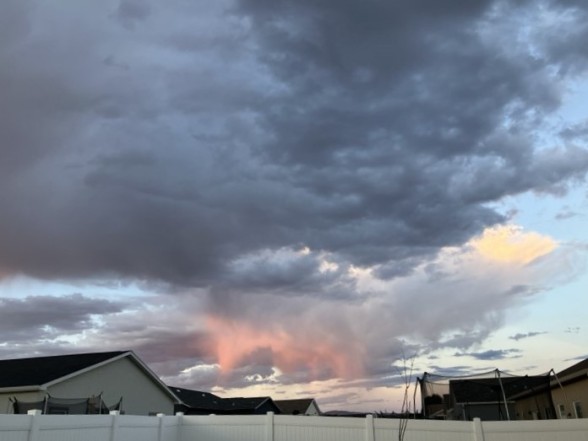
We have fight or flight for the sympathetic nervous system state, when we are ramped up, aggressive, go getters, all that stuff. We need a term for the parasympathetic nervous system state, the relaxed one. So far I’ve come up with lie low and flow. Other suggestions? I welcome them! We need more lie low and flow and glow and say no and ho, ho, ho in the world. What puts you in that state? Knitting? Stupid cat videos? Bugs Bunny? A bubblebath? Watching toddlers? What makes you laugh and yawn and relax and lets all the tension flow out and sink or float away?

In clinic I am seeing a wide age range. Most of the younger ones, say, under 60, look a bit shell shocked. I think this is still from the pandemic and wars and political nastiness. The over 60 crowd seems to not care as much. They’ve been through it, they know people die, they know bad stuff happens.

A friend and I were talking about pandemics and he pointed out that HIV and AIDS was a pandemic too. So we are on track for two pandemics per century. The younger folk do not remember the HIV and AIDS pandemic and how frightening it was. Right before that started, some doctors proclaimed that infectious disease had been conquered by medicine. Um, RONG RONG RONG! Boy did they eat THOSE words. And early in that pandemic, no one knew what to believe, what was happening, how to stay safe, and the communication from the medical establishment changed very fast. I wonder if the people who were young adults and older in the 1980s were less surprised by the Covid-19 Pandemic and all the rumors and confusion. Yep, seen it before.

I am not sure how to help the younger shell shocked looking folks. Colorado is a bit tough and manly and consequently there is not a huge amount of resources for emotional health. Yesterday I asked if we have anyone who does neuropsychiatric testing and the answer I got was “I don’t know.” I will dig around today but did not find it on the internet. I have found neuropsych testing hugely helpful for traumatic brain injuries, post brain surgery, and to sort out unusual learning and memory styles. One woman had a brain tumor removed. Her memory was affected. She could remember things that she wrote down and read, but not things that she only heard. No one had given her the report to read. They only told her, so she did not remember it. At least, that was the story. I gave her the report and said, “Read it. And tell your family. And if you are on the phone, take notes.”

Ok, now I should get ready for work, though I want to lie low and watch a silly cat video.

For the Ragtag Daily Prompt: yawn.
Daily Evil: N is for Nowledge

WHY do we spell knowledge with a K? And why does know rhyme with no? If that isn’t evil, I don’t know what is. Ok, here is a site that explains: https://www.dailywritingtips.com/kn-words-in-english/.

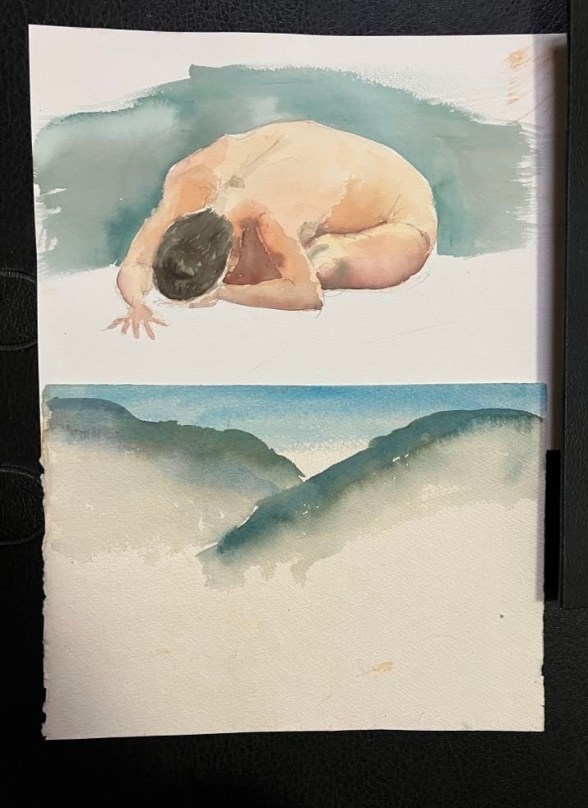
Let’s talk about knowledge and technique in art. Above are two watercolors by my mother, Helen Burling Ottaway. Neither has a date. The lower one is certainly unfinished and I am not sure about the upper one. I can tell by the technique that the lower one is a much earlier painting. Some of the watercolor nudes do have a year: 1998. That was two years before she died of cancer. I think the lower one is from the 1970s, but the use of wet and dry paper for painting is already apparent, as well as color and line.

(You always know) post trauma

You always know

You always know
when I am afraid
when I am running
when I am hiding
how afraid I am

when I keep secrets

You always know
so far
when I am triggered and terrified
and hiding and broken
and pretending to be ok

so far
you respond
and are gentle
draw me out
offer food
and company

You always know
so far
and I am still afraid
and I am still planning
and this is what I am hiding
the plan for what I will do

What I will do
when you know
you always know
when you know
but you don’t
respond

when you don’t respond
and aren’t gentle
don’t draw me out
don’t offer food
or company

You always know
so far

But I feel safer
if I don’t
trust

11/28/21

Admitting diagnosis: old guy, don’t know

I wrote this in 2010, after I worked for three months at Madigan Army Hospital. I really enjoyed working there. It was the first time since residency that I had worked in a big hospital — 450 beds — and in a not rural setting. I kept asking to work with residents and eventually the Captain and I worked it out to both our satisfactions.

______________________________________

During my three months temp job at a nearby Army Hospital, I am asked to help the Family Medicine Inpatient Team (FMIT) whenever a faculty member is sick or out or deployed, which turns out to be fairly often. I enjoy this because I want to work with residents, Family Practice doctors in training. It is very interesting to be at a training program, watch the other faculty and work at a 400 bed hospital instead of my usual 25 bed one.

Two patients need to be admitted at the same time on our call day, so the second year resident takes one and I take the other. The report on mine is an 82 year old male veteran, coughing for three weeks, emergency room diagnosis is pneumonia.

The resident soon catches up with me because her person is too sick and gets diverted to the ICU. Mr. T, our gentleman, is a vague historian. He says that he has always coughed since he quit smoking 15 years ago and he can’t really describe his problem. He’d gotten up at 4:30 to walk around the assisted living; that is normal for him because he still does some o the maintenance. He had either felt bad then or after going back to sleep in a chair and waking at 10. “I didn’t feel good. I knew I shouldn’t drive.”

He’s had a heart attack in the past and heart bypass surgery. Records are vague. The radiologist reads the chest xrays essentially as, “Looks just like the one 3 months ago but we can’t guarantee that there isn’t a pneumonia or something in there.” He has a slightly elevated white blood cell count, no fever, and by then I do a Mini-mental status exam. He scores 22 out of 30. That could mean right on the edge of moderate dementia, or it could be delirium. I get his permission to call his wife.

“Oh, his memory has been bad since he spent a year in a chair telling them not to amputate his toes. And he was on antibiotics the whole time. He wasn’t the same after that. This morning he just said he didn’t feel right and that he shouldn’t drive.” So his wife called an ambulance.

The third year chief resident comes by and wants to know the admitting diagnosis. “Old guy, don’t know.” is my reply. “Either pneumonia or a urinary tract infection or a heart attack maybe with delirium or dementia or both.

The second year is helping me put in the computer orders, because I am terrible at it still. She could put them in upside down and asleep. “Why are we admitting him, anyhow? We can’t really find anything wrong, why not just send him home?”

“We can’t send him home because he can’t tell us what’s wrong. He might have an infection but he might not, and he has a really bad heart. If we send him home and he has a heart attack tonight, we would feel really bad. And he might die.”

I was getting a cold. I had planned to ask to work a half day but half the team was out sick so I just worked. But by morning I had no voice and felt awful. I call in sick.

At noon the phone rings. It is the second year. “You know Mr. T, who we admitted last night?”

“Yes,” I say.

“He had that heart attack during the night. Got taken to the cath lab. You made me look really good.” We had worked on the assumption that it could be early in a heart attack though the first labs and the ECG were negative. I had insisted on cardiac monitoring and repeating the enzymes. The resident had finished the note after I left and the night team had gotten the second and abnormal set of enzymes.

82 year olds are tricky. With some memory loss he couldn’t tell us much except that “I don’t feel right.” He was right not to drive and we were right to keep him in the hospital. And if it had all been normal in the morning, I still would not have felt bad about it. The residents are looking for a definitive diagnosis, but sometimes it’s “Old guy, don’t know,” until you do know.

I don’t think I realized what I had gotten myself into, but it seemed like the potential for fun and insanity were there in equal parts

sometimes you know things
without knowing

sometimes you no things
without noing

sometimes you know things
without noing

sometimes you no things
without knowing

sometimes you koanow things
without knowing

sometimes you no things
without koanowing

sometimes you koanow
without koanowing

sometimes you koanow

snow

also published on another site today.

Happy no

Name, noun, nut, gnome, know, no…

I have a nutty streak, a silly streak and love silly things. It helps me to balance clinic. Sometimes things are hard there, I hope to be able to do something for many people that I see. Half my patients are over 65, one is now 100, and no one lives forever even if I recommend the right things and they live a medically perfect life. I am always mourning for someone.

So my nutty streak comes out with listing words for the letter N and adding gnome and know. Are they N words or not? I think they are.

And my happy thing today is the word NO. How, you say, can NO be a happy thing?

This weekend I wanted to do too much. I wanted to attend a retreat about change that went from 9:30 to 3:00 but I also was already tired. It would be with aΒ  group of people that I don’t know well, so my introvert side would be on guard. My son was coming into town and I needed to make choices and save energy and say no to myself. I went to the retreat, but only for two hours. I wanted to stay longer but did not. And that protected my energy for the next day and this busy week.

Do you argue with yourself and want to do too much or something your shouldn’t or spend too long on something that you didn’t plan to? Look, I thought this would be a very short post to catch up….

N

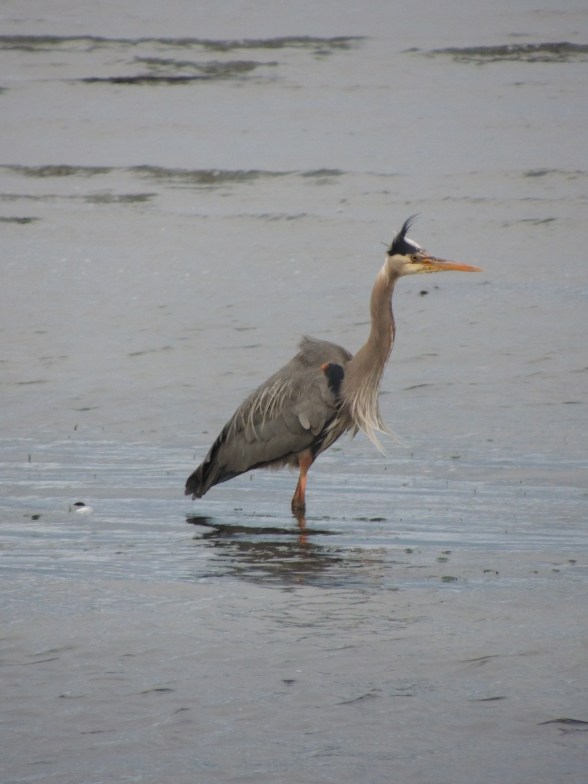
There were three great blue herons on the beach the other night, and then an eagle in the surf. The herons were fishing but also watching the nearby eagle, the people on the beach, loose dogs going by, and each other. Their feathers were windblown and they made me think of teens at a dance, looking at each other with interest, but pretending they were more interested in fishing.

Happy Blogging from A to Z!