PTSD and The Singing Tree

The Singing Tree by Kate Seredy, 1939, is a children’s book that illustrated PTSD for me long before I went to medical school. The Singing Tree is the sequel to The Good Master, and describes the survival of a Hungarian family and farm during World War I.

The good master is Marton Nagy, and he is called up as a Corporal, leaving the farm to be cared for by his wife, son, niece and workers. The farm suffers because so many men are called up. They are getting behind on the work and then find a diary from Marton, which gives suggestions and instructions for the year round work on the farm. One of the instructions is “to make out an application for Russian prisoners if necessary.”

They do. They apply and take 6 Russian prisoners, homesick farmers, who don’t speak Hungarian. Jansi and his cousin Kate take the chains off them and the prisoners quickly become part of the family. “Comrade, eh? Friend?” says one of the prisoners. And they are. They are also excellent workers and homesick.

As the prisoners are taken home in the wagon, they also take Peter, a deserter from the Hungarian army. He has panicked about his wife and new baby. He is crazy with worry. He is hidden under the six Russians, who sympathize. After seeing the baby he returns to his regiment. But Peter is angry and expresses his rage at Jews, even though it is Uncle Moses, the Jewish shopkeeper, who has helped hide him.

    Mother took Jancsi’s arm then and they left he room. They didn’t speak; what was there to say? Something, somebody had poisoned Peter’s soul against those who had been good to him all his life. Into Jancsi’s mind flashed the words Father had said: “The stampede… the mad whirlwind that sucks in men…and spits out crippled wrecks.” Crippled in body and soul, Jansci thought then, with an understanding far beyond his years.
    “Poor Peter,” he said aloud. Mother pressed his arm. “I knew you would see it that way, Son. I only hope the war ends before this poison has spread too far.” p 163.

Marton is missing and they have not heard from him. Jansci and Kate make the wagon trek to bring back their grandparents, because the front is now too close for them to be safe. Kate and Lily smuggle the cat along. The cat gets “sick” and the girls insist at stopping at a hospital. The sickness is kittens. The nurses laugh at the girls, but then let them help on the wards. Injured soldiers who are healing.

    “Almost an hour passed before all the patients had been fed. “There was only one asleep,” Lily said, coming back with the empty bowls; “he even had the sheet pulled over his face.” The nurse followed Lily’s pointing finger with her eyes. “Oh, the amnesia case. He sleeps most of the time.”

    “Whats am-amnesia?” Kate wanted to know.

    “Loss of memory. They forget who they are and have to begin life all over again; like babies.” “Does it hurt?”
    “No,” smiled the nurse. “It comes from a shock; like a big scare, you know.” She looked toward the bed again. “He is such a nice man too, poor fellow. He tries so hard to remember. if we could find out who he is, find something to remind of his home, he might remember. You wan tto see him?” she asked as Kate kept staring at the bed. “Come on then, but be quiet.”
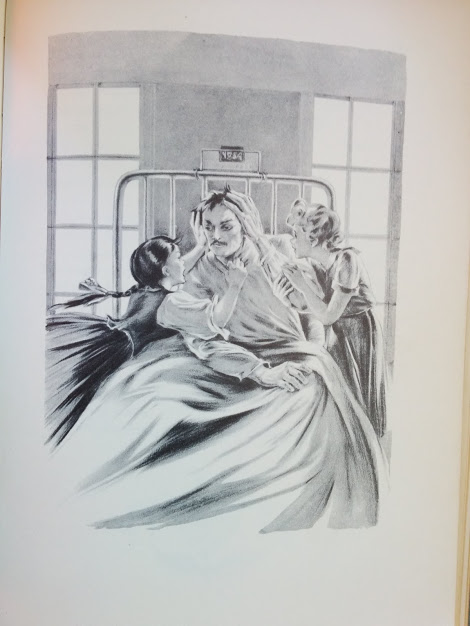
    “No. 54, Amnesia,” was written on the headboard. The nurse gently lifted the sheet. Pandemonium broke loose immediately. Kate, with her famous tin-whistle scream gong at full blast, threw herself on the bed. “UNCLE MARTON! UNCLE MAAARTON! IT’S KATE. Can’t you….? UNCLE MARTO-O-O-ON!”

    Every patient was sitting bolt upright. Doctors and nurses were running in, Lily joined Kate, tugging at Uncle Marton’s hands. “Say something…you know us, don’t you? Say something.”

    “Kate, if you don’t stop that infamous yelling this minute, I’ll take Milky away from…Say! Where am I? Who are these people?” Uncle Marton was looking around dazedly.

    “Never mind them,” sobbed Kate, laughing at the same time. “You know who you are now, don’t you?”

    “Why shouldn’t I? Let me out of this bed!” Uncle Marton cried, trying to peel Kate and Lily off his chest.
    “Take it easy, take it easy,” said a doctor who stepped up. “What is your name?” “Lieutenant Marton Nagy of the Seventh Infantry,” snapped Uncle Marton, glaring at him. “Seventh Infantry… Seventh…oh…”His eyes clouded.
    “Now it all comes back, doesn’t it? You’ll be all right now, Lieutenant Nagy. Don’t think about that now. Tell me who this…this calliope is. That scream was the best I ever heard.” The doctor sat down on the bed, smiling at Kate. “I wish we could produce for each amnesia case we get; we wouldn’t have any.” pp 186-189

He gets to go home.

    “From Corporal to Lieutenant in a year. Pretty good, Lieutenant Nagy,” an officer with a lot of gold braid all over him said to Father. “And a handful of medals to catch up with you, as I heard. What did you do?”
    Father looked him straight in the eye. The muscles in his jaws were working. “I don’t know sir. I would rather not try to remember.”

    The officer sighed. “Go home, Lieutenant. Forget, if you can. I wish I could.”

And will he have to return?

    “Then Father went to report to the hospital and this time Mother and Jansci went with him. The doctors found that in body he was sound, but only time, long months or even years, could make him forget the things he never spoke about.
    “There are none braver than he is,” the doctor told Mother, “but the human mind can stand just so much of horror and no more. We dare not tke the risk of sending him back to war.”
    “Thank God!” Mother had exclaimed, and the doctor smiled very sadly.
    “I hear that every day now. Wives, mothers thanking the Lord for an injury their beloved ones have received. A broken bone, a brave mind darkened with nameless fear, anything that takes a long time to heal, has become a blessing, a gift. They are safe for a little while longer.”

And Jansci talks to one of the Russian prisoners.

    “Big boss come home…maybe war over?” Grigori wanted to know when they had come with Father. Jansci tried to explain and he thought that Grigori didn’t understand because for a long while he didn’t say anything. Then he sighed: “Grigori know. Hear, Jansci. Bad man, stupid man, he go kill and laugh. Good man, man with good heart, good head, no can kill and laugh. He cry inside. Baby cry with big noise. Man cry–no noise, but it hurt very bad. Me know….me know.” p. 203

Death affects the village.

    “More white envelopes were coming to the village now than ever since the war started. The hands of Uncle Moses began to tremble and he seemed to grow smaller, more bent. Aunt Sarah was like a silent little wraith, going from house to house to comfort, to help, or just sit, holding the hand of a woman who would never wait for the mail again because there was no one left to writ to her. Often she and priest met in one of the houses and the priest would bow deeply to her Once he told Father: “She seems to give more comfort, more strength to these poor women than I can.” pp 203-204

I wish that we had the sense expressed in this book about PTSD and the effects of war. When I worked at Madigan Army Hospital, some soldiers were getting ready for their fourth or fifth tour of duty. If we as a country are going to continue these wars, we must take more responsibility and have more care for the damage done. When people talk about “curing” PTSD or keeping it from happening: if we didn’t respond with PTSD as a species with horror for the evils of war, we don’t deserve to survive. We will be the Bad People, the Stupid People, who Kill and Laugh. We need to stop. This book was written in 1939 and clearly they knew the effects of PTSD. It’s been almost 80 years since Kate Seredy’s book was published: and still we question PTSD?

http://www.pdhealth.mil/clinicians/assessment_tools.asp
Civilians too: http://www.mirecc.va.gov/docs/visn6/3_PTSD_CheckList_and_Scoring.pdf

illustration from p. 187

Magical childhood

Let’s keep the children
safe and warm
cuddled close
and free from harm

No, but what monster
hides underneath the bed
let’s find and name
the monsters all instead

we are wired not for safety
but for truth
don’t hide grief and fear
from the youth

a child survives by attunement to
your heart
they listen deeply from
their start

long before they understand
your words
they sense the world’s
monsters as a herd

a disney childhood is
a lie
the heartfelt child
wonders why

name your sorrows and
your pain
then your child will know
they have a name

no monsters hide beneath
my childrens’ bed
they know I hold them
close and dear instead

also published on everything2.com

Sophistocated Noder

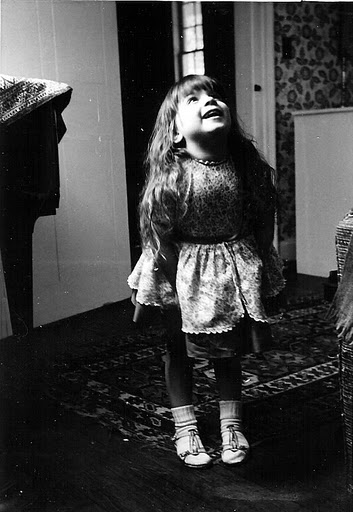
The picture is my daughter years ago. But hey! That’s how I am feeling at the end of the Blogging 101 class! I am a sophistocated noder! I know stuff! I know a lot more than I did a month ago! I have met other people! I have made another page! I have Big Plans!

And…. I am still a clueless newbie really, but it’s been very fun.

More Seattle

In Seattle Monday afternoon the sun was out but it was not exactly warm. Probably 40s and starting to cool off by 3 pm as I walked around. The fountain was quite gorgeous in the sun. I like this picture, with the woman trying to lure the little girl a bit closer. Over an edge and on to the slope leading down to the fountain. The child wouldn’t quite go, until the adult got up and held her hand.

I want to try adding a second photo. seattle trip docs 123 Yes! In spite of the cool air, there was a person who went in the fountain! All of his friends cheered. I hope he had a towel and a change of clothes nearby….. I love fountains that are built to play in.

Adverse Childhood Experiences 2: Out on a Limb

We are approaching a seismic shift in psychiatry. I am now going out of a limb to predict the direction we will go in.

The allopathic medical community will resist, including many psychiatrists. But it is the neurobiologists and brain imaging and psychiatrists who will prevail. If the creek don’t rise and we aren’t hit by a giant asteroid, nuclear winter, devolve into fighting over the remaining arable land as the world heats up….

I have been thinking about this all through my career, but especially since the lecture on adverse childhood experiences, which I heard in Washington, DC about ten years ago. I wrote about that lecture on January 6, 2015. The lecturer was a woman. She said that it appeared that the brain formed differently in response to childhood adverse experiences. She said that we don’t yet know what to do with this information.

Staggering understatement. I went from that lecture to one about ADHD. The lecturer was male. He said, “Children diagnosed with ADHD have brains that are different from normal children on PET scans and functional MRIs. We don’t understand this.” He sounded puzzled. I thought, he didn’t go to the previous lecture….

Childhood adverse experiences are scored zero to seven. I score a five. I am at high risk for addiction. I assumed this when I realized at age 19 that my father was an alcoholic and my mother was enabling. I was very very careful about alcohol. I tried pot twice and didn’t like it. I refused to try anything else, and refused benzodiazepines when I was depressed: they are addictive. With an ACE score of five, I am also at higher risk than a person with a score of zero for ALL mental health diagnosis: ADHD, depression, bipolar disorder, obsessive compulsive disorder, etc. People with a score of five had a 60% chance of being diagnosed with depression compared with a 10% chance in people with a score of zero over the life of the study. In the last fourteen years I’ve only been diagnosed with a “grief reaction” which is a temporary reaction to grief. It is also called an adjustment disorder. High adverse childhood experience scores are also at higher risk for morbidity and mortality from heart disease, emphysema, arthritis, basically everything and tend to die younger.

What this means, I think, is that our brains are plastic in utero and in childhood: the wiring is put down in response to the environment. This is adaptation. I have crisis wiring: my mother had tuberculosis when I was conceived and born. Really, from an evolutionary standpoint I AM weird: babies whose mothers had tuberculosis died. Quickly. I was saved because my mother coughed blood one month before I was due. A lot of blood. She thought she had lung cancer and would die. The fetus is bathed in those stress hormones, grief, fear….

I was removed from my mother at birth to save my life. I then was removed from people at 4 months and at 9 months. I grew up trying to be independent and highly suspicious of adults.

I predict that we are going to revamp all of our ideas about mental health. The brain wiring is set up depending on the environment, physical and emotional, that the child grows up in. My friend Johanna was outraged in college when we learned that the fetus and placenta basically take over the hormones of the woman for 9 months. “I’m not letting some baby grow in me and do that!” Johanna said. “I am going to figure out how to implant the pregnancy in a cow. You take good care of the cow and you can drink beer through the whole pregnancy! The cow won’t even notice when the baby falls out!” She has three children, an MD and a PhD in genetics. She did not use a cow.

The brain wiring is an adaptation to the environment. If there is war or domestic violence or addiction or mental health problems, the child’s brain kicks in emergency wiring. This is to help the child survive this childhood. As an adult they are then more at risk for mental health disorders, addiction and physical health disorders.

In the end, the sins of the parents, or the terrible circumstances of the parents, are visited upon the children. We have to take care of the children from the start in order to be healthy.

And people who have low adverse childhood experience scores don’t understand. They grew up with nice people and in a nice environment. They wonder why people can’t just be nice. The fear and grief and suspicion and emotional responses that appear maladaptive in adults, that is what helped people survive their childhoods. That is what I remember each time I see an addict in clinic, or someone who is on multiple psychiatric medicines, or someone who is acting out.

Adverse Childhood Experiences

I went to a sparsely attended lecture about the Adverse Childhood Experiences Study, or ACE Study, in 2005 and it blew my mind. I think that it has the most far reaching implications of any medical study that I’ve read. It makes me feel hopeful, helpless and angry at God.

The lecture was at the American Academy of Family Practice Scientific Assembly. That year, it was in Washington, DC. There are 94,000 plus Family Practice doctors and residents and students in the US, the conference hall had 10,000 seats and the exhibition hall was massive. At the most recent assembly, there were more than 2600 exhibitors.

I try to attend the lectures numbered one through ten, because they are the chosen as the information that will change our practices, studies that change what we understand about medicine.

The ACE Study talk was among the top ten. Yet when I walked in, the attendees numbered in the hundreds, looking tiny in three joined conference rooms that could seat 10,000. The speaker was nervous, her image projected onto a giant screen behind her. My experience has been that doctors don’t like to ask about child abuse and domestic violence: I thought, they don’t want to go to lectures about it either.

The initial part of the study was done at Kaiser Permanante, from 1995-1997, with physicals of 17,000 adults. The adults were given a confidential survey about childhood maltreatment and family dysfunction. A simpler questionnaire is at http://www.acestudy.org/files/ACE_Score_Calculator.pdf, but it is not the one used in the study. Over 9000 adults completed the survey and were given a score of 0-7, their ACE score. This was a score for childhood psychological, physical or sexual abuse, domestic violence, or living in a household with an adult who was a substance abuser, mentally ill or suicidal, or ever imprisoned.

Half of the adults reported a score over 2 and one fourth over 4. The scores were compared with the risk factors for “the leading causes of death in adult life”. They found a graded relationship between the scores and each of the adult risk factors studied. That is, an increase in addiction: tobacco, alcohol and drugs. An increase in the likelihood of depression and suicide attempt. And an increase in heart disease, cancer, chronic lung disease, fractures and liver disease. The risk of alcoholism, drug addiction and depression was increased four to twelve times for a score of four or more.

The speaker said that the implications were that the brain was much more malleable in childhood than anyone realized. She said that much of the addictive behaviors and poor health behaviors of adults could be self-medication and self-care attempts as a result of the way the brain tried to learn to cope with this childhood damage.

I left the lecture stunned. How do I help heal an adult who is smoking if part of it is related to childhood events? From there I went to a lecture about ADHD, where the speaker said that MRIs and PET scans were showing that children with ADHD had brains that looked different from children without ADHD. I thought that speaker should have come to the other lecture. And I did not much like my ACE score, though it does explain some things.

I feel hopeful because we can’t address a problem until we recognize it.

I feel helpless because I still do not know what to do. The World Health Organization has used the ACE Study in their Preventing Child Maltreatment monograph from 2006. But it is not very cheerful either: “There is thus an increased awareness of the problem of child maltreatment and growing pressure on governments to take preventive action. At the same time, the paucity of evidence for the effectiveness of interventions raises concerns that scarce resources may be wasted through investment in well-intentioned but unsystematic prevention efforts whose effectiveness is unproven and which may never be proven.”

Do I do ACE scores on my patients? With the new Washington State opiate law, we do a survey called the Opiate Risk Tool. It includes parental addiction in scoring the person’s risk of opiate addiction. But not the rest of the ACE test. At this time, I don’t do ACE scores on my adult patients. I don’t like to do tests where I don’t know what to do with the results. “Wow, you have a high score, you will probably die early,” does not seem very helpful. But I remain hopeful that knowledge can lead to change. And it makes me more gentle with my smoking patients, my addicted patients, the depressed, the heart patient who will not exercise.

I am angry at God, because it seems as if the sins of the fathers ARE visited upon the children. It is the most vulnerable suffering children who are most damaged. That does not seem fair. It makes me cry. I would rather go to hell then to the heaven of a God who organized this. I stand with the Bodhisattva, who will not leave until every sufferer is healed.

1. ACE study   http://www.cdc.gov/ace/about.htm

2. American Academy of Family Practice   http://www.aafp.org/events/assembly.html

3. ACE questionaire   http://www.cdc.gov/ace/questionnaires.htm

4. Score correlation with health in adults   http://www.ajpmonline.org/article/PIIS0749379798000178/abstract

5. WHO preventing child mistreatment   http://whqlibdoc.who.int/publications/2006/9241594365_eng.pdf

6. Washington State Opiate Law   http://www.agencymeddirectors.wa.gov/

7. Opiate Risk Tool   http://www.partnersagainstpain.com/printouts/Opioid_Risk_Tool.pdf

First published on everything2 November 2011.

Painting Angels

You were an artist
You are an artist
You said that you’d have to live to 120 to finish all your projects
And died at 61
I keep wondering
what the art supplies are like
and if you work on sunsets
or mountains
or lakes

Trey, 9
made a clay fish last summer that I admire.
He said grumpily “It’s too bad Grandma Helen died before I could do clay with her.”
He tells me he’s ready to make raku pots for fire in your ashes as you wished
I ask what he’d make
He considers and says, “What was Grandma Helen’s favorite food?”
I can’t think and say that she liked lots of foods
At the same time wondering squeamishly if maybe
he should make a vase and then being surprised
that I am squeamish and thinking of blood and wine,
too, I wonder if my dad would know. “Maybe guacamole.”
I need to find a potter to apprentice him to.

Camille, 4.
asks how old Grandma Helen was when she died.
I explain that she died at 61 but her mother died at 92.
Camille asks how old I am.
40.
When are you going to die?
I say I don’t know, none of us do, but I hope it’s more towards 90.

Camille studies me and is satisfied for now.
She goes off.
I think of you.

I perpetuate
the Christmas cards you did with us
upon my children
They each draw a card.
We photocopy them and hand paint with watercolors.
Camille wants to draw an angel
and says she can’t.
I draw a simple angel
and have her trace it.
She has your fierce concentration
bent over tracing through the thick paper
She wants it right.
The angel is transformed.

My kids resist the painting after a few cards as I did too.
Each time I paint the angel
to send to someone I love
I think of Camille
and you
and genes
and Heaven
I see you everywhere

published in Mama Stew: An Anthology: Reflections and Observations on Mothering, edited by Elisabeth Rotchford Haight and Sylvia Platt c. 2002

written January 19, 2002

The Introverted Thinker and the Extroverted Feeler play

I am an introverted thinker by preference on the Meyers Briggs test and my sister was an extroverted feeler. My kids each have one of those preference patterns. This story first appeared on an obscure writing website in November 2014.

_____________________________________

When my sister ChrisΒ and I were very little, we went on long car trips each summer to a lake in Canada. This is a small lake north of Lake Erie and one of hundreds in Ontario, but to us it was “Canada”.

This was before seatbelts. My father was in graduate school, my mother was an artist who was not making money at it and they were “independently wealthy at a poverty level.” Our cars were always used and tended to break down. My father favored old Peugots and once he and a friend put a new engine in the International Travelall right before we left. We were living in Johnson City, New York, so it was either one very long day’s drive or two days to the lake.

ChrisΒ and I had the back seat, often piled with camping gear. She was three years younger. When we were very small we played “Red eye, white eye.” I don’t know who made it up, but I remember my father’s voice. The eyes were tigers. “White eyes” meant that there was an oncoming tiger and we had to duck down behind the seat until it passed, so that it wouldn’t get us. “Red eyes” meant a receding tiger or a tiger in front of us going the other way, so we could pop back up. It also meant no tigers.

“White eyes,” said my father, and we hid, scared. Then there was such a feeling of safety and of not being caught when he said, “Red eyes,” and we could return. We knew that he would protect us from the tigers.

Don’t panic, prepare

We need to help people with ebola in other countries: or else we won’t deserve and won’t get help when the United States is the center of an epidemic.

I am a member of a doctor website called Sermo. I rarely write there, especially after I found advertisements to medical equipment and drug companies saying that they could pay to put announcements and articles on the site and “reach doctors”. Also, apparently some doctors on the site think that it is “safe” to write things. Ha. It’s the internet, silly, the opposite of safe. Your words could get back to your patient, ok?

Anyhow, there was a survey and 75% of the doctors on the site who took the survey (I didn’t)Β  said we should stop flights from Liberia. I think they are wrong, are not compassionate, and I would cross them off my referral list as discriminatory “I’ve got mine, everyone else can go to hell.” selfish gits. I disagreed and said that the United States could be the center of an epidemic, easily. Could be. Will, some day. We need to treat our international neighbors as we want to be treated.

That being said, I am pleased to see the CDC and United States hospitals now stepping up and getting their hazmat suits on. The rest of us need to NOT PANIC.

If you want to do something, think about your communities emergency preparedness. Are you prepared?

1. Do you have a weeks worth of food, water, medicines, supplies? Do you update the supplies (ok, I have food from 2009. Time to update.)

2.Do you have a weather radio? (http://www.emd.wa.gov/publications/pubed/where_to_get_weather_radios.shtml)

3. Do you have a family meeting point? Do you have an out of state person that the family is to call to check in? That everyone knows about?

4. Have you subscribed to emergency notifications? (http://www.emd.wa.gov/publications/pubed/noaa_weather_radio.shtml)

5. Consider buying your community a shelter box. Or teaming with friends to buy one for the community and another for a disaster area. Our Rotary group buys at least one a year for international disaster relief. (http://www.shelterbox.org/Β Β  and http://www.shelterboxusa.org/)

6. Do you have skills? Can you set up a tent, cook food, do medical care, start a fire, build shelter? What skills could stand brushing up? Have you taken a first aid class recently? Have you taught your children these skills? Do you have neighbors that would need help? You would want someone to help your grandmother, who lives four states away. Adopt a local elderly person or couple that you would help……

The picture is my daughter and niece in 2009 in a 19 pound canoe that is very tippy. They only tipped it over on purpose. They both have a lot of skills, some learned at cabins in Ontario, Canada. The cabins are one room and could also be described as shacks: but the kids get to use tools, paddle canoes, start fires, sleep in a tent……

My parents taught care of the tent so well that I have a kelty tent that my sister and I set up, took down and used, and it still does not leak. It is more than 40 years old! Aluminum poles, no shock cords and a fly. Excellent.