Pain as a vital sign

A recent article in the Family Practice News says that a survey of 225 physicians reveals that 33% of them think that the opioid crisis in the US is caused by over prescribing opioids. 24% said aggressive patient drug seeking and 18% said it is due to drug dealers. How quickly things change.

In 1996 pain was declared the fifth vital sign, after temperature,  pulse (heart rate), respiration rate and blood pressure. I disagreed with it because it focused on pain, by telling the nurses in the hospital and the outpatient providers to always to ask about pain. I thought it would be better to focus on level of comfort than pain. I thought we were using opioids far too freely and I thought that patients were getting addicted. The pain specialists said that we had to treat pain, and we were given very few tools other than opioids. Primary care providers were told that they could be sued for too much or too little pain medicine.

I also disagreed with it because pain is NOT a vital sign. That is, the level of pain does not correlate with illness. If a person has a high fever of 104 I am sure they are sick, a fast or very slow heart rate, a blood pressure too high or two low, they are breathing too fast: these are vital signs. They often correlate to illness and help us decide if this is outpatient, urgent or emergent. But pain does not. A chronic pain patient may have a pain level of 8/10 and yet not be an emergency or in a life-threatening state at all. That does not mean that they are lying or that we don’t wish to help with pain.

In June, 2016, the American Medical Association recommended dropping pain as a vital sign. https://www.painnewsnetwork.org/stories/2016/6/16/ama-drops-pain-as-vital-sign. The Joint Commission for Hospital Accreditation dropped pain as a vital sign in August, 2016. https://www.jointcommission.org/joint_commission_statement_on_pain_management/

Why? Not only were people getting addicted to opiates, but they were and are dying of unintentional overdoses: sedation from opiates with alcohol, with anxiety medicines such as benzodiazepines, with soma, with sleep medicines such as ambien and zolpidem. If the person is sedated enough, they stop breathing and die. The CDC declared an epidemic of unintentional overdoses in 2012: https://www.cdc.gov/mmwr/preview/mmwrhtml/mm6101a3.htm and said that more US citizens were dying of prescription medicines taken as instructed then from motor vehicle accidents and guns and illegal drugs.

So the poem below and a second poem I will post tomorrow reflect how I thought about pain as a vital sign. It is not a vital sign, because a high pain level does not tell me if the person is critically ill and may die. It does not correlate. Pain matters and we want to treat it, but the first responsibility is “do not harm”. Letting people get addicted and killing some is harm.

Also, opioids have limited effectiveness and high risk for chronic pain. I have worked with  The University of Washington Pain and Addiction Clinic since 2010 via telemedicine. They say that average improvement of chronic pain with opioids is about 30%. Higher and higher doses do not help and increase the risk of overdose and death. And the risk of addiction.

I think of pain as information. Studies of fibromyalgia patients with functional MRI of the brain show that they are not lying about their pain. In a study normal and fibromyalgia patients were given the same pain stimulus on the hand. The normal patients said that they felt 3-4/10 pain. The fibromyalgia patients felt 7-8/10 pain with the same stimulus and the pain centers lit up correspondingly more in their brains. So they are not lying.

Why would opioids only lower chronic pain about 30% even with higher doses? The brain considers pain important information. We need to snatch our finger away from a flame, stop if we smash our toe, deal with a broken bone. I think of opioids like noise cancelling headphones. Say you are listening to music. You put on headphones/take round the clock opioids. Your brain automatically turns up the gain: the music volume or the pain sensors. Now it hurts again. You take more. The brain turns up the gain. Now: take the noise cancelling headphones off. The music/pain is too loud and it hurts! With music we can turn it down, but the brain cannot adjust the gain for pain quickly.

We do not understand the shift from acute pain to chronic pain, yet. The shift is in the brain. I think that we are too quick to mask and block pain rather than use the information. Now the recommendations for opioids are to only use them for 3-5 days for acute pain and injury. For years I have said with any opioid prescription: try not to take them around the clock and try to decrease the use as soon as possible. Some people get addicted. Be careful.

If we don’t hand people a pill for pain, what can we do? There are more and more therapies. Jon Kabot Zinn’s 30 years of studying mindfulness meditation is very important. His chronic pain classes reduce pain by an average of 50%: better than opiates. Pain and stress hormones drop by 50% in a study of a one hour massage. Massage, physical therapy, chiropracty and acupuncture: different people respond to different modalities. Above all, reassuring people that the level of pain in chronic pain does not correlate to the level of illness or ongoing damage. And pain is composed of at least three parts: the sharp nocioceptive pain, nerve pain (neuropathic) and emotional pain. We must address the emotional part too. We have no tool at this time to sort the pain into the three categories. My rule is that I always address all three. That does not mean every person needs a counselor or psychiatrist. It means that we must have time to discuss stress and discuss life events and check in about coping.

In the survey of 225 providers, 50% estimated that they prescribe opioids to fewer than 10% of their patients. 38% said less than half. 12% estimated that they prescribe opioids to more than half their patients. The survey included US primary care, emergency department and pain management physicians.

Handing people a pill is quicker. But we can do better and primary care must have the time to really help people with pain.

Vital Signs I

In the hospital now
I am told we have a new
Vital sign
Like blood pressure and pulse
We are to measure
Pain
And always treat it

Sometimes I wonder

Mr. X is in the ICU
I tell his family
He may die

On a scale of one to ten
What is his wife’s pain?
His daughter’s
We are not treating them
Only Mr. X

We try to suppress pain
Signals from our nerves
Physical pain is easier

I think of our great forests
We suppressed fire

And that was wrong
If fire is suppressed
Undergrowth builds up
Fuel levels rise
Fire comes
Rages out of control
All is destroyed

If fires burn
More naturally
More regularly
What is left?

At first it looks desolate
The tall trees are burnt
Around their bases
But they live
Adapted to the fire
Majestic pines
Revealed
Would our values were as clear

Some pines
Seeds
Pinecones
Will only germinate
In fire
When the undergrowth
Is cleared
Conditions are right
For new growth

Perhaps pain is our fire
Grief is our fire

If we block pain
Where does it go?
Does the fuel build?

I wonder if the tall pines
Fear fire
Would they avoid it
If they could

Perhaps suppression
Is not the answer

Perhaps we can change
Remain present
Acknowledge pain
As normal
As joy

Perhaps if I
Step into the fire
I can remain
Present
For you

And you will be
Less alone
Less afraid

I open my doors

Let the fire burn

poem written before 2009

CDC guidelines for treating chronic pain: https://www.cdc.gov/drugoverdose/pdf/guidelines_factsheet-a.pdf
that

Whenever I think

that
is what I don’t want to be

the Beloved laughs
and orders me
to be that

as if I’ve called it
that

the angels surround me
curious

it’s my passion
anger
fear
that calls them

motes from heaven
fall on me
from their wings

and I weep

and step forward
and fall
fall
fall

becoming
that

Heart call

I am lying in bed and missing my heart.

I prayed to the Beloved to fall in love and I do. I happen to be terribly sick because the Beloved is teaching me to take time off and not just work harder and longer to avoid grieving. This is the second lesson. Or the fifth, depending on how I count it. The previous one was two months, this will be ten.

But early on, before I realize that death is standing in my doorway, I am at a picnic. A sports picnic with parents and teens and some younger children. I see a man who has been flirting with me be nice to a tween girl. My heart falls out of my chest and attaches itself to him. It follows him home.

He is quite spectacularly wrong for me. I know it but my heart doesn’t care. And he is a liar, manipulator and a slut. Familiar ground, just like my family. I go to his place and try to catch my heart, but it is stubborn and skitters away from me. It is covered with sawdust, cat hair and motor oil. Also rabbit fur. He raises bunnies for meat and kills them. I cuddle the babies and then he does too.

My heart is brutally stubborn. I tell it it is stupid, it will get hurt, he doesn’t want it, all the usual stuff. I think the Beloved is laughing at me. By January I revise my prayers. Ok, Beloved, you win AGAIN, I am STUPID, now I want NOT ONLY to fall in love but to fall in love with someone who loves me back. I am so stupid I can’t believe it.

The Beloved ignores me, since my heart is already gone. Damn it.

The man tells me a dream. He dreams that his son is stuffed inside a giant teddy bear to keep him safe. He is fighting a war alone, being shot at and shooting a multitude of enemies. He tells me that his son is trained. If he needs to come out of the bear, he will be angry and he is trained to kill. Another dream is of zombies coming up from the shop and attacking the door. He and a teen or two are trying to hold them off.

There are no women in his dreams. At least the ones he tells me.

Uh, Beloved? Shit. I dream of angels, as many angels as there are stars. I meet with my minister to challenge his ideas. “The people in dreams are aspects of ourselves, ok, but not angels right? I can’t have that many angels. I was raised atheist, damn it.”

“The angels are aspects of yourself.”

And zombies…well, we’re well matched on a psychic level, right? I have enough angels to handle any number of zombies and more.

I connect with his small child self, because our small child selves are so alike. Abandoned at the same age and afraid and with desperate courage.

His pattern is obvious from the start. Mapped out like a constellation. I tell my heart, but it scurries up ladders, into boats, down the metal stands, under cars. It plays among the tools. I tell it to be careful of the saws and tools and it ignores me.

He lies and ignores emails and lies again and avoids me when he’s done something that will hurt me and like, obvious, duh. I get angry, but my angels map a new path to his small child each time. Boundary after boundary after boundary.

And now I am in contact only by text. Only by distant virtual message. He is showing up again, of course, because that’s the pattern. He has tried so hard to make me angry and make me abandon him in rage. I don’t really care. He fixes the leak on my boat that I asked him about over a year ago. He texts about installing the bilge pump. He offers to bag up the cushions and put them in his loft.

No, I reply. I have room in my house.

The only things left at his shop are a broken outboard, pipe clamps that I inherited from my father and my heart. I will go to get them.

I lie in bed, thinking of getting the motor and clamps. I think of asking for my heart too. But he has never noticed that he had it. I didn’t tell him. It was obvious. And he didn’t want it. So why would I tell him now?

And then I think, I can just call my heart. I don’t need to go in person.

I call my heart. Come home, I say. He never noticed you. You could stay, but we have done everything we can. He is still fighting the zombies, he doesn’t know he is fighting himself. He is fighting his own feelings. Come home.

My heart comes home.

It is in my chest. Filthy, sawdust, bruised, motor oil, banged up, with old tears that I mended with ribbon and dental floss and sewing thread and artificial cat gut.

Welcome home, my heart. Welcome home.

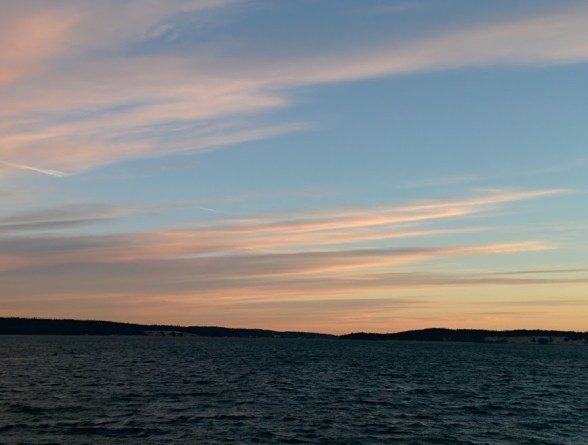
This is for the Music Prompt #63: Daniel Powter Bad Day. I took the photograph on the train from Chicago, in the evening in a storm. Prayers for those hit by the hurricane and other disasters.

Fraud in Medicine: Heartwood

Here in my neck of the woods, people are continuing to quit medicine. Two  managers who have worked in the clinics eaten by the hospital are leaving on the same day, after 30 years. And another woman doctor, around my age, is retiring from medicine. She is NOT medicare age.

Meanwhile, the Mayo Clinic is publishing articles about how to turn older physicians into “heartwood”.

http://www.mayoclinicproceedings.org/article/S0025-6196(15)00469-3/fulltext

“As trees age, the older cells at the core of the trunk lose some of their ability to conduct water. The tree allows these innermost cells to retire…. This stiffened heartwood core…continues to help structurally support the tree…. Here a tree honors its elderly cells by letting them rest but still giving them something meaningful to do. We non-trees could take a lesson from that.” Spike Carlsen

Oh, wow, let’s honor the elderly. Even elderly physicians. Instead of what, killing them? Currently we dishonor them, right?

But what is the core of the issue? Skim down to “Decreased patient contact”:

“Already, many physicians are choosing to decrease their work to less than full-time, with resultant decreased patient encounters and decreased institutional revenue. Prorating compensation to match full-time equivalent worked will aid in financial balance, but the continued cost of benefits will remain. However, when that benefit expense is compared with the expense of recruiting a new physician (estimated by some to approach $250,000 per physician), the cost of supporting part-time practicing physicians becomes more attractive.”

Ok, so the core of the matter. “Decreased institutional revenue” and the employer still has to pay BENEFITS. NOTHING ABOUT THE QUALITY OF CARE FOR PATIENTS.

Again, the problem is still that you can’t really “do” a patient in twenty minutes, and that full time is really 60 or more hours a week. To be thorough, I  have to absorb the clinical picture for each patient: chief complaint, history of present illness, past medical history, allergies, family history, social history (this includes tobacco, drugs and alcohol), vital signs, review of systems and physical exam. And old records, x-rays, pathology reports, surgical reports, laboratory reports. I fought with my administration about the 18 patient a day quota. I said: ok, I have a patient every twenty minutes for 4 hours in the morning, a meeting scheduled at lunch, four hours in the afternoon. When am I supposed to call a specialist, do refills, read the lab results, look at xray results, call a patient at home to be sure they are ok? The administration replied that I should only spend 8 minutes with the patient and then I would have 12 minutes between patients to do paperwork. I replied that they’d picked the Electronic Medical Record telling us that we could do the note in the room. I could, after three years of practice. But it nearly always took me twenty-five minutes. I would hit send and our referral person had so much experience that she could have the referral approved before my patient made it to the front desk. BUT I felt like I was running as fast as I possibly could all day on a treadmill. Also, the hour lunch meetings pissed me off. I get 20 minutes with a patient and they get an hour meeting? Hell, no! I set my pager for a 20 minute alarm every time I went into a meeting and I walked out when it buzzed. I needed to REST!

After a few weeks of treadmill, I dropped a half clinic day. But of course that didn’t go into effect for another month and I was tired and ran late daily. And every 9 hour clinic day generated two hours of paperwork minimum: nights, weekends, 5 am when I would not get interrupted and could THINK. Do you really want a doctor to review your lab work when they are really tired and have worked for 11 hours or 24 hours? Might they miss something? It might have been best if I had been quiet and just cancelled two people a day, since the front desk knew I was not coming out of any room until I was done, but I argued instead.

The point is, you would like to see a doctor who listens and is thorough. You do not actually want a medical system where there all these other people who read your patient history forms and enter them in to the computer and your doctor tries to find the time to read it, like drinking from a fire hose. If we want doctors and patients to be happy, then doctors need time with patients and we need to off the insurance companies who add more and more and more complicated requirements for the most minimal care. One system, one set of rules, we’ll fight over the details, medicare for all.

Red rock

Two days ago I went on a bike ride near the C & O Canal and we walked to this old stone cutting mill. Rocks were cut at the Seneca Quarry and and down the canal, which ends in Georgetown, and used for many buildings and monuments. Seneca Red Sandstone is used for the Smithsonian Castle. Beautiful.

This is for photrablogger’s Mundane Monday #75. He has sand and this is sandstone.