Adverse Childhood Experiences 14: Hope

I keep reading bits about despair and about how a generation of children is being “ruined” by the pandemic.

Not so, I say. There is hope. We need to support each other to survive and then to thrive.

This generation WILL have a higher than average ACE score. If the Adverse Childhood Experience scale is from zero to eight, children in this time period will have at least one higher point than average and many will have three or four or more. Loss of a parent, a sibling, beloved grandparents during covid. Increases in domestic violence, child abuse and addiction. These are all part of the ACE score.

What does this do to children? They have survival brain wiring. They will do their best to survive what is happening. A friend and I both have high ACE scores, 5 or more, and we are both oppositional defiant. We showed this in different ways. He grew up in the same community. He escaped from home and knew all the neighbors. He walked to the local church and attended at age 3 or 4. He has lived in this community all his life.

His oppositional defiance showed up at home, where he consistently refused to obey. And in school, where he confounded and disobeyed teachers and passed anyhow.

My family moved every 1-5 years. I hated moving. I wouldn’t talk to kids in a new school for a year. It was very difficult. So my oppositional defiance was very very internal. I hid in books and in my head. In 6th grade I got in trouble for hiding novels inside the school book I’d already read. I also would just not listen and my respect for the teacher got even lower when she would be angry that I knew the answer to the question once she’d repeated it. I wasn’t listening because I was bored. She was the first teacher that I thought, well, she is not very bright. The next year they stuck me in the honors class and I stopped being bored, though I still questioned practically every opinion every teacher had. I wanted evidence and I did not believe it just because the teacher said it.

I am not saying that oppositional defiance is in every high ACE score. I don’t know that. Why oppositional defiance? Imagine you are a small child and you are beaten. There isn’t rhyme or reason. You can’t predict when the adult will be out of control. Why would you behave “well” if it makes no difference? You might as well do what you want, because nothing you do will change the adult. Or imagine you are a small child who is with one person, passed to another, then to another. You may not exactly trust adults after two or three repetitions. And you want to survive.

There is an increase in addictions, behavioral health diagnoses, and chronic illness in adults with a high ACE score. A researcher when I first heard a lecture about it said, “We think perhaps that addiction is a form of self medication.” I thought, oh, my gosh, how are we ever going to treat THIS? Well, we have to figure that out now, and we’ve had 30 years to work on it.

I was very comfortable with the oppositional defiant patients in clinic. I got very good at not arguing with them and not taking their behavior personally. They might show up all spiky and hostile and I might be a little spiky and gruff back: sometimes that was enough. I think the high ACE score people often recognize each other at some level, though not always a conscious one. With some people I might bring up ACE scores and ask about their childhood. Sometimes they wanted to discuss it. Sometimes they didn’t. Either was ok.

One thing we should NOT do is insist that everyone be “nice”. We had a temporary doctor who told us her story. Her family escaped Southeast Asia in a boat. They had run out of water and were going to die when they were found by pirates. The pirates gave them water. They made it to land and were in a refugee camp for eight years or so. She eventually made it to the US. She was deemed too “undiplomatic” for our rural hospital. I wondered if people would have said that if they knew her history and what she had been through. It’s not exactly a Leave it to Beaver childhood, is it? When she was telling us about nearly dying of thirst in the boat, my daughter left her chair and climbed on my lap. She was under ten and understood that this was a true and very frightening story.

We can support this generation of children. This has been and is still being Adverse Experiences for adults as well. Family deaths, job loss, failure of jobs to support people, inflation. Remember the 1920s, after World War I and the last pandemic, of influenza. “On October 28, 1919, Congress passed the National Prohibition Act, also known as the Volstead Act, which provided enabling legislation to implement the 18th Amendment.” (wikipedia). There were forces trying to legislate behavior, as there are now. The result in 1920s of making alcohol illegal was speakeasies, illegal alcohol, and violence. Some people acted wild after WWI and the influenza pandemic and some people tried to lock down control, by controlling other peoples’ behavior. It did not work then and it will not work now. The wildness is out of control grief, I think, grief dysfunctional and drinking and shooting and doing anything and everything, legal or not. We remember how the 1920s ended too. Let us not repeat that. Let us mourn and grieve and support each other and support each other’s decisions and autonomy.

Blessings.
Sun tui

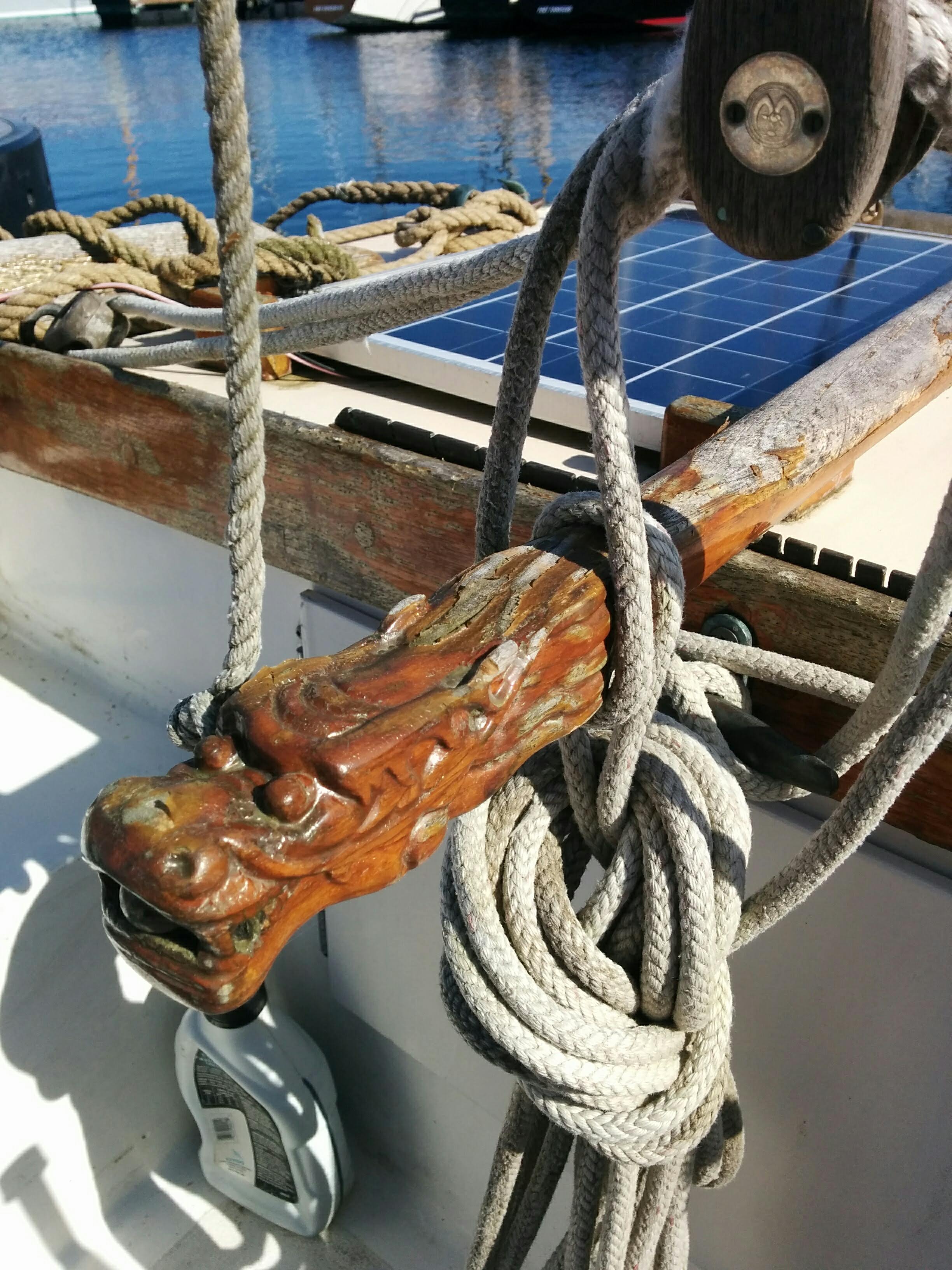
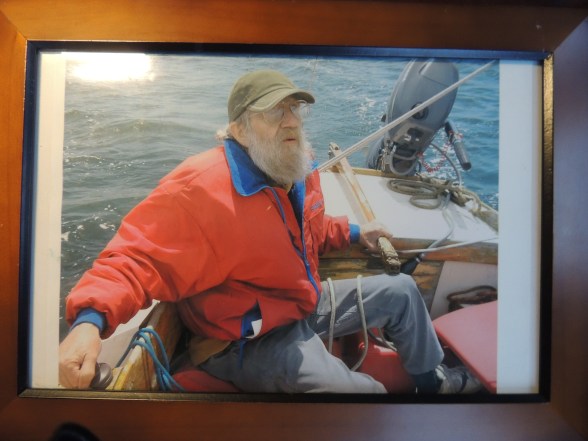
A photograph of a photograph. This is my father, Malcolm Kenyon Ottaway, sailing Sun Tui, our 1960s boat. A 23 foot sloop built in Hong Kong by American Marine. The tiller is a dragon with the world in it’s mouth and inside there is a carving of Kwan Yin.

My father died in 2013. I still have the boat. Needs some work, but hoping I can sail again soon.

I can’t credit the original photographer because I don’t know who it is. It might have been me.

For the Ragtag Daily Prompt: sail.

A dragon with the world in her mouth.
Carving of Kwan Yin (or Guan Yin).
Sun Tui.

of the air and water

Great blue herons never look like they are of the earth to me. They look like they are of the air and of the water. Unearthly. I keep wondering if they are angels.

Eagles do not look earthly either. They do land on the beach occasionally but I see them in the air or in the trees most of the time.

For the Ragtag Daily Prompt: unearthly.

angels

The Ragtag Daily Prompt is halo, and I wrote this yesterday, after a discussion with a new friend about angels and my angel dream.

______________________________

angels

light angels fall into dark

dark angels fall into light

there is no separation

we are longing for the Beloved

we are longing to be reunited with the Beloved

we have never been separate

we are one

light falling in to dark

dark falling in to light

seeing both is grace

no separation

sun halo

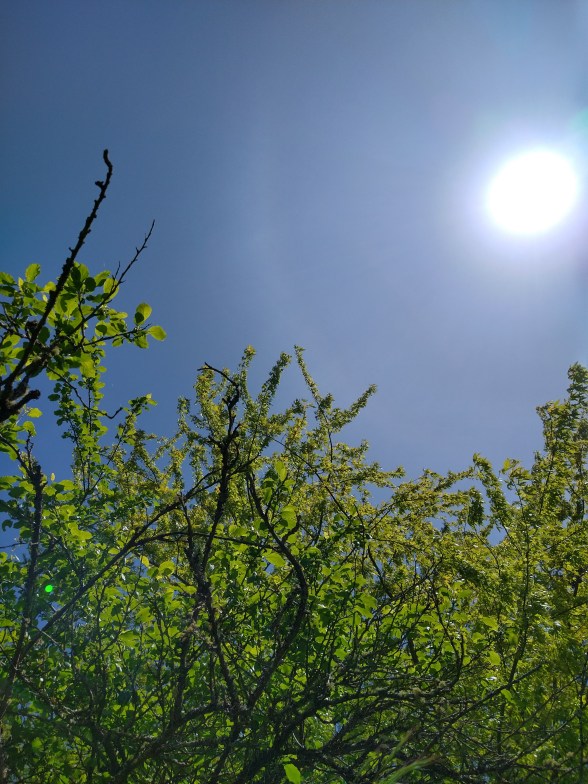
I search my phone photographs for moon and come up with this photograph: an eerie sun and cloud photograph with a halo. Sometimes the clouds and fog combine with the sun to form frightening light, even though it is beautiful too.

The computer also picked this picture in the moon search. I’m not sure what that is about. Elwha had hopped into the bathtub not realizing that I had just gotten out. He was soaked and howled, because he couldn’t get out. He was a very grumpy kitten, grooming for an hour.

For the Ragtag Daily Prompt: halo.

foxglove

The source of digoxin and digitalis. I am interested when people tell me they don’t take prescription medicines and that they only take “natural” medicines. Meaning pills. Pills do not grow on trees or bushes and are made by human beings. How exactly is the person defining “natural”?

My father said that anything a human could think up was “natural”. “Though that does not mean safe.” Think wingsuits and basejumping.

Digoxin and digitalis are used less than in the past, because there are many other medicines to choose from to control heart rate. However, they are still used because digoxin is one of the very few rate controlling medicines that does NOT lower blood pressure. Most of the others do lower blood pressure. When nothing else works or is tolerated, the cardiologist may sigh and say, ok, start digoxin. It is a tricky medicine because levels that get too high are toxic and the dose is different for each person and the dose must be lowered as kidney function changes with age. We still use it, though.

About one third of prescription medicines originate from a plant source like this, where the plant actually makes the active substance. Plants and animals and humans evolved together. We have deer all over town and they do not eat the foxglove. They love roses but stay away from foxglove.

I am seeing advertisements for a book to make your own medicines at home. I have not bought it. I would stay away from any recipe with foxglove: I want a lab to test to get the dose exactly right.

For Cee’s Flower of the Day. Heh, it turned into an essay of the day too. Wordy, wordy, wordy.

Adverse Childhood Experiences 13: on gratitude

I saw a meme today about gratitude. It is saying that some people look at a garden and see thorns and weeds, but others see the roses. That we need to have gratitude. I think this is simplistic and papers over the trauma and grief that some people have. If they have endured a highly traumatic childhood, who am I to say they should focus on the roses? They may have a very good reason to see if there is something like a thorn that can hurt them before enjoying the roses.

I work with many patients with high Adverse Childhood Experience scores and mine is high too. I don’t tell my patients that they should have gratitude. I tell them “You survived your childhood. You have crisis wiring. Good for you. Some of your learned crisis survival wiring may not serve you as well now as it did when you were a child.” Then we discuss whether they want to work on any aspects and the many many different approaches. One example: a man who sleeps very lightly. He said that it was lifelong. When asked about his childhood he says, “We would have to leave in the night when there was shooting in my neighborhood. It was a very dangerous area.” I said, “I am not surprised you sleep lightly. You HAD to in childhood to survive. Is this something you want to try and change?” He thought about it and decided, no. Once it was framed as learned in childhood to survive, he stopped worrying about “normal”. He was satisfied that the way he slept was “normal” for him and he wanted to wake up if he heard shooting.

I think we have to ask why a person sees thorns and weeds in a garden before we judge them. My first thought with a new and angry or hostile patient is always, oh, they have been badly hurt in the past. What happened? I don’t worry that the anger is at me. I know it’s not at me, it’s at the system or a past physician or a past event. Under the anger there are other emotions, usually fear or humiliation or grief. I have brought up Adverse Childhood Experience scores on the first visit sometimes. One person replies, “I am a 10 out of 10.” The score only goes up to 8 but I agree. He was a 10. He stated once, “The military loved me because I could go from zero to 60 in one minute.” Very very defensive and very quick to respond. The response may seem extreme and inappropriate to other people: but it may feel like the only safe way to be to my patient.

I grew up hiding any grief or fear in my family, under anger, because grief or fear would be made into a story told for laughs. In college, a boyfriend told me I was an ogre when I was angry. I started working on it then and it was difficult to tame that. The person who took the longest was my sister: she could make me explode until I was in my residency. Medical training was excellent for learning emotional control, at least, on the surface. After my mother died, I had to do the next piece of emotional work: open the Pandora’s Box of stuffed emotions, mostly fear and grief, and let them out. It was such hard work that my day where I saw the counselor for an hour was harder than my ten hour clinic day. I did the work, for two long years. Blessings on the counselors who stood by me while I worked through it.

I do not think we are ever done with that sort of work. I think, what do I need to learn next? What is this friend teaching me? Why is this behavior frustrating me and I have to look in my inner mirror. Why, why, why?

Blessing on your healing path and may you not be judged.

Link about ACE scores: https://www.cdc.gov/violenceprevention/aces/about.html

Sometimes I do feel like a fossil, now that I am middle aged. For the Ragtag Daily Prompt: fossil.