Dream state

I am in the soft dream state
longing for my love and mate
my heart won’t stop or hesitate

I cross the border into dreams
nothing quite is what it seems
I stop and play in bubbling streams

I wander in the tall green grass
years since the mower’s pass
unsullied by the smell of gas

I lean against a tree
I feel quiet happy free
I feel accepted just as me

my childhood was a frightened place
the woods were the safest space
if I spoke my heart would race

my work is with adults in pain
scars deep as canyons bleeding strain
my tears fall as gentle rain

my youngest child has reached eighteen
she’s bright and smart and kind not mean
I wonder what her eyes have seen

my adult work is nearly done
it’s time for me to have some fun
beneath the tree in moon or sun

I wander as a child
heart gentle meek and mild
connected to the world so wild

Adverse Childhood Experiences 8: Social cues

I am thinking about social cues for people with high Adverse Childhood Experience scores. With crisis brain wiring the response to social cues may be very different than what is considered the acceptable “norm”.

I always miss the cue when someone says “see you later”. I think “When?” Then I realize it’s a social comment and they do not in fact plan to see me later. I have a moment of disappointment. I do the same thing when someone says, “Let’s get together for dinner.” or “Let’s have coffee some time!” or “I will call you back!” or “Why don’t you come to our cabin some day?” Yes, I think, when?

And then I think “Liar.”

So I fail social cues….. or do I? Maybe I am not responding to the “correct” or “conventional” or “nice” social cues.

My father drank too much and especially while I was in high school and college. And my mother would enable and cover up and pretend nothing was happening. Children in this situation, which is way too common, develop special skills.

My sister was three years younger. As adults we discussed the stages of drinking and which one we hated most. We would both walk in the house from school with trepidation. In the door and almost feeling the air: what is happening? Am I safe? Do I need to hide? How dangerous is it? How much will it hurt?

I walked in once during high school and missed the cue. I was thinking about something. I thought my father was asleep in the kitchen. I went in to get something. I was very quiet so as not to wake him. I made a cup of tea.

He was not asleep, or else he woke up. And it was the worst stage, or the one I hated most.
Not physical violence. But he started talking. One of things he said was “You can tell me anything.” Now, he meant it. But he was crying by then and I knew I did not want to tell him anything and all I wanted was desperately to leave the room. And neither my sister or my mother was home. Finally I was crying too, because I said “I just want to go read my book.” and he was more crushed and maudlin and emotional and crying. And I tore out of the room and up to my room, as my mother walked in.

I did not cry much. Ever.

I refused to talk to my mother about it.

The next day she said to me, “Your father told me that you were talking about Lamont.” Lamont Cranston was a very beloved cat, The Shadow, who was missing now. Dead, we thought.

I said nothing. Because we had not talked about Lamont. So either my father was lying or else he’d had a blackout, didn’t remember and was making shit up. And if I told my mother the truth, she would back him and deny what I said or make it into a joke.

The stages my sister and I identified were:
1. sober
2. a little bit
3. goofy/silly/makes no sense
4. crying
5. asleep

We were ok with 2 and 5. I don’t think we saw 1 for years. We disliked 3 intensely, especially in public and especially when our mother was doing a cover up dance. And 4 we hated.
And yet I loved my parents and mostly miss them now that they are gone. Except when I remember things like this.

So, what is the point?

I miss “social cues” because that is NOT what the crisis brain, the ACE score brain, pays attention to. I am paying attention to far more intuitive things: body language. Whether what the person is saying matches what I know about them and what they have done in the past. I am looking for whether this person is telling me the truth.

I don’t trust instantly. Why would I?

I said to a counselor once that reading the “cloud” around the person was terribly useful in medicine but made me a social misfit. “I don’t know how to turn it off.” I said. She grimaced and said, “Why do you think I went into counseling?” She said, “I can’t turn it off either but I have learned to ignore it during social situations.” I was in my forties before I realized that there are people who don’t sense this cloud, who trust people until the person is dishonest, who understand that it is just fine to say “Let’s get together.” and not mean it.

Because actually, when someone says “I’ll see you later.” and they don’t mean it, they are saying an untruth. They are not planning to see me later. They don’t mean it. And my brain automatically files that under evidence that this person is not trustworthy. To them it is a social cue that is polite. To some of us, it is clearly something that is not actually true. I pick up on a cloud of social cues, but not the ones that are acceptable or conventional. And I am not the only one.

my sister on the left and me on the right, in the 1960s

Why care for addicts?

Why care for addicts?

Children. If we do addiction medicine and help and treat addicts, we are helping children and their parents and our elderly patients’ children. We are helping families, and that is why I chose Family Practice as my specialty.

Stop thinking of addiction as the evil person who chooses to buy drugs instead of paying their bills. Instead, think of it as a disease where the drug takes over. Essentially, we have trouble with addicts because they lie about using drugs. But I think of it as the drug takes over: when the addict is out of control, the drug has control. The drug is not just lying to the doctor, the spouse, the parents, the family, the police: the drug is lying to the patient too.

The drug says: just a little. You feel so sick. You will feel so much better. Just a tiny bit and you can stop then. No one will know. You are smart. You can do it. You have control. You can just use a tiny bit, just today and then you can stop. They say they are helping you, but they aren’t. Look how horrible you feel! And you need to get the shopping done and you can’t because you are so sick…. just a little. I won’t hurt you. I am your best friend.

I think of drug and alcohol addiction as a loss of boundaries and a loss of control. I treat opiate overuse patients and I explain: you are here to be treated because you have lost your boundaries with this drug. Therefore it is my job to help you rebuild those boundaries. We both know that if the drug takes control, it will lie. So I have to do urine drug tests and hold you to your appointments and refuse to alter MY boundaries to help keep you safe. If the drug is taking over, I will have you come for more frequent visits. You have to keep your part of the contract: going to AA, to NA, to your treatment group, giving urine specimens. These things rebuild your internal boundaries. Meanwhile you and I and drug treatment are the external boundaries. If that fails, I will offer to help you go to inpatient treatment. Some people refuse and go back to the drug. I feel sad but I hope that they will have another chance. Some people die from the drug and are lost.

Addiction is a family illness. The loved one is controlled by the drug and lies. The family WANTS to believe their loved one and often the family “enables” by helping the loved one cover up the illness. Telling the boss that the loved one is sick, procuring them alcohol or giving them their pills, telling the children and the grandparents that everything is ok. Everything is NOT ok and the children are frightened. One parent behaves horribly when they are high or drunk and the other parent is anxious, distracted, stressed and denies the problem. Or BOTH are using and imagine if you are a child in that. Terror and confusion.

Children from addiction homes are more likely to be addicts themselves or marry addicts. They have grown up in confusing lonely dysfunction and exactly how are they supposed to learn to act “normally” or to heal themselves? The parents may have covered well enough that the community tells them how wonderful their father was or how charming their mother was at the funeral. What does the adult child say to that, if they have memories of terror and horror? The children learn to numb the feelings in order to survive the household and they learn to keep their mouths shut: it’s safer. It is very hard to unlearn as an adult.

I have people with opiate overuse syndrome who come to see me with their children. I have drawings by children that have a doctor and a nurse and the words “heroes” underneath and “thank you”. IΒ  have had a young pregnant patient thank me for doing a urine drug screen as routine early in pregnancy. “My friend used meth the whole pregnancy and they never checked,” she said, “Now her baby is messed up.”

Addiction medicine is complicated because we think people should tell the truth. But it is a disease precisely because it’s the loss of control and loss of boundaries that cause the lying. We should be angry at the drug, not the person: love the person and help them change their behavior. We need to stop stigmatizing and demeaning addiction and help people. For them, for their families, for their children and for ourselves.

I took the photo of my daughter on Easter years ago.

Adverse Childhood Experiences 7 : Revisiting Erikson

Welcome back, to Adverse Childhood Experiences, and I have been thinking about Erikson’s Eight Stages of Psychosocial Development.

These were mentioned in medical school and in residency. I was in medical school from 1989 to 1993 and in Family Practice Residency from 1993 to 1996. Family Practice is at least half psychiatry, if you have time. We are losing the time with patients in order to achieve “production”. I complained about the 20 minutes I was allotted per patient and was told that I should spend 8 minutes with the patient and 12 minutes doing paperwork and labs and calling specialists. This is why I now have my own practice. A new patient under 65 gets 45 minutes and over 65 gets an hour and my “short” visits are 25 minutes. I am a happy doctor. And on the Boards last year I scored highest in psychiatry….

So, back to Erikson. The first stage, at birth to one year is Basic Trust vs Mistrust. “From warm, responsive care infants gain trust or confidence that the world is good.”

I was taught that people would have to “redo” the stage if they “failed”. Let’s look at that a little more closely.

Take an infant in a meth house. No, really, there are babies and small toddlers that have addict parents, alcohol, opiates, methamphetamines. We do not like to think about this.

A social worker told me that the toddlers from a meth house were really difficult to deal with. They do not trust adults. The first thing they do in foster care is hide food.

Hide food? Well, adults on meth are not hungry, sometimes for 24 hours or more, and they are high. So they may not feed the child.

Now, should this child trust the adult? No. No, no, no. This child is adaptable and would like to survive. So even under three they will learn to hide food. In more than one place. This is upsetting to foster care parents, but perfectly understandable from the perspective of the child.

So has the child “failed” the first stage? Well, I would say absolutely not. The child looked at the situation, decided not to starve and learned not to trust adults and hid food. Very sensible. Adaptive.

Is the child “damaged”? That is a very interesting question. After 25 years of family practice medicine I would say that no, the child is not damaged. However, the child has started out with a “crisis” brain. The brain is plastic, all our life, and so this child did what was needed to survive.

Is the child “sick”? Again, I would argue no, though our society often treats the child as sick. We think everyone should be “nice” and “warm” and “why isn’t he/she friendly?” Well, if you started in an addiction household or a crazy household or a war zone, it would not be a good adaptation to be warm and fuzzy to everyone.

How do we treat the adult? In a warm fuzzy nice world the child would have a foster parent who adored them, was patient with them, healed them and they would be a nice adult. I have a friend who said that foster care was so bad that he chose to live in an abandoned car his senior year rather than stay in foster care. He couldn’t play football because he had to get back to the car and under the layer of newspapers before it got too cold. I am sure that most foster parents are total wonders and angels. But some aren’t.

I have a person who says that he lived on the streets from age 8. He did get picked up and put into foster care. He kept running away. “The miliary loved me because I could go from zero to 60 in 60 seconds.” That is, he has crisis wiring. He is great in a crisis. The military is a sort of a safe place, because it has rules and a hierarchy and stands in for the failed parenting. Expect that then you get blown up by an AED in Afganistan and hello, that makes the crisis wiring worse.

How DO we treat the adult? We treat them horribly. We say why can’t this person be nice. We diagnose them we drug them we shun them we isolate them we as a society discriminate against them deny them and we are a horror.

I get so angry when I see the Facebook posts where people say “surround yourself with only nice people”. Ok, how dare you judge someone? You don’t know that person’s history. You don’t know what they grew up with. How dare they say that everyone should be NICE.

I am a Veteran’s Choice provider. I have 6 new veterans in the last 3 months. I suspect I will get more. They are not “NICE”. They come in suspicious, hurt, wary, cadgy. And I don’t care, because I am not “NICE” either. We get along just fine.

When I run into someone who isn’t “NICE”, I think, oh, what has happened to this person? What happened to them when they were little? What happened to them as an adult? How have they been hurt?

Pema Chodron writes about sending love: to your loved ones, to a friend, to an acquaintance, to a stranger, to a difficult person and to an “enemy”.

Send love. And do something about it. Help at your local school, help families on the edge, help single parents, sponsor a child to a sport if their parents can’t afford it, pay for musical instrument lessons, do Big Brother/Big Sister, become a “grandparent” to a child at risk, be a good foster parent, donate to addiction care….

The photo is from 2007, when my children and I visited their father in Colorado. A stranger in the parking lot took it at our request…..

safe enough to have a fence and roses

A friend said that he observed me for a long time before we got to know each other a little.

I asked what he observed. He said, “Thoughtful, deliberate and shy.”

I started laughing and said I am not shy. But….that is not true. I am guarded all the time with people. Even with him, still.

So what am I guarding and what is shy?

I have a little girl self that is very very shy. Hidden for a very long time. Now I have felt safe enough that she can play. I see her as playing in a wild place. Sun and a forest and a stream and a field. Sometimes it rains. She plays alone in the sun with rocks by the stream or runs in the field or climbs the trees.

I think many people have a small child hurt and hidden. I think it’s common. I think sometimes it’s so well hidden they can’t even reach it.

At any rate, my small child can’t be reached by any sort of force or intimidation. She could only be reached by gentleness. Another small child with daisies and even then, trust would take a long time. At first she would run away and hide. And I don’t think it will happen and I have given up, but I can still love her and protect her. And she is happy in her wild place, lonely sometimes, but happy.

Every time I see the pink soft romantic roses in my front yard I laugh, because those roses are for that little girl part, shy and romantic. She feels safe enough to have a fence and roses.

the photo is from my front yard and the rose is Betty Boop

Adverse Childhood Experiences 6: Reactivity

I hear people say, “Why is this person so reactive?” “They are suspicious.” “They just aren’t nice. Why can’t they be nice?”

When I get a new patient in clinic who is not friendly and looks suspicious at my questions and is not warm, I do not react. I assume that this person has been hurt and has a past that has a lot of dark in it.

Recently I was talking to a person about chronic pain. We were nearly out of time and I was describing Adverse Childhood Experience scores.

“I have the highest possible score,” he said.

I said, “I believe you.” and waited. He had my attention.

He did not want to tell me about it and he knew we were out of time. “I ran away to live on the streets when I was six.” he said flatly.

I said, “Yes, if things were that bad, I think you would have the highest possible score.”

That was the end of that visit. I gave him the link to the CDC website about ACE scores and studies and set up a follow up.

But think about that. He ran away at age six and lived on the streets. Not with a sibling or a parent or an adult. He was by himself.

He told me a little more on the second visit. I knew he could read. I pictured street classes under bridges. “How did you learn to read?” I asked.

“The authorities kept picking me up. I would run away from foster care as soon as they placed me. Usually the same day. When I was fifteen, a judge said “If you get your GED, I will emancipate you.” It took me a year and three months, but I got my GED.”

So is this your image of a street person? All losers? All crazy? This is a man who left because the street was safer than home and got a GED living on the streets.

He said, “My life has all been like that.”

I said, “Chronic pain is not exactly surprising then, is it?”

There is a song by The Devil Makes Three with this line: “I grew up fast and I grew up mean, there’s a thousand things inside my head I wish I ain’t seen. Now I just wander through a real bad dream, feeling like I’m coming apart at the seams.” That song speaks to me and speaks about the people who view the world with suspicion and fear and whose porcupine defensive spines are quickly raised if they feel threatened. I do well with them because I am the same way and I mostly don’t react to them. I don’t tell them to calm down. I don’t get scared or angry. I stay present and wait. And sometimes they will tell me what happened to them.

How can any of us blame an adult for their fearful terrible childhood? Instead we need to give them space and not reject them out of hand. All that does is reinforce the damage. I think that people can heal, but we must make room for them and behave ourselves and not react.

The photo is my daughter at the Wooden Boat Festival in 2009.

the kind of people

my cousin’s husband said
I wouldn’t want to be around the kind of people who play paintball
which silenced me as I suppose he meant to as I stared at him thinking that since I was telling him that I had taken my son to play paintball as a celebration of my son getting a 4.0 in sixth grade and we were framing it as a celebration rather than a reward so that low grades would not generate in turn a punishment and I was trying to tell my cousin’s husband about the third round of paintball and I was the only woman there and definitely the only mother there and by then the sharpshooters in camouflage had asked why I was there and I had explained upon which one said “you are a good mom” and so in the third round when my son said that he wanted to be on the opposite team as his mother the guys giggled and we were on opposite teams and I am good at hiding in the woods but was having a bit of trouble with trajectory so everyone on his team was shot but him and everyone on my team was shot but me and I was trying to shoot my son with a paintball in a desultory sort of way since he was peppering the tree I was crouched behind when he ran out of ammo and we walked back to the safe area me with the gun held over my head saying “moms rule” and the sharpshooters in camo said we are going to shoot you next time and they certainly did
and I didn’t say any of that to my cousin’s husband
because I am one of the kind of people who play paintball and so is my son and I realized abruptly when my cousin’s husband said that that I really want to love everyone and so I still send love to my cousin’s husband but honestly I have trouble being around people who divide the world into us and them and didn’t Jesus and buddha and Muhammed all say essentially that god is love and Rumi says that the universe is the Beloved and so everyone is Beloved and we are all part of the one and there is no division and if god is love then there can be no hell
and I don’t really visit that cousin any more
and I still wonder why people want us and them and why people talk about that kind of people and I try to work with every kind of people that comes into my clinic that’s why I became a doctor really because I wanted to understand people and understand love and forgive things that happened when I was very little and thought that really, the big people were insane and loving but not trustworthy and obviously this is a fail in the end because I truly don’t understand how anyone could ever make assumptions about anyone else and ever say that they wouldn’t want to be around
the kind of people

PTSD and The Singing Tree

The Singing Tree by Kate Seredy, 1939, is a children’s book that illustrated PTSD for me long before I went to medical school. The Singing Tree is the sequel to The Good Master, and describes the survival of a Hungarian family and farm during World War I.

The good master is Marton Nagy, and he is called up as a Corporal, leaving the farm to be cared for by his wife, son, niece and workers. The farm suffers because so many men are called up. They are getting behind on the work and then find a diary from Marton, which gives suggestions and instructions for the year round work on the farm. One of the instructions is “to make out an application for Russian prisoners if necessary.”

They do. They apply and take 6 Russian prisoners, homesick farmers, who don’t speak Hungarian. Jansi and his cousin Kate take the chains off them and the prisoners quickly become part of the family. “Comrade, eh? Friend?” says one of the prisoners. And they are. They are also excellent workers and homesick.

As the prisoners are taken home in the wagon, they also take Peter, a deserter from the Hungarian army. He has panicked about his wife and new baby. He is crazy with worry. He is hidden under the six Russians, who sympathize. After seeing the baby he returns to his regiment. But Peter is angry and expresses his rage at Jews, even though it is Uncle Moses, the Jewish shopkeeper, who has helped hide him.

    Mother took Jancsi’s arm then and they left he room. They didn’t speak; what was there to say? Something, somebody had poisoned Peter’s soul against those who had been good to him all his life. Into Jancsi’s mind flashed the words Father had said: “The stampede… the mad whirlwind that sucks in men…and spits out crippled wrecks.” Crippled in body and soul, Jansci thought then, with an understanding far beyond his years.
    “Poor Peter,” he said aloud. Mother pressed his arm. “I knew you would see it that way, Son. I only hope the war ends before this poison has spread too far.” p 163.

Marton is missing and they have not heard from him. Jansci and Kate make the wagon trek to bring back their grandparents, because the front is now too close for them to be safe. Kate and Lily smuggle the cat along. The cat gets “sick” and the girls insist at stopping at a hospital. The sickness is kittens. The nurses laugh at the girls, but then let them help on the wards. Injured soldiers who are healing.

    “Almost an hour passed before all the patients had been fed. “There was only one asleep,” Lily said, coming back with the empty bowls; “he even had the sheet pulled over his face.” The nurse followed Lily’s pointing finger with her eyes. “Oh, the amnesia case. He sleeps most of the time.”

    “Whats am-amnesia?” Kate wanted to know.

    “Loss of memory. They forget who they are and have to begin life all over again; like babies.” “Does it hurt?”
    “No,” smiled the nurse. “It comes from a shock; like a big scare, you know.” She looked toward the bed again. “He is such a nice man too, poor fellow. He tries so hard to remember. if we could find out who he is, find something to remind of his home, he might remember. You wan tto see him?” she asked as Kate kept staring at the bed. “Come on then, but be quiet.”
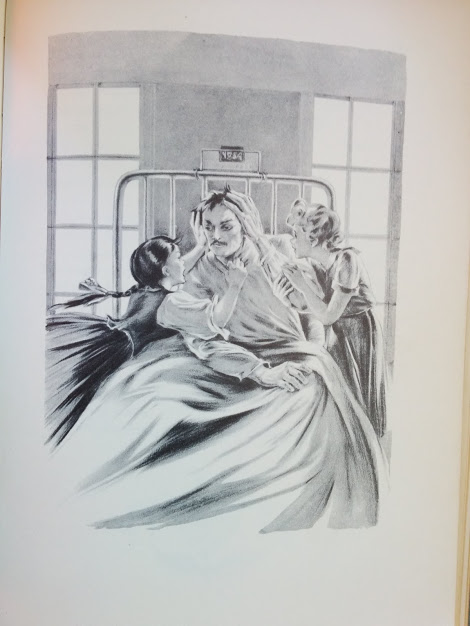
    “No. 54, Amnesia,” was written on the headboard. The nurse gently lifted the sheet. Pandemonium broke loose immediately. Kate, with her famous tin-whistle scream gong at full blast, threw herself on the bed. “UNCLE MARTON! UNCLE MAAARTON! IT’S KATE. Can’t you….? UNCLE MARTO-O-O-ON!”

    Every patient was sitting bolt upright. Doctors and nurses were running in, Lily joined Kate, tugging at Uncle Marton’s hands. “Say something…you know us, don’t you? Say something.”

    “Kate, if you don’t stop that infamous yelling this minute, I’ll take Milky away from…Say! Where am I? Who are these people?” Uncle Marton was looking around dazedly.

    “Never mind them,” sobbed Kate, laughing at the same time. “You know who you are now, don’t you?”

    “Why shouldn’t I? Let me out of this bed!” Uncle Marton cried, trying to peel Kate and Lily off his chest.
    “Take it easy, take it easy,” said a doctor who stepped up. “What is your name?” “Lieutenant Marton Nagy of the Seventh Infantry,” snapped Uncle Marton, glaring at him. “Seventh Infantry… Seventh…oh…”His eyes clouded.
    “Now it all comes back, doesn’t it? You’ll be all right now, Lieutenant Nagy. Don’t think about that now. Tell me who this…this calliope is. That scream was the best I ever heard.” The doctor sat down on the bed, smiling at Kate. “I wish we could produce for each amnesia case we get; we wouldn’t have any.” pp 186-189

He gets to go home.

    “From Corporal to Lieutenant in a year. Pretty good, Lieutenant Nagy,” an officer with a lot of gold braid all over him said to Father. “And a handful of medals to catch up with you, as I heard. What did you do?”
    Father looked him straight in the eye. The muscles in his jaws were working. “I don’t know sir. I would rather not try to remember.”

    The officer sighed. “Go home, Lieutenant. Forget, if you can. I wish I could.”

And will he have to return?

    “Then Father went to report to the hospital and this time Mother and Jansci went with him. The doctors found that in body he was sound, but only time, long months or even years, could make him forget the things he never spoke about.
    “There are none braver than he is,” the doctor told Mother, “but the human mind can stand just so much of horror and no more. We dare not tke the risk of sending him back to war.”
    “Thank God!” Mother had exclaimed, and the doctor smiled very sadly.
    “I hear that every day now. Wives, mothers thanking the Lord for an injury their beloved ones have received. A broken bone, a brave mind darkened with nameless fear, anything that takes a long time to heal, has become a blessing, a gift. They are safe for a little while longer.”

And Jansci talks to one of the Russian prisoners.

    “Big boss come home…maybe war over?” Grigori wanted to know when they had come with Father. Jansci tried to explain and he thought that Grigori didn’t understand because for a long while he didn’t say anything. Then he sighed: “Grigori know. Hear, Jansci. Bad man, stupid man, he go kill and laugh. Good man, man with good heart, good head, no can kill and laugh. He cry inside. Baby cry with big noise. Man cry–no noise, but it hurt very bad. Me know….me know.” p. 203

Death affects the village.

    “More white envelopes were coming to the village now than ever since the war started. The hands of Uncle Moses began to tremble and he seemed to grow smaller, more bent. Aunt Sarah was like a silent little wraith, going from house to house to comfort, to help, or just sit, holding the hand of a woman who would never wait for the mail again because there was no one left to writ to her. Often she and priest met in one of the houses and the priest would bow deeply to her Once he told Father: “She seems to give more comfort, more strength to these poor women than I can.” pp 203-204

I wish that we had the sense expressed in this book about PTSD and the effects of war. When I worked at Madigan Army Hospital, some soldiers were getting ready for their fourth or fifth tour of duty. If we as a country are going to continue these wars, we must take more responsibility and have more care for the damage done. When people talk about “curing” PTSD or keeping it from happening: if we didn’t respond with PTSD as a species with horror for the evils of war, we don’t deserve to survive. We will be the Bad People, the Stupid People, who Kill and Laugh. We need to stop. This book was written in 1939 and clearly they knew the effects of PTSD. It’s been almost 80 years since Kate Seredy’s book was published: and still we question PTSD?

http://www.pdhealth.mil/clinicians/assessment_tools.asp
Civilians too: http://www.mirecc.va.gov/docs/visn6/3_PTSD_CheckList_and_Scoring.pdf

illustration from p. 187

Chronic pain update 2015

As a rural family practice physician, I am in an area with very few specialists. Our county has a 25 bed hospital and we have a urologist, three general surgeons, three orthopedists (except when we were down to none at one point), two part time hematologist oncologists and that’s it. We have a cardiologist who comes one day a week. We have a physicians assistant who worked with an excellent dermatologist for years: hooray! Local derm! Our neurologist retired and then died. We had two psychiatrists but one left. We had one working one half day a week.

I trained in treating opiate addiction with buprenorphine in 2010 and attended telemedicine with the University of Washington nearly weekly for a year and a half. Then life intervened. I attended last week again, but not the addiction medicine group. That is gone. Now there are two telemedicine pain groups.

And what have I learned since my Chronic pain update 2011?

Chronic opiates suck, and especially for “disorders of central pain processing” which includes fibromyalgia, reflex sympathetic dystrophy, TMJ, chronic fatigue, and all of the other pain disorders where the brain pain centers get sensitized. We don’t know what triggers the sensitization, though a high Adverse Childhood Experience score puts a person more at risk. Cumulative trauma? Tired mitochondria? Incorrect gut microbiome? All of them, I suspect.

Jon Kabot Zinn, PhD has been studying mindfulness meditation for over 30 years. He has books, CDs, classes. Opiates at best drop pain levels an average of 30%. His classes drop pain levels an average of 50%. I’ve read two of his books, Full Catastrophe Living and ….. and I used the CD that came with the former to help me sleep after my father and sister died. Worked. Though I used the program where he says, “This is to help you fall more awake, not fall asleep.” Being contrary, it put me to sleep 100% of the time.

Body work is being studied. Massage, physical therapy, accupuncture, touch therapy and so forth. It turns out that when you have new physical input, the brain says, “Hey, turn down the pain fibers, I have to pay attention to the feathers touching my left arm.” So, if you have a body part with screwed up pain fibers, touch it. Touch it a lot, gently, with cold, with hot, with feathers, a washcloth, a spoon, something knobby, plastic. Better yet, have someone else touch it with things with your eyes closed and guess what the things are: your brain may tell the pain centers “Shut up, I’m thinking.” Well, sensing. A study checking hormone blood levels every ten minutes during a massage showed the stress hormone cortisol dropping in half and pain medicating hormones dropping in half. So, massage works. Touch works. Hugs work. Go for it.

There are new medicines. I don’t like pills much. However, the tricyclic antidepressants, old and considered passe, are back. They especially help with the central pain processing disorders. I haven’t learned the current brain pathway theories. The selective serotonin uptake reinhibitors (prozac, paxil, celexa, etc) increase the amount of serotonin in the receptors: chronic pain folks and depressed folks have low serotonin there, so increasing it helps many. As an “old” doc, that is, over 50, I view new medicines with suspicion. They often get pulled off the market in 10 to 20 years. I can wait. I will use them cautiously.

We are less enthused about antiinflammatories. People bleed. The gut bleeds. Also, the body uses inflammation to heal an area. So, does an antiinflammatory help? Very questionable.

Diet can affect pain. When I had systemic strep, I would go into ketosis within a couple of hours of eating as the strep A in my muscles and lungs fed on the carbohydrates in my blood. This did not feel good. However, the instant I was ketotic, my burning strep infected muscles would stop hurting. Completely. I am using a trial diet in clinic for some of my chronic pain patients. I had a woman recently try it for two weeks. She came back and said that her osteoarthritis pain disappeared in her right hip entirely. She then noticed that the muscles ached around her left hip. She has been limping for a while. The muscles are pissed off. She ate a slice of bread after the two weeks and the right hip osteoarthritis pain was back the next day. “Hmmmm.” I said. She and I sat silent for a bit. It’s stunning if we can have major effects on chronic pain with switching from a carb based diet to a ketotic one.

I attended one of the chronic pain telemedicines last week and presented a patient. My question was not about opiates at all, but about ACE scores and PTSD in a veteran. The telemedicine specialists ignored my question. They told me to wean the opiate. He’s on a small dose and I said I would prefer to wean his ambien and his benzodiazepines first. They talked down to me. One told me that when I was “taking a medicine away” I could make the patient feel better by increasing another one. As I weaned the oxycodone, I should increase his gabapentin. I thought, yeah, like my patients don’t know the difference between oxycodone and gabapentin. No wonder patients are angry at allopaths. I didn’t express that. Instead, I said that he’d nearly died of urosepsis two weeks ago, so we were focused on that rather than his back pain at the third visit. All but one physician ignored everything I said: but the doctor from Madigan thanked me for taking on veterans and offered a telepsychiatry link. That may actually be helpful. Maybe.

And that is my chronic pain update for 2015. Blessings to all.

http://www.cdc.gov/violenceprevention/acestudy/

http://www.umassmed.edu/cfm/about-us/people/2-meet-our-faculty/kabat-zinn-profile/

I can’t think of a picture for this. I don’t think it should have a picture.

Chronic pain and antidepressants

Continue reading