abstract

This is a cell phone snap from a few days. It reminds me of Jackson Pollock’s paintings, all the complex colors and layers.

The tide was way way way out and it’s a snap of the green layer on the beach. Gorgeous. The beaches here are an endless wonder.

For the Ragtag Daily Prompt: wonder.

Exercise mets

Mets could be metastases, a terrible word in cancer. But this is exercise mets. I am half way through my pulmonary rehabilitation for pneumonia and getting stronger. So what is a met? “One MET is approximately 3.5 milliliters of oxygen consumed per kilogram (kg) of body weight per minute.” (from https://www.healthline.com/health/what-are-mets#definition).

Ok, that doesn’t seem very useful. I find this way more useful, a chart of how many mets are used for certain activities:

https://www.healthline.com/health/what-are-mets#examples

The treadmill I am using at pulmonary rehab tells me how many mets I am using. However, last time I turned it on and didn’t enter my weight. It uses 155 pounds, which is more than I weigh. I think that then the mets are wrong. It isn’t exact anyhow. The important thing is that I am improving and off oxygen! I am now up to 5.3 mets, going at 3.3 mph, on a 4% grade, for 40 minutes. Pulmonary rehab is twelve weeks, twice a week, with a respiratory therapist and a physical therapist.

My respiratory therapist asks my goals. To bicycle distance, hike across the Olympics, and to ski again, off oxygen. That means altitude. Once we are above 5500 feet, the body really starts noticing the thinner air. I am not there yet but I am so pleased to be improving.

On the chart, I am in the moderate exercise range. To bicycle, I would have to be able to sustain 8 mets. Not yet, not yet.

Being off oxygen (except night, flute, sustained singing and heavy exercise) is GREAT! The intrinsic problem has not been fixed, thought. Fully twenty specialists since 2012 have not figured out why I get pneumonia easily and how to protect me, other than masking and not working in Family Medicine or anything people intensive. It’s annoying, my career has been blown up. I don’t have much hope of an overarching diagnosis at this point, but I’m willing to keep trying. We don’t know everything in medicine and really, I do not think we ever will. It’s endlessly complex and fascinating.

I think the mets chart should be shared with patients. I had one couple who insisted that the woman had PMS even though she was postmenopausal. I scratch my head and continue to watch her. After months something made me suspicious and I order an echocardiogram. She had congestive heart failure, seriously reduced heart output. I promptly called the cardiologist and said, “This is new, she is on NO MEDICINES.” He saw her within a week. Sometimes things do not present in a straight forward manner. She felt much better once we got her heart functioning better. If a person is losing their ability to perform moderate intensity mets, they should see their doctor. It could be spending too many hours in front of a screen (turn it off, get up, go outside, walk daily!) but it could also be something else. Heart is the number one killer still.

Stay healthy and keep those mets up!

Ha. I did use the word certain, didn’t I? And one of my favorite exercises is dancing. Listening to this right now:

patriotic lobster

…because the pants alone aren’t loud enough.

Another in my Outfits Inappropriate For Work series. It is difficult to type wearing my claws. Also patients would get distracted if I wore something too weird. I can’t think why.

I got the claws at a church sale yesterday. I was told they went with a game, “You’ve Got Crabs!” Turns out they don’t, but maybe they should! I went looking vaguely for a CD case for my car and got two: however they came with CDs. Everything from Cake to Spongebob Favorites to Johnny Cash to Disney Favorites. I am SET.

So who wants to play “You’ve got crabs!”?

Do you have an Outfit Inappropriate For Work? Is a Silly Selfie a Silthie?

flying dream

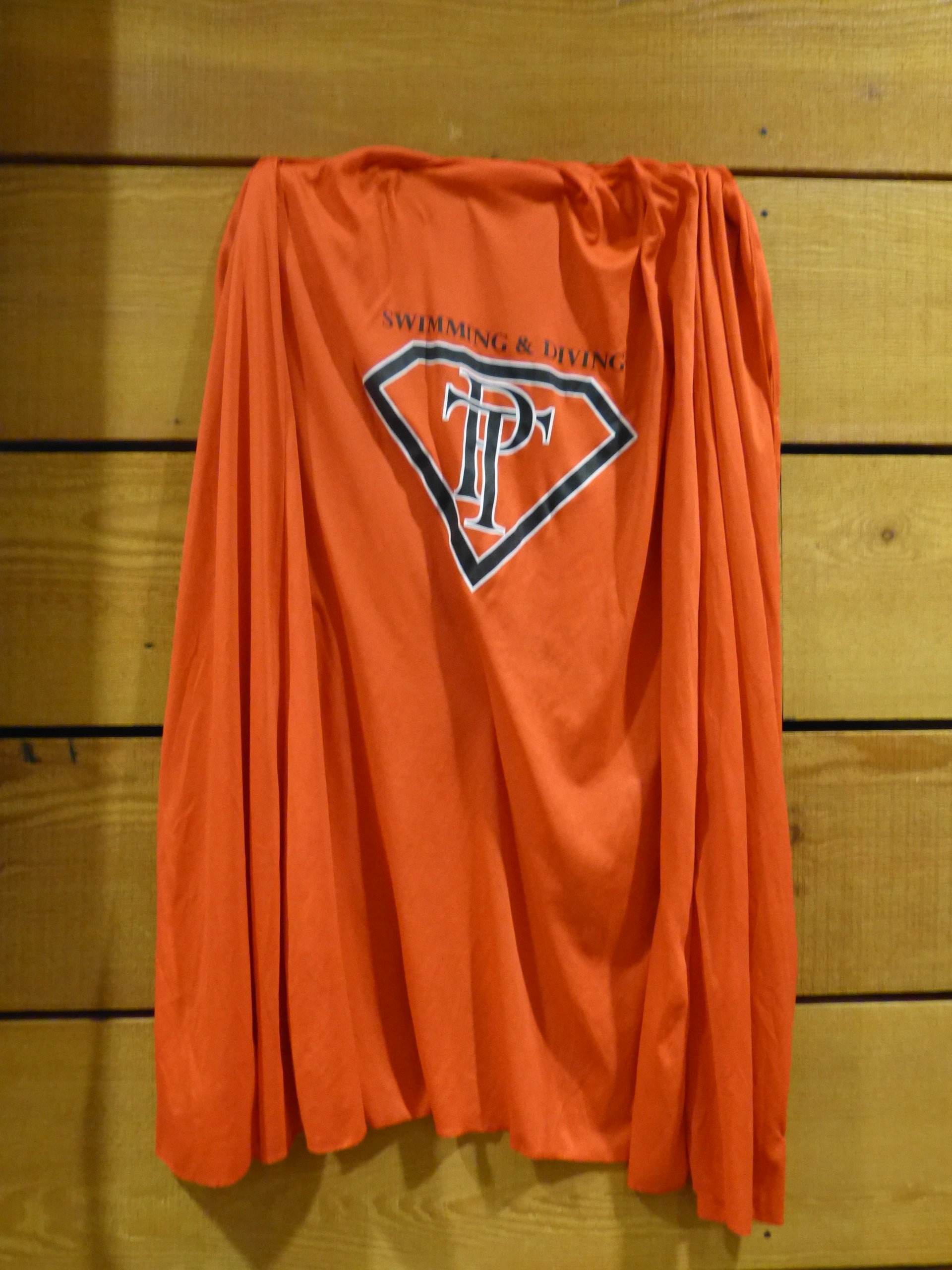
I dream I am Superman flying, but I am still me and female too. It is night and I fly over a beautiful bay, with a bridge at the opening of the bay. Cars are crossing. The people on the bridge call me down, calling β€œHelp!” I fly down. β€œThere are people in the water below the bridge! What are they going to do! Stop them!” I fly down to the water. β€œCome in,” say the people in the water. β€œThe water is warm!”

I join them in the water. It is warm and the bridge is beautiful. I say, β€œThe people on the bridge are scared of you.” The people in the water say, β€œWe just like the water. They are silly. They should join us. We won’t hurt them.” I thank them and fly back up.

I say, β€œThe people in the water just like the water. They say they won’t hurt you.” The people on the bridge say, β€œNo, no! They will hurt us. We don’t want them in the water! They might blow up the bridge!” I shrug. β€œWell, the water is fine. I am going back there.” I fly down and join the people in the water.

I wake up.

For the Ragtag Daily Prompt: cape.

flight

Cormorant, I think.

About to take flight.

A good take off point.

It takes five years for bald eagles to fully mature. This one is close.

And a great blue heron in flight in the fog.

For the Ragtag Daily Prompt: flight.

Covid-19, Long Haul and the immune system

“Whether immune-mediated secondary OCD could also develop as a consequence of COVID-19 poses a highly relevant research question to be elucidated in the near future [35, 36]. The first studies of their kind have demonstrated infection-triggered neuronal antibody production against various antigens in COVID-19 patients who were presenting with unexplained neurological symptoms [37].” from https://www.nature.com/articles/s41398-021-01700-4

Um, yes. It is looking highly likely that chronic fatigue, fibromyalgia, and Long Haul Covid-19 are all immune system responses. They are not simple at all. They can involve antibodies, cytokines and killer T cells and probably other things.

Antibodies: the difficulty here is that we all make different antibodies. It’s all very well to say that people with PANDAS and PANS make antibodies to Dopamine 1 and 2 receptors, tubulin receptors and lysoganglioside receptors, but people each make different antibodies. The antibodies can attach and block the receptor or can attach to the receptor and turn the key: act like dopamine, for example. Dopamine makes people tachycardic, a fast heart rate. If dopamine receptors are blocked, that could be a source for “brain fog” and feeling down.

Cytokines: I worked at the National Institutes of Health back in the 1980s before medical school. We were studying interleukin 2 and tumor necrosis factor for cancer treatment. Building 10 had mice on the north south axis and human patients on the east west. It was fascinating. Now I am reading a current book on the immune system. There has been a lot of research since 1988. Cytokines are released by cells and are immunodulating agents. They are a form of communication in the immune system.

Killer T cells: When antibodies coat a cell, there are immune system cells that kill and/or eat the coated cells. This is good if it is an infectious bacteria or a cell infected with virus, but it is bad if it is your own joint cells or your heart cells or, horrors, brain cells. In rheumatic fever, antibodies to strep A attack the patient’s own cells as well as the strep A cells. This is called “pseudo autoimmune” but I am starting to suspect that all the autoimmune disorders are responses to stress or infection or both.

So if you are still reading, you are saying wait, this is awful, what can we do about it?

Our understanding of the immune system is better than 1988 however… it still has a ways to go. I think that Covid-19 and Long Haul Covid are going to seriously accelerate the research in this area. Meanwhile there are some things people can do to “down regulate” or quiet down the immune system.

If antibodies are causing some of the problem, we need to quiet them down. With severe PANDAS in children, plasmapheresis filters the blood and filters out antibodies. However, the body keeps making them. Infection must be treated first, but then the initial antibody response lasts for 6-8 weeks. Then the body makes memory antibodies and cells to remember. With reinfection, the response lasts for 2-4 months and then subsides if the infection is gone.

Treat infection first. Then treat urgent symptoms, including urgent psychiatric symptoms. Then work can start on the sympathetic nervous system, quieting down to the parasympathetic state. This is not easy with Long Haul Covid-19 or chronic fatigue or fibromyalgia because people are afraid, confused, in pain, exhausted. I have written about the sympathetic and parasympathetic nervous systems here and here. Start with slow breathing, four seconds in and four seconds out. It takes practice.

I have been getting feedback at the pulmonary rehab. When I arrive, they take my pulse, 02 saturation and blood pressure. They put the pulse oximeter on and often I am up in the 90s. I slow my breathing and watch my pulse drop. One day I came in relaxed and my initial pulse was 71. When I was a little late, it started at 99 and came down. The therapist took it off when I got my pulse down to 90. We can check our own pulse, the number of heart beats in one minute, or a small pulse oximeter is about $30.

We can’t really “fix” the immune system with drugs. Steroids can quiet inflammation but they make us more susceptible to infection and raise blood sugar and cause multiple problems when used chronically, like osteoporosis. Plasmapheresis is expensive and requires specially trained nurses. Doesn’t a breathing exercise sound a lot more DIY and cheaper too? You got this. Practice, practice, practice.