Daily Evil: X is for Xenophobic

Are phobias evil? A fear of strangers or of foreigners. I think a phobia can make someone behave strangely or dangerously and harm others. I think that the isolation of the pandemic has increased our fear, so it may well exacerbate xenophobia. Not only the pandemic, but inflammatory news and war and changing weather patterns and the news that one in five trees is dying in part of California, unable to survive the warming.

This is a watercolor, again no date, but I think it is of the Olympic Mountains. That means it was painted in the last four years of her life, between 1996 and 2000. She and my father bought five acres with a house and barn in Chimacum, off of Center Valley Road. She loved the views up and down the valley. She was diagnosed with ovarian cancer in 1997 and died in 2000.

The mountains look like they have a crosshatching, Xes to indicate snow and valleys and places where the snow can’t stick. Or has fallen down.

Daily Evil: W is for Wild

Is wildness evil? What sort of wildness? The forest and waves and wilderness are not things we think of as evil, but some wildness in humans seems very evil. Some is silliness, some is substances, and some is truly violence and cruelty and terror and evil.

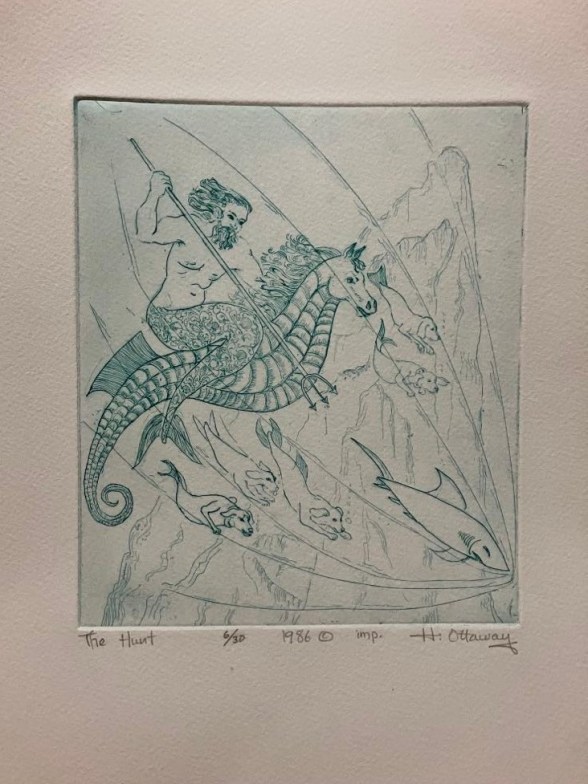
This is another of Helen Burling Ottaway’s fantasy etchings, titled The Hunt, number 6 of 30, 1986. A merman with a trident and dogfish, with a variety of tails. The etching is 6.75 by 8, the paper 11 by 15. I like the lines of movement, of waves, from the escaping shark.

Daily Evil: V is for Virago

Virago gives positive and negative definitions, but all female. The most positive ones are of a very strong woman, “like a man”. Is there a male word that means the same thing? A word for a man, where the most positive one is that he’s very strong, “like a woman”. Perhaps “like a woman in labor”. Let’s make one up if we can’t think of one. “Obstetico”, perhaps. A man who complains like he’s a woman in labor, but the positive definition is strong like a woman in labor.

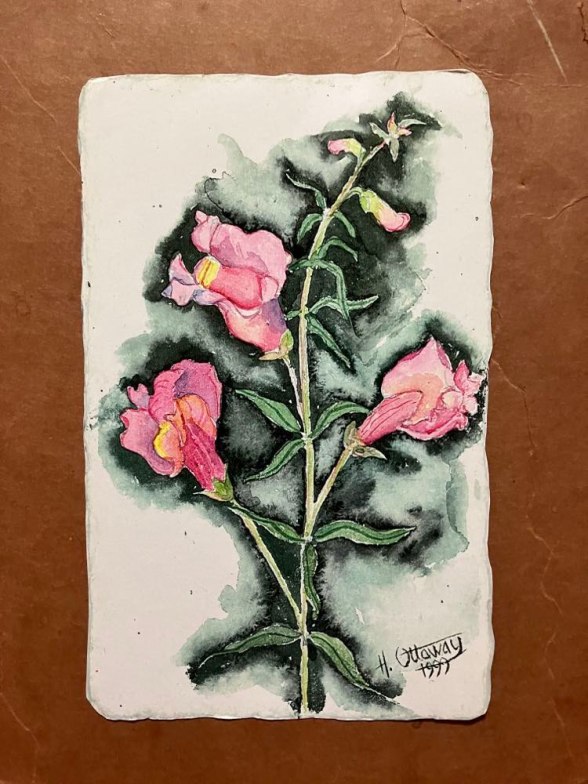
This is a watercolor postcard. Helen Burling Ottaway painted a bunch of postcards, with wonderful detail. These snapdragons could be viragos or obstetricos or perhaps both. This is from 1999, two years into her ovarian cancer. So the song is the Bald Headed Blues.

Daily Evil: U is for Unlikely

Unlikely isn’t evil. Well, I am tired of evil, so U is for Unlikely because I am tossing in a monkey wrench. U for unexpected, too.

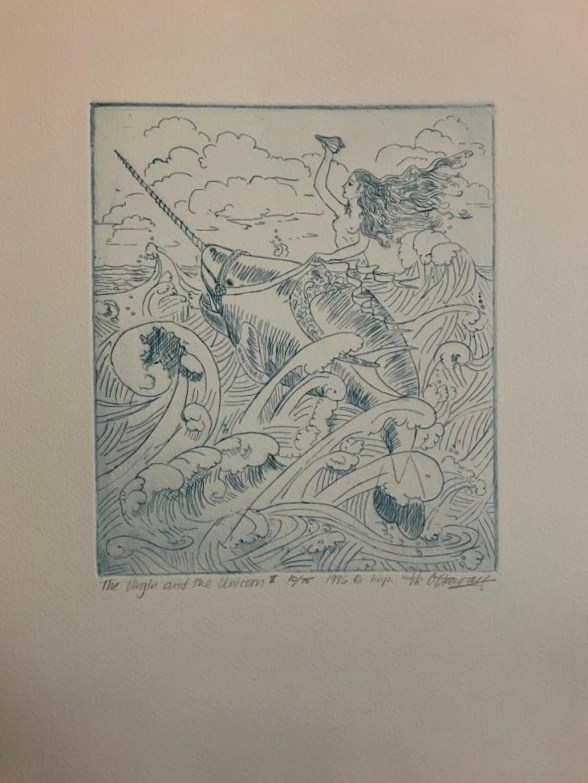
Back to etchings: U is for Unicorn. This is titled “The Virgin and the Unicorn II”, number 10/75, 1986, H. Ottaway. The etching is 7 inches by 8 inches and the paper is 11 inches by 15 inches. She would often frame them mounted but not matted, in frames that have a slot to hold the glass away from the picture. She did her own framing and especially disliked cutting glass. I knew when a show was close because she would be framing and grumpy.

Daily Evil: T is for Thief

Time is the evil thief I am thinking of today. This is my sister, Christine Robbins Ottaway, painted by Helen Burling Ottaway in the early 1970s. Time has stolen both of them.

This is another watercolor, over a pencil drawing, 10.5 inches by 14 inches.

Daily Evil: S is for Sneaky

Sneaky. One thing that I think really is evil is gossip. Talking about someone behind their back and spreading rumors and never speaking to the person themselves. But I do not need to punish anyone. The gossip will eat them from the inside, like a cancer, and they will look like fools when they are proven wrong. Curling churlishly with guilt.

I look at the sea and I let it all go.

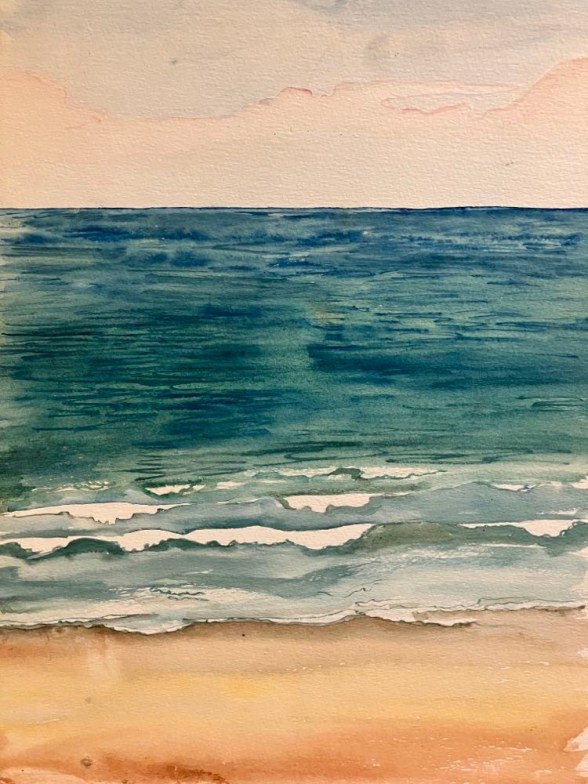
This watercolor by Helen Burling Ottaway does not have a date. I love the whitecaps using the paper. Tricky to do that, I have tried. My daughter also draws horizons and seascapes, over and over. This is 11 by 15. I suspect it is from the late 1970s or early 1980s, because there is a watercolor of my sister on the beach, similar to this. My paternal grandparents lived on Topsail Island in North Carolina and that is the most likely location.

S is for sneaky and snarky and sea. Here is a snarky song.

Daily Evil: R is for Ridiculous

This is Donkey Oatie and Sancho Panda. Helen Burling Ottaway did a series for a book or a show or something in the early 1990s. I do not know if it was ever published. There is no date on this. This is colored pencil and the drawing is 9 by 12 inches. I think she did larger watercolors as the final project.

Is being ridiculous evil? I read that today is National Humorous Day. We need humor to let go of stress and blow off steam and to go from the fight or flight sympathetic nervous system to the parasympathetic relaxed one. Humor is a really good way to go. So watch those silly cat videos and laugh. Ok, not when you are at work. But even at work, my office manager and I needed to blow off steam and laugh. One day she was playing whale songs. I heard her say very seriously into the phone, “Oh, those are whale songs. Dr. Ottaway insists on whale songs.” I howled, because she had picked them. For revenge I made whale noises at her between patients all day. Anybody walking into clinic might have thought we were loons. I can do loon songs very well, better than whale songs.

I know a slightly different tune for The Dummy Line, a variation. There seem to be a bunch!

Daily Evil: P is for Persnickety

Again, this might be evil in some situations and not in others.

I interviewed at the National Institutes of Health in the mid 1980s, with Dr. Steve Rosenburg. He asked how good I was with details. I said it depended. He asked what I meant. I said that I was excellent and persnickety when it came to science experiments, but at my present job I had trouble caring about the exact margin widths that the director of the non-profit I was working for wanted. He said that might be important. I said that I agreed, but I would be better off in a lab. He hired me.

I was excellent and persnickety in the lab and went from there to medical school 3 years later.

Etchings are profoundly persnickety. You can’t even do the drawing until you have tarred the zinc plate and then you etch the drawing in acid, take the tar off, ink the plate, run it through the press with paper and put more tar on the plate after you wipe the ink off. And once you get what you want, you have to re-ink the plate for every picture. This etching has two colors, which makes wiping enough ink off to get the lines right very tricky.

This is “Those are the pearls”, 4 out of 25, 1981, Helen Burling Ottaway. The plate size is 8.5 by 11 inches.

I am having to be persnickety about photographing my mother’s works. I am getting better at it, but it’s tricky to get the light right, without shadows. The cats always want to help. Today they are out in the box watching the birds, since they kept walking over the etching. I am jealous of the professionals downtown who have a camera on a frame and can be very very persnickety about the photograph. I may try my tripod, as a weak second. I have my mother’s slides too, so I could try digging those out. She did her own mostly, so I am not sure about them.

Hooray for the letter P!

Daily Evil: O is for Ornery

OOOOOO, ornery. What a lovely word! It can be purely negative or it can be positive and joking, or it can just mean stubborn.

This is one of Helen Burling Ottaway’s self portraits. My photograph, through glass. This is 20 by 26 inches, pastel chalk, dated 1979.

I had this up in the guest room, but a guest said he felt nervous with her watching. I laughed and said, “Ok, yeah, I can see that.” I moved it. My mother always looked fierce when she was concentrating. She captures that expression very well. People often thought she was angry when she was teaching, but it’s just concentration. I could tell the difference but the students could not.

And speaking of ornery:

Sol Duc helping with the photograph. Sort of.

Daily Evil: N is for Nowledge

WHY do we spell knowledge with a K? And why does know rhyme with no? If that isn’t evil, I don’t know what is. Ok, here is a site that explains: https://www.dailywritingtips.com/kn-words-in-english/.

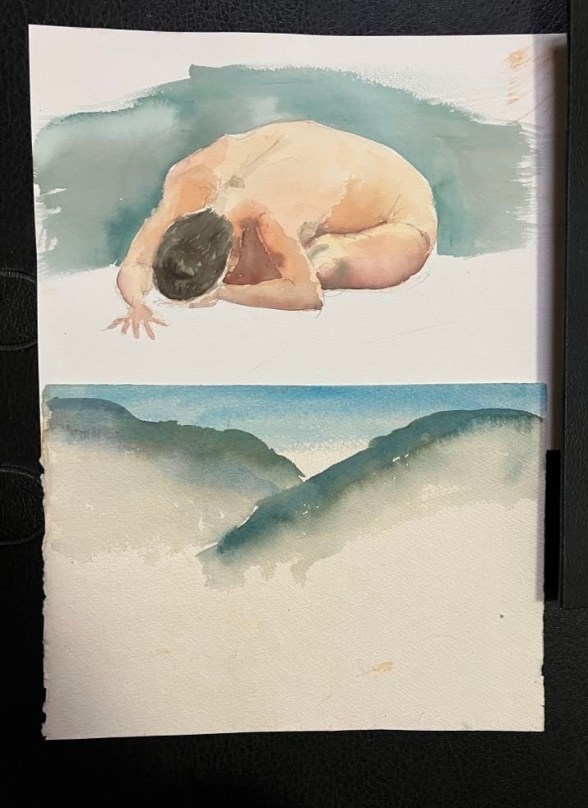
Let’s talk about knowledge and technique in art. Above are two watercolors by my mother, Helen Burling Ottaway. Neither has a date. The lower one is certainly unfinished and I am not sure about the upper one. I can tell by the technique that the lower one is a much earlier painting. Some of the watercolor nudes do have a year: 1998. That was two years before she died of cancer. I think the lower one is from the 1970s, but the use of wet and dry paper for painting is already apparent, as well as color and line.