This is for photrablogger’s Mundane Monday #36… I picked the photograph before I looked at this week’s contest. Look, Jithin, what is missing from this photo?
Taken at Joshua Tree by me in 2009.


This is for photrablogger’s Mundane Monday #36… I picked the photograph before I looked at this week’s contest. Look, Jithin, what is missing from this photo?
Taken at Joshua Tree by me in 2009.

Prior authorization is where, in the insane United States medical system, the doctor orders a test or medicine. The insurance requires “prior authorization”, that is, the doctor or their office have to call or go on line to fill out forms to get the prior authorization. Otherwise the test or therapy or medicine or even surgery will not be covered by the insurance and the patient eats the bill. Over 60% of bankruptcies in the US are now over medical bills*.
In most doctors’ offices, the prior authorization is done in the back rooms. Employees are on the computer or on the phone trying to obtain the permission, the code number, the magic words that will help the patient. This is a HUGE business and a scam as well. Physicians for a National Health Care Program estimated in 2011 that it costs at least $82,975 PER PHYSICIAN PER YEAR to have a person calling.* Now, there is a person on the other end receiving that call or going over the forms. That person is paid with your insurance premium. Is that health care? It seems more like a barrier to health care. Let’s look at an example.
I do my prior authorizations in the room with the patient. I only have a front desk person, no back room people, and anyhow, if I do it face to face with the patient, I can charge the insurance company for the call. It is face to face counseling and coordination of care. I don’t get paid well for this, but it’s worth it for the patient education.
Yesterday I called for a patient. The insurance company first has a recording that tells me it is recording this conversation. I am too, in the chart note. Then it reminds me I could do all this on line. Well, that is sort of true. I could, but every insurance company has a different website, they all require logins and passwords and it would take me hours to learn them all. Nope, not doing that. After the message it says: “Please enter the physicians NPI number.” I do. Then it leads me through choices: confirm the patient is insured, check the status of a prior authorization, appeal a prior authorization, initiate a prior authorization. That one.
At 3 minutes 50 seconds, I get a human. We are on speaker phone.
“This is Rex. You are calling for prior authorization?”
“Yes. This is Dr. Lizard. Mr. X is in the room.”
“Please spell the doctor’s name.” They are not used to doctors calling.
“Please give the NPI number.” (ok, we typed that in. But every time you are transferred, you have to give all of the information again. I am not kidding.)
“Please give your clinic address. Please give your clinic phone number. Please give your clinic tax ID number. Please give your clinic fax number.”
I do.
“Please give the patient id number. Please give the patient name. Please give the patient date of birth.”
Ok.
My patient is looking amazed. This is how insurance companies treat the doctors who call them? Yep.
“What medicine are you authorizing?”
“A compounded testosterone.”
“Please list the ingredients.”
Crap. didn’t think of that. “Ok, we want to authorize an fda approved one.”
That is entered. “What are the instructions for the patient?”
“What is the dose or strength?”
“What is the diagnosis?”
“He has a condition from birth with no testosterone.”
I have to spell the condition for Rex.
“What is the ICD 10 code?”
I give that.
“Have you measured a testosterone level?”
“Yes. It’s zero. His body doesn’t make testosterone. Since birth.”
My patient is rolling his eyes.
“The form will be sent for review and you should get a fax within 24-72 hours regarding the authorization. Here is a number for tracking.”
“Thank you, we are recording this phone call as face to face counseling and coordination of care in the chart.”
Phone call is 13 minutes and 50 seconds. That is a fast one, actually. Most are 25-30 minutes and I fought for an hour once when a patient’s prescription coverage was cancelled.
I wish that every doctor in the country would do one prior authorization on the phone once a week with the patient in the room. The doctors’ heads would blow off. They might finally see what the current system is doing and how the insurance companies throw more and more and more barriers up to refuse people care.
And how is it a scam? One way is that the patient calls the insurance. The insurance has people who only talk to patients. That person says, “Have your doctors office call for a prior authorization.” The patient calls the doctor’s office. The doctors office calls the insurance, but they are talking to a different branch of the insurance company. That branch tells the doctors office “We don’t cover that.” The doctors office calls the patient, who then thinks that the doctor’s office has screwed up the prior authorization.
How do I know that? With the person in the room, the insurance tells me “No.” I have had patients say, “Your company told me yesterday that all I needed was for the doctor to call!” The insurance person replied, “I only talk to doctors. It is another part of the company that talks to patients.” I have also had an insurance person say “Take me off speaker phone, I am only allowed to talk to physician’s offices, not to patients.” Riiiiiight. I took him off but put him right back on. My patients are outraged and furious: at the insurance, not me. The insurance companies are doing brilliant business plan triangulation and I hope whoever thought it up and whoever allows it as a business plan roasts in hell. No, instead I hope that they wake up and realize how many people they are hurting and I hope that they turn and work to heal a broken sick system.
*http://www.pnhp.org/new_bankruptcy_study/Bankruptcy-2009.pdf
http://www.pnhp.org/sites/default/files/docs/Bankruptcy_Fact_Sheet.pdf
**http://www.pnhp.org/news/2011/august/us-doctors-administrative-costs-4-times-higher-than-in-canada
http://www.pnhp.org/news/2014/august/adventures-in-prior-authorization
I took the photograph at Lake Matinenda in August 2015. It is of a storm. A storm is here in medicine: people versus the corporations who prey on us. We need to heal the system and heal the fear and greed.

I go in the sea
of dreams
open the chest
the trunk
the saddlebags
Empty the dirty laundry
Of emotion
On the floor
Grief and joy
Fear and hope
Mine
All mine
There is a place
Beyond words
I see you in that place
It is very old
And very young
It is so frightening to go there
Lose words
The first time
It is haunted and hunted
Are you aware
Of that place
Do you go there
Of your own volition?
Or do you struggle
Fight and suffer in the
Choppy boundary between air and water
Fear drowning
Water surrounds you
Above you too
You are in the wordless place
Over your head
Are you too deep?
Open your eyes
In the green water light
A mermaid waits to lead you
To a rope to a raft
And me
But first you must open your eyes
I did not take this photo: it was taken at the Weyerhaeuser Pool in Seattle in 2009 at the National Junior Synchronized Swimming Competition. The professional photographer asked our girls to jump in so that he could get some practice shots from the underwater window. No one else was allowed down to that window. My daughter was in her third year of synchro and already so comfortable in the water that she and the others just mugged and played….
First published on everything2.com.
The Honeydrippers: Sea of Love

Medicare quit paying my clinic at the end of July, on the 31st.
I was still half time in clinic, we were interviewing a new receptionist as my receptionist of five years wanted to retire by August first. We got some sort of notification from medicare, but their letters are very cryptic.
My new receptionist was needing orientation and help and I was really tired after July. I redid the medicare application and sent it in. We continued to see medicare patients and turn in the bills.
Our medicare contractor is noridian. They sent us a cryptic letter saying that something was wrong with the application. This was, mind you, a renewal. I had been seeing medicare patients for five years in my clinic.
I call them. I am given a name and a number to identify the call. I have two Ptan numbers, one for me as a physician and a second for the clinic. The first call said that my personal Ptan application was correct but the clinic one wasn’t.
I did it again and mailed it. Second day air. He said that our payments should be released in 10-14 days.
Ten days. Nothing. Fourteen. Nothing. I am pulling from savings to run the clinic. I call a second time. Again I am given a name and a number. She said I had to CALL to get paid once the application was received. I said the first guy didn’t say that. She said another 10-14 days.
We wait. After ten days I call. A third number and person. Once again I have a cryptic email. I ask about the PTan number on the email, which is not my clinic’s Ptan number. Oh, says the man, that is what is wrong with your application. He says to do form (numbernumbernumber B) not form (numbernumbernumber A). And it will be 10-14 days after they receive it.
I do it AGAIN. I do notice that all of the old copies of the form in our file have the PTan numbers wrong. Weird. They have been paying me for five years.
Ten days. I call a fourth time. She says that it will be 30 days not 10 to 14 until medicare lets me know if my application is correct. Or they might pay me after 10-14 days. They aren’t, so I argue that something must still be wrong. What is it? She can’t tell me. I want a supervisor. She says that I can talk to a supervisor in 10-14 days. We figure out that the Ptan number on the application is correct. I say, “I am writing my congresswoman.” and hang up.
So I do. I find my Senator’s email and I write to her. I have been a rural family practice doctor for 25 years and I saw a 98 year old yesterday and a 91 year old today and I LIKE my elderly patients, but I have HAD it with medicare, at least with the contractor noridian that is running medicare for my state. I list the phone call dates and names and identifying numbers and I say FIX IT because otherwise I am for the first time in 25 years seriously considering quitting medicare.
Two days later noridian sends an email saying they are releasing my payments.
The next day we get a direct deposit for $9000.00. That is a START.
One week later we get a call from noridian explaining what is wrong with our application. Not just one thing. Noridian doesn’t seem to have a copy of our business license from five years ago. We have to put the personal Ptan on page xgyb-14. They want details about the nursing home. Do I do home visits?
The noridian person explains that our application has actually been wrong for five years, but now they are getting audited so they have to get everything cleaned up.
So THEY have KNOWN it was wrong for five years, but held my payments since July, while they try to get their act together and tell me what the hell is wrong with it?
I want to be paid INTEREST for all the time I have spent on the phone and redoing the cryptic application.
And many thanks to my congresswoman, for keeping my clinic open.
I took the picture at the Kinetic Sculpture Festival here in September. The outfits make more sense than dealing with noridian, that’s for sure….
first posted on everything2.com on 11/30/15
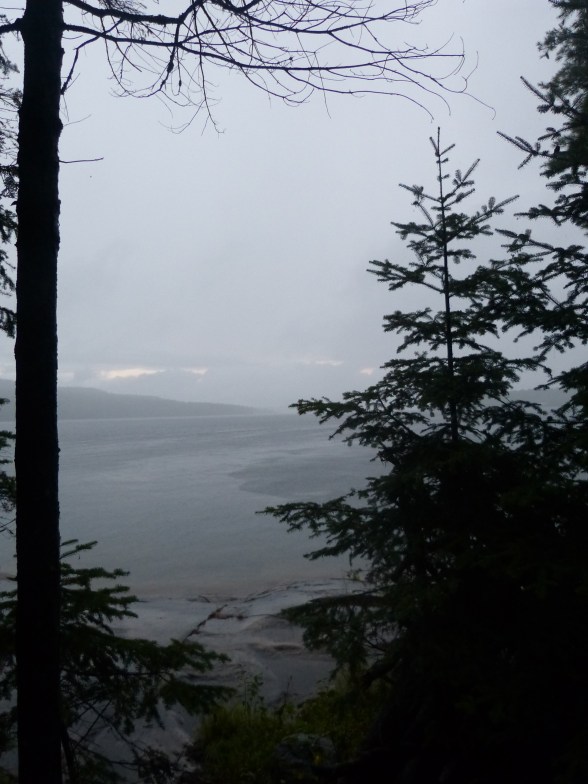
This is for RonovanWrites Weekly Haiku Challenge #73, prompt words black and white. I was thinking of the shades in between and all of the stances on the internet: this is true, this is false, this is horrible, this is wonderful. We only seem to be able to agree about cute cat photos and videos. I keep hoping that the loss of privacy on the internet will teach us gentleness and peace and tolerance: entertain strangers for they might be angels. Peace, all, and work to end all discrimination.
white light darkening
hark angels black and white sing
black tract lightening
I took the picture at the start of a rain storm at Lake Matinenda, Ontario, Canada in August.

This is for Ronovan’s Weekly Haiku Challenge #72, prompt words life and give.
They say they protect
life given by taking a
life, germ live alone
I am thinking of more than one definition of germ: an ovum and a sperm are germ cells, that could develop into an organism. When there is fighting and death over abortion I remember that the egg and the sperm are alive too separately. They can’t all live: we don’t have room or food, do we? And I was playing with more than one meaning and pronunciation of live.
1a : a small mass of living substance capable of developing into an organism or one of its parts
b : the embryo with the scutellum of a cereal grain that is usually separated from the starchy endosperm during milling
2: something that initiates development or serves as an origin : rudiments, beginning
3: microorganism; especially : a microorganism causing disease
I took the photo at our home swim meet.

at the end of the massage
I was dreamy and he put a warm towel over me
and said that I was not to get up until
my body had absorbed all of the heat from the towel
and he left the room
and I thought dreamily that it was so nice
to have my armor removed and muscles unlocked
and to just be assigned to let warmth seep in to me
until I held it all
and I thought dreamily that if all of the archetypes
are in each of us and I am learning to love all of mine
and even and especially the most horrific ones the ones
we all want to reject, not mine, the monsters, oh, poor monsters
that howl in the wilderness that howl in the dark that howl
to be loved
and I thought dreamily that if I love all of the archetypes
inside me then they aren’t a group that is around a table
in my mind, when they are all loved they come together and I
am one and everything is one
and I thought dreamily that how surprising that I felt one
quite suddenly and with no warning and with warming and oh
Beloved all connected
and I thought dreamily that was I really feeling healed as if
all of the splits and breaks and damaged are healed just by
love and I can add to the love in the world loving the inside
terrible parts of myself oh and the monsters long to be loved so
their weeping is terrible
and I thought dreamily blessings monsters blessings Beloved and
love to all and I lay there until I had absorbed all of the warmth
from the towel
and I got up slowly
and returned to the world
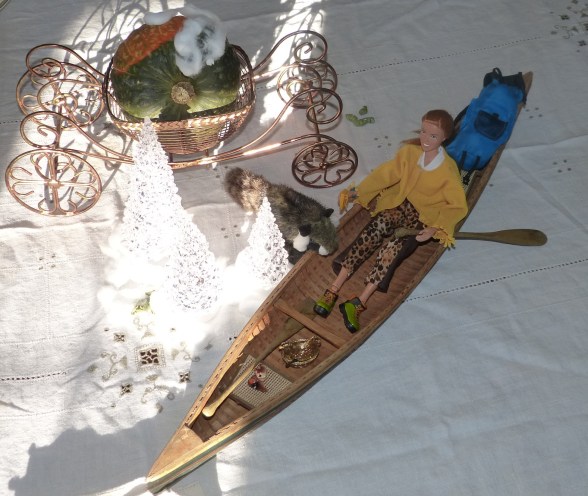
We had a lovely dinner with family and friends. I look at the tablecloths and napkins that I have inherited and I am glad that I live in a time where I can work as a female physician and am not embroidering elaborate tablecloths and napkins. Some of the ones that I have WERE done by female relatives. Amazing and work that is currently not very valued.
So my centerpiece was an acknowledgement of the changes: Cindy is not going to ride in the coach. She has a canoe and paddles and a backpack, sleeping bag, stove, water bottle and GPS. She is going to find her own way and paddle her own canoe.

This is for photrablogger’s Mundane Monday #34.
I was downtown in the early morning for coffee and a walk. I walked out to Port Hudson. The wind was blowing very hard and the rigging was singing that eerie whistle wail. There are giant cleats out as both seats and advertising. I put one of my earrings on the cleat and took the picture. The earrings were my mother’s. After she died I looked at her jewelry. She loved little boxes and I was trying to understand the organization of the earrings. It was not by value, since plastic and gold were all mixed together. She was an artist and organized the earrings by color. These little plastic eiffel towers were in the box with red and pink earrings of all sorts. They are probably at least 30 years old. The tower looks so small against the black cleat with the rainwater. I hope that we can all care for each other through storms and fear.

My clinic refuses to fax to mail order pharmacies. Instead, I give the prescription to the patient and tell them to mail it.
I started this policy over a year ago, when five different patients called in the same week, about two mail order pharmacies.
Patient: “I called my mail order. They say that they don’t have the prescription and the doctor just needs to cal.”
I check. Each of the prescriptions had been faxed. I called the two companies a total of five times that week. Each time they would ask for my identifying information, the patient’s identifying information, transfer me and then say, “Oh, yes, we have the prescription.”
Ah. This is a nice example of triangulation. The patient calls for their refill. The mail order company faxes me a request. I check the chart, see if the person is due for labs or a visit, and fax the prescription. Then the company sits on it. The patient calls them and the company says they don’t have it. They delay. Finally the patient calls me to call the company and then the company admits, oh, yes, actually we do have it.
So we refuse to fax to these companies.
Last week I saw a patient who had mailed her prescriptions. She did not get her medicine.
“I called the company five times. They told me they didn’t have it. They said to call you to send a “hard copy”. I said, “I mailed it to you myself on this date.” Then they said, “Oh, yes, we have it.” However she was out of her medicine for three weeks.
I said, “They saved the cost of three weeks of medicine. That is fraud.” I explained the scam.
Comprehension dawned on her face. “They do it on purpose?”
I shrug. “Five in one week seems like a business operation to me. I recommend that you write to the state insurance commissioner.
She said, “Next time I will mail it certified. And yes, I will call the insurance commissioner if they do it again.
The patient main insurance sends information that getting the prescriptions mail order will be cheaper, and so people want to use the mail order: but the mail order pharmacies in our area are saving costs by ripping people off and delaying prescribed medicine. I do hope they end up in jail: if we can’t jail the corporation, let’s at least jail the CEO and the top 4 officers.
I took the picture yesterday at sunrise.
Home to the Longette & Longette Lite
Intelligence that is not artificial: we are real.
BLIND WILDERNESS
in front of the garden gate - JezzieG
Discover and re-discover Mexico’s cuisine, culture and history through the recipes, backyard stories and other interesting findings of an expatriate in Canada
Or not, depending on my mood
All those moments will be lost in time, like tears in rain!
An onion has many layers. So have I!
Exploring the great outdoors one step at a time
Some of the creative paths that escaped from my brain!
Books, reading and more ... with an Australian focus ... written on Ngunnawal Country
Engaging in some lyrical athletics whilst painting pictures with words and pounding the pavement. I run; blog; write poetry; chase after my kids & drink coffee.
Coast-to-coast US bike tour
Generative AI
Climbing, Outdoors, Life!
imperfect pictures
Refugees welcome - Flüchtlinge willkommen I am teaching German to refugees. Ich unterrichte geflüchtete Menschen in der deutschen Sprache. I am writing this blog in English and German because my friends speak English and German. Ich schreibe auf Deutsch und Englisch, weil meine Freunde Deutsch und Englisch sprechen.
En fotoblogg
Books by author Diana Coombes
NEW FLOWERY JOURNEYS
in search of a better us
Less Noise. More Meaning
Art from the Earth
𝖠𝗇𝗈𝗍𝗁𝖾𝗋 𝖶𝗈𝗋𝖽𝖯𝗋𝖾𝗌𝗌.𝖼𝗈𝗆 𝗌𝗂𝗍𝖾.
Taking the camera for a walk!!!
From the Existential to the Mundane - From Poetry to Prose
1 Man and His Bloody Dog


You must be logged in to post a comment.