For the Ragtag Daily Prompt: flow.
Evening ebb and flow


For the Ragtag Daily Prompt: flow.

A friend calls today and says that another person is bleeding and yet they have been set up to be seen Monday. Why isn’t this an emergency?
Based on the limited information the friend tells me, I agree with the doctors. It is NOT an emergency and I explain why. It is uncomfortable for the person because it may be cancer. Why is that not an emergency?
Let’s use chest pain in the emergency room as an example. Doctors have two brain tracks that are triggered simultaneously by every patient. The first one is “What could kill this person in the next five minutes?” The second is “What is common?” Common things are common and more likely. In medical school the really rare things are nicknamed zebras. You know there are a lot of horses but you can’t miss the zebra. I suppose that in Africa the common things are zebras and the rare ones are orcas or something like that.
Anyhow, the killers for chest pain are heart attacks, sudden death. But there could also be a dissecting aortic aneurysm, where the largest artery in the body is tearing. That person can bleed to death really really fast and that is a surgical emergency. No doctor wants to miss it. There could be a pulmonary embolism, a clot blocking the lung. Chest pain could be from a cancer. A very rare chest pain is from the valve leaflets in the heart tearing so that the person goes in to flash pulmonary edema. And there is Takayasu’s Arteritis, “broken heart syndrome”, where the heart suddenly balloons in size and again, heart failure ensues. Heart failure is actually pump failure, so fluid backs up in the lungs or the legs or both. It is usually slow but rarely very fast and dramatic. A collapsed lung can also cause a lot of pain. And my list is still not complete, I haven’t mentioned pericarditis or myocarditis or a compression fracture.
The common things do include heart attacks, but also anxiety, musculoskeletal problems, inflamed cartilage of the chest wall, fibromyalgia flares, broken ribs, trauma and other things. I was very puzzled in clinic by a woman with pain on both sides of her lower chest wall. In front but cutting through her chest. I ruled out many things. I thought that it was her diaphragm. I sent her to a rehab doctor for help. The rehab doctor sent her to radiology. She had a compression fracture of her spine and the nerves were sending pain messages on both sides. That was not even on my “differential diagnosis” list, because she had no back pain at all. My list changed that day.
Physicians and nurse practitioners and physicians assistants and registered nurses and licensed practical nurses and medical assistants are all trained to think of this differential diagnosis. We are alerted by the history and have to think down both pathways. Last year working as a temporary doctor, the medical assistant came to me saying, “This patient’s blood pressure is 80/60.” “Is he conscious?” I asked, as I went straight for the room. “Yes, he’s talking.” He WAS talking, which means that he’s gotten to 80/60 slowly or is used to it. His heart rate was fast, up near 120. I immediately had him drink water and keep drinking, as soon as he denied chest pain. The problem was dehydration: he was developmentally delayed and had only had one cup of fluid that day and it was now midafternoon. I spent time explaining that he needed 8 cups each day. Not more than that, because if he had too much fluid, it would lower his sodium and make his muscles weak. Most days he drank 3-4 cups. His chart graphed the problem: some days he had normal blood pressure and a normal heart rate. Other days his blood pressure was below normal and his heart rate was fast, his heart trying to make up for the low level of fluid. Cars don’t do so well when there is almost no oil, do they? His kidneys were affected as well. I asked him to drink the 8 cups a day, discussed the size of the cup (not 8 gallons, please) and then recheck labs in 2 weeks. If his kidneys did not improve, he would need a kidney specialist. It turned out that he had nearly fainted that morning in the waiting room. His group home person admitted that no one had noticed that he really was not drinking fluid. I thought that the patient understood and would try to drink a better amount of fluid.
So back to the person I was called about. Infection has been ruled out. This is blood in the urine. A kidney stone has been ruled out, but there is something in the kidney. This is urgent, but if the person is not bleeding hard, it is not emergent. When there is blood in the urine it does not take very much to turn it red. If there is a lot of blood, that can be an emergency, but from the story I got third person, it’s not very much. The emergency things are ruled out but there is still not a clear diagnosis. Yes, cancer is one of the possibilities but it could also be benign. Now a specialist is needed to figure out the next step and the differential diagnosis, the list of things it could be. They will order tests in the same dual order: what could kill this person quickly and what do we need to rule out as common? People often can be very anxious during this period, which is normal. The person says, “I don’t care what it ISN’T, I want to know what it IS.” But sometimes it is a zebra and it takes a while to get to that specific test.
Another example is a woman that I sent to the eye doctor. The optometrist thought it was something rare and bad. He sent her to the opthamologist, who ruled out the first thing, but thought it was something else rare and bad. He sent her to a retinal specialist. The retinal specialist ruled out the second rare and bad thing and said, “No, you have something very rare that is benign.” My patient said, “I have three diagnoses. Who do I believe?” I replied, “No, you have one. The optometrist knew it was unusual and sent you to an eye doctor. The eye doctor know it was unusual and sent you to an even more specialized eye doctor (a “sub specialist”. We keep them in basements.) Now you have a diagnosis. It was a scary process, but I think you should focus on the third opinion because hey, she said it’s benign and it won’t hurt you! That is the best outcome!” She thought about it and agreed. The process was frightening but the conclusion could not have been better.
For the Ragtag Daily Prompt: disquieting.
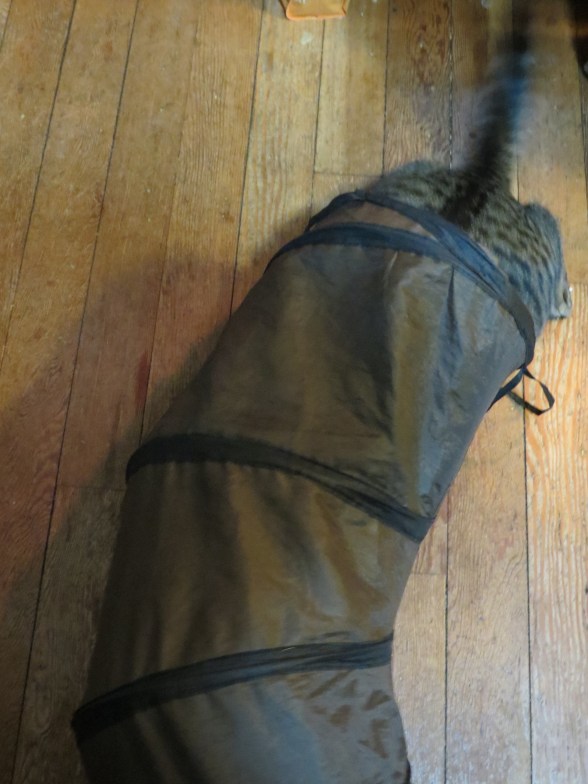
Do you know the song? Tube Snake Boogie?
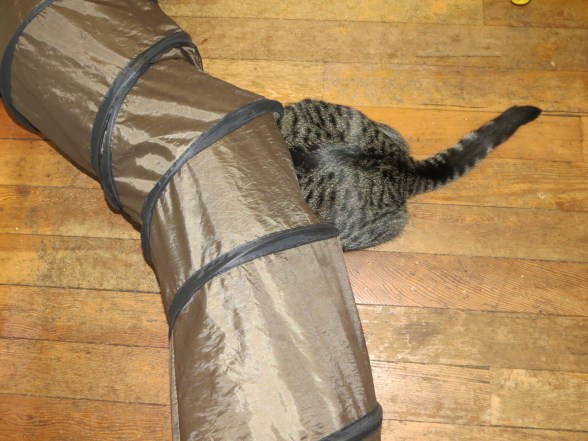
My cats LOVE the tube. But it’s a little disquieting at times. I don’t have a photograph yet, but when there is one cat head first in at one end and another cat sticking out at one of the side holes or the other end… well, it’s a tube cat. A bit worrisome. Kind of a cat/snake cross. It doesn’t help that the tube really matches Elwha’s coloring. I am learning to step over the tube quite carefully because sometimes there are hidden paws.
Elwha barely fits in the side entrances. Cats can do that snakey thing of going through a space that really looks too small for them.

For the Ragtag Daily Prompt: disquieting.


For the Ragtag Daily Prompt: beam and for Cee’s FOTD.

In a recession we learn how to do without.
We tighten our belts. We drive less.
I am glad that I’ve paid for the CSA for the season
Vegetables until late September. The money is gone.
I like the computer. I could do without.
I have songs and instruments and many books.
I wish my children lived closer. On the other hand
maybe they have a better chance of survival scattered
around these United States when it comes to war.
The war has already started. The war has been beating women down
for centuries. I am tired of it. Women are tough. I am tough.
I know how to do without. Right now I am glad each time
I turn the tap and there is clean water. There are many many people
without clean water. I have filter systems. They won’t last forever.
I am loved by my children and friends. I can do without.
I am sad but I can do without. I am preparing to do without
you.

I took a photograph yesterday of a large chalkboard outside a coffee shop downtown. Isn’t it fabulous and creative? And she has a website, here: https://aine-sandford.format.com/#3
Now you can name another woman artist, who does chalk pastels and gorgeous water colors.
For the Ragtag Daily Prompt: creativity. My photograph of her chalk art and my blog!

I am in a CSA, Community Supported Agriculture. I go pick up my box on Wednesday. Early in the year we get tulips as well as greens. I love both.
This is for Cee’s Flower Photo of the Day.
I am a rural Family Medicine doctor, board certified and board eligible. I have used the Telemedicine groups in the nearest big University Hospital since 2010.
Initially I started with the Addiction Telemedicine. I accidentally became the only physician in my county prescribing buprenorphine for opioid overuse in 2010. I panicked when I started getting calls. Dr. Merrill from UW had taught the course and gave me his pager number. I acquired 30 patients in three weeks, because the only other provider was suddenly unavailable. Dr. Merrill talked me through that 21 day trial by fire.
I think that I presented at least 20 patients to telemedicine the first year. The telemedicine took an hour and a half. First was a continuing medical education talk on some aspect of “overuse”, aka addiction, and then different doctors would present cases. We had to fill out a form and send it in. It had the gender and year of birth, but was not otherwise supposed to identify the person. TeleAddiction had a panel, consisting of Dr. Merrill (addiction), a psychiatrist, the moderator/pain doctor, and a physiatrist. Physiatrists are the doctor version of a physical therapist. They are the experts in trying to get people the best equipment and function after being blown up in the military or after a terrible car wreck or with multiple sclerosis. There would usually be a fifth guest specialist, often the presenter.
After a while, TeleAddiction got rolled into Telepain and changed days. They added other groups: one for psychiatry, one for HIV and one for hepatitis C. These can all overlap. I mostly attend TelePain and TelePsychiatry.
After a while, I pretty much know what the Telepain specialists are going to advise. So why would I present a patient at that point? Ah, good question. I use Telepain for the weight of authority. I would present a patient when the patient was refusing to follow my recommendations. I would present to Telepain, usually with a very good idea of what the recommendations would be. The team would each speak and fax me a hard copy. I would present this to the patient. Not one physician, and a rural primary care doctor, but five: I was backed up by four specialists. My patients still have a choice. They can negotiate and they always have the right to switch to another doctor. Some do, some don’t.
I am a specialist too. Family Practice is a specialty requiring a three year residency. The general practitioners used to go into practice after one year of internship. My residency was at OHSU in Portland, with rotations through multiple other specialties. We rotated through the high risk obstetrics group, alternating call with the obstetrics residents, which gave me excellent training for doing rural obstetrics and knowing when to call the high risk perinatologist. In my first job I was four hours by fixed wing from the nearest more comprehensive obstetrics, so we really had to think ahead. No helicopter, the distance was too far and over a 9000 foot pass, in all four directions. That was rather exciting as well.

Gnomes have dermatomes
call me on their cell phones
inflammed neurons fire moans
after lifting heavy stones
gnomes with grumpy dermatomes
stop riding on your spotted roans
ice your backs, lie down at home
gnomes complain and curse and moan
gnomes with calming dermatomes
glad they iced them there at home
families help, they’re not alone
healing gnomes pained dermatomes
For the Ragtag Daily Prompt: dermatome.

For Cee’s Flower of the Day.
BLIND WILDERNESS
in front of the garden gate - JezzieG
Discover and re-discover Mexico’s cuisine, culture and history through the recipes, backyard stories and other interesting findings of an expatriate in Canada
Or not, depending on my mood
All those moments will be lost in time, like tears in rain!
An onion has many layers. So have I!
Exploring the great outdoors one step at a time
Some of the creative paths that escaped from my brain!
Books, reading and more ... with an Australian focus ... written on Ngunnawal Country
Engaging in some lyrical athletics whilst painting pictures with words and pounding the pavement. I run; blog; write poetry; chase after my kids & drink coffee.
Coast-to-coast US bike tour
Generative AI
Climbing, Outdoors, Life!
imperfect pictures
Refugees welcome - Flüchtlinge willkommen I am teaching German to refugees. Ich unterrichte geflüchtete Menschen in der deutschen Sprache. I am writing this blog in English and German because my friends speak English and German. Ich schreibe auf Deutsch und Englisch, weil meine Freunde Deutsch und Englisch sprechen.
En fotoblogg
Books by author Diana Coombes
NEW FLOWERY JOURNEYS
in search of a better us
Personal Blog
Raku pottery, vases, and gifts
𝖠𝗇𝗈𝗍𝗁𝖾𝗋 𝖶𝗈𝗋𝖽𝖯𝗋𝖾𝗌𝗌.𝖼𝗈𝗆 𝗌𝗂𝗍𝖾.
Taking the camera for a walk!!!
From the Existential to the Mundane - From Poetry to Prose
1 Man and His Bloody Dog
Homepage Engaging the World, Hearing the World and speaking for the World.
Anne M Bray's art blog, and then some.
My Personal Rants, Ravings, & Ruminations
 KO Rural Mad As Hell Blog
You must be logged in to post a comment.