Eating his words

After today’s international zoom on Cardiovascular Complications of Long Covid, I am thinking about one of my former partners. An ex-partner.

I got influenza in 2003. I was working full time plus all the call, had two small children, my mother had died two years before of cancer, and I was worrying about my marriage. Quite a stress load. I got influenza, running a temperature of 104 for a week and tachycardic. My heart rate was 100 at rest instead of my normal 62, and when I walked across the room slowly, it went up to the 130s or above and I got short of breath. I did not figure that out the fast heart rate immediately.

I tried to go back to work a week after I was out. By lunch time I thought, I feel like I’m dying. I stuck the pulse oximeter on my finger. My heart rate standing was 135. Oh. Normal is 60-100 and 135 is not ok. It’s exhausting. My office manager chose that moment to call me into her office and scold me for missing work. I was so freaked out by my heart rate that I did not show ANYONE in my clinic. I left and went to my physician, upstairs in the same building.

The tachycardia continued for two months.

I didn’t understand it, my Family Practice doctor didn’t understand it, and my partners accused me of malingering and were pissed. My instinct was to lie on the couch, so that’s what I did. Rest and wait. That level of tachycardia makes a person anxious, so my communication skills were challenged. After six weeks, I had an echocardiogram, which was normal EXCEPT for a fast heart rate. After two months, it went away. I staggered back to work, still frail and tired, and still down ten pounds.

One of my partners said, “I could understand you being out two months for heart disease or cancer, but not for influenza.”

At the time I didn’t say anything. That comment really, really hurt. I told myself that I should TRY to be a nice person and not wish that he would get a bad case of pneumonia with tachycardia. That took some major effort on my part.

Now with all the people with a fast heart rate after Covid-19, he can eat his words.

Long Covid imaging

In the last Long Covid talk that I attended and wrote about (here: Pulmonary Manifestations of Long Covid), the pulmonologist and intensivist says that one problem with Long Covid is that we do not have imaging that can “see” it.

That is, the chest x-ray looks normal, the echocardiogram may look normal (heart ultrasound), the chest CT scan may look normal, a brain CT or MRI may look normal, but the patient may still be tachycardic, feel exhausted, feel brain fog and have multiple other symptoms.

That pulmonologist listed five of the top mechanisms that are prolonged in the immune system. Most of the scientists and physicians are framing this as “immune system dysfunction”. I am not. I am framing it as “you were really really sick and your immune system is still on high alert and trying to protect you so you can recover”. Now wait, you say, how could chronic fatigue like symptoms protect me? Well, if you are exhausted, you can’t go to work and you’ll stay quiet at home most of the time and less exposure chance. But what about brain fog? Again, this will slow your interaction with other people and force you to rest and heal. But, you say, I don’t like it. Well, yeah. Patience. We call grumpy patients that are recovering “convalescents”. It is a good sign when they are grumpy and over it and just want to be better. That doesn’t mean I can make myself or anyone else heal faster.

The pulmonologist says that the best test is the six minute walk test. This is usually done by a respiratory therapist. The person walks in a circle for six minutes wearing a pulse ox, with the respiratory therapist doing regular checks. This distinguishes between the people who have primarily a lung issue from all the other issues. If the person is tachycardic (fast heart rate) but not hypoxic (oxygen level dropping), then it’s not primarily lungs though blood clots to the lungs sometimes have to be ruled out. One of the mechanisms in the immune system is microclots and an increased risk of blood clots. That can mean heart attack, stroke, or pulmonary embolus, a clot in the lungs. The microclots are suspected of causing some of the muscle fatigue and exercise intolerance, by clogging capillaries and reducing oxygen flow to muscle cells. Muscle cells do not like this at all.

I have done my own quick walk test with patients since 2003, when I had terrible influenza. About a week after my influenza started, with the temperature of 104 and heart rate at 100 at rest and 135 walking, my temperature came down. However, the fast heart rate continued. Normal heart rate is 70-100 and 135 walking will make you feel exhausted. I lay on the couch and could barely make my kids dinner for two months. It resolved then. I read a book about influenza and thought that I had “influenza viral pneumonia” where there is lung tissue swelling, reducing the air spaces, after influenza.

My quick walk test in clinic is to check a sitting oxygen level and heart rate and then have the person walk. I would have them walk up and down a short hall three times then sit down. When they sat, I watched the pulse oximeter recovery. Some people would jump from a resting heart rate of 62 to a walking heart rate of over 100, say 120. Their oxygen level could stay normal or it could drop. If they dropped below 88, I would get home oxygen and forbid them to return to work. If their oxygen level held, then they needed to rest until their walking heart rate stayed under 100 and they were no longer exhausted by gentle or normal activity. If they return to work with a walking heart rate of 120, they will be exhausted and are more likely to get a secondary pneumonia or have other problems. The heart does not like to run at 120 all the time. You can see why a person who already has some coronary artery blockage would be more likely to have a heart attack if they get pneumonia from influenza or Covid-19.

The conferences I am attending are talking about “targets” in the immune system. That is, new drugs. I think the science is wonderful and amazing, but I also think we need to step back and say, this is a really really bad infection and some people need a lot of support and reassurance and time to heal. Reassure them that even though they have not yet returned to normal, the immune system is working hard to protect them from other infections and it is saying very very loudly that they need to rest. Rest, recuperate and trust the immune system. Some things need immediate treatment, especially blood clots, heart attacks and strokes, but once those are ruled out, we need to support people through their convalescence and healing.

______________

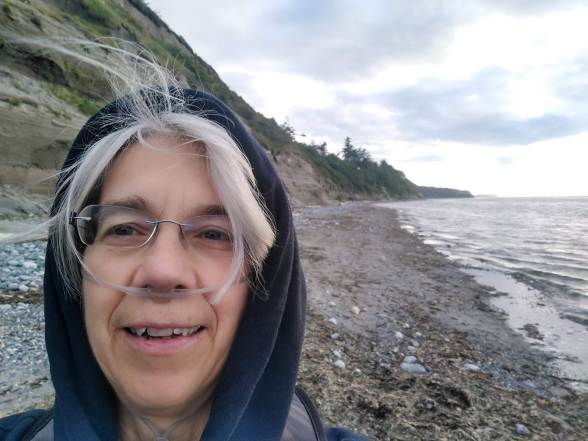
The photograph is from April 2021, a few days after I was put on oxygen. A selfie.

Pulmonary Manifestations of Long Covid

Today’s Zoom lecture was about pulmonary manifestations of Long Covid, and this is from the Schmidt Initiative for Long Covid Global ECHO Webinar Series, out of the U of New Mexico.

First of all, the talk is brilliant. The speaker is Lekshmi Santhosh, MD, MAEd, Asso Prof Med, Pulm Critical Care Med, UCSF, Intensive Care.

Two things to start with: she stressed the six minute walk test for patients, to distinguish oxygen desaturation (dropping) from the people who have terrible tachycardia (fast heart rate) only. The oxygen drop indicates that the person needs lung studies and may need oxygen, while tachycardia alone means either a heart problem, chronic fatigue/ME pattern or dysautonomia, where the heart goes fast when the person sits or stands up. Her point was that it’s a simple test and that Long Covid presents in multiple different patterns.

The second point is that there are least five main mechanisms that Long Covid can mess us up and people can have one or many. There is a review article in Nature last month (I need a copy!) and it talks about these five: immune system problems, gut microbiome problems, autoimmune responses, blood clotting/microclotting/endothelial problems and dysfunctional neurological signalling. SO: this is a MESS. She says that patient care needs to be individualized depending on which mechanism(s) are predominant and it can be more than one. This Covid-19 is a hella bad virus.

So: “The underlying biological mechanism may not be the same in each patient.” That is the understatement of the year.

She reiterates that the current diagnostic criteria, subject to change, is symptoms that last longer than 12 weeks after Covid-19 and two months past that. She states that the symptoms can wax and wane and that we need to listen to and believe patients.

In JAMA this month, there is an article that uses big data to find which symptoms are more associated with Long Covid, and lists 13 symptoms. Smell/taste tops the list but fatigue is there too. However, this is not a list for diagnosis, it’s a study list.

She also is careful to say that the treatment for the pulmonary manifestations is not the same as the people with the pattern that resembles chronic fatigue syndrome/ME. The pulmonary people can build exercise tolerance, but the CFS/ME folks need a different regimen, with pacing and energy conservation. That sounds like a subtle difference. I had both though my CFS/ME is weird. It does not put me in bed, I just can get really tired and need to sleep. It’s a bit invisible. People see me dance and would not guess that I have CFS/ME. All relative to previous function and energy, right?

For lung manifestations, she lists a pyramid, with the more rare things at the bottom. As follows:

  1. persistent dyspnea (shortness of breath)
  2. post viral reactive airways disease (asthma that can resolve from irritated pissed off lung tissue)
  3. deconditioning. She says that the isolation and quarantine with some people in very small rooms, leads to terrible deconditioning in some folks. They can build up, especially with supervised exercise with pulmonary rehabilitation and/or physical therapy. It is scary to exercise when you are short of breath and the supervision really helps, with limits on how much you should push, or encouragement to push.
  4. organizing pneumonia. This is rare and responds to steroids. Otherwise steroids are not good for the muscles in Long Covid, with the exception of inhaled steroids for the asthmatics and post viral reactive airways.
  5. post ARDS fibrosis: fibrosis is fibrous scarring that can form in the lungs. Anyone who has any terrible pneumonia and is in the ICU and intubated and on a ventilator can get this. Not everyone gets it, thankfully. ARDS is Acute Respiratory Distress Syndrome. Luckily the fibrosis is rare and it turns out that in some people it improves with time, like years. She does not recommend the pulmonary fibrosis medicines right now. There are many causes of pulmonary fibrosis besides infection.
  6. PVD: peripheral vascular disease. Covid-19 increases clotting, so we have to look for both clots and for disease in arteries, which could be lungs, brain, heart, anywhere in the body.

She says DON’T assume that chest pain is from the lungs and don’t miss cardiovascular. That is, rule out a heart attack and pulmonary embolus first.

Other lung problems have to be kept in mind that are not caused by Covid-19. This list: Reflux associated cough, pleuritic pain, neuromuscular disease, vocal cord dysfunction, tracheal stenosis, tracheomalacia. Watch for those. She says that it is very very important to look at old chest x-rays and CT scans, because those can show previous signs of emphysema/COPD/asthma/fibrosis.

Testing: She puts the 6 minute walk test first. AFTER the thorough history and making sure there are no red flags for pulmonary embolism and heart attack. Those have to ruled out if there is any suspicion. Next: pulmonary function testing. If the DLCO is low, consider a chest CT. Consider TTE -TransThoracic Echocardiogram, to look at the heart. Labs: CBC (blood count), ESR, CRP, thyroid, +/-CPK.

She has diagnosed people who are sent to her with NOT Long Covid: they have metastatic lung cancer, metastatic prostate cancer, new pregnancy, hypersensitivity pneumonitis and many other things. She says, “Don’t assume it is Long Covid. Sometimes it isn’t.”

Now, this is all a formidable list of problems and this is JUST the lungs. Long Covid can affect every system in the body and every patient is different.

She also says that she has done more disability and accommodation paperwork in the last three years than in her entire career before that. That the US disability system is a horrid mess and that she has to talk to employers and insurers OFTEN to say that the person will get better faster and have less long term problems if she treats now and they have rest and return to work may need to be very gradual.

She approaches new patients by asking which symptoms are worst. She thinks about severity of the infection, vaccination status, previous/present other medical problems and habits that can contribute or worsen things (smoking, vaping, exposures). Her clinic is for Long Covid pulmonary, but now they have opened up a neurological branch. They use multiple other specialists as well.

Last quotation: “Until we elucidate the biology and have clinical trials, treatments are largely symptomatic.” So the basic science studies working on immune system, the gut microbiome, the clotting problems, are huge in figuring out what to do in clinical trials. This is a tremendously complex illness and three years into Covid-19, we are still trying to figure out the multiple mechanisms that cause Long Covid.

This was a very hopeful lecture from my standpoint, admitting that this is complex but that we are also working to sort out the mechanisms and work on treatments. She works hard at getting patient input and feedback as well.

Two links: A free PDF from Johns Hopkins on Bouncing Back from Covid. https://www.hopkinsmedicine.org/physical_medicine_rehabilitation/coronavirus-rehabilitation/_files/impact-of-covid-patient-recovery.pdf

The American Physical Therapy Association has articles as well: https://www.apta.org/patient-care/public-health-population-care/long-covid

Also here are webinar links:

SILC Global ECHO Webinar Series Resource Links June 28, 2023

Now, how will I use the Ragtag Daily Prompt riposte for this? I think I will just say again how important it is to listen to and believe our patients!

The photograph is from Marrowstone Island, East Beach. The shape in the driftwood is sort of lung shaped.

Long Covid and fatigue

Sometimes medical articles are SO IRRITATING! Like this:

Symptomatic Long COVID May Be Tied To Decreased Exercise Capacity On Cardiopulmonary Exercise Testing Up To Three Months After Initial SARS-COV-2 Infection

Healio (10/18, Buzby) reports a 38-study systematic review and meta-analysis β€œsuggested with low confidence that symptomatic long COVID was associated with decreased exercise capacity on cardiopulmonary exercise testing up to 3 months after initial SARS-COV-2 infection.” According to the findings published in JAMA Network Open, β€œunderlying mechanisms may include but are not limited to deconditioning, peripheral mechanisms, hyperventilation, chronotropic incompetence, preload failure and autonomic and endothelial dysfunction.”

Wouldn’t it be nice if they believed the patients?

Let’s break this down. What does it all mean? Ok, the “low confidence” irritates me because it implies that the physicians can’t believe the patients who say “hey, I am short of breath and have a fast heart rate and get really fatigued if I try to do anything!”

I have had my fourth bout of pneumonia with shortness of breath and tachycardia. This time, since I am older, I had hypoxia bad enough to need oxygen. This is the FIRST TIME that some physicians have actually believed me. They believed the pulse oximeter dropping down to 87% and below, with a heart rate in the 140s, but they did not believe me and some accused me of malingering, for the last 19 years. Can you tell that I am a little tiny bit annoyed? If my eyes shot lasers, there would be some dead local physicians. And I AM a local physician, disbelieved by my supposed peers.

Let us simplify this gobbdygook: β€œunderlying mechanisms may include but are not limited to deconditioning, peripheral mechanisms, hyperventilation, chronotropic incompetence, preload failure and autonomic and endothelial dysfunction.” The way I think of it is that sometimes a pneumonia will cause lung tissue swelling. Ok, think of the air space in your lungs as a large balloon. Now the wall of the balloon swells inwards and suddenly there is half as much air space. Guess how your body takes up the slack? The heart goes faster and you have tachycardia. This is a very simple way to think about it. I have tested patients who complain of bad fatigue after an upper respiratory infection with a very simple walk test. 1. I test them at rest, heart rate and oxygen saturation. 2. I walk them up and down a short hallway three times. 3. I sit them back down, and watch the heart rate and oxygen saturation. I watch until they are back to their seated baseline.

A friend tested recently and his resting heart rate was 62. After walking, his heart rate is in the 90s. H does not have a pulse oximeter, but his oxygen level is probably fine. However, that is a big jump. He has had “a terrible cold” for 8 days. I would bet money that his heart rate normally doesn’t jump that much. He still needs recovery time and rest.

In clinic, I had people who were ok at rest but needed oxygen when they walked. We would get them oxygen. More often, they did not need oxygen, but they were tachycardic. When they walked, their heart rate would jump, over 100. Normal is 60-100 beats per minute. If they jumped 30 beats or jumped over 100, I would forbid them to return to work until their heart rate would stay under 100 when they walked. If they went back to work they would be exhausted, it would slow healing, and they might catch a second bacteria or virus and then they could die.

Patients did not need a pulse oximeter. I would teach them to take their own pulse. The heart rate is the number of beats in 60 seconds. I have trouble feeling my own wrist, so I take mine at my neck. It’s a bit trickier if someone has atrial fibrillation but the pulse oximeters aren’t very good with afib either.

When I have pneumonia, my resting heart rate went to 100 the first time and my walking heart rate was in the 140s. I had influenza and felt terrible. My physician and I were mystified. It was a full two months before my heart rate came down to normal. I was out of shape by then and had to build back up. If I tried to walk around with my heart at 140, I was exhausted very quickly and it also felt terrible. The body does NOT like a continuous fast heart rate and says “LIE DOWN” in a VERY FIRM LOUD VOICE. So, I lay down. Until I recovered. For a while I was not sure if I would recover, but I did. This time it was a year before I could go to part time oxygen.

The fatigue follows the heart rate. Tachycardia is not good for you long term. If the heart is making up for reduced air space in the lungs, it doesn’t make sense to slow the heart rate with drugs. You NEED the heart to make up for the lungs. You need to rest, too!

Blessings and peace you.

The photograph is Elwha, helping me knit socks. With the bad air from the fires and my still recovering lungs, I am staying indoors and knitting socks .

Covid-19: Hope for Long Haul

I want to offer hope to the people with Long Covid-19. Having been through four bad pneumonias, with increasingly long recovery times, and now disabled for doing Family Medicine, I have experience to share. First I want to talk about chronic fatigue and fibromyalgia.

I am a piler, not a filer. Including in my brain. I have been adding to the chronic fatigue and fibromyalgia pile since I was in medical school.

In residency a new patient questions me. “Do you believe in chronic fatigue?” he says, nearly hostile.

“Yes,” I reply, “but I don’t know what it is or what causes it or how to fix it.”

For years different causes were suggested. Often infections: EBV, mononucleosis, lyme disease. Some people didn’t have any infection. I did note even in residency that my chronic fatigue patients all had one thing in common: they were exhausting.

Does that sound terrible? They were all type A, high achievers, often super high energy. Often they got sick or crashed when they were working three jobs, or working 20 hours a day on their own business, or doing something that sounded insanely exhausting and unsustainable. And most of them wanted that back. “Ok, wait. You were working 20 hours a day, seven days a week, got sick and THAT is what you want to get back to?”

None of the chronic fatigue people seemed to be type B.

Eventually I read that one in ten people with ANY severe infection can get chronic fatigue.

Then I work with the U of Washington Telepain Clinic, on zoom. They start studying functional MRIs of the brains of people with fibromyalgia.

They use a thumbscrew. They put a measurable amount of pressure on a person with no fibromyalgia. The person reports 3-4 out of 10 pain. The brain lights up a certain amount in the pain centers on the MRI. The doctors can SEE it. Then they test the fibromyalgia people with the same amount of thumbscrew pressure. The fibromyalgia people report 8-9/10 pressure and they are not lying. The pain centers in the brain light up correspondingly more. So they ARE feeling 8-9/10 pain.

Is this a muscle problem? A brain problem? Or both?

It appears to be both. Chronic fatigue and fibromyalgia and other disorders with pain out of proportion to the physical findings were being called “central pain processing disorders”.

I thought of chronic fatigue as a sort of switch. As if at a certain level of stress or exhaustion or infection the body would throw a switch. And force the person to rest.

I wondered if the type B people just rested and got over it, while the type A people fought it like tigers. Which seemed to make it worse.

And now we have Covid-19. The study getting my attention is saying that 20%, or 1 in five people age 18-64, have Long Haul symptoms. Over 65 it is 25%, one in four. And it can happen in people with no preexisting conditions. Preexisting conditions or not, this sucks. The two biggest complaints are lung related and muscle related.

I have chronic fatigue following my third pneumonia in 2014. I might be just a little type A. I went back to work too soon (6 months after the pneumonia) and after a half day would crash asleep at 3 pm. For another 6 months. Now that I have had the fourth pneumonia and have been off for a year and been on oxygen, I feel better than I have since before 2014, even though I still need oxygen part time. Guess I was in denial about the chronic fatigue. NOT ME!

So, dear reader, learn from me and don’t be like me. The biggest thing that I have had to get through my thick type A skull is that when my body wants rest, I need to rest. This can be hella annoying, as my son would say. I have to pay attention to my energy level and decide what to do. And some of my precious energy has to go to things like laundry and paying bills! How very frustrating. My markers are energy level and also pulse. My pulse tells me when I need oxygen and when I am really sick. With the first pneumonia back in 2003, influenza, my resting pulse stayed at 100. My normal then was about 65. When I stood up, my pulse went to 135. It was EXHAUSTING to stand up. I had to rest half way up one flight of stairs. It was hard to walk two blocks to pick my daughter up from primary school. And I looked fine. Neither my doctor nor I could figure it out. I finally guessed that it was lung tissue swelling and hoped it would go down eventually. It did, but it was a full two months and my doctor partners thought I was malingering. I tried not to wish it on them. It sucked and I felt awful back at work, but my pulse had finally come down. We even did a heart ultrasound, but all it showed was a fast heart rate. My chest film looked “normal”, because the tissue swelling is throughout the lungs, so it cannot be seen on a chest xray. It was very weird, but I recovered. And all the descriptions of Long Covid sound like my lung swelling. Fast heart rate, difficulty breathing, muscle pain and terrible fatigue. Go back to the couch.

Go back to the couch and wait. Do what you have to but if your heart rate is over 100 when you get up, you have to rest. Otherwise you will prolong it. Seriously.

More later. Peace me and sending love and peace.

Anna’s hummingbirds can survive below freezing temperatures by slowing their metabolism at night, until it warms up in the morning. Talk about resting!

Lung swelling and long covid

I wrote this in 2017, about influenza. However, I think covid-19 can do the same thing. Part of long covid is letting the lungs really heal, which means infuriating amounts of rest and learning to watch your own pulse. Watching the pulse is easier then messing around with a pulse oximeter. The very basics of pulse is that normal beats per minute is 60 to 100. If your pulse is 70 in bed and 120 after you do the dishes, you need to go back to bed or the couch and REST.

From 2017: Influenza is different from a cold virus and different from bacterial pneumonia, because it can cause lung tissue swelling.

Think of the lungs as having a certain amount of air space. Now, think of the walls between the air spaces getting swollen and inflamed: the air space can be cut in half. What is the result?

When the air space is cut down, in half or more, the heart has to work harder. The person may be ok when they are sitting at rest, but when they get up to walk, they cannot take a deeper breath. Their heart rate will rise to make up the difference, to try to get enough oxygen from the decreased lung space to give to the active muscles.

For example, I saw a person last week who had been sick for 5 days. No fever. Her heart rate at rest was 111. Normal is 60 to 100. Her oxygen level was fine at rest. Her oxygen level would start dropping as soon as she stood up. She had also dropped 9 pounds since I had seen her last and she couldn’t afford that. I sent her to the emergency room and she was admitted, with influenza A.

I have seen more people since and taken two off work. Why? Their heart rate, the number of beats in one minute, was under 100 and their oxygen level was fine. But when I had them walk up and down a short hall three times, their heart rates jumped: to 110, 120. Tachycardia. I put them off from work, to return in a week. If they rest, the lung swelling will have a chance to go down. If they return to work and activity, it’s like running a marathon all day, heart rate of 120. The lungs won’t heal and they are liable to get a bacterial infection or another viral infection and be hospitalized or die.

I had influenza in the early 2000s. My resting heart rate went from the 60s to 100. When I returned to clinic after a week, I felt like I was dying. I put the pulse ox on my finger. My heart rate standing was 130! I had seen my physician in the hospital that morning and he’d gotten a prescription pad and wrote: GO TO BED! He said I was too sick to work and he was right. I went home. It took two months for the swelling to go down and I worried for a while that it never would. I dropped 10 pounds the first week I was sick and it stayed down for six months.

Since the problem in influenza is tissue swelling, albuterol doesn’t work. Albuterol relaxes bronchospasm, lung muscle tightness. Cough medicine doesn’t work very well either: there is not fluid to cough up. The lungs are like road rash, bruised, swollen, air spaces smaller. Steroids and prednisone don’t work. Antiviral flu medicine helps if you get it within the first 72 hours!

You can check your pulse at home. Count the number of beats in one minute. That is your heart rate. Then get up and walk until you are a little short of breath (or a lot) or your heart is going fast. Then count the rate again. If your heart rate is jumping 20-30 beats faster per minute or if it’s over 100, you need to rest until it is better. Hopefully it will only be a week, and not two months like me!


Feel free to take this to your doctor. I was not taught this: I learned it on the job.

I took the photograph, a stealthie, in June 2021, when I was still on oxygen continuously.

Update on whatever it is I have

I had the heart echocardiogram bubble study. Normal. I really really did not like having the mix of blood, saline and AIR injected and I COULD FEEL IT. My logical brain knew it was going into a vein, but my emotional brain kept yelling “Air embolisms kill people!” Yes, but that is arterial. My emotional brain did not care. Anyhow, it was fine.

Saw the cardiologist who said he can understand why I feel PTSD going into my local hospital. He says I should not need oxygen at age 60 with no smoking. He says “Not your heart.” Yeah, duuuude, I know. He suggests I go to the Mayo Clinic. I agree.

Meanwhile, my primary sent a referral to rheumatology to have me seen at Swedish to confirm chronic fatigue. This is to keep the stupid disability off my back. Swedish rheum doesn’t call me. I ask my primary’s office. Swedish STILL doesn’t call me. I call them, as follows.

“Hi, I was referred to Swedish rheum and I have not been called.”

“Name, serial number, date of birth, length of little toe. Ah, we just received the referral yesterday.”

“Um, I don’t think so. I was referred over a month ago.”

“Uh, oh,” scrabble noises, “Oh, uh, we got a referral in December. We were not taking new patients in December.”

“When did you start taking new patients?”

“Oh, um.”

“When did you start taking new patients?”

“Oh, uh, January. But we only took the ones that called us, because after they call, we then review the notes.”

“So you ignored the referral until I call? How am I supposed to know that?”

“Oh, uh, we will expedite your referral. Maybe even today.”

So THEN I get a message from my primary that they have REFUSED the referral. Great.

Meanwhile I read the cardiologist’s note, which pisses me off. “We will refer you to Mayo Clinic since you have unexplained hypoxia and you think you have PANS.”

I send my primary a very pissed off note saying, could we please phrase this as “a psychiatrist suggested PANS in 2012 and while no one likes this diagnosis, no one else has suggested an overarching diagnosis since that time in spite of her seeing four pulmonologists, neurology, cardiology, infectious disease, four psychiatrists, allergy/asthma, and immunology”. Saying “the patient thinks she has PANS” automatically labels me as crazy and obsessed.

So, it seems I should write a book, about how the medical communities treat patients, including a fellow physician, horribly. Of those doctors, three have treated me with respect and were grown up enough to say, “We don’t know.” The neurologist, the infectious disease doc and the present pulmonologist. All the rest are dismissive and disrespectful. Oh, and the one psychiatrist, but the next one says, “I don’t believe in PANDAS.” I stare at him in disbelief, thinking “they are animals related to raccoons that live in China, you moron”. I did not even know it was controversial until that moment. Holy PANDAS, Batman.

My primary has suggested I write to the Mayo Clinic myself, and I am going to. Because the present people aren’t listening, except my pulmonologist and she is short staffed and looks like death warmed over post call every time I see her.

So it’s all annoying as hell. The cardiologist seemed pretty nice, but damn, he put the same damn rumor down about me self diagnosing. Most of the doctors apparently think I might be a tolerable person if they could just drug me with psych drugs. And from what I have seen, there are many patients who are in this situation.

For the Ragtag Daily Prompt: WAR.

https://pubmed.ncbi.nlm.nih.gov/30724577/

Covid-19: simplified self care

  1. I am a Family Practice Physician for 30 years. I have had pneumonia four times. I last got pneumonia on March 20, 2021 and I am still off work and on oxygen. This is the first time I have been on oxygen. No tobacco, no marijuana, no lung disease found to date but my mother had tuberculosis when I was born and my father smoked unfiltered Camels. With the hospital beds filling up, this is to help keep people out of the emergency room if they don’t need to be there and to help people track how sick they are.
  2. Learn to take your pulse. You need a second hand. Your heart rate is the number of beats in 60 seconds. Take it at rest (which means sitting or lying down). Then try taking it after you walk. It should be regular unless you have known atrial fibrillation. Also, if you are fifty or older, you may skip some beats so that you have early or late ones. That is not worrisome.
  3. Normal is 60-100. If you are very out of shape, you might go up to 120 after you run up the stairs or walk fast.
  4. If your resting pulse is 120 or higher, call your physician. If you are very short of breath with that or your lips are turning blue, call an ambulance right away.
  5. If your resting pulse is normal, say, 70 beats per minute, and your pulse after walking goes up 30 points or over 100, you are sick. If you are very short of breath after walking you may need oxygen. Call your physician and walk… really… slowly. When your lungs are swollen, there is less air space to exchange oxygen and your heart makes up the difference. If your heart is beating at over 100 for long, it is like running a marathon. Don’t stop walking completely because you are at risk for blood clots. But walk really slowly.
  6. If your resting pulse is normal and your walking pulse is ok, try a loaded walk. Carry something that weighs 20 pounds if you can. Then sit down and check a pulse again. If it is over 100 or jumps 30 points, you too have lung swelling, it’s just a little more subtle. You need to rest too.
  7. With practice, you will have a good idea what your pulse is before you do a formal count.
  8. You can use a pulse oximeter but you have to use it accurately. The fingers should be not moving and lying on the person’s knee or table or something. Otherwise it will give inaccurate readings and scare you. With a regular heart rate, look for the light to be picking up regularly before you believe the oxygen level. O2 sats under 87% need oxygen, but also if someone is going below 95% or is a child, call doctor or ambulance.
  9. Take a multivitamin. It is a lot of work for your heart to race fast. Rest, rest, rest. I have had 4 rounds of pneumonia with lung swelling. It took two months, two months, a year and this time I am five months post pneumonia and still on oxygen.
  10. Don’t use quack supplements and don’t take veterinarian ivermectin. Hello, you are not a sheep.
  11. Remember that if someone is hypoxic, they may act goofy, happy and unconcerned or be scared or have memory loss or just be confused. I write really weird rhyming songs when hypoxic and have the poor judgement to sing them to my doctor.
  12. GETTING VACCINATED IS YOUR BEST BET TO NOT DIE OF COVID-19. AND WEARING A MASK ALL THE TIME AROUND OTHER PEOPLE.

Good luck and take care.

Covid-19: caring for yourself

audio version, covid-19: Caring for yourself

A friend took his father to the ER in the next bigger town, sent there for admission to the hospital from the clinic. His father is in his 90s, has heart failure, and his legs were puffed up like balloons with weeping blisters.

They were in the ER for 13 hours, never given food though it was promised, the staff couldn’t even find time to bring a urinal and his father was not admitted. He was sent home. No beds. On divert.

Ok, so when should you go to the hospital right now? Only if you really really can’t breathe….

First, the emergencies. An ER nurse friend talks about β€œhappy hypoxia” where people do not feel bad but have an oxygen saturation of 50%. I suspect that this is when their lungs really are swelling shut very fast. They will turn blue quickly. Call an ambulance. In the 1918-1919 influenza, soldiers β€œturned blue and fell over dead”. In Ralph Netter’s book on pulmonary diseases, he has a drawing of the lungs of a person who died from influenza pneumonia. The lungs are basically one big red purple bruise with no air spaces. So if a friend is goofy and their lips are turning blue: AMBULANCE.

The one in five hospitals that are 95% full or more in the US are now cancelling all of the elective surgeries: knee replacements, hip replacements, non emergent heart surgeries, all of it.

If you are not dying, do not go to the emergency room if you are in one of the totally swamped areas.

So how to care for yourself with covid-19? Like influenza, it is pretty clear that it either causes lung swelling or the lungs fill with fluid or both. With lung swelling you may be able to stay home. First take your pulse. If you have a pulse oximeter, great, but no worries if you don’t. .What is your resting heart rate? Count the number of heart beats in 60 seconds

If it’s 60-100, that is good. It’s normal. If it is 120 at rest, that is getting worrisome. If you are short of breath at rest and your pulse is over 100, call your doctor. If they can get you oxygen, you still may be able to stay home. If not, emergency room.

Now get up and walk. Do you get short of breath? Sit back down and again, count the number of heartbeats when you are sitting. If your resting pulse was 90 and you jump to 130 walking, you have lung swelling. Functionally you have half the normal air space and so your heart is making up the difference. How to cope? Well, walk slowly. Walk during the day, do get up because otherwise you may get a leg blood clot, but really minimize your activity. Now is not the time to rearrange the furniture. Also, you may not go to work until your walking or loaded pulse is under 100.

If your pulse does not jump up when you walk, next try walking loaded. That is, carry something. Two bags of groceries, a toddler, a pile of books. Go up the stairs. Sit down and take your pulse when you are short of breath or it feels like your heart has speeded up. I am in this category. My pulse is 70, oxygen at 99 sitting. Walking my pulse jumps to 99. Walking loaded my pulse goes to 125 and my oxygen level starts dropping, need oxygen once it gets to 87. I tried a beach walk without oxygen 3 weeks ago. I photographed the pulse ox when it was at 125 with O2 sat at 87. I still need oxygen.

The treatment for lung swelling is rest. This is my fourth time, so I am used to it. Some people will have so much swelling they will need oxygen at rest. If the lungs swell shut, they need to be intubated or they die. Suffocation is not fun. The other treatment is not to catch another virus or a bacteria on top of the present lung swelling. Wear mask, get vaccinated, put out the cigarrette, no vaping, pot is terrible for the lungs too and increases the risk of a heart attack.

With my four pneumonias, the first two made me tachycardic and it took two months for the lung swelling to subside. It sucked. Inhalers don’t work, because they work by bronchodilating. You can’t bronchodilate swollen lung tissue. The steroid inhalers might help a little but they didn’t help me. The third pneumonia took 6 months to get back to work and then I was half time for 6 months. This time I am five months out today and I still need oxygen. Darn. Don’t know if my lungs will fully recover. They may not.

So: rest. Good food. Avoid substance abuse. Mask all visitors and don’t go to parties/raves/concerts/anything. Oxygen if needed and if you can get it.

Take care.

The photograph is me wired up for a sleep study a week ago. The technician took it at my request. I won’t have results until next week.