Songs to raise girls: Pack up your sorrows

This song interests me. It is the fourth in my series about the songs that my sister and I learned growing up.

When we recorded our family songs, my sister said she liked it. I said, I think it is creepy, with that juxtaposition of a sweet tune and then words that are not so sweet.

No use cryin’
Talking to a stranger
Namin’ the sorrows you’ve seen

Oh, ’cause there are
Too many bad times
Too many sad times
Nobody knows what you mean

If somehow
You could pack up your sorrows
And give them all to me

You would lose them
I know how to use them
Give them all to me

The line that bothered me was “I know how to use them”. What does that mean? Use them for what?

No use ramblin’
Walkin’ in the shadows
Trailin’ a wanderin’ star

No one beside you
No one to hide you
An’ nobody knows where you are

Ah, if somehow
You could pack up your sorrows
And give them all to me

You would lose them
I know how to use them
Give them all to me

And how could you give your sorrows to someone else? The singer is offering to listen to sorrows but also take them away. “You would lose them.” And then the singer “knows how to use them”.

No use roamin’
Walking by the roadside
Seekin’ a satisfied mind

Ah, ’cause there are
Too many highways
Too many byways
Nobody’s walkin’ behind

Ah, if somehow
You could pack up your sorrows
And give them all to me

You would lose them
I know how to use them
Give them all to me

I never got around to asking my sister if it was the tune she liked or the words or what it meant to her. I chose to play that recording at her Washington memorial. I could not go to her California memorial because I was too ill. My father had terrible emphysema and was on oxygen. I thought I had pertussis but it turned out to be systemic strep A, which hurts. At any rate, I was too sick to travel. Her Washington Memorial was a month or two later, when I was well enough to organize it…..

You would lose them
I know how to use them
Give them all to me

It is by Pauline Baez. The version by Richard and Mimi Farina is the one I’m familiar with, so my parents probably had the record:  https://www.youtube.com/watch?v=U4LbU8w7Th4.

Joan Baez, Pauline and Mimi Farina were sisters. Joan Baez recorded it https://www.youtube.com/watch?v=NAMe1bRW8Ao. So did Peter, Paul and Mary: https://www.youtube.com/watch?v=IVxNleqVpx4.

And so did Johnny Cash and June Carter: https://www.youtube.com/watch?v=_ctVhDEuTYE

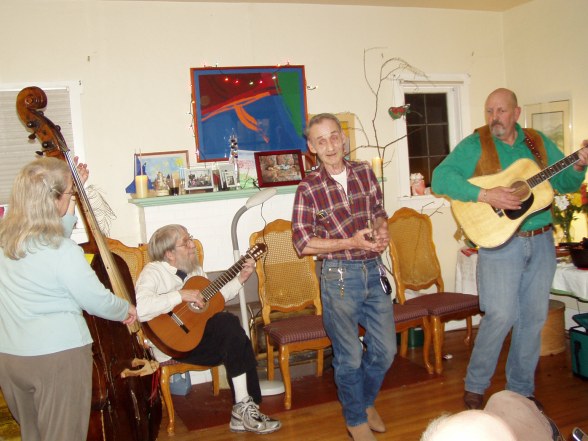
The picture is a music party at my house in 2009, my father seated and Andy Makie on harmonica, Jack Reid standing with the guitar.

Songs to raise girls: Billy Barlow

I knew the song “Billy Barlow” as “Let’s go hunting”. It was one of the silly songs that we recorded. I adored this song when I was little for two reasons. One was that it was funny. The other was that I interpreted it as a song that could be changed and sung about more than one animal. I can remember when I realized that no, the adults sang it the same way each time and they would not change the animal. I was disappointed but I still loved the song. And I could change the animal on my own.

It’s a good song to raise girls: an illustration of a group of guys….

Let’s go hunting, says Risky Rob
Let’s go hunting, says Robin to Bob
Let’s go hunting, says Dan’l and Joe
Let’s go hunting, says Billy Barlow

When my son was a teen, another parent commented that the IQ dropped in half for each teen added to a group. Two boys cut the IQ in half, three had it to one quarter and four was trouble.

What’ll we hunt for, says Risky Rob
What’ll we hunt for,
Let’s hunt rats, says Billy Barlow

How’ll we catch them,
Let’s borrow a shotgun, says Billy Barlow

How’ll we divide them,
How’ll we divide them, says Billy Barlow

I also loved this song because the last line changed. Sometimes Billy Barlow said the same thing and sometimes he said something different. When I was very small and still learning the song, that was part of the joy of it, to see what Billy Barlow would do. And clearly he was wicked, like Coyote or Pan or Loki and going to lead the group to trouble if he could….

I’ll take shoulders,
I’ll take sides,
I’ll take hams
Tailbone mine, says Billy Barlow

How’ll we cook them,

I’ll fry shoulders,
I’ll boil sides
I’ll bake hams,
Tailbone raw, says Billy Barlow

Oh, delicious ickiness, raw rat tailbone… It would give my sister and me shivers….

Let’s go hunting, says Risky Rob
Let’s go hunting, says Robin to Bob
Let’s go hunting, says Dan’l and Joe
Let’s stay home, says Billy Barlow

And relief. Billy was messing with them all the time and he doesn’t want to go and he never did, which is why he suggested a shotgun to hunt rats…. I like this Billy.

When I search on Billy Barlow, here is an entirely different song, a civil war marching song for Company B from New York City that marched into Maryland in 1863 and had a 63% loss. My sister had a civil war marching band play at her rehearsal dinner and we ended up marching in pea gravel for a couple hours. It turns out that my oldest cousin had ambitions to be a marching band drum leader. The band thought we were so funny that they offered to return. But the civil war fighters on both sides had marching bands with them. https://www.youtube.com/watch?v=M1ZlfsP7dZA

And here is Pete Seeger with our song, in a slightly different style: https://www.youtube.com/watch?v=FrgTOPufru4

And here is another site that says the song is a version of “The Cutty Wren” or “The Hunting of the Wren”. https://www.youtube.com/watch?v=P_oAPCVkMP0

The picture is my daughter. She was playing alone and was having a wonderful time with her imagination. I am not sure who took this picture…..

Songs to raise girls: Dark as a Dungeon

We sang Dark as a Dungeon as a family song and at singing parties from when my sister and I were very little. We learned many of the songs before we knew what the words meant. At some age I considered this a cautionary song and was glad that my father was not mining coal. I also decided that I didn’t want to mine coal.

It was written by Merle Travis, whose father was a miner in an Appalachian shaft mine: https://www.youtube.com/watch?v=-FPmSLzsbdM&list=RD-FPmSLzsbdM#t=1. Johnny Cash sang it: and Willie Nelson: https://www.youtube.com/watch?v=nKGCKwACj1I and Willie Nelson https://www.youtube.com/watch?v=s66nbyzqq8o. It became a protest song, to fight for safer conditions. We learned this and Drill ye Terriers, Drill and Sixteen Tons, so we were raised on protest songs.

The song words have morphed a little, since we sang from memory. Here is our version:

Come all ye young fellows so young and so fine
And seek not your fortune in the dark, dreary mines
It will form as a habit and seep in your soul
‘Til the stream of your blood runs as black as the coal

Where it’s dark as a dungeon and damp as the dew
Where the danger is double and the pleasures are few
Where the rain never falls and the sun never shines
It’s dark as a dungeon way down in the mines

I wrote an essay in college about a song that I learned from my mother. I researched versions of Green Grow the Rushes Oh. I had always wondered about some of the verses, because it’s a counting song, from one to 12. Twelve for the twelve apostles and eleven for the eleven that went up to heaven. In an atheist household it takes a while to figure out the meaning of apostle. But other verses are mysterious to this day: nine for the nine Bright Shiners and eight for the April Rainers. In oral traditions if you forget a verse you make up a new one.

There’s many a man that I have seen in my day
Who lived just to labor his whole life away
Like a fiend with his dope and a drunkard his wine
A man will have lust for the lure of the mine

The comparison of  mining to addiction impressed me: “it will creep in your soul, til the stream of your blood runs as dark as the coal”. “Like a fiend with his dope” — opiate addicts were called fiends. And people were called drunkards. So this song also made me cautious about both drugs and alcohol.

We didn’t learn the third verse:

The midnight, the morning, or the middle of the day
It’s the same to the miner who labors away
Where the demons of the death often come by surprise
One fall of the slate and you are buried alive

The last verse interested me. I liked the idea of bones turning to coal over time. My parents were atheists and did not go to church, but there were lots of songs that talked about God or heaven or the devil: including sacred music. We went to big chorus rehearsals when my parents couldn’t find a sitter and we were expected to behave politely during concerts: The Messiah. And we got to go to operettas. I saw Ruddigore in Ithaca at Cornell when I was 5 and the ancestral ghosts stepping out of their portraits and singing was terrible and wonderful.

I hope when I’m gone and the ages shall roll
My body will blacken and turn into coal
Then I’ll look out the door of my heavenly home
And I’ll pity the miners A-diggin’ my bones

The photo is my father’s family and he is in the back, first trumpet. This is the Bayers Family Orchestra. My great grandfather is conducting, my grandmother on violin and my grandfather on saxophone. They became a band when my grandparents moved away, because my grandmother was the only string player.

my love is so sweet

my love is so sweet
my heart sees him and skips a beat
my heart feels like it trips
how many beats do you think I’ll miss?

(all count the skips out loud)

you’ve got it really bad
it’s pathetic, you’re so sad
all day long I hear your sighs
guess how many times I roll my eyes

(all count the skips out loud)


The photo is mine from the 2015 Wooden Boat Festival

Solar panels in the mist

This is for Photrablogger’s Mundane Monday number 25.

I took this in 2005 at Lake Matinenda in Ontario. The solar panel raft charges a battery that in turn powers a pump to fill a hot tub on a cliff about 12 feet above the water. It is a box with a custom pond liner and a propane pool heater. The raft was deployed each summer.

This year the solar panels are moving to the roof of the cabin….. no more raft.

what I miss

what I miss after 8 years of divorce and 14 years of marriage is sleeping with a warm body not you but anyone after you fill the U-Haul and are surprised because you think that I am the packrat and all the stuff is mine but you have a piano and bicyles and a motorcycle and clothes and music and books and really you are one too, it’s just that I am worse and you drive away and I can’t sleep though really it did start before then we did over a year of couselling and I slept alone some and then kick you out and sleep alone more our daughter moves into the room across the hall up from the basement when you leave and in the middle of the night she comes up with me because you are gone to Colorado and now 6 years later she asks about it and I say you came in with me and she says she didn’t know that and would wonder why I would steal her in the middle of the night and I say I didn’t but as she is older and moves back two flights down to have that distance that one needs from a parent when one is in puberty and growing up and away and I wake at four am and now that same sex marriages are legal I wonder about buying an asian bride and then I would have a body a warm body to sleep with but it wouldn’t work and yes I miss sex too but not in the same way it’s the warm breath and heartbeat and movements and I am the monkey longing for a mother to cling to and I too make do with a pillow I could make a scarecrow for my bed a body not an inflatable too cold but something warm and I could put a watch in its chest an old one that ticked it doesn’t actually help to be in love because I am not sleeping with my love and that makes it all the worse I long for a warm body really no I long for my warm love this particular body and breath and heartbeat and I wake often longing for my warm love

the picture is my sister, who died in 2012 of breast cancer. I made her stuffed animals and puppets for years starting when we were little. I made the red eared puppet and bought her the puppet with legs that year….

Any day now

any day now

I will be going going to the lake to the rocks to the place I went to when I was five months and in the womb too

any day now

no electricity and the cell phones don’t work we filter the lake water now as the coliform count rises but still the water I taste it and memories rise like fish like turtles like lake trout from the depths my sister wants her ashes there but no worries there are bits of all our skin my uncles ashes were scattered there last time I went I burned a little of my hair my father’s hair my daughter’s hair my son’s hair so that our ashes would be there too

any day now

forwarded email as I’ve left the cousin email in protest of the emails about my father’s will circulating behind my back the propane delivery has closed down and we must go out of Blind River for propane the 100 pound tanks have to be carried upright which makes the rental car more of a challenge we used to get 60 pound tanks but they are harder to replace we are all always getting older

any day now

my cell used to work on one cabin porch when it was overcast but that was tmobile and I have another now so probably it won’t work and we are all still broken in the aftermath of my sister I will look in the cabin and donate all the shoes that none of us will every wear hers her daughter’s her husband’s that cabin is a castle a monument of dreams and I have not been there for three years and I hear the roof is going we don’t have enough money or cooperation I thought the Trust we fail at that by the way was 30 years but it is 40 and we are now half way and I am thinking about how to handle it

any day now

because I love this land this lake and I will not give it up oh Beloved help us heal

Fourthful of hearts

Ronovan’s weekly haiku challenge words five and thrive bring Walt Kelly’s poem to my mind:

Many Harry Returns

Once you were two,
Dear birthday friend,
In spite of purple weather.
But now you are three
And near the end
As we grewsome together.

How fourthful thou,
Forsooth for you,
For soon you will be more!
But – ‘fore
One can be three be two,
Before be five, be four!

My version is

Fourthful of hearts

thrive has six letters
five has four and six has three
words alive you see

The moths were in my garden one morning. They ignored my cat and me completely. They were busy. It appears that the moth supply will be replenished.

http://pnwmoths.biol.wwu.edu/browse/family-erebidae/subfamily-arctiinae/

Great Tiger Moth

PTSD and The Singing Tree

The Singing Tree by Kate Seredy, 1939, is a children’s book that illustrated PTSD for me long before I went to medical school. The Singing Tree is the sequel to The Good Master, and describes the survival of a Hungarian family and farm during World War I.

The good master is Marton Nagy, and he is called up as a Corporal, leaving the farm to be cared for by his wife, son, niece and workers. The farm suffers because so many men are called up. They are getting behind on the work and then find a diary from Marton, which gives suggestions and instructions for the year round work on the farm. One of the instructions is “to make out an application for Russian prisoners if necessary.”

They do. They apply and take 6 Russian prisoners, homesick farmers, who don’t speak Hungarian. Jansi and his cousin Kate take the chains off them and the prisoners quickly become part of the family. “Comrade, eh? Friend?” says one of the prisoners. And they are. They are also excellent workers and homesick.

As the prisoners are taken home in the wagon, they also take Peter, a deserter from the Hungarian army. He has panicked about his wife and new baby. He is crazy with worry. He is hidden under the six Russians, who sympathize. After seeing the baby he returns to his regiment. But Peter is angry and expresses his rage at Jews, even though it is Uncle Moses, the Jewish shopkeeper, who has helped hide him.

    Mother took Jancsi’s arm then and they left he room. They didn’t speak; what was there to say? Something, somebody had poisoned Peter’s soul against those who had been good to him all his life. Into Jancsi’s mind flashed the words Father had said: “The stampede… the mad whirlwind that sucks in men…and spits out crippled wrecks.” Crippled in body and soul, Jansci thought then, with an understanding far beyond his years.
    “Poor Peter,” he said aloud. Mother pressed his arm. “I knew you would see it that way, Son. I only hope the war ends before this poison has spread too far.” p 163.

Marton is missing and they have not heard from him. Jansci and Kate make the wagon trek to bring back their grandparents, because the front is now too close for them to be safe. Kate and Lily smuggle the cat along. The cat gets “sick” and the girls insist at stopping at a hospital. The sickness is kittens. The nurses laugh at the girls, but then let them help on the wards. Injured soldiers who are healing.

    “Almost an hour passed before all the patients had been fed. “There was only one asleep,” Lily said, coming back with the empty bowls; “he even had the sheet pulled over his face.” The nurse followed Lily’s pointing finger with her eyes. “Oh, the amnesia case. He sleeps most of the time.”

    “Whats am-amnesia?” Kate wanted to know.

    “Loss of memory. They forget who they are and have to begin life all over again; like babies.” “Does it hurt?”
    “No,” smiled the nurse. “It comes from a shock; like a big scare, you know.” She looked toward the bed again. “He is such a nice man too, poor fellow. He tries so hard to remember. if we could find out who he is, find something to remind of his home, he might remember. You wan tto see him?” she asked as Kate kept staring at the bed. “Come on then, but be quiet.”
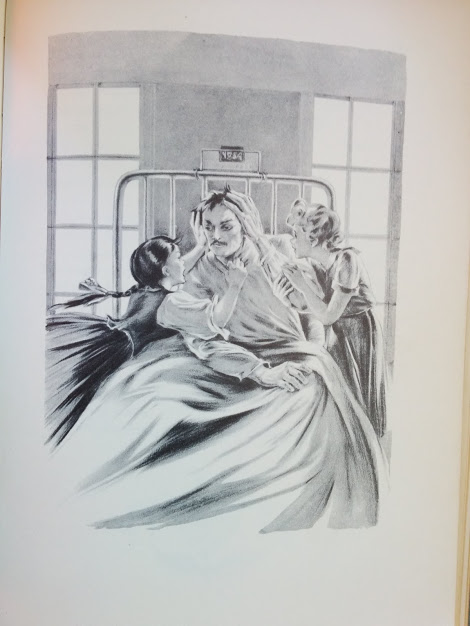
    “No. 54, Amnesia,” was written on the headboard. The nurse gently lifted the sheet. Pandemonium broke loose immediately. Kate, with her famous tin-whistle scream gong at full blast, threw herself on the bed. “UNCLE MARTON! UNCLE MAAARTON! IT’S KATE. Can’t you….? UNCLE MARTO-O-O-ON!”

    Every patient was sitting bolt upright. Doctors and nurses were running in, Lily joined Kate, tugging at Uncle Marton’s hands. “Say something…you know us, don’t you? Say something.”

    “Kate, if you don’t stop that infamous yelling this minute, I’ll take Milky away from…Say! Where am I? Who are these people?” Uncle Marton was looking around dazedly.

    “Never mind them,” sobbed Kate, laughing at the same time. “You know who you are now, don’t you?”

    “Why shouldn’t I? Let me out of this bed!” Uncle Marton cried, trying to peel Kate and Lily off his chest.
    “Take it easy, take it easy,” said a doctor who stepped up. “What is your name?” “Lieutenant Marton Nagy of the Seventh Infantry,” snapped Uncle Marton, glaring at him. “Seventh Infantry… Seventh…oh…”His eyes clouded.
    “Now it all comes back, doesn’t it? You’ll be all right now, Lieutenant Nagy. Don’t think about that now. Tell me who this…this calliope is. That scream was the best I ever heard.” The doctor sat down on the bed, smiling at Kate. “I wish we could produce for each amnesia case we get; we wouldn’t have any.” pp 186-189

He gets to go home.

    “From Corporal to Lieutenant in a year. Pretty good, Lieutenant Nagy,” an officer with a lot of gold braid all over him said to Father. “And a handful of medals to catch up with you, as I heard. What did you do?”
    Father looked him straight in the eye. The muscles in his jaws were working. “I don’t know sir. I would rather not try to remember.”

    The officer sighed. “Go home, Lieutenant. Forget, if you can. I wish I could.”

And will he have to return?

    “Then Father went to report to the hospital and this time Mother and Jansci went with him. The doctors found that in body he was sound, but only time, long months or even years, could make him forget the things he never spoke about.
    “There are none braver than he is,” the doctor told Mother, “but the human mind can stand just so much of horror and no more. We dare not tke the risk of sending him back to war.”
    “Thank God!” Mother had exclaimed, and the doctor smiled very sadly.
    “I hear that every day now. Wives, mothers thanking the Lord for an injury their beloved ones have received. A broken bone, a brave mind darkened with nameless fear, anything that takes a long time to heal, has become a blessing, a gift. They are safe for a little while longer.”

And Jansci talks to one of the Russian prisoners.

    “Big boss come home…maybe war over?” Grigori wanted to know when they had come with Father. Jansci tried to explain and he thought that Grigori didn’t understand because for a long while he didn’t say anything. Then he sighed: “Grigori know. Hear, Jansci. Bad man, stupid man, he go kill and laugh. Good man, man with good heart, good head, no can kill and laugh. He cry inside. Baby cry with big noise. Man cry–no noise, but it hurt very bad. Me know….me know.” p. 203

Death affects the village.

    “More white envelopes were coming to the village now than ever since the war started. The hands of Uncle Moses began to tremble and he seemed to grow smaller, more bent. Aunt Sarah was like a silent little wraith, going from house to house to comfort, to help, or just sit, holding the hand of a woman who would never wait for the mail again because there was no one left to writ to her. Often she and priest met in one of the houses and the priest would bow deeply to her Once he told Father: “She seems to give more comfort, more strength to these poor women than I can.” pp 203-204

I wish that we had the sense expressed in this book about PTSD and the effects of war. When I worked at Madigan Army Hospital, some soldiers were getting ready for their fourth or fifth tour of duty. If we as a country are going to continue these wars, we must take more responsibility and have more care for the damage done. When people talk about “curing” PTSD or keeping it from happening: if we didn’t respond with PTSD as a species with horror for the evils of war, we don’t deserve to survive. We will be the Bad People, the Stupid People, who Kill and Laugh. We need to stop. This book was written in 1939 and clearly they knew the effects of PTSD. It’s been almost 80 years since Kate Seredy’s book was published: and still we question PTSD?

http://www.pdhealth.mil/clinicians/assessment_tools.asp
Civilians too: http://www.mirecc.va.gov/docs/visn6/3_PTSD_CheckList_and_Scoring.pdf

illustration from p. 187