Long Covid and post pneumonia update

I was up above 5000 feet last week and did not need oxygen.

This is wonderful! I was on oxygen continuously from March of 2021 for a year and a half. I was really getting better and then had my Covid booster in early October. I crashed again. Do I regret the shot? No, because the crash is because antibodies went back up. Only some of them, though. My muscles and lungs were not working well again, but brain was fine (ok, some people do not like my brain, but they are idiots) and aside from having to avoid gluten, no digestive stuff.

About a month ago I really started feeling my fast twitch muscles work again. It was two years in March since this fourth pneumonia and I’ve had something Long Covid like after each one. Recovery took 2 months in 2003, 2 months in 2012 and 6 months off in 2014 and then an ongoing mild chronic fatigue, so I worked about half of a regular family medicine schedule. I saw 7-10 people per day instead of 16-22. I was also a single parent running a business with two children, so that has a lot of energy draw as well.

On the second morning there, my pulse was 61 and oxygen level 98% on room air. HOORAY! I am back to baseline from 2014. Since it took 2 years to recover, I really do not want to do this again. No more pneumonia. I have had two more rounds of Covid, but apparently the super high antibody level made it really really mild. An immunologist tested the antibodies since I keep getting pneumonia. He said I have the highest Covid antibody level he’s ever seen. Protective was over 50 and mine was 25,000. I seem to be darn good at making antibodies.

Now what? I have felt better for the last month. I still get tired and have about a half day of the energy level from my 20s or 30s, which was high. I am hiking, up to 6 miles in a day twice two weeks ago. Now to start biking and maybe running. I don’t like to run but it’s good training. I want to ski next winter at least one day. Maybe I will swim too. I used to swim a mile twice a week, but it’s been a long time. Also my swim team daughter expressed scorn for my freestyle stroke. Sigh, children are born to humble us, which sucks.

I am still trying to see if I can work with Long Covid patients. I have rather too much experience with something very like it. But I think I would like to enjoy feeling well for a month or two, first!

Hooray! I hope other Long Covid folks are working their way out of the woods too.

Roof tiles

The roof tiles are imbricated. This is from my travels in March 2022. What do you call a female gargoyle?

Maybe it’s better not to call one.

I also have assisted at imbrication in the operating room. I did obstetrics as part of Family Medicine for 19 years. During a cesarean section, we do a double layer of stitches on the uterus, imbricating it. Enough said.

For the Ragtag Daily Prompt: imbricate.

Xeno or infection phobic?

So is Xenophobia a pathological fear of strangers or foreigners? Like agoraphobia or arachnophobia? The Mayo Clinic site has a listing for agoraphobia but not for arachnophobia or xenophobia. Perhaps agoraphobia is more disabling. Though with our world having more and more people, xenophobia might be terribly dangerous as well.

Current world population: https://www.worldometers.info/world-population/.

Number of people with Long Covid: at least 65,000,000, though the talk I attended yesterday say that’s a low estimate. Nearly one percent of the world population.

This article in Nature: https://www.nature.com/articles/s41579-022-00846-2 is about Long Covid, the research to date and the areas that need research. This is a very fast moving target with information exploding from multiple labs.

I attended an on line continuing medical education about Long Covid yesterday: https://hsc.unm.edu/echo/partner-portal/echos-initiatives/long-covid-fatiguing-illness-recovery/. This is a global monthly teaching session about Long Covid and current research and diagnosis and treatment. Yesterday’s talk was about immune cell abnormalities that persist and evidence is showing up that they are causing some of the problems. However, as one researcher said, the problems are multifactorial and any system in the body can be affected in more than one way.

Essentially some of the immune cells are puffy, sticky and enlarged. The suspicion is that the postexertional malaise is related to these puffy sticky cells. During exercise, or for some people normal activity, the muscles need more blood flow and more oxygen. The puffy sticky cells are stiff and won’t slide through capillaries easily. The muscles send a panic “I need oxygen!” message to the brain and the muscles do not work. The recovery can take a day or two days because of the food/oxygen deprivation. The researcher said that the same mechanism is suspected in ME-CFS (myalgic encephalopathy-chronic fatigue syndrome).

My muscles are feeling normal. My chronic fatigue is comparatively mild and happens with bad infections or with a vaccine that raises antibody levels, as it is supposed to. That’s how immunizations work. Do I have antibodies that shut down my muscles or do I have puffy cells? I would postulate the former but I can’t be sure right now. My home science kit is not quite up to that study.

When my fast twitch muscles are not working, are affected, it is very weird. They DO NOT WORK RIGHT. It is hard to describe: it is sort of pain, but it’s more of a very very strong STOP EXERCISING NOW message. And then I am exhausted for 1-2 days. In contrast, my muscles are a bit sore after a four mile beach walk 2 days ago and then an intense physical therapy session, but I am not exhausted. No naps the last two days. I have returned to my normal sleep patterns, less hours.

One of the researchers presented new technology that can make a movie of the microscopic cells going though a space with a narrowing like a capillary. Video electron microscopy. They are describing the cell shapes and whether they go through a capillary diameter normally or stick, for people with no Covid, diabetics, acute Covid and Long Covid. All are different. It is fascinating new technology.

I think I am more infection phobic than xenophobic. People all have the same basic blood cells inside, even with lots of different genetic patterns. So far infection phobia has not led me to agoraphobia, but the talk yesterday sure makes me want to keep my mask on.

There were over 350 attendees yesterday from all over the world. Lay people can sign up as well and the videos are stored for anyone to watch. I will watch yesterday’s a second time because five different scientists presented in 30 minutes and I ignored the chat which was going full speed with references to look up. Homework. And progress is being made.

Blessings.

______________

For the Ragtag Daily Prompt: xenophobia.

______________

I took the photograph two days ago from East Beach on Marrowstone Island. The distance between the sea lions and the container ship is much further than it appears, and this is taken with a Canon PowerShot SX40HS zoomed most of the way out.

You will be labeled

If you get sick
with something the doctors don’t understand
you will be labeled
unstable
mental
bipolar
crazy.

They will try to drug you.

How do you tell
when they are right
and you are crazy
brain on fire
and when you aren’t?

Don’t ask me.
I’m a Family Practice doc
and I’m rural
and I’m a girl.

I’m the one they make fun of
in the medical schools.
“The rural doctor
transferred this patient.”

Yes we did.
Because we knew it was something
different
that needed more
than we had
in our small town
in our small hospital.

Once a neurosurgeon says,
“You are transferring the patient
because it’s Friday
and you don’t want to work
on the weekend.”
“She needs an MRI,” I say
“and we don’t have one.”
and transfer her anyway.
I call two days later.
After the MRI, she is in
the operating room
for a tumor in her spine.
He doesn’t call me back
but I hope he remembers.
I certainly do, after years
and years.

If you get sick
with something the doctors don’t understand
you will be labeled
unstable
mental
bipolar
crazy.

Love sorrow

Love sorrow

There are a lot of people that I love

that don’t love me. The family that

believed my sister’s stories, about me,

my father, and her daughter’s father.

My sister died ten years ago.

I wait a decade, trying to repair it,

and now I give up. I do not want to

see them again, any of them, though

I still send them love. They may not

have my presence, after a decade of

cruelty or indifference.

Work, too. I am labeled malingerer

twenty years ago, after influenza.

“I don’t understand how you could be

out for two months from flu. I could understand

a heart attack or cancer, but not flu.”

Do you understand it now? I had

Long Covid before Long Covid existed,

after pneumonias: influenza, strep A

strep A and then Covid. Each time it

takes longer to recover. After the third round

and a year, I know that I have chronic fatigue.

I don’t bother my doctor as I am a doctor

and I know we have no cure. I can work

half time, see half the number that we are

supposed to see daily. I work anyhow.

The money ends almost meet. After a decade,

Covid closes me down. I go to work for The Man,

suspecting I’ll get pneumonia. I walk in rooms

to patients with their masks off. I react

with PTSD each time but take care of them

anyway. It only takes five weeks to get

Covid. I am on oxygen for a year and a half,

chronic fatigue magnified. How did I not get

it in my clinic? I masked everyone with a cough

or cold from 2014 on. My patients were USED

to masks and I masked too.

I am on oxygen and suddenly the doctors

who thought I lied, are pleasant and stop to

talk to me, while I think cynically, you’ve

disbelieved me and spread rumors about me

for 20 years. Do you think I forgive you now?

And one who said he’d be my friend forever

no matter what. And also said that when people

go over his invisible line, he never speaks

to them again. I think, oh, that will be me,

this is a set up. It is. But Beloved, Universe,

Earth, Sun, and Moon

why do I love them all anyway?

______________________

For the Ragtag Daily Prompt stable, because maybe love is the only stable thing in an unstable world.

The bones of the great blue heron are so light, that I think it is standing on the floating kelp beds. I’d wish my bones were that light, but that would be osteoporosis. Maybe I could come back as a heron.

Perchance to dream

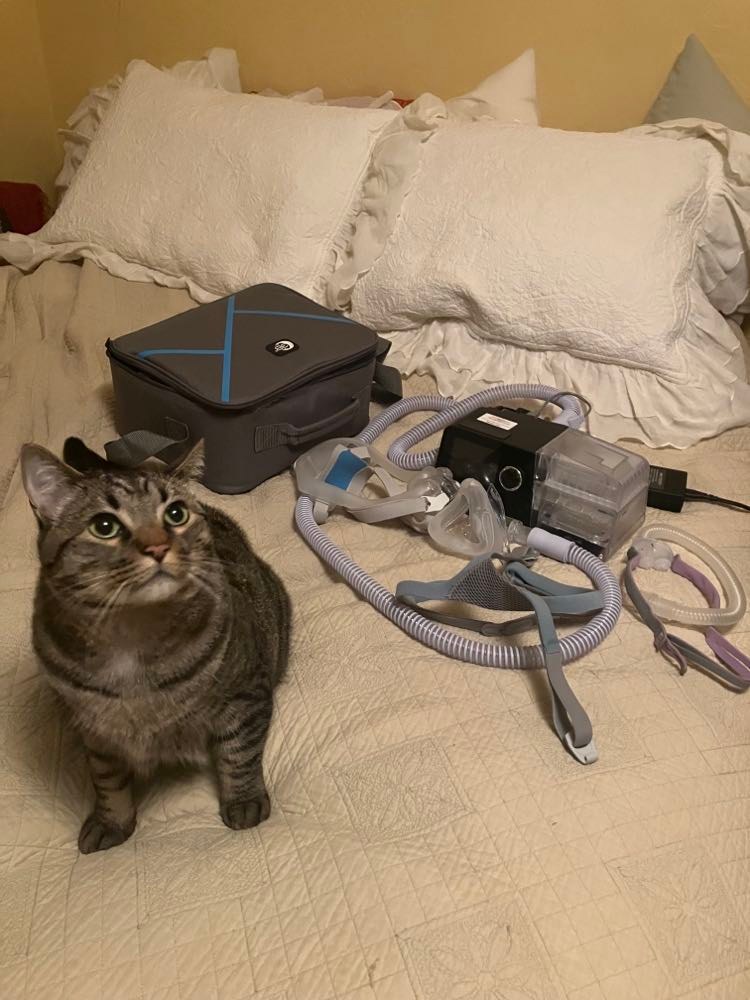
I have been dreaming regularly since mid-January, nightmares. The cause is my sleep apnea machine. I got it in December, but two days before I flew east to my son’s for Christmas. I did not take it with me. I delayed getting back for nine days to visit an ill friend in Michigan and help out. On January 11, I took the class on how to use the machine.

My initial “mask” was the “nasal pillow” one. I go to sleep by slowing my breathing and using the Zen Buddhist and Jon Kabat Zinn’s body scan to relax. However, if I slow my breathing, the CPAP will start to blow pressure when my breath out drops below a certain volume. Then I was breathing against pressure and it woke me up. Also I would sometimes open my mouth, which lets the air out and the machine instantly increases pressure and is much noisier.

I got another mask within ten days. This is a face mask. It did not have one strap around the head, but four. The hose is attached to the top of the head. The main pressure point is where the four straps meet right at the back of the skull.

The dreams started. Nightmares every single night. About being trapped and trying to escape. An octopus grabbing me by the skull. One dream about trying to rescue a man from a building that was under attack or going to blow up and he kept saying, “But I’m not READY. I have to PACK.” I’m arguing, “You can get more stuff! We have to go! We’ll get killed if we stay! Come on, I am here to rescue you.” He keeps looking for his stuff because he can’t believe that a 5 foot 4 female could actually be a heroine and there to rescue me. Dumb male. I wake up and laugh. Even men in my dreams have little respect for me. That is a pretty sad illustration of my lifetime experience with the other gender.

Anyhow, to have the insurance pay for the stupid sleep apnea machine, I needed 21 out of 30 days with more than 4 hours on the machine. And I have to do this within 3 months of getting the machine. I got it in December, remember? So I was motivated and hella grumpy with it. At least twice a night I would wake up from a nightmare and rip the darn thing off my head. The cats do not like it when it hisses.

I took to using it during naps too. Since I was NOT sleeping well on it, I was sleeping longer. Nine or ten hours a night, at least three or four OFF the machine. Pretty pathetic.

Last week I had my visit where I am blessed and the insurance will now pay for the machine. I begged a little to talk to the mask guy. They said no at first and then yes. He gave me another octopus headdress. This one also goes around the back of the skull, but the hose is hanging from the front. That means the weight is more in front.

It still took three or four days before I got to four hours on the new one. It works better and I am not dreaming about escape rooms twice a night. Phew!

The interview to have the machine paid for was pretty amusing. The insurance wants me to say I am sleeping better to qualify for the machine. I answered that I was sleeping longer. There are a bunch of questions. Mostly I could be positive except for the “are you waking up less?” “No, more.” “More? Why?” “Because the octopus has me by the head or I am dreaming I am trapped.” I had the nurse laughing at my answers, but I still qualified.

Anyhow, if I can invent a different mask that doesn’t feel like an octopus, I could probably be a gadzillionaire. I think I will look at some bondage stores, seems like they have various masks that could be adapted. Then they could do double duty and I will be a double gadzillionaire!

_______________________

For the Ragtag Daily Prompt: dreams.

Keep it simple

Sometimes I just despair as I read new guidelines. Don’t you? Maybe you are not a physician and don’t try to keep all of this impossible stuff in your head. Mine is full. Tilt.

Diabetes alone: if someone has type II diabetes, there are specific blood pressure guidelines, cholesterol guidelines, we are to do a hgbA1C lab test every six months minimum and more often if they are out of control, and a urine microalbumin/creatinine ratio yearly. If that starts being abnormal we are to start one of two classes of blood pressure medicines even if they have normal blood pressure.

Oh, and don’t forget: a yearly eye test and we are supposed to check their feet at EVERY visit to make sure they are not getting diabetic ulcers.

Got that? And that is just type II diabetes. And there are a whole raft of medicines, about forty right now. Some are weekly shots, some are daily tablets, some are twice a day or with every meal and they all have their own side effects, how fun. Check drug interactions, are their kidneys ok? Is their liver ok? Diabetes increases the risk of heart attack and stroke and don’t forget those feet.

Diabetes is one of the most complicated sets of guidelines, but there are a rather appalling number of guidelines. Maybe we should sic an AI on that job: Mr. Smith has type II diabetes poorly controlled, hypertension, erectile dysfunction, feels a little short of breath and has a bruise on his left shin after tripping yesterday. Please, AI, organize a twenty minute visit to cover as many things as possible efficiently and have the note finished and followup arranged by the end of it. Then it turns out that what Mr. Smith really wants to talk about is his niece who has just overdosed and nearly died from heroin, so everything else goes out the window. Maybe I should see him weekly for the next month.

Do you want to keep it simple and stay out of the doctor’s office and more importantly out of the hospital? If you are 25 and healthy, you don’t much care because old is unimaginable.

But there is a very nice study that looked at just five things regarding health, over 28 years for men and 34 for women: “The researchers looked at NHS and HPFS data on diet, physical activity, body weight, smoking, and alcohol consumption that had been collected from regularly administered, validated questionnaires.”

Here is an article about the study: https://www.health.harvard.edu/blog/healthy-lifestyle-5-keys-to-a-longer-life-2018070514186

Here is the study: https://www.ahajournals.org/doi/10.1161/CIRCULATIONAHA.117.032047

So let’s break the five things down. Here are the more formal definitions: “Using data from the Nurses’ Health Study (1980–2014; n=78 865) and the Health Professionals Follow-up Study (1986–2014, n=44 354), we defined 5 low-risk lifestyle factors as never smoking, body mass index of 18.5 to 24.9 kg/m2, β‰₯30 min/d of moderate to vigorous physical activity, moderate alcohol intake, and a high diet quality score (upper 40%), and estimated hazard ratios for the association of total lifestyle score (0–5 scale) with mortality.”

First: never smoking. I would add never vaping and not living in a cave and burning wood and hopefully not living right next to a 12 lane superhighway, all of which are bad for the lungs. Ok, while we are at it, don’t use methamphetamines or heroin or cocaine or krocodil, right? They didn’t even include those in the study.

Second: Body mass index 18.5-25. If you aren’t there, it is diet and exercise that need to change.

Third: Thirty minutes or more per day of moderate to vigorous physical activity. That can be ten minute intervals. Three can have an enormous effect on number two.

Fourth: moderate alcohol intake. Ok, alcohol is bad for the heart, period. So is tobacco. They defined moderate as less than or equal to “5 to 15 g/d for women and 5 to 30 g/d for men”. Let’s do the math: a 12 ounce beer that is 5% has 14gm of alcohol. Here: https://www.niaaa.nih.gov/alcohols-effects-health/overview-alcohol-consumption/what-standard-drink. The 8.9% 16 ounce beer at our local pub has quite a bit more. Here is a website where you can calculate how much alcohol is in a drink: https://www.rethinkingdrinking.niaaa.nih.gov/Tools/Calculators/Cocktail-Calculator.aspx.

Fifth: Diet. There is an overwhelming amount of confusing information on the internet and some of it is not only confusing but wrong. “Diet quality in the NHS, HPFS, and NHANES was assessed with the Alternate Healthy Eating Index score (Methods in the online-only Data Supplement), which is strongly associated with the onset of cardiometabolic disease in the general population.” I have not assessed my own Alternate Healthy Eating Index score. However, there are a couple very straightforward things that help with diet. First: No sweetened drinks. That means that sugary coffee with the syrup should go. I quit drinking mochas when I read that a 12 ounce one has 62 grams of carbohydrate. I would rather have a small dark chocolate. And sodas are just evil and juice not much better. Eat the fruit instead. Second: eat vegetables, every meal. A fruit is not a vegetable and no, potato chips don’t count. I mean a green or yellow or red vegetable. You can saute any vegetable, or any that I can think of. I am not counting grains as a vegetable, so pasta, pizza, potato chips and so forth do not count. Beans do count. Third: the DASH diet recommends only a tablespoon of sweetener per day. That is not very much. You can make that cheesecake slice last a week! A small piece of dark chocolate daily or tablespoon size chunk of that cheesecake.

I had a diabetic patient who would be fine, fine, fine, then out of control. “WHAT are you eating? And drinking?” The first time it was two 16 ounce Mochas a day. Then he was fine for a year and a half. Then labs went haywire again. “What are you drinking?” “Well,” he said, not wanting to admit it, “Ok, I decided to try Caramel Machiattos.” “No, no, no! You can’t do that! You’ll end up on insulin!” “Ok, ok, got it, got it.”

And what is the difference if I try to do those five things, you ask, skeptical. “We estimated that the life expectancy at age 50 years was 29.0 years (95% CI, 28.3–29.8) for women and 25.5 years (95% CI, 24.7–26.2) for men who adopted zero low-risk lifestyle factors. In contrast, for those who adopted all 5 low-risk factors, we projected a life expectancy at age 50 years of 43.1 years (95% CI, 41.3–44.9) for women and 37.6 years (95% CI, 35.8–39.4) for men.The projected life expectancy at age 50 years was on average 14.0 years (95% CI, 11.8–16.2) longer among female Americans with 5 low-risk factors compared with those with zero low-risk factors; for men, the difference was 12.2 years (95% CI, 10.1–14.2).”

____________________

I took the photograph from Marrowstone Island. What does a healthy seal diet look like? I am so lucky to have miles of beach to hike, as long as I watch the tides and don’t mind rain.

Shame and anger in overuse illnesses

“amongst those who treat addicts of any kind generally agree that anger and shame help no one and is actively counter-productive.”*

Wait.

I have to think about that statement.

I do not agree at all.

Ok, for the physician/ARNP/PAC, anger at the patient and shaming the patient are not good practice, don’t work, and could make them worse. BUT anger and shame come up.

In many patients.

Sometimes it goes like this with opioid overuse: the person shows up, gets on buprenorphine, and is clean.

It may be a long time since they have been “clean”.

One young man wants to know WHY I am treating him as an opioid overuse patient. “Why are you treating me like an addict?”

I try to be patient. I recommended that he go inpatient, because I don’t think we will cut through the denial outpatient. Very high risk of relapse. “You have been buying oxycodone on the street for more than ten years.”

“I’ve been buying it for back pain, not to party.”

“Did you ever see a doctor about the back pain?”

“Well, no.”

“Buying it illegally is one of the criteria of opiate overuse.”

“But I’m not an addict! I’ve never tried heroin! I have never used needles!”

“We can go through the criteria again.”

He shakes his head.

He is in denial. He is fine. He doesn’t need inpatient. He is super confident, gets work again, is super proud.

And then angry. “My family still won’t talk to me!”

“Um, yes.”

“I’m clean. I’m going to the stupid AA/NA groups! Though I don’t need to. I’m fine!”

“What have you noticed at the groups?”

“What a bunch of liars!” he says, angry. “There are people court ordered there and they are still using! I can tell. They are lying through their teeth!”

“Obvious, huh?”

“Yeah!”

“Did you ever lie while you were taking the oxycodone?”

Now he ducks his head and looks down. “Well, maybe. A little.”

“Do you think your family and friends could tell?”

He glances up at me and away. “Maybe.”

“Your family may be angry and may have trouble trusting you for a while.”

“But I’ve been clean for four months!”

“How many years did you tell untruths?”

“Well.”

Shame and anger. Anger from the family and old friends, who have heard the story before, who are not inclined to trust, who are hurt and sad. The first hurdle is getting clean, but that is only the first one. Repairing relationships takes time and some people may refuse and they have that right! Sometimes patients are shocked that now that they are clean, a relationship can’t be repaired. Or that it may take years to repair. My overuse folks are not exactly used to being patient. And sometimes as they realize how upset the family and friends are, they are very ashamed. And some are very sad, at years lost, and friendships, and loved ones. I have had at least one person disappear, to relapse, after describing introducing someone else to heroin. He died about two years later, in his forties.

Shame and anger definitely come up in overuse illness.

The above is not a single patient, but cobbled together from more than one.

______________________

*from an essay titled “F—ing yes, I’m a fatphobe” on everything2.com. Today there are two with that title. The quotation is from the second essay.

If it don’t fit, don’t force it

Templates in primary care medicine suck.

Why? The problem with templates in primary care medicine is they focus on getting a specific list of questions answered for something like ear pain or back pain. They miss the weird stuff. They miss the outliers.

I hated the templates when we got our first electronic record in the early 2000s. The doctors who liked computers spent a year picking the system. Then they trained all the clinics for one week and we all went live. One of the biggest problems was that they liked computers and talked the language. We didn’t. We quit asking questions within a week, because when we asked a question it 1. Was a user problem and 2. They treated us like we were stupid and 3. They answered in Geek, which we did not understand.

We quit asking questions. The nurses and I all filed for workman’s comp because our shoulders locked up. Our shoulders hurt. We figured out how to get the stupid thing to work. Every doctor and nurse and PAC and nurse practitioner worked to figure it out on our own.

Two years later, they set up some standards for use. We resisted again, because they gave us orders in Geek and anyhow, we had no respect for them and we didn’t care. Change what we were doing? After no support for two years? Good luck!

It took me two years and three months to get the system to write what I considered a good clinic note. I had contacted an outside specialist three months in and asked how our notes were.

“You want me to be honest?” he said.

“Yes.”

“They suck. They are useless.”

“That’s what I thought.” I went on fighting the system and hating it. I won, eventually. Parts of my note continued to suck, but I figured out how to work around the stupid templates and put in some REAL information.

Now wait, you say, is the template totally useless?

In some situations, like emergency rooms, it may be very useful. It helps keep a harried ER team with four people from a car wreck from missing something. And if you are an ENT, otolaryngologist, you do see a lot of ear and mouth and throat things, so templates may help. But I think they are terrible for primary care.

They are good for billing, though. If you have all the boxes checked, the insurance company pays, and you can move on to the next victim. The insurance companies pay more if you see more people in a day. That is why our administration said, “See people for one thing per visit.”

However, that is not ethical. Say it is a 70 year old diabetic with atrial fibrillation on coumadin with a bladder infection. You cannot just say bladder infection and slap them on sulfa. For one thing sulfa screws up the coumadin and puts them at risk for bleeding. For a second, diabetes can affect kidney function and so can age and you have to adjust antibiotic dose for lower kidney function. For a third, if their glucose levels are out of control, the infection may not be controlled by an antibiotic. It’s not one thing. And the average patient has 4 chronic disorders in a study way back in the early 2000s. That means some people have none, some people have eight or more and most people have 3-5. Hypertension, diabetes, toe fungus, chronic shoulder pain, heart disease, the list goes on and on.

In any visit, I am alert for the things the DON’T fit. One time I am doing a new patient visit for back pain and note that she is hoarse. I bug her about the hoarseness. She admits it is continuous and has been there for two months. I do two referrals, because continuous hoarseness can be laryngeal cancer.

When she returns, she thanks me. She has vocal cord polyps, not cancer, but needs laser surgery. “You didn’t have to do that but you did.” she says. And do I feel good about not ignoring it? The visit went over time, but I’d rather go over time than miss laryngeal cancer, right?

We were taught to let the patient talk. Open ended questions. They’ve done studies that doctors cut people off from telling their stories very very quickly. If you let people talk, sometimes they say something that doesn’t fit the template, and we have to pay attention. Sometimes a comment or a couple comments are the clue, the key, the thing that doesn’t fit. Don’t force it into the template. Pay attention instead.

_______________________

The very serious group of people is a county medical meeting, 2014.

Diagnostic quest

Some diagnoses take months or even years. How can that be?

A patient comes to me with right shoulder pain. His pain is “out of proportion to the exam”. His shoulder exam does not fit with a rotator cuff tear, he has good range of motion, it is weird. I hospitalize him and ask orthopedics to see him.

The orthopedic surgeon agrees with me. It is not a musculoskeletal shoulder problem. We do xrays and labs. We do a chest xray as well as a shoulder xray because on the right side of the body, the recurrent laryngeal nerve goes down to the diaphragm and then returns to the shoulder and neck. So sometimes shoulder pain on the right is referred pain from a problem or tumor or pneumonia at the base of the lung.

His chest xray is normal.

We are having trouble controlling his pain even with morphine.

I call the general surgeon. My patient has some small lymph nodes in his supraclavicular spaces. We actually have lymph nodes all over, but many are hidden deep in muscles or under bone. We can feel them in the neck, the supraclavicular space, under each arm and in the groin.

The surgeon says there isn’t anything large enough to biopsy.

I call the oncologist in the next county. We are too small a rural hospital and do not have an oncologist at that time. I say, “I think he has cancer, but I can’t find it.” The oncologist listens to the story. He agrees. We do a chest and abdominal CT scan and some blood tests. The patient has had his colonoscopy. Nothing.

I send the patient to the oncologist’s bigger hospital. They can do some tests that I can’t. A bone scan and a PET scan.

The oncologist calls me. “I think you are right, but we can’t find it yet. Send him back when there is something to test.”

My patient goes home with pain medicine.

He then calls me every week or two. “It still hurts,” he says. “Please come in and let me do another exam,” I say. “No,” he says and hangs up. I am a Family Practice physician so his partner is also my patient. She comes in and rolls her eyes. “He complains, but he won’t come in!”

At last he shows up in the emergency room and now he has enlarged supraclavicular lymph nodes. The general surgeon biopsies them. It is an undifferentiated carcinoma. That means we don’t know where it is from. We don’t know the primary.

The oncologist says, “Send him down, so we can do the tests again.”

The patient is at home and refuses.

I call the oncologist back. “He’s refusing.”

“Oh.” says the oncologist. “Well, we can treat it with chemo blindly. We can try to figure out the primary and treat it more exactly. Or he can choose hospice.”

Ok, yes, three choices. I call and leave a message to go over the choices with him.

He comes up with a fourth choice: he refuses to talk to me at all.

I call his partner. “Yes,” she says, “He’s grumpy.”

“We are happy to help with whatever choice he makes.” I say.

“I’ll tell him.”

He continues to refuse to talk to me or the oncologist. Eventually he goes back to the emergency room and goes to hospice at the local nursing home.

I tell the oncologist. He comforts me. “Yes, sometimes we are pretty sure there is a cancer, but it has to get big enough to find.”

I am not comfortable with that but medicine is way more complex and messier than people realize. Sometimes it is really nice to have a patient with something where I know what it is AND it can be treated. Appendicitis. Gallstones. Strep throat.

But sometimes it is complicated and can take months or even years. Stay present and keep checking in.

Diagnostic quest.

_____________________

The boat is returning to the water after work in our boatyard. Healed and seaworthy.

For the Ragtag Daily Prompt: quest.