What to check before bringing your elder home from the hospital

I get a call from the hospital (this is over a year ago). They say, “Your friend is ready for discharge. What time can you pick her up?”

I reply, “Can she walk?”

“What?”

“She has three steps up into her house. Can she walk, because otherwise I can’t get her into her home.”

“Oh, uh, we will check.”

They call me back. “She can’t walk. She’ll have to stay another day.”

I knew that she couldn’t walk before they called. She could barely walk before the surgery and after anesthesia, surgery and a night in the hospital, her walking was worse. She had been falling 1-5 times at home and the surgeon knew that. He did not take it into account. The staff would have delivered her to my car in a wheelchair and then it would have been my problem.

She was confused by that afternoon, which is not uncommon in older people after anesthesia. She stayed in the hospital for six days and then went to rehab, because she still couldn’t walk safely.

Recently I have a patient, an elder, that I send to the emergency room for possible admission. He is admitted and discharged after two and a half days. Unfortunately he can barely walk and his wife is sick as well. The medicare rules say that he needs 72 hours in the hospital before he qualifies for rehab. We scramble in clinic to get them Home Health services, with a nurse check and physical therapy and occupational therapy, and I ask for Meals on Wheels. It turns out that Meals on Wheels will be able to deliver in two months.

The wife refuses to go to the emergency room. I tell her that if she does get sicker, that they both need to check in. The husband can barely walk and is not safe home alone. If one gets hospitalized, they both need it.

If you have a frail elder, be careful when you are called about discharge. Go look at them yourself, make sure that you see that they can get out of bed, get to the bathroom, walk up and down the hall. Can they eat? Do you have steps into your house or theirs and can they go up the steps? I got away with saying please check that my friend could walk because I am a physician, because I knew she couldn’t and because there was no one else to pick her up. Do NOT ask your elder. They may want nothing more than to go home and they may well exaggerate what they can do or be firmly in denial. You want them to be safe at home, to not fall, to not break a hip and to not be bedridden.

For an already frail elder, even two and a half days in bed contributes to weakness. And being sick makes them weaker. If they are barely walking when they are admitted, it may be worse even after just 2-3 days. I used to write for physical therapy evaluation and exercise when elder patients were admitted, to help them for discharge. Once I got a polite query from physical therapy saying, “This patient is on a ventilator. Do you still want a consult?” I reply, “Yes, please do passive range of motion, thank you!”

Your elder does not have to be doing rumbustious dancing before they go home, but they need to be able to manage stairs, manage the bathroom, manage walking so that they can get stronger. Otherwise a stay in a nursing home or rehabilitation facility may be much safer for everyone.

For the Ragtag Daily Prompt: rumbustious.


Conserving energy

I was out of clinic for two years and then very part time for a year and now not quite full time as a temp. I bargained to not quite be full time.

The electronic medical record is having a consequence, along with the pressure to see more people faster. The primary care doctors, at least the younger ones, do not seem to call their peer specialists any more. (Family Medicine is a specialty, just as Internal Medicine and Obstetrics/Gynecology are.) I called a gastroenterologist and left a message last week about a difficult and complex patient. The patient had cried three times during our visit. The gastroenterologist was very pleased I had called, was helpful, agreed with my plan of using the side effects of an antidepressant to try to help our patient, and thanked me three times for calling her. Wow. I am used to calling because during my first decade in Washington State, our rural hospital had Family Practice, General Surgery, a Urologist, Orthopedics and a Neurologist. For anything else, we called. I knew specialists on the phone for a one hundred mile radius and some knew me well enough that they’d say a cheery hi.

Now communication is by electronic medical record and email on the medical record and by (HORRORS) TEXT. Ugh. I think that there is quite a lot of handing the patient off by referring them to the Rheumatologist or Cardiologist or whatever, but the local Rheumatologist is booked out until February for new patients. That leaves the patient in a sort of despair if we don’t keep checking in on the problem. If I am worried, I call the Rheumatologist and say, “What can I do now?” I’ve had two people dropping into kidney failure and both times a call to the Nephrologist was very very helpful. I ordered the next tests that they wanted and got things rolling. One patient just got the renal ultrasound about three months after it was ordered. Sigh.

I have one patient who is booked in February for a specialist. I called that specialist too, they did not want any further tests. I told the patient, “You aren’t that sick so you won’t be seen for a while. It isn’t first come first serve: it is sickest first. We all have to save room for the emergencies and sometimes those are overwhelming.” The specialist agreed and the patient is fine with that and I think pleased to know that we do not think she’s that sick. She feels better. If things get worse, she is to come see me and might get moved up. Neither I nor the specialist think that will happen.

Is this conservation of energy, to communicate by email and text? I don’t think so. I think sometimes a phone call is much more helpful, because the other physician knows exactly what I am worrying about and they can tell me their thoughts swiftly. Sometimes they want me to start or change a medicine. Things can get lost in the overwhelming piles of data and the emails and labs and xrays and specialist notes all flowing in.

My Uncle Jim (known as AHU for Ancient Honorable Uncle Jim) used to sing part of this:

Yeah, that’s just how I call my fellow specialists.

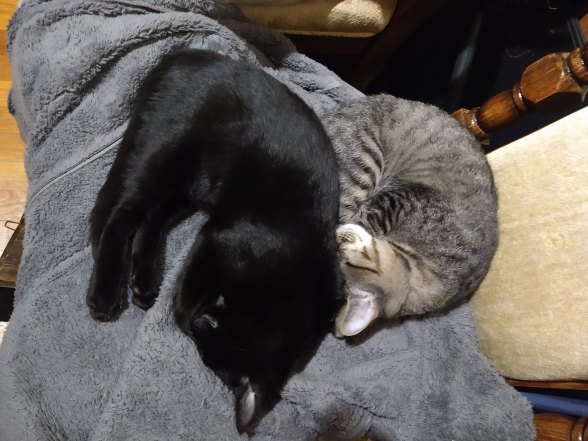
For the Ragtag Daily Prompt: conservation. Don’t cats win at conservation of energy?

The isolated working

I ran my own small clinic from 2010 to 2022, working somewhere else, got Covid, was on oxygen for a year and a half, did some healing and then came back to work.

There has been a culture change in medicine that feels very strange to me. I did not notice it because I was in a solo clinic and not “part of the system”.

All the doctors, providers, are more isolated. I got a compliment yesterday when I was doing a “warm hand off” of the most sick or complicated patients, three new diabetics, a person with cancer, a person with a genetic heart problem. The doctor who I was handing off to is in the same clinic but we have barely talked since May. I don’t know her at all. She complimented me on excellent care “and calling specialists”.

I thought, huh. But I think that is a dinosaur doctor thing. I think mostly people communicate through the electronic medical record email, send messages about patients. For the decade that I was solo, I had to call other specialists because I was on a different electronic medical record. The email didn’t connect. The hospital reluctantly gave me a “link” to their system, but it was only a link to look. I could not write or send anything.

About two months ago I got an echocardiogram result. I read it and thought, ok, it’s not normal but what does it mean? Outflow obstruction by the thickened heart wall. Hmm. I called cardiology and spoke to the cardiologist who read it. He sounded surprised and said, “Idiopathic hypertrophic cardiomyopathy, most likely. It’s a classic echo.” “So, what do I do?” “Send him to me.” “Anything that I should change meanwhile?” “Yes,” says the cardiologist. He had me stop one medicine and start another. “No vasodilators and the beta blocker slowing the heart rate should help decrease the outflow obstruction.” “Got it.” I said. He also gave me two more tests to order.

I referred the patient to cardiology but it was a month before he got in. The two tests were done and they ordered more. If the diagnosis is correct, he’ll be sent to a special clinic in Denver. I called my patient while we were waiting for the cardiology visit. The medicine change had not made much difference as far as he could tell.

I was also told when I got here that I would never get a local nephrologist to see a patient, they were two busy. However, I have called two nephrologists about two patients and both took the patient and again, gave me instructions.

Two specialties have been very difficult to contact: orthopedics and gastroenterology. I have no idea why they are so difficult.

I can see that email feels faster. But there is no human contact, asking follow up questions is difficult, I don’t get that bit of further helpful education: this is what you do next. I have learned so much over the years by touching base with specialists. Once I fussed at a patient to go to hematology oncology about their high platelet count. The patient didn’t want to. He came back and said, “Apparently I have this newly found genetic problem. They put me on two medicines, not expensive. And I feel better than I have in 20 years.” I asked the oncologist about it the next time I called. He lit up, excited, and told me about the JAK-2 mutation. It is so exciting to learn about new areas in medicine and my patient says, “I have to thank you for pushing me to see the oncologist. I feel so much better.” Wow and cool.

Clinic feels like I am mostly isolated, a silo, an island, rarely talk to the other physicians unless I go to find them. I think hospital administrations like this, keeping the physicians in line by having their schedule be so packed that they almost never talk to each other. What a good way to keep physicians from interfering in the money making production! Ugh, I think it is quite horrible and unhealthy for the providers and for our countries medical system in the long run. I was seriously less lonely in a solo clinic.

The prognosis for our current medical system is very poor. The patients say to me, “Why do my doctors keep leaving?” They aren’t attached, they are isolated, I don’t think the physicians know what they are missing. Colleagues. Not silos.

For the Ragtag Daily Prompt: prognosis.

The photograph is from the Fruita Fall Festival.

Love gently

Honey is older, nearly thirty years since that first feeling of being bitten by ants. She is back in corporate medicine, as a temp. Temporary, short term, maybe that will work better.

It is a joy to go in a room and be alone with a person and their monsters. Theirs and hers. Sometimes the younger ones haven’t experienced it, they are terrified if one of their monsters becomes a little bit visible, they hate seeing them. Honey tries to be gentle. If they only want to talk about the sore shoulder and not the stress and violence, well, she leaves the door open a crack. Sometimes the monsters cry.

Older people may be stiff to start with, but when they realize their monsters are seen, acknowledged, this isn’t another robot doctor in to say increase your diabetes medicine, lower your diabetes medicine, tell them a plan without ever connecting, the older ones lean back, sigh, and relax. The monsters play on the floor, Honey’s monsters playing with theirs, happy, engaged.

The hard part is the clinic staff. Honey is with them daily. The medical assistants are young. They kick their monsters aside as they walk down the hall. It is terribly hard and heartbreaking to work at her desk, with the medical assistants’ monsters cowering under their desks, kicked, abused, silent tears and holding bruises. Honey’s monsters mind. They climb into her lap and hide their faces in her shirt, under her jacket, peer over her shoulder. They don’t understand! Why can’t she be nice to THESE monsters?

Honey whispers to her monsters when the medical assistants are rooming patients. “I am so sorry, loves. If I acknowledge these, the monsters of the women working, I become a demon. It is very hard to share an office, no wonder I worked in a clinic alone for eleven years.” Honey has been through that. It is still inconceivable that some people don’t see the monsters at all. Is it learned blindness? Or just not developed unless someone had to learn it? Unless someone grows up in terror and seeing the monsters is the only way to survive.

Honey thinks some people learn to see them as adults, at least their own monsters. Hard enough to do that, without seeing the monsters clinging to other people.

Honey is tired of her monsters crying in sympathy with the staff’s monsters. She thinks maybe there are small crumbs that she can leave for these demons. Little gifts. Her monsters can creep under the desk when she is the only one in the room and leave something. A flower. A dust bunny. A crumb of a crisp. A small rock. A little gift to let them know they are seen and loved. A poem. A prayer. Just a tiny bit of love.

_____________________________

For the Ragtag Daily Prompt: crisp.

The photograph is me all dressed up for the 1940s ball.

______________________________

A yarn about paper

On Friday in the morning I took notes on paper. I was attending a conference on diabetes on Zoom. There are three new things added to the diabetes guidelines. It is now impossible to do a visit about diabetes and actually talk to the human being who has diabetes. We’ll be too busy doing the stupid checklists.

The personnel person stopped by. I said I was taking notes. “On PAPER? You are killing me!”

“Ok. I will use yarn this afternoon.” I drove home and got my knitting and worked on a sock in the afternoon. All the clinics were having a slow day. I guess the kids are getting out of school and everyone is feeling good. Or panicked.

I retain as much information knitting as I do taking notes. Tactile-auditory learner and the controlled fidgeting of knitting helps me stay awake, retain information, and produce socks and others items. I wear the socks more than I reread the notes.

I still like paper. I keep a paper journal. I wanted notes from the most complex lecture. The new medicines are jockeying for position but right now there are different indications for each one, so it’s rather confusing. They said that Type II Diabetes takes two hours daily to manage “correctly”. And that Type I and Type II on insulin take 3 or more. We are supposed to check for Diabetes Distress, which is not depression, exactly. I think I need to be checked for Guideline Distress and Contact Diabetes Distress, sigh. At least the Diabetes Distress speaker thought we should talk to the patient, though I think the talking should have been long before that. Medicine in the US is a mess.

I used the back of the clinic schedules for notes. I do print it out daily. It’s to try to run on time. What time am I supposed to see the patient, but they can be up to 7 minutes late and then the medical assistant still has to “room” them (yes, room has been verbed). Then I can go see them. So the theoretical starting time and the actual starting time can vary quite a bit. I don’t feel bad about being twenty minutes late if I didn’t get to go in the room with the last patient until twenty minutes late. Maybe a no show will let me catch up. Or not.

Anyhow, I still like paper.

For the Ragtag Daily Prompt: paper.

Spirit take flight

Death from memory loss is a mixed bag for families.

In the past, the average time to death from Alzheimer’s was 8 years. I don’t find a number on the CDC website, CDC Alzheimer’s. I find these statistics:

  • Alzheimer’s disease is one of the top 10 leading causes of death in the United States.2
  • The 6th leading cause of death among US adults.
  • The 5th leading cause of death among adults aged 65 years or older.3

The site also says that the number of people with Alzheimer’s doubles every five years after age 65. Sigh. Those numbers are the same ones that they taught me years ago, in a different format. 6% at age 60, then 2% more every year. By 70, 26%, by 80, 46%, by 90 66%. Like hypertension, if you live long enough, you may well get it. And yet, I have had patients over 100 years old with intact memories.

The death of a family member with memory loss can have complicated grief. On the one hand, loss and grief. On the other, a burden is lifted. If the person is in memory care, the cost may be very heavy. In our town, the memory care facility costs $7000 per month. That is a heavy burden to carry when the person no longer recognizes the family or speaks. The family may feel hugely relieved when their person passes and at the same time, feel guilty. This is someone that they love and loved. And yet, they are relieved by death. I think of it as a patient of mine described it: “The grief group at the hospital said that my husband isn’t gone. I said, yes he is, he just left his body.” It is very very hard for a family to watch their loved one deteriorate, lose skills, become confused and/or frightened and/or paranoid and the process can happen for years. With an average death at 8 years, some people live beyond 8. Maybe 12 years. It is very hard.

Blessings on those who care for the memory loss people and the families who do their best for them. Alzheimer’s is one sort of dementia, but we now have many. Pick’s disease, frontotemporal dementia, Parkinson’s dementia, multi stroke dementia, alcohol induced dementia, illegal drug dementia, primary progressive supranuclear palsy, and others.

The spirit has already taken wing and let the body follow.

For the Ragtag Daily Prompt: wing.

My son took the photograph while he was visiting.

Here is the top ten causes of death in 2022: https://www.cdc.gov/nchs/data/databriefs/db492.pdf.

No, really!

No, really! I am a mature adult! I swear! My inner child has grown up!

Well, maybe not at the end of October.

My friend P took the photographs with my phone in 2022.

For the Ragtag Daily Prompt: maturity.

Stand up

I am in a large room, like an expensive hotel lobby. There is a large black bowl like structure, fountain size, but without a fountain. There is a big woman bullying me. She is making me dump containers of ice into the bowl structure. It will overflow and I will be blamed. Another woman whispers to me: “You have to sing a song about abuse, so that people will know that she is making you do this.” I know songs about abuse but at that moment I can’t think of any. Then I do. I remember a song my mother sang, this verse:

“Two little babies, crying for bread. With none to give them, don’t you wish that you were dead. Don’t you wish you were a single girl again.”

I wake up. The song is about a young woman, married, whose husband is drinking up his paycheck. She and the babies are starving and he beats them. Not a pretty picture of marriage, is it?

I wake up. One way to think about dreams is that each person in the dream represents an aspect of ourselves. So WHY is my inner bully showing up? I don’t like this!

That day my friend goes from the hospital to a nursing home for rehab. I speak to three people on the team, because my friend has a cardiology appointment the next day and I want to be sure that she will be taken to the visit. She is going to a nursing home 40 minutes away.

On the appointment day, I call the rehab just after 9 am when the internet says they open. There are three choices: two halls and a main office. I leave a message on hall one. I call back and leave a message on hall two. I wait another ten minutes and call the office. No answer, I leave a third message. I wait until 9:30 and call again. This time that inner voice with gumption is fired up: “I need a call back by 11:30 or I will drive up there, I need to know that my friend has transport to cardiology for her 12:45 appointment.”

I get a call back at 10:30. The rehab person introduces herself. “Oh, we can’t transport her because she just got here yesterday.”

“You don’t understand,” I say. “This visit is to make sure her heart is ok after restarting a medicine. It is not optional.”

“We can’t transport her.”

“I am sick, I can’t transport her. What is your name? What is your position? Who is in charge of the facility? What about her heart, your facility has no concerns if her heart is poisoned?”

“Just a moment.” Papers rattle. “Oh, we DO have transport arranged. Someone else wrote it down and I didn’t see it.”

“Oh, thank you so much. I was so worried!”

I go to the appointment, masked. The driver says my friend was a last minute addition. The visit goes well. I am on the tail end of a cold, not covid, and I am very tired from trying to be sure that my friend gets good care. I think THAT is what the dream is about, the inner strong voice who is not going to let my friend be abandoned, be bullied, be ignored. She is too ill to fight for herself so I am fighting for her. And I am formidable.

For the Ragtag Daily Prompt: gumption.

Double standard: AI technology can take jobs but improving healthcare can’t

The United States could go to single payer healthcare, but one objection has been “People will lose their jobs with health insurance companies.” Yet no one seems to object to AI, Artificial Intelligence taking jobs. It’s technology so it’s fine! The wave of the future! Coming whether we like it or not!

One form of single payer healthcare is medicare for all. Expand medicare so that it covers everyone. At first, it only covered retired female teachers. Women were only considered for teaching jobs if they were single. A married woman was expected to work in the home. The teaching pay was low. Men were expected to be supporting a family, so they got more. Women were often supporting parents or children if spouses died or divorced or abandoned a family or were disabled. Early census information was a finagle: any male in the household was listed as “head” even if it was an elderly disabled father or a boarder or a teen. So the true numbers of women as head of households were obscured.

Single payer would improve healthcare. There would be ONE set of rules. Physicians would know if something was covered. Right now there are over 500 health insurance companies and they each have multiple different policies. Not only that, but the policies can change monthly in what they cover. Did you know that? I would get monthly postcards from multiple companies saying that I could go on line to one of the 500 different websites and see what they had changed and were no longer covering. I found little time to learn 500 websites. We spend enormous amounts of healthcare money on communication back and forth from insurance companies to hospitals and clinics. Trying to prior authorize CT scans, MRIs, surgeries, referrals, medications (even old cheap ones!) and then attempting to get the health insurance companies to pay for the care. Remember that the insurance companies are allowed a 20% profit: so for 1 million dollars of healthcare money, $200,000 can go to profit. The people and computer work is not in that profit, so what percentage of your healthcare dollar goes to attempting to prior authorize and get paid? How much of your healthcare dollar would you like to go to healthcare?

Medicare’s overhead is either 1.4% or 6%, instead of that 20% profit and the prior auth/collection effort. There are two different estimates (from here):

1. There are two different measures of Medicare’s administrative costs. One figure comes from the Medicare Board of Trustees’ annual report, while the other comes from CMS’ National Health Expenditure Accounts. According to the latest trustees’ report, Medicare’s overhead represented 1.4 percent of its total expenditures. According to the latest NHEA, Medicare’s overheard was 6 percent of expenditures.

2. The discrepancy between the two figures is due to Medicare Parts C and D. Mr. Sullivan wrote that the difference between the trustees’ measure of overhead and the NHEA measure β€œis due almost entirely to the fact” that the NHEA figure includes administrative expenses incurred by health insurers that participate in Medicare Advantage (Part C) and Medicare’s prescription drug program (Part D). In essence, the overhead associated with the private insurers involved with Medicare raise the program’s overhead by almost 5 percent, or $24 billion in 2010.

People worry about “socialized medicine” but really, the closest system to socialized medicine is the Veterans Administration. I don’t think anyone wants to take their healthcare away, and some of it is specialized depending on where they were deployed and what they were exposed to. I saw veterans in my clinic because we were more than 30 miles by car from a VA hospital.

What about medicare fraud? I saw way more fraud with the insurance companies. Companies will maximize revenue by sending equipment at the exact interval insurance allows (like sleep apnea equipment and diabetes glucometers). It doesn’t matter to them if it’s being used or not. After my father died, there were 16 full oxygen tanks full in his house. The company was happy to pick them up and no, they did not want to reimburse the payments. A biller told me that often the health insurance companies will pay less then the contracted amount. When challenged, they say, “Oh, that was a computer error! We will fix that!” She said, “I have never once seen the error in the physician’s favor.” When I had cobra insurance, they would not pay my bills and I had to call them every single time to force them to pay. It took enormous amounts of time and again they claimed, “Oh, computer error!” I finally called their counseling line and said, “I want to be counseled for your company refusing to call me back and screwing over this cobra policy, and by the way, I have a family member dying of cancer.” That finally made them fix it.

WHY is our culture ok with technology taking jobs, while improving healthcare can’t? Get rid of the health insurance companies! Medicare for all! If we all had secure health insurance, think of the work innovation in our country!

For the Ragtag Daily Prompt: finagle.

Elder care: stairs

Most of us do NOT live in homes practical for aging. My house has four steps in the front and five in the back to get in and out. The main floor has almost everything needed if I cannot climb a flight of stairs: only the laundry is in the basement.

I am helping a friend in her 80s. The issue, from my practical and pragmatic Family Medicine standpoint, is that she is falling. She told me that she was falling, five times in a day, in November. I got involved right away, because she had a surgery canceled because of it. She has three specialists and a primary. I called them all and took her to the emergency room first and then to her primary.

We asked her primary for disabled parking and for home health services. In Washington State, if you can’t leave your house except to the store or the doctor, you qualify for home health. I also fussed about her blood pressure, but her primary thought she was fine.

The thing is, we should not always have a blood pressure goal of 130 or less systolic once we hit 75 or 80. With weight loss, people can drop a blood pressure point for each 2 pounds lost. The blood pressure range that is safer at age 75 or 80 is to keep it around 140-150, unless the person has heart disease or congestive heart failure. Over 150 is getting too high. The brain must get good oxygen by blood flow and if it doesn’t, there are sensors in our neck that make us faint. That can be a full on loss of consciousness, or just a decrease and drop to the floor. There are some instances where the blood pressure still needs to be kept down at 125-130 systolic: bad coronary artery disease and congestive heart failure especially. But being able to stand up and walk is rather important to elder health.

The distraction for my friend’s physicians is that she has had cancer for three years. We are told that she needs an MRI of her head to rule out brain tumors, metastases from her cancer. Yes, brain tumors can cause falls, so that does need to be ruled out. My friend only falls when standing, sometimes at the counter, gets lightheaded and once has had a full on syncope. No chest pain or heart racing.

It took two months to get the brain MRI, which is negative. We saw her oncologist this week and I pushed for her cardiologist to see her sooner than June. He saw her yesterday. She is on medicine for a heart arrhythmia, but it doesn’t sound like her arrhythmia is acting up. He’s still checking: a monitor and heart ultrasound, but meanwhile he says, “I don’t tell many people this, but you need to drink more fluid and eat more salt.”

“They told me low salt. I stopped salt when I cook.”

“Start salt again and more fluid and return in 3 weeks.” She has been falling 1-5 times a day in her home. She lives alone. She is stubbornly resisting leaving her home and I am ok with that. But, it would be most helpful for her health if she was not falling. That is the priority here. She will not live forever, but she wants to stay in her home. Let’s help with that.

I am NOT saying that everyone over 75 should increase salt. If a person has bad hypertension, or heart disease, or congestive heart failure, they should not increase salt unless their doctor has a specific reason. And heart is the number one killer, so there are lots of people who should continue to eat a low salt diet. But falling and breaking a hip is also a killer.

My friend has three steps to get out of her house. The first day last week that I took her to get labs, she fell three times. “But Jim, I’m a doctor, not a nurse!” Ok, I am not a good nurse. However, we got her back inside after labs and getting the CT scan contrast for her to drink. She has not fallen when I have gotten her in or out since. I’ve had to enlist help twice, since she’s taller than me. Going down the steps is worse than going up. Home health is doing physical therapy and she has a raised seat on her commode. That is good, except those are the muscles that help us go up and down stairs. She has a walker too. She is still falling, because to cook, one has to let go of the walker, right?

So if someone wants to stay at home, think about the home. Are there steps? How strong is the person? Do they have the resources to pay for around the clock care if they become bedridden? I am practicing getting down on the floor and back up every single day, because I want to be strong. I have an upstairs and a basement, and I am going to continue with stairs for as long as possible. If I break my leg, those four front stairs are going to be an issue, but I am thinking about it. Perhaps I should design a decorative ramp, or a sloping earth entry.

Will the house accomodate a wheelchair? Is there a bathroom and a bedroom, as well as the kitchen, on the main floor? Is there clutter? I know I am supposed to keep the floors clear to reduce fall risk. I had one person who kept falling at night because he wouldn’t turn on a light. “It would wake my wife and disturb her,” he said. “It will disturb her more if you break your hip.” I said. “Turn on a light or a flashlight or something.”

Harvard Medicine agrees: https://www.health.harvard.edu/staying-healthy/master-the-stairs

Be careful out there. Or maybe in there.

For the Ragtag Daily Prompt: Elder care can’t be laissez-faire.

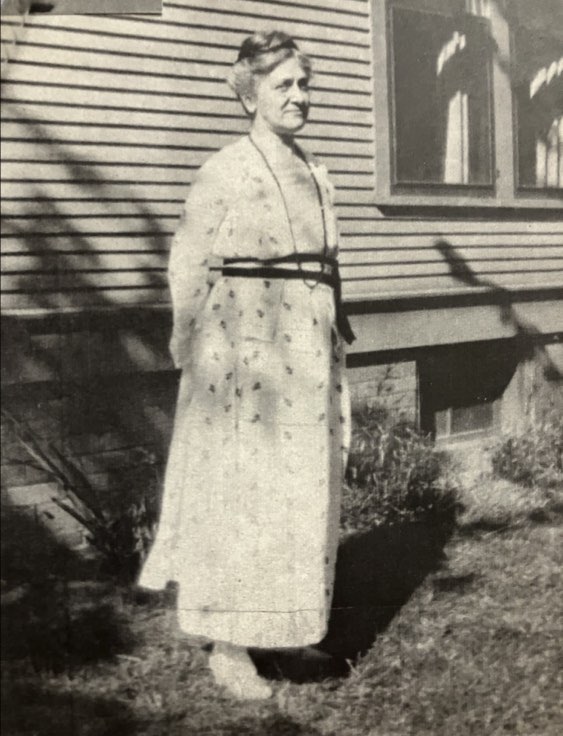
The photograph is not my friend. This is Tessie Temple, my maternal grandfather’s mother. I do not have a date nor who took the photograph. Another photograph is stamped on the back: Battle Creek. She must have gone to one of the famous sanatoriums, like Kellogg’s, for rest or the cures.