Hormones and rabbit holes

Medicine is confusing right now. Ok, it is always confusing because we try to base it on science and science is always changing. There are always special areas that are currently a mess. Hormones!

I speak to a patient recently who is female, premenopausal, and is getting hormone replacement therapy for hot flushes and not sleeping well from an outside source. The person wants me to order hormone tests. I do order hormone tests but not the ones she has in mind. I test a TSH, thyroid stimulating hormone, to see if she is low or high in thyroid.

She is thinking of me testing estrogen and progesterone and other related hormone levels. The party line from gynecology MDs and DOs is that these are not useful tests because women’s hormone levels are so varible. However, there are lots of naturopaths out there and functional medicine MDs and DOs who will test levels. Why is the patient asking ME to test them? Most of those naturopaths and functional medicine providers do not take insurance and charge cash. Also, insurance may not pay for them anyhow because the party line is that they aren’t useful. Why would the cash providers check levels? One reason is CASH. Another is to prescribe “bioequivalent hormone replacement”. Sounds natural, right? Well, the natural thing was for the hormones to stop at menopause and all of the hormones are either made in a laboratory from plant pre-estrogens or from pregnant mare urine, so bioequivalent seems to imply natural but it really isn’t. Pills do not grow on trees, they are made by humans in laboratories.

However, I question party lines, and off I go down the hormone rabbit hole. The current guidelines are that female hormone replacement, after menopause, should be lowest dose possible and only for a maximum of three years because of the increased risk of breast cancer. This doesn’t address my question: does premenopausal hormone replacement count as part of those three years? I may need to ask gynecology. I don’t think it counts. A woman is postmenopausal when she has had no periods for a year. Or had her ovaries removed. Or if she’s had a hysterectomy and still has her ovaries, a yearly follicle stimulating hormone and lutienizing hormone test. Both tests rise when the ovaries stop making hormones and eggs.

Also, there is another caveat. We know that when men are on opioids, the opioids can suppress their hormones and lower testosterone. Here is a paper: https://pubmed.ncbi.nlm.nih.gov/31511863/. Half the men studied in multiple studies had low testosterone when on chronic opioid therapy. 18429 subjects (patients) in 52 studies. That is a lot. Women studied? NONE. What? Yeah, none. Why? Here is part of the answer: about a decade ago I worked with the UW Telepain group and asked the head of the UW Pain clinic a question. “If opioids lower hormones in men, do they in women too?”

His reply, “I don’t know.”

“Have you ever tested a woman?”

“No.”

“Isn’t that sort of sexist?”

“Yes.”

So here I am, rechecking a decade later, and we still don’t know if giving women chronic opioids messes up their hormone levels. It would be more complicated and difficult to check women. We might have to do individual hormone baselines or something in premenopausal ones, say, 2 weeks after menses. Remember that for most of the history of medicine, clinical drug trials were only done in men, because, well, sexism. They said women could get pregnant. Yes, but then we gave the drugs to women who could get pregnant. Also, postmenopausal women can’t get pregnant. The whole thing seems stupid to me.

There is an interesting new finding here: https://neurosciencenews.com/estrogen-t-cells-pain-28548/ . Apparently in women, estrogen and progesterone work on receptors at the base of the spine to reduce pain signals using T cells, part of the immune system. The article says this doesn’t happen in men, but they were studying mice. The male mice didn’t seem to have worse pain after estrogen and progesterone were blocked. The female mice were in more pain. But wait, estrogen and progesterone are produced in men as a by product of making testosterone. Less than women, until menopause. Then the 70 year old man has more estrogen and progesterone than his postmenopausal wife. The article says that they don’t know why the receptors are in women and female mice (um, my intuitive guess would be childbirth and micebirth, right? Men don’t do that and women giving birth to a child after the first one sometimes say, “WHY did I want to do THIS again?” I think those receptors are so that women and mice can get through more than one pregnancy.) Now I need to read the article again because maybe men and male mice don’t have the receptors, even though they do have some estrogen and progesterone. Maybe they just don’t have enough estrogen and progesterone.

Maybe we can’t figure out women’s hormone because men aren’t smart enough, heh, heh. Yes, that is sexist right back at all those historical figures who didn’t study women.

At any rate, that still doesn’t answer my two questions: does premenopausal hormone replacement count towards the three year total beyond which hormone replacement increases the risk of breast cancer? And does chronic opioid treatment lower women’s hormone levels?

_________________

For the Ragtag Daily Prompt: hormone.

I took the photograph of a Port Townsend rabbit in 2011.

Travel risks

The President is withdrawing the United States from the World Health Organization. https://www.whitehouse.gov/presidential-actions/2025/01/withdrawing-the-united-states-from-the-worldhealth-organization/

Here is the link to write to the President: https://www.45office.com/contact/

I am writing daily, just not for the Ragtag Daily Prompt. Here is my short note today:

Dear President Trump: I strongly disagree with withdrawing the United States from the World Health Organization. One function of that organization is travel clinics. If a person is traveling to another country, they can find out what illnesses are present there and get immunizations and advice to avoid getting ill. This also helps physicians treat people who have returned from another country. The physician can contact a state health department which is in turn connected to the World Health Organization. This is a foolish, dramatic and unscientific decision on your part. I suggest that you reverse it immediately or resign as President.

________________

The question I have, is he closing the borders to United States citizens too? Without the travel clinics, who get information about each country from the World Health Organization, aren’t even our own state department employees at higher risk for illness? My son was an exchange student to southern Thailand. At the time he went, there was Japanese encephalitis. He was there two years after the tsunami. He got vaccinated for Japanese encephalitis before he went and he also took medicine to avoid malaria. So, are we not going to send or accept any more exchange students?

I strongly disagree with the decision to leave the World Health Organization and our country is on the verge of crazy.

For the Ragtag Daily Prompt: verge.

All of my patients are smart 3

Human behavior doesn’t surprise me, really. Sometimes it disappoints, depresses, demeans, dispirits and demoralizes. And it’s not the patients. It is the corporate workplace and how it abuses people. And circles the wagons against a threat. Including against employees that it views as threats.

I think all of my patients are smart. “You got this,” I say. I explain what carbohydrates are and that they are in everything, practically, except meat and oil. And some meats have carbohydrates too: shrimp, for example. But my patients can figure this out! My patients rise to the occasion! I am not saying that they do smart things all the time. No one does, including me. Even the smartest ones can do things that are not a good idea or are a really bad idea. Growing up in an addiction household, I think I escaped addiction mostly because I had decided that no adults could be trusted by the time I was three. I thought they loved me but I couldn’t trust them not to give me to someone else. Ironic, that the distrust saved me from taking the same path. My sister took it and is gone. My patients are smart and all I have to do is share my education and experience! They take the ball and run with it! Not all. Sometimes it’s too late and everyone dies eventually.

Corporations, on the other hand, are infuriatingly stupid.

The photograph is me in 2015, sailing my father’s boat with my daughter, in Port Townsend Bay.

Something

Something is happening all around me
Something unpleasant is creeping around
I trust that feeling, that core that is free
I go quiet and listen, I will stand my ground
I am told no problem, this is routine
Nothing to worry about, averting their eyes
Lay down and be walked on, take it for the team
Blind-sided, I walk through a jungle of lies.
I walk very slowly then take to the trees.
I swing on a vine past the river of tears.
Wave to the gators with teeth to eat me,
Routine bad treatment not surprising nor feared.
In the treetops I sing to the stars quite alone
I am happy and making my quiet way home.

Suddenly I am thinking about home. Travel does that sometimes.

For the Ragtag Daily Prompt: travel.

G6PD deficiency and diabetes

Today I follow an online trail to this article on diabetes from Nature Medicine here.

It is talking about a genetic variant that is found in people with African-American heritage called G6PDdef. This genetic pattern makes the HgbA1C test inaccurate. It will look low and “in control” even when blood sugars are high. Since the blood sugars are NOT in control, complications from diabetes can happen: damage to vision, to kidneys, to nerves in the hands and feet.

I have been reading articles about current and changing guidelines about diabetes. The current guidelines say that checking blood sugars at home doesn’t make a difference. I REALLY disagree with this and at the same time, I don’t think that physicians are approaching blood sugars in a practical manner.

I saw a man recently who is diagnosed with “insulin resistance”. His HgbA1C is in between 5.6 and 6.0. Normal is 4.5 to 5.6. Over 6.5 is diabetes. He has prediabetes. He has not checked blood sugars at all, but he is on metformin.

There is evidence that metformin is helpful, and still, I think it is putting the cart before the horse. I ask my people to go buy an over the counter glucometer. Ask for the one that has cheap strips, 6 for a dollar instead of a dollar apiece. Then we go over the normal and abnormal blood sugar ranges and I ask them to start checking blood sugars. If I give them a medicine right away, they don’t learn how to control their blood sugar with diet. ALL of my patients can figure out how to bring their blood sugars down with diet. If we can’t get to a good range, then we will add metformin. I do explain that the guidelines say use a medicine right away, but I ask, “Would you like to see if you can control your blood sugars with diet?” The answer is overwhelmingly “YES!” I have never had someone say no. If we do not give them the chance and explain the goals, why would they even try?

Also, I read the dietician handouts for diabetes yesterday and I am not satisfied. I do not think they explain carbohydrates well. Foods have fats, proteins, and carbohydrates, and anything that isn’t fat or protein has carbohydrates. I think of carbohydrates as a line, from ones with high fiber that do not send the blood sugar up fast, to ones that shoot it way high. At the low end is kale and lettuce and chard and celery. Then the green and yellow and red vegetables that are not sweet. Then beets and sweet peas. Next come the fruits, from blueberries up to much sweeter ones. Fruits overlap with grains: bread and pasta and potatoes and rice. The whole grains have more fiber and are slower to digest. Candy then sweet drinks (sodas are evil) and sugar.

Sugar has 15 grams of carbohydrate in a tablespoon. Kale has 7 grams of carbohydrate in a cup. That’s a pretty huge difference. A small apple has about 15 grams of carbohydrate and a large one 30 grams. Read labels for grains. There is a lot of carbohydrate in a small amount. The issue with fruit juice is that most of the fiber is gone, so the sugars are broken down and absorbed much faster. A 12 oz coke has 32 grams of carbohydrate and a Starbucks mocha has 62! I quit drinking the latter when I looked it up.

Most people with diabetes are supposed to stay at 30 grams of carbohydrate per meal, or 45 if it is a big person or if someone is doing heavy labor. Snacks are 15 grams.

Avocados are weird. They have about 17 grams of carbohydrate in a whole one, but they also have a lot of fat. They do have a lot of fiber, which surprises me.

Diet control takes a combination of paying attention to what is on the plate and serving amounts. Three servings of pasta is not going to work, unless you are out fighting forest fires or are on the swim team. Fire fighters are allotted 6000 calories a day, but most of us do not get that much exercise.

At the same time that articles are telling me that home blood sugars are not useful with a glucometer, everyone is pushing the continuous glucose monitors. I think we like technology. And other articles say that diabetes can be reversed with major lifestyle changes.

Articles: about not using home glucose checks, here. Starting metformin, here. Starting with one of the newer medicines, here.

I think people feel a lot more successful if they get a glucometer and can bring their blood sugar down by messing about with diet. I tell them to check after what they think is a “good” meal and after a “bad” one. How much difference is there? Contrast that with being handed a pill to control it, while someone talks about diet and says all the same stuff that we’ve heard for years. Nearly all of my people want to avoid more pills and are willing to try a glucometer to see if they can avoid a pill. People who have been on diabetes medicine for a while are less willing to try, but sometimes they do too. And sometimes they are surprised that some meals do not do good things for their blood sugar.

This is all type II diabetes. For type I, we have to have insulin. If type II has been out of control for a long time, sometimes those people have to have insulin too. Right now insurances will usually cover continuous glucose monitors for people with diabetes who are on insulin, both type I and II. I do hope that they really make a huge difference for those people!

The spectrum from the low carbohydrate vegetable, the green and yellow and orange ones, up to the really high simple sugar ones is also called the glycemic index. There are lists of low to high glycemic index foods. Perhaps some people with diabetes find that helpful, but I think it’s simpler to say, ok, the stuff that doesn’t taste sweet will send the blood sugar up less. Also, since we are all genetically different and then our gut bacteria and microbiome are all different, it is individualized care to say how does this person at this time respond to this food? We change over time!

There are other examples of the HgbA1C not working to track diabetes. A resident and I looked over a person with diabetes and spherocytosis. The HgbA1C was nearly normal but the blood sugars were in the 300 range. Spherocytosis is a genetic blood cell abnormality, and the red blood cells don’t live as long. People with a past bone marrow transplant also have red cells that live for a shorter time. The G6PD deficiency is thought to help people survive malaria, so persists in the population, like sickle cell anemia. Isn’t genetics fascinating?

Diabetes update

Friday I attended a Zoom diabetes update all day. Sigh. We are really doing diabetes wrong.

Diabetes affected every system in the body and so the guidelines want us to check everything. They made the point that controlled diabetes does NOT lead to blindness, kidney failure, and amputations. Only uncontrolled diabetes. There, do we feel better now?

There are three NEW things to check for. One is CHF, aka Congestive Heart Failure. Heart Failure is pump failure. It makes a lot more sense if you think of the heart as a pump. Diabetes doubles the risk of heart failure in men and increases it by five times in women. We are now to do a yearly BNP (Brain Natriuretic Peptide, got that?) except that it is useless if the person is in renal failure, because that raises it artificially.

The second NEW thing is liver problems. Liver failure is back in the top ten causes of death, having fallen off that list for a while. People drank more alcohol during COVID, there was more drug abuse adding to hepatitis B and C, but the biggest cause is NASH and NAFLD. More acronyms: NASH is Nonalchoholic Steatohepatitis and NAFLD is Nonalcoholic Fatty Liver Disease. This is related to overweight and obesity. Being overweight or obese messes up fat storage and over time this inflames the liver and then cells die, leading to cirrhosis. We are to watch liver tests, think about an ultrasound, and then there are two specific tests for cirrhosis.

Third NEW thing is Diabetes Distress. This is not depression. People score “depressed” on the PHQ-9 test, but don’t respond to anti-depressants. The lecturer said that we have to talk to the patient and find out why they are distressed, or what part of diabetes is getting them down. I thought that we should have been talking to the patient all along. There is a convenient 30 question tool we can use for this, if we have time. Will we?

Now, the old guidelines said that we are to check these things:

HgbA1C every 6 months if not on insulin, every 3 months on insulin and even more in pregnant patients.

Microalbumin/creatinine ratio: a urine test that tells us if the kidneys are starting to leak albumin. They shouldn’t.

Yearly eye test to check for diabetes damage.

Specific blood pressure ranges.

Keep everyone’s LDL cholesterol under 70. So nearly every person with diabetes gets a statin drug.

Do a foot check yearly for neuropathy.

So six things plus the new three. Can’t explain that in one visit and can’t do it in one visit either. I think we should revamp the Diabetes Distress tool and check if physicians and nurses have Guideline Distress. Diabetes is the most complicated set of guidelines other than pregnancy.

Diabetes also takes a lot of time for the person who has it. To check things “correctly”, it takes a minimum of two hours a day for Type II not on insulin and more like three or more for Type I and II on insulin. Think if you have to take two or three or more hours away from your current daily activities and devote it to diabetes. No wonder people are distressed.

The medicines are also confusing. Wegovy is in the same class as Ozempic, but is FDA approved only for weight loss in people who are overweight and have a complication, or people who are obese. Ozempic is for diabetes but people often lose weight so think about it if the person is overweight. Some of the medicines in that class also are approved to reduce the risk of heart disease, which goes up with diabetes. Another class has medicines some of which have approval for diabetes and others for diabetes and renal problems, BUT don’t use it if the eGFR is under 20, got that? The lecturer on medicines said that we’ll see less in each of those classes after they fight it out for dominance of the market. He’s been an endocrinologist for 30 years and remembers when the very first non-insulin medicine was approved. Cool! He is not discouraged, but another lecturer said that we have one endocrinologist for 5000 people with diabetes, which is not enough. We were encouraged to do more continuing medical education.

There is one guideline that I disagree with and would like to see changed. I will write about that next. After I memorize all of the different things the new medicines do, which is changing every month as new research comes out! Stay tuned!

I think I will put the clutch in and coast a bit. Or perhaps clutch handfuls of hair and pull at them, I don’t know.

For the Ragtag Daily Prompt: clutch.

I hiked again yesterday and had a very cooperative bunny stop for a snack in camera range.

Pneumonia makes me slenderize

Pneumonia makes me slenderize
I feel like I’ve been blenderized
Steals my breath and appetite
Work to breathe both day and night
My heart goes fast, trials one to four
I’d rather not have any more
Ten pounds down, gone like smoke
Carbohydrates make me choke
The legacy of my fourth round
I can’t eat gluten, ounce nor pound
And yet I still come out ahead
Since I am alive and still not dead

_____________________________________

Four pneumonias in 24 years. I have an antibody response, which peaks about six weeks after the infection. Colds don’t trigger it. This photograph is two months in to my 2021 round. I drop ten pounds in the first week and eating is always difficult. I do not recommend this method of weight loss.

For the Ragtag Daily Prompt: slenderize.

Lily wins

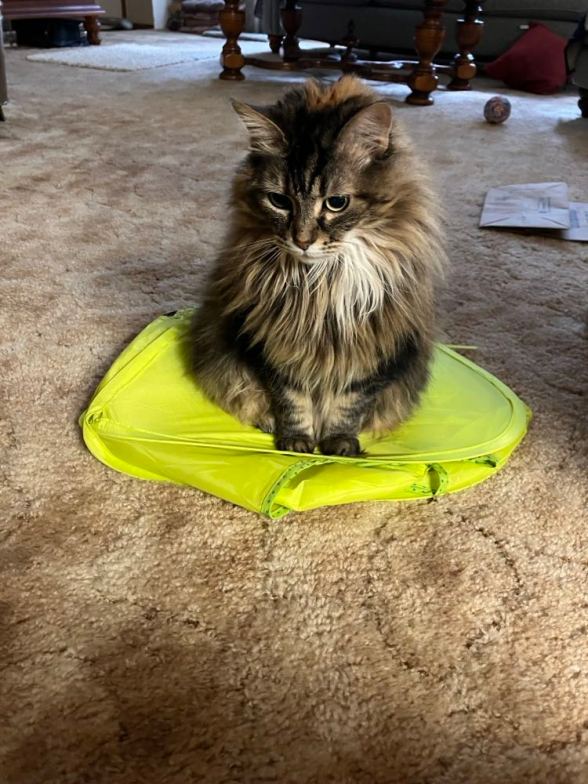
I have been cat sitting Lily, for my friend who is in a nursing home.

Lily is worried about her human and I am only in for about an hour and I don’t know her habits. And I am not her person. However, we have finally figured out how to play. Lily has a tent, a small one. I started scritching it one day and Lily reveals her tendencies: she is a bag stomper. She played with the tent until I get the picture above, with her sitting on it.

Next I bring a stick with line and various things tied on, including a toy mouse. Lily and I play and I don’t leave with large hand scratches. I could grit my teeth, but it was not that fun. Lily wants me to pet her now too.

Lily wins and I do too.

We hope her person will be home soon.

For the Ragtag Daily Prompt: grit.

Stand up

I am in a large room, like an expensive hotel lobby. There is a large black bowl like structure, fountain size, but without a fountain. There is a big woman bullying me. She is making me dump containers of ice into the bowl structure. It will overflow and I will be blamed. Another woman whispers to me: “You have to sing a song about abuse, so that people will know that she is making you do this.” I know songs about abuse but at that moment I can’t think of any. Then I do. I remember a song my mother sang, this verse:

“Two little babies, crying for bread. With none to give them, don’t you wish that you were dead. Don’t you wish you were a single girl again.”

I wake up. The song is about a young woman, married, whose husband is drinking up his paycheck. She and the babies are starving and he beats them. Not a pretty picture of marriage, is it?

I wake up. One way to think about dreams is that each person in the dream represents an aspect of ourselves. So WHY is my inner bully showing up? I don’t like this!

That day my friend goes from the hospital to a nursing home for rehab. I speak to three people on the team, because my friend has a cardiology appointment the next day and I want to be sure that she will be taken to the visit. She is going to a nursing home 40 minutes away.

On the appointment day, I call the rehab just after 9 am when the internet says they open. There are three choices: two halls and a main office. I leave a message on hall one. I call back and leave a message on hall two. I wait another ten minutes and call the office. No answer, I leave a third message. I wait until 9:30 and call again. This time that inner voice with gumption is fired up: “I need a call back by 11:30 or I will drive up there, I need to know that my friend has transport to cardiology for her 12:45 appointment.”

I get a call back at 10:30. The rehab person introduces herself. “Oh, we can’t transport her because she just got here yesterday.”

“You don’t understand,” I say. “This visit is to make sure her heart is ok after restarting a medicine. It is not optional.”

“We can’t transport her.”

“I am sick, I can’t transport her. What is your name? What is your position? Who is in charge of the facility? What about her heart, your facility has no concerns if her heart is poisoned?”

“Just a moment.” Papers rattle. “Oh, we DO have transport arranged. Someone else wrote it down and I didn’t see it.”

“Oh, thank you so much. I was so worried!”

I go to the appointment, masked. The driver says my friend was a last minute addition. The visit goes well. I am on the tail end of a cold, not covid, and I am very tired from trying to be sure that my friend gets good care. I think THAT is what the dream is about, the inner strong voice who is not going to let my friend be abandoned, be bullied, be ignored. She is too ill to fight for herself so I am fighting for her. And I am formidable.

For the Ragtag Daily Prompt: gumption.

Double standard: AI technology can take jobs but improving healthcare can’t

The United States could go to single payer healthcare, but one objection has been “People will lose their jobs with health insurance companies.” Yet no one seems to object to AI, Artificial Intelligence taking jobs. It’s technology so it’s fine! The wave of the future! Coming whether we like it or not!

One form of single payer healthcare is medicare for all. Expand medicare so that it covers everyone. At first, it only covered retired female teachers. Women were only considered for teaching jobs if they were single. A married woman was expected to work in the home. The teaching pay was low. Men were expected to be supporting a family, so they got more. Women were often supporting parents or children if spouses died or divorced or abandoned a family or were disabled. Early census information was a finagle: any male in the household was listed as “head” even if it was an elderly disabled father or a boarder or a teen. So the true numbers of women as head of households were obscured.

Single payer would improve healthcare. There would be ONE set of rules. Physicians would know if something was covered. Right now there are over 500 health insurance companies and they each have multiple different policies. Not only that, but the policies can change monthly in what they cover. Did you know that? I would get monthly postcards from multiple companies saying that I could go on line to one of the 500 different websites and see what they had changed and were no longer covering. I found little time to learn 500 websites. We spend enormous amounts of healthcare money on communication back and forth from insurance companies to hospitals and clinics. Trying to prior authorize CT scans, MRIs, surgeries, referrals, medications (even old cheap ones!) and then attempting to get the health insurance companies to pay for the care. Remember that the insurance companies are allowed a 20% profit: so for 1 million dollars of healthcare money, $200,000 can go to profit. The people and computer work is not in that profit, so what percentage of your healthcare dollar goes to attempting to prior authorize and get paid? How much of your healthcare dollar would you like to go to healthcare?

Medicare’s overhead is either 1.4% or 6%, instead of that 20% profit and the prior auth/collection effort. There are two different estimates (from here):

1. There are two different measures of Medicare’s administrative costs. One figure comes from the Medicare Board of Trustees’ annual report, while the other comes from CMS’ National Health Expenditure Accounts. According to the latest trustees’ report, Medicare’s overhead represented 1.4 percent of its total expenditures. According to the latest NHEA, Medicare’s overheard was 6 percent of expenditures.

2. The discrepancy between the two figures is due to Medicare Parts C and D. Mr. Sullivan wrote that the difference between the trustees’ measure of overhead and the NHEA measure β€œis due almost entirely to the fact” that the NHEA figure includes administrative expenses incurred by health insurers that participate in Medicare Advantage (Part C) and Medicare’s prescription drug program (Part D). In essence, the overhead associated with the private insurers involved with Medicare raise the program’s overhead by almost 5 percent, or $24 billion in 2010.

People worry about “socialized medicine” but really, the closest system to socialized medicine is the Veterans Administration. I don’t think anyone wants to take their healthcare away, and some of it is specialized depending on where they were deployed and what they were exposed to. I saw veterans in my clinic because we were more than 30 miles by car from a VA hospital.

What about medicare fraud? I saw way more fraud with the insurance companies. Companies will maximize revenue by sending equipment at the exact interval insurance allows (like sleep apnea equipment and diabetes glucometers). It doesn’t matter to them if it’s being used or not. After my father died, there were 16 full oxygen tanks full in his house. The company was happy to pick them up and no, they did not want to reimburse the payments. A biller told me that often the health insurance companies will pay less then the contracted amount. When challenged, they say, “Oh, that was a computer error! We will fix that!” She said, “I have never once seen the error in the physician’s favor.” When I had cobra insurance, they would not pay my bills and I had to call them every single time to force them to pay. It took enormous amounts of time and again they claimed, “Oh, computer error!” I finally called their counseling line and said, “I want to be counseled for your company refusing to call me back and screwing over this cobra policy, and by the way, I have a family member dying of cancer.” That finally made them fix it.

WHY is our culture ok with technology taking jobs, while improving healthcare can’t? Get rid of the health insurance companies! Medicare for all! If we all had secure health insurance, think of the work innovation in our country!

For the Ragtag Daily Prompt: finagle.