This is for Ronovanwrites weekly haiku prompt challenge #85.
The prompt words are tight and warm.
where is safe from harm?
home? warm, tight closed open doors
warm heart is safe home
I took the photograph last year during sunrise on my street.

This is for Ronovanwrites weekly haiku prompt challenge #85.
The prompt words are tight and warm.
where is safe from harm?
home? warm, tight closed open doors
warm heart is safe home
I took the photograph last year during sunrise on my street.
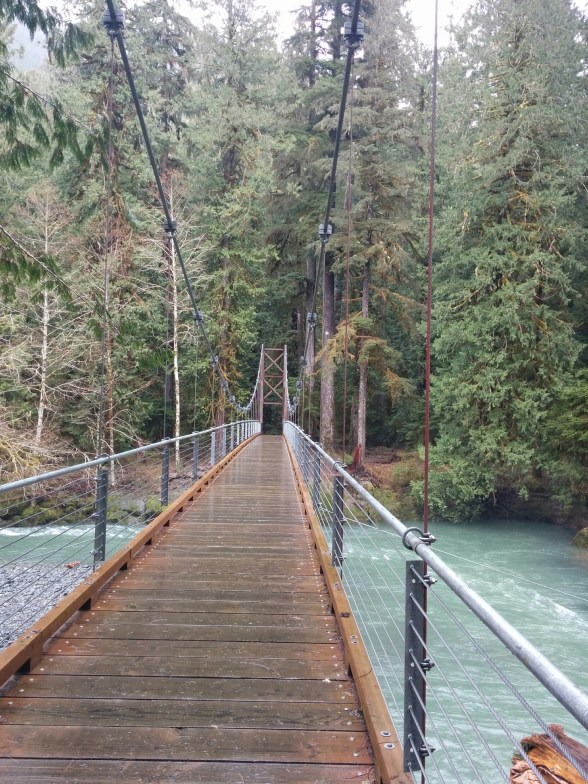
A much more comfortable bridge on the Staircase hike than the log in a previous post. The water is high and fast and pale magical green.
I can’t find a source for this: “The older I get, the more I learn, which bridges to cross and which to burn.”
Doesn’t seem wise to burn bridges when rivers are flooding. But the bridge could wash out anyhow and then I would need to wait or go another way or build a new one.

The last time I visit my sister in hospice, my cousin is sitting by the bed when I arrive.
My sister looks terrible and like she is suffering. She is in renal failure and her eyes are slitted against the light. She is in a hospital bed and barely eating. It takes me three days to figure out how to make her comfortable.
But when I first arrive, I say hello and hug her. She laughs and it is dark.
She doesn’t want to talk. “Shall I sing to you?” I ask.
She nods.
I start singing a lullaby: I gave my love a cherry.
She shakes her head: no.
I study her. “How about Samuel Hall?”
She smiles and nods.
“My name is Samuel Hall,
Samuel Hall, Samuel Hall.
My name is Samuel Hall
And I hate you one and all
you’re a bunch of buggers all
damn your eyes, damn your eyes
you’re a bunch of buggers all
damn your eyes.”
Another song to raise girls. We adored it, because it is unrepentant, horrible and had swears.
I killed a man tis said
and I left him there for dead
with a bullet in his head
damn his eyes
My cousin’s eyes widen. “I haven’t thought of that song in years.” he says. He starts singing along, remembering.
They took me to the quod
They left me there by God
With a ball and chain and rod
Damn their eyes
My cousin has two children. I guess he is not raising them with the dark songs we were raised with….
The preacher he did come
And he looked so goddamn glum
As he talked of Kingdom Come
Damn his eyes
My sister is smiling, eyes slit against the light, angry.
The sheriff he came too
With his boys all dressed in blue
They’re a bunch of buggers too
Damn their eyes
To the gallows I must go
With my friends all down below
Saying “Sam, I told you so.”
Damn their eyes
I see Nellie in the crowd
I am shouting right out loud
I shout “Nellie, ain’t you proud!
Damn your eyes!”
“Let this be my parting Nell
Hope to see you all in Hell
Hope to Hell you sizzle well
Damn your eyes!”
And my sister laughs and then she sleeps for a while, angry, angry at death.
My name is Samuel Small: http://www.wtv-zone.com/phyrst/audio/nfld/02/sam.htm
My name is Samuel Hall: https://www.youtube.com/watch?v=iSpk1t4WYNY
My name is Samuel Hall: https://www.youtube.com/watch?v=pxiPCw21T-w
and Johnny Cash: https://www.youtube.com/watch?v=Ss_KyPfM1es
This is not the suffering photo. I can’t bear to post that….

This is the Staircase hike on Monday. It was not slick enough to make me turn back, but if the water had been higher or there had not been a railing, I would have turned back. I thought about rising water on that hike.
And the same day, I received a county email that an 18 year old slipped crossing a creek and was swept away.
Love to his friends and family and I am so sorry.

This is for the RonovanWrites weekly haiku challenge #83. The prompt words are flame and gem.
We all go through times that feel difficult and we feel pressure. Think of a diamond and endure.
buried heat pressure
tons crushing no flame but red
hot molten rock: gem

This week I see a patient that I sent to a specialist that I don’t know well.
“How is he?” I like to get feedback on the specialists.
Q grimaces. “He knows his stuff. But…. he’s by the book. I complained about a side effect. He says it is not listed. But I go on line and there are lots of people complaining about that side effect.”
“Hmmm.” I say.
“He doesn’t really listen if it doesn’t fit…. if it’s not in the book.” Q brightens. “But I am going to call the nurse line for the drug and see what they say.”
“Cool.” I say. “Some doctors are very by the book. I’m into practical medicine: use it if it works. Don’t care if it’s witchcraft.”
Q giggles.
“What about the rash?” I say.
Q pulls up a pant leg. There is almost no rash. “He said it wasn’t related to the problem.”
We both look at Q’s leg. “Looks better to me.” I say. “Looks a lot better.”
“Yeah,” says Q. “It does. It looks nearly gone.” The rash was what initially triggered the testing that led to the diagnosis that led to the specialist.
“I use whatever I can figure out for people.”
Once I had an elderly woman with an intestinal bleed. She is transferred to Virginia Mason and goes through every possible test to localize the bleed. Upper endoscopy, lower endoscopy, swallow the camera, CT scan, probably pet scan and bone scan. Can’t find it. It is too slow a leak to use radioactive tagged red blood cells. She comes back.
I transfuse her every three weeks. This is not good. She will develop antibodies eventually.
She goes back to Virginia Mason. They do it all again. The surgeons discuss opening her up. “No.” they say. “Too frail at 88. She will die on the vent.” They send her back.
I am still transfusing her every three weeks. I am grumpy as hell.
Her daughter says, “I have a friend in Canada who knows a scientist. He is studying aloe vera. They said take aloe vera twice a day. What do you think?”
“Well I don’t have anything! Try it! We will test a chem panel in two weeks and watch the blood count!”
She takes aloe vera twice a day. Her blood count stabilizes. No more transfusion. Happy dance. Not absorbed or at least doesn’t bother her kidneys or liver tests….
After a year she says, “Can I try stopping it?”
“Sure,” I say. “We will check a blood count in 2 weeks.”
It drops. She goes back on aloe vera.
Practical medicine. If the book has nothing, try something else…..

Here are the four questions and fears:
1. How can I avoid being kept alive on a machine?
2. How can I avoid dying in pain?
3. How can I avoid having too much done, too many resources used, and dying in a hospital?
4. How can I avoid dying of starvation or thirst?
1. How can I avoid being kept alive on a machine?
The myth here is that we can keep someone alive on a machine. We almost never can. Comas are extremely rare. There are a very few people who survive a high spinal cord injury, like Christopher Reeves, and can be kept alive for a period on a ventilator. Or people with a disease that leads to the failure of the breathing muscles: Steven Hawkings with ALS has outlived all predictions.
But for the most part we can’t. I have tried: I have had two patients in 25 years with brain death who had signed organ donor cards. When brain death is established, an organ donor team will fly in to a rural area. Meanwhile, I was to attempt to keep the patient’s body alive. One lived long enough and the other did not. I could not stop the death with machines or drugs and that person was already on a ventilator.
Part of this myth is fear relating to hospital settings. ICUs, intensive care units, frighten people. There are alarms going off and machines with blinking lights and it is brightly lit and quiet and alien. Why? If a person is on a ventilator, they are sedated. Otherwise they will automatically pull the breathing tube out or the urinary catheter or the iv or all of them. It is instinctive. They are sick, may be delirious or injured, they are not in their right minds, they are not logical. So they are sedated. Most of the alarms are rightly ignored by the nurses: most alarms are going off because the patient has moved and the machine is not picking up. The nurses learn to filter automatically which alarms are trivial and which alarms do need attention and are an emergency.
I wanted to see an elderly aunt. When I arrived, my cousin said I couldn’t because she was in the emergency room. I said that I am pretty comfortable in emergency rooms and thought I could talk my way back to see her, since I am a physician. We had to wait in the lobby for a couple of hours, but then they let me back.
Part of the drama and horror that shows up in ICUs is the family’s feelings. Family members may feel guilty or angry or afraid and they often lash out at each other. Families are both at their best and their absolute worst when someone is critically ill. I have a friend who still doesn’t speak to a sibling after their father died in hospice three years ago, because they disagreed so strongly on how he should be cared for. The hospital staff and nurses and doctors and maintenance people and laundry people and dietitians are used to families crying or arguing or even yelling at each other. We try to support the patient and the family. But we cannot make them agree and don’t try.
We will return to the “in hospital” death later.
2. How can I avoid dying in pain?
Wear your seatbelt, wear helmets, don’t drive in blizzards, change the batteries in your smoke alarm, don’t text while driving….
That seems like a joke, but not really. Accidents are in the top ten causes of death in the United States currently. People do die in pain if shot, in car accidents, in falls. If we can’t get to them and get pain medicine on board in time.
When death is coming, the fear is that we will die in pain from, for example, cancer. However, most people that I have seen dying of cancer DECREASE the pain medicine rather than increase. There are at least two reasons. One is that they want to be awake. As the kidneys fail, the pain medicine lasts longer. They may not need as much. If they are in hospice and have family present, my experience has been that they say “Turn it down. I don’t want it. I don’t need it.” They want to be awake with their family.
The second reason is that it really may hurt much less. When people stop eating and go into ketosis, some pain receptors are turned off. This is very interesting. I have been using it in clinic: my patients with osteoarthritis who try a ketotic diet say that the joint stops hurting when they become ketotic. One patient said that when her right hip stopped hurting entirely, she realized that the muscles from the left hip were very sore from limping. “After two weeks, I tried one piece of bread,” she said, “And the right hip joint pain came right back.” So a person with end stage cancer or end stage dementia, who does not want to eat, may have little pain or different pain.
3. How can I avoid having too much done, too many resources used, and dying in a hospital?
First, fill out a POLST form: Physician orders for life sustaining treatment. The first question is the one medical people want you to answer: if your heart and lungs STOP, and you are dead, do you want us to try to revive you? If someone is over 80, I don’t want to do CPR. I will break their ribs and if we DO get them back, they WILL have damage. People often say, “Bring me back if I will be ok.” I joke that we don’t have the little turkey pop up that says “Too late. Done.” But it is minutes until brain death. If you want to be revived, your best bet is to die in the emergency room in front of the emergency room staff. They can move very fast. The security guards in Las Vegas are also very very good at putting AEDs on people who drop dead from a big win or a big loss.
Living wills are better than nothing, but they often say “If two doctors agree that I am terminal within six months, no extraordinary measures.” This is entirely too vague. What do YOU mean by an extraordinary measure? A ventilator? Aspirin? An iv? No one has ever defined what an extraordinary measure is.
The other questions on a POLST form ask specifically about resources. Hopefully the medical person will explain a little: what is a ventilator, when would we use it, would oxygen be ok, are antibiotics ok, have you talked to your family about this? The POLST form can’t cover everything but it does give us an idea of what someone wants when they can’t talk to us. And it takes some of the burden off the family: father DID say what he wanted and it is in writing and he talked to his doctor about it. If you are the family, how are you going to decide what an extraordinary measure is?
Now: dying in a hospital. Our culture currently pays lip service to dying at home. Sort of. A survey of Veterans revealed THREE DIFFERENT IDEAL DEATHS. One: the Hallmark death, in hospice, at home, surrounded with friends and family making peace with the world. Two: Sudden death, no warning, no attention. Three: fight to the death. This person won’t go, will fight, a miracle is possible and they are NOT at acceptance. Do EVERYTHING.
And dying in a hospital. In residency in Portland I had two patients dying on my medicine rotation. One was a young man in his 20s, surrounded by family and friends, of HIV. He was in the hospital because that is where he felt comfortable and safe and could get immediate help. The friends asked if our team was tired of wading through a crowd to check on him each day. I replied, “No. I am so glad you are here. I have another person dying, and he has no one, an elderly man. He is alone except for me and the staff.” So we, the hospital staff, are the ones who try to comfort the elderly alcoholic dying, the cancer patient estranged from her family, the lost and depressed and solitary and addicted. And we don’t care what they did to get there, the sins committed, the regrets, the mistakes. We try to help as much as we can. I do addiction medicine in part because I felt so sad watching people with addiction die alone. So dying in the hospital is NOT a failure. Sometimes it is where the person feels safest or they don’t have anyone. And not having anyone is a failure of our culture, not of medicine.
4. How can I avoid dying of starvation or thirst?
When someone is dying of cancer or dementia or another slow disorder, they want to stop eating at some point. Sometimes the family gets them to continue eating and the patient will do so out of love for their family. They have no hunger or thirst. Renal failure sets in and the rising creatinine takes them into a gentle coma and then into the great mystery. This looks like a kind death to me: the brain is quietly sedated and put to sleep by the body, by the rising creatinine. Let them go. We will offer food and drink to anyone, but sometimes they are letting go….let them.

During my three months temp job in 2010 at a nearby Army Hospital, I was asked to help the Family Medicine Inpatient Team (FMIT) whenever a faculty member was sick or out, which turned out to be fairly often. I enjoyed this because I wanted to work with residents, Family Practice doctors in training. It was very interesting to be at a training program, watch the other faculty and work at a 400 bed hospital instead of my usual 25 bed one.
Two patients needed to be admitted at the same time on our call day, so the second year resident took one and I took the other. The report on mine was an 82 year old male veteran, coughing for three weeks, emergency room diagnosis was pneumonia.
The resident soon caught up with me because her person was too sick and got diverted to the ICU. Mr. T, our gentleman, was a vague historian. He said that he always coughed since he quit smoking 15 years ago and he couldn’t really describe the problem. He’d gotten up at 4:30 to walk around the assisted living; that was normal for him because he used to do the maintenence. He had either felt bad then or after going back to sleep in a chair and waking at 10. “I didn’t feel good. I knew I shouldn’t drive.”
He’d had a heart attack in the past and heart bypass surgery. Records were vague. The radiologist read the chest xrays essentially as, “Looks just like the one 3 months ago but we can’t guarentee that there isn’t a pneumonia or something in there.” He had a slightly elevated white blood cell count, no fever, and by then I did a Mini-mental status exam. He scored 22 out of 30. That could mean right on the edge of moderate dementia, or it could be delerium. I got his permission to call his wife.
“Oh, his memory has been bad since he spent a year in a chair telling them not to amputate his toes. And he was on antibiotics the whole time. He wasn’t the same after that. He just said he didn’t feel right and that he shouldn’t drive.” So his wife called an ambulance.
The third year chief resident came by and wanted to know the admitting diagnosis. “Old guy, don’t know.” was my reply. “Either pneumonia or a urinary tract infection or a heart attack maybe with delerium or dementia or both.”
The second year was helping me put in the computer orders, because I was terrible at it still. She could put them in upside down and asleep. “Why are we admitting him, anyhow? We can’t really find anything wrong, why not just send him home?”
“We can’t send him home because he can’t tell us what’s wrong. He might have an infection but he might not, and he has a really bad heart. If we send him home and he has a heart attack tonight, we would feel really bad. And he might die.”
I was getting a cold. I had planned to ask to work a half day but half the team was out sick so I just worked. But by morning I had no voice and felt awful. I called in sick.
At noon the phone rang. It was the second year. “You know Mr. T, who we admitted last night?”
“Yes,” I said.
“He had that heart attack during the night. Got taken to the cath lab. You made me look really good.” We had worked on the assumption that it could be early in a heart attack though the first labs and the ECG were negative. I had insisted on cardiac monitoring and repeating the enzymes. The resident had finished the note after I left and the night team had gotten the second and abnormal set of enzymes.
82 year olds are tricky. With some memory loss he couldn’t tell us much except that “I don’t feel right.” He was right not to drive and we were right to keep him in the hospital. And if it had all been normal in the morning, I still would not have felt bad about it. The residents are looking for a definitive diagnosis, but sometimes it’s “Old guy, don’t know,” until you do know.
Previously posted on everything2.com in April 2010. I am not sure if this branch was dead or not, but the moss grows on it here in the wet winter anyhow.
I took the photograph in the woods last weekend.

For RonovanWrites Weekly Haiku Prompt #79, the words are crystal and hope….
fear stands strong don’t look
crystal water reveals rocks
open eyes give you hope
I took the photograph in 2012, when my sister was referred to hospice for breast cancer. I took three trips to see her before she died. She was still very engaged with everyone on the second trip. But when she was not talking to anyone, her face was different. She was looking at eternity. She knew that I could see her doing it, because we knew each other so well. She did not want to talk about it to me until my last visit with her in this life. I felt so blessed and honored when she did talk to me, and I hope that she feels loved.

At each massage, one every two weeks, I have locked my hips back up in the Armour suit. This is really annoying.
My massage person says he wants to be able to lie face down like a baby: head, arms and legs all lifted and playing. That is core strength. Babies can do that… why can’t we? He says that when he does play therapy with kids, by a certain age they lose that. He picks them up and flies them around lying on his arms: by age 4 or 5, they fold up. They have lost touch with that core.
I think about that.
During a massage a few months ago he pokes my lower belly. “Tilt your hips using your abdominal muscles.” Feels weird, but I do. “You aren’t engaging your core.” I find it really annoying to have to relearn how to walk.
Engaging my core. Little children who have just learned to walk do lead with their bellies. And they can still lie on the floor on their bellies, all limbs up.
I am trying to picture an adult who walks with their belly. Who? The Buddha’s belly comes to mind. But I can’t see him walking. Who? Toshiro Mifune: the old samurai movies. He and the others walk like small children: from their core, from their bellies.
I try it for two weeks. I flatten the arch of my lower back by using my abdominal muscles, not my gluteus maximus. I walk with my feet apart a bit, my belly leading. I am trying not to walk with my toes gripping the ground. I walk with toes up. He says I have walked with my toes gripping the ground for years, and that is the only place that I have early arthritis.
It feels a bit silly to walk like a samurai. When I do it right, I can feel that engaged core and my legs and hips feel looser. It is not elegant, not a catwalk uptight shake your ass walk. It is more of a loose free walk, like a toddler, like a buddha. I don’t care. I have to concentrate to keep my abdominal muscles flattening the arch of my back, and so I walk slower.
After two weeks I am back: it’s worked. Partially. My hips are LESS locked. The metatarsal phalangeal joints, the big toes, are less sore then they’ve been for years. And I can feel that abdominal core.
Skiing I try to do the same thing. Engage the abdomen and keep it engaged, and ski with my toes up. I ski slowly and with great swooping turns, letting the skis do the work. Rentals. They give me 158s the first day, I talk them into 165s the second day and then I am on 172s. Finally feels stable. I am getting used to that core feeling. I quit when I get too tired, going in before my kids.
Walk like a toddler, walk like a samurai, walk with core engaged.
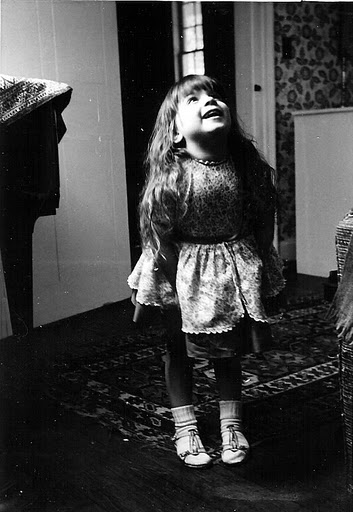
First published on everything2.com January 7, 2016. I needed the right picture: this is my sister and me about a month before she died of breast cancer. I miss her so.
BLIND WILDERNESS
in front of the garden gate - JezzieG
Discover and re-discover Mexico’s cuisine, culture and history through the recipes, backyard stories and other interesting findings of an expatriate in Canada
Or not, depending on my mood
All those moments will be lost in time, like tears in rain!
An onion has many layers. So have I!
Exploring the great outdoors one step at a time
Some of the creative paths that escaped from my brain!
Books, reading and more ... with an Australian focus ... written on Ngunnawal Country
Engaging in some lyrical athletics whilst painting pictures with words and pounding the pavement. I run; blog; write poetry; chase after my kids & drink coffee.
Coast-to-coast US bike tour
Generative AI
Climbing, Outdoors, Life!
imperfect pictures
Refugees welcome - Flüchtlinge willkommen I am teaching German to refugees. Ich unterrichte geflüchtete Menschen in der deutschen Sprache. I am writing this blog in English and German because my friends speak English and German. Ich schreibe auf Deutsch und Englisch, weil meine Freunde Deutsch und Englisch sprechen.
En fotoblogg
Books by author Diana Coombes
NEW FLOWERY JOURNEYS
in search of a better us
Personal Blog
Art from the Earth
𝖠𝗇𝗈𝗍𝗁𝖾𝗋 𝖶𝗈𝗋𝖽𝖯𝗋𝖾𝗌𝗌.𝖼𝗈𝗆 𝗌𝗂𝗍𝖾.
Taking the camera for a walk!!!
From the Existential to the Mundane - From Poetry to Prose
1 Man and His Bloody Dog
Homepage Engaging the World, Hearing the World and speaking for the World.
Anne M Bray's art blog, and then some.
My Personal Rants, Ravings, & Ruminations
 KO Rural Mad As Hell Blog
You must be logged in to post a comment.