Songs to raise girls: Pack up your sorrows

This song interests me. It is the fourth in my series about the songs that my sister and I learned growing up.

When we recorded our family songs, my sister said she liked it. I said, I think it is creepy, with that juxtaposition of a sweet tune and then words that are not so sweet.

No use cryin’
Talking to a stranger
Namin’ the sorrows you’ve seen

Oh, ’cause there are
Too many bad times
Too many sad times
Nobody knows what you mean

If somehow
You could pack up your sorrows
And give them all to me

You would lose them
I know how to use them
Give them all to me

The line that bothered me was “I know how to use them”. What does that mean? Use them for what?

No use ramblin’
Walkin’ in the shadows
Trailin’ a wanderin’ star

No one beside you
No one to hide you
An’ nobody knows where you are

Ah, if somehow
You could pack up your sorrows
And give them all to me

You would lose them
I know how to use them
Give them all to me

And how could you give your sorrows to someone else? The singer is offering to listen to sorrows but also take them away. “You would lose them.” And then the singer “knows how to use them”.

No use roamin’
Walking by the roadside
Seekin’ a satisfied mind

Ah, ’cause there are
Too many highways
Too many byways
Nobody’s walkin’ behind

Ah, if somehow
You could pack up your sorrows
And give them all to me

You would lose them
I know how to use them
Give them all to me

I never got around to asking my sister if it was the tune she liked or the words or what it meant to her. I chose to play that recording at her Washington memorial. I could not go to her California memorial because I was too ill. My father had terrible emphysema and was on oxygen. I thought I had pertussis but it turned out to be systemic strep A, which hurts. At any rate, I was too sick to travel. Her Washington Memorial was a month or two later, when I was well enough to organize it…..

You would lose them
I know how to use them
Give them all to me

It is by Pauline Baez. The version by Richard and Mimi Farina is the one I’m familiar with, so my parents probably had the record:  https://www.youtube.com/watch?v=U4LbU8w7Th4.

Joan Baez, Pauline and Mimi Farina were sisters. Joan Baez recorded it https://www.youtube.com/watch?v=NAMe1bRW8Ao. So did Peter, Paul and Mary: https://www.youtube.com/watch?v=IVxNleqVpx4.

And so did Johnny Cash and June Carter: https://www.youtube.com/watch?v=_ctVhDEuTYE

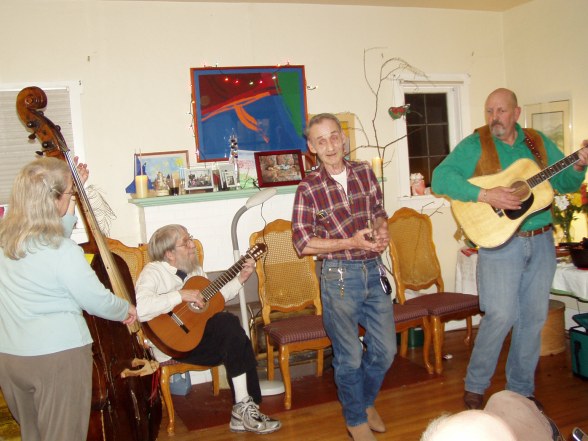
The picture is a music party at my house in 2009, my father seated and Andy Makie on harmonica, Jack Reid standing with the guitar.

Adverse Childhood Experiences 7 : Revisiting Erikson

Welcome back, to Adverse Childhood Experiences, and I have been thinking about Erikson’s Eight Stages of Psychosocial Development.

These were mentioned in medical school and in residency. I was in medical school from 1989 to 1993 and in Family Practice Residency from 1993 to 1996. Family Practice is at least half psychiatry, if you have time. We are losing the time with patients in order to achieve “production”. I complained about the 20 minutes I was allotted per patient and was told that I should spend 8 minutes with the patient and 12 minutes doing paperwork and labs and calling specialists. This is why I now have my own practice. A new patient under 65 gets 45 minutes and over 65 gets an hour and my “short” visits are 25 minutes. I am a happy doctor. And on the Boards last year I scored highest in psychiatry….

So, back to Erikson. The first stage, at birth to one year is Basic Trust vs Mistrust. “From warm, responsive care infants gain trust or confidence that the world is good.”

I was taught that people would have to “redo” the stage if they “failed”. Let’s look at that a little more closely.

Take an infant in a meth house. No, really, there are babies and small toddlers that have addict parents, alcohol, opiates, methamphetamines. We do not like to think about this.

A social worker told me that the toddlers from a meth house were really difficult to deal with. They do not trust adults. The first thing they do in foster care is hide food.

Hide food? Well, adults on meth are not hungry, sometimes for 24 hours or more, and they are high. So they may not feed the child.

Now, should this child trust the adult? No. No, no, no. This child is adaptable and would like to survive. So even under three they will learn to hide food. In more than one place. This is upsetting to foster care parents, but perfectly understandable from the perspective of the child.

So has the child “failed” the first stage? Well, I would say absolutely not. The child looked at the situation, decided not to starve and learned not to trust adults and hid food. Very sensible. Adaptive.

Is the child “damaged”? That is a very interesting question. After 25 years of family practice medicine I would say that no, the child is not damaged. However, the child has started out with a “crisis” brain. The brain is plastic, all our life, and so this child did what was needed to survive.

Is the child “sick”? Again, I would argue no, though our society often treats the child as sick. We think everyone should be “nice” and “warm” and “why isn’t he/she friendly?” Well, if you started in an addiction household or a crazy household or a war zone, it would not be a good adaptation to be warm and fuzzy to everyone.

How do we treat the adult? In a warm fuzzy nice world the child would have a foster parent who adored them, was patient with them, healed them and they would be a nice adult. I have a friend who said that foster care was so bad that he chose to live in an abandoned car his senior year rather than stay in foster care. He couldn’t play football because he had to get back to the car and under the layer of newspapers before it got too cold. I am sure that most foster parents are total wonders and angels. But some aren’t.

I have a person who says that he lived on the streets from age 8. He did get picked up and put into foster care. He kept running away. “The miliary loved me because I could go from zero to 60 in 60 seconds.” That is, he has crisis wiring. He is great in a crisis. The military is a sort of a safe place, because it has rules and a hierarchy and stands in for the failed parenting. Expect that then you get blown up by an AED in Afganistan and hello, that makes the crisis wiring worse.

How DO we treat the adult? We treat them horribly. We say why can’t this person be nice. We diagnose them we drug them we shun them we isolate them we as a society discriminate against them deny them and we are a horror.

I get so angry when I see the Facebook posts where people say “surround yourself with only nice people”. Ok, how dare you judge someone? You don’t know that person’s history. You don’t know what they grew up with. How dare they say that everyone should be NICE.

I am a Veteran’s Choice provider. I have 6 new veterans in the last 3 months. I suspect I will get more. They are not “NICE”. They come in suspicious, hurt, wary, cadgy. And I don’t care, because I am not “NICE” either. We get along just fine.

When I run into someone who isn’t “NICE”, I think, oh, what has happened to this person? What happened to them when they were little? What happened to them as an adult? How have they been hurt?

Pema Chodron writes about sending love: to your loved ones, to a friend, to an acquaintance, to a stranger, to a difficult person and to an “enemy”.

Send love. And do something about it. Help at your local school, help families on the edge, help single parents, sponsor a child to a sport if their parents can’t afford it, pay for musical instrument lessons, do Big Brother/Big Sister, become a “grandparent” to a child at risk, be a good foster parent, donate to addiction care….

The photo is from 2007, when my children and I visited their father in Colorado. A stranger in the parking lot took it at our request…..

Headache without words

When I was in residency, a staff member brought a young man to see me.

The young man couldn’t talk. He could make some sounds. His head was a funny shape, asymmetric. His mother had rubella during her pregnancy: German measles.

“His head hurts.” said the group home staff member.

“How do you know?” I asked.

“He isn’t acting right. There is something wrong. He’s different.”

“How long?”

“About a week or ten days.”

“Did he fall?”

“We’ve talked about that but we don’t think so.”

I tell the young man what I am going to do before each part of the exam. I look in his ears carefully. His ear canals are odd too and I can’t see well. His exam is basically pretty normal for him. He is not running a fever. He doesn’t have a stiff neck. He doesn’t seem to have nasal congestion.

“If he hit his head, he could have a subdural, a bleed pressing on his brain.”

The staff member shakes their head.

“Ok. I can treat him for an ear infection, though I can’t see that well. If that doesn’t work, we will have to image his head. Would he stay still in a CT scanner?”

“No.” says the staff member.

“Then I would have to set it up with anesthesia. Which is difficult.”

So we treated him for an ear infection. No improvement. He returned. Exam unchanged. The staff was still sure his head hurt. I had never seen him before the initial visit, so I couldn’t tell.

I set up the CT scan with anesthesia. Twice, because they mucked it up the first time and it wasn’t coordinated right. I had to explain to multiple people on both anesthesia and radiology what and why I was doing it. “His head hurts and he can’t talk?” I argued until they gave in.

The ENT chief resident called me with the results. Not radiology. “What?” I said.

“It’s the biggest pseudocyst we’ve ever seen!” said the ENT chief. Surgeon. “He needs surgery!” His voice said “Cool!”

In residency I’d noticed a striking difference between family practice and other residency folks: internal medicine, surgery, neurology, all the subspecialties. They got excited when there was something rare or weird. I always thought, oh, shit, my poor patient.

“What is a pseudocyst?” I actually didn’t ask, because they knew I was just a lowly family practice resident and would probably not have heard of a pseudocyst. A cyst like structure can form of snot in the sinuses and can cause headaches. It can erode through the bone into the brain. His hadn’t, thank goodness, because that can be bad. Bad as in lethal.

Because of the measles, he had some of the largest sinuses ENT had seen ever, and the largest pseudocyst. ENT happily took him off to surgery. Great case.

I got to see him in follow up. He was his normal self. His group home staff member was delighted. “He’s back to normal! Thank you so much!”

But it’s the group home staff that noticed and cared and brought him in. “Thank you for bringing him in,” I said, “I would not have noticed. And some people wouldn’t have cared.”

Differentiating pseudocysts and other things: http://www.oapublishinglondon.com/article/1266

More on pseudocysts: http://www.ncbi.nlm.nih.gov/pubmed/6595617

Pseudocyst images: https://www.google.com/search?q=maxillary+sinus+pseudocyst&biw=1366&bih=634&source=lnms&tbm=isch&sa=X&ved=0CAcQ_AUoAWoVChMIoZzWwv_QyAIVUJuICh248gGC

Rubella in pregnancy: http://www.marchofdimes.org/complications/rubella-and-pregnancy.aspx

Rubella, aka German measles: http://www.mayoclinic.org/diseases-conditions/rubella/basics/definition/con-20020067

Pink and blue

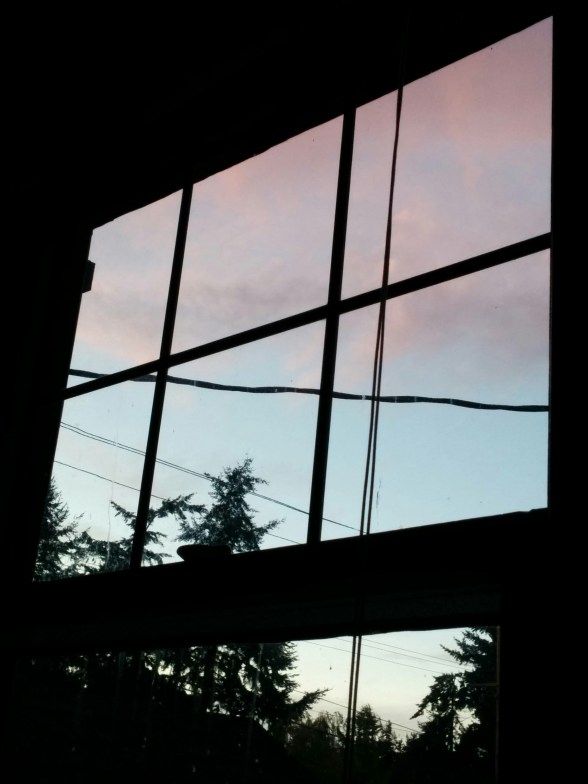
This is for Jithin’s Mundane Monday Photo Contest. I took this in the evening last week when I had a cold and was lying on the guest bed at home. I was nauseated when I stood up, so spent two days at home. I saw one patient on the first day and called the rest myself. If the doctor calls and sounds horrible and says they are contagious, most people are willing to reschedule….

Cat Collapse Disorder

Boa cat is 11. We got her and Princess Mittens when my daughter was 7.

Last summer Princess Mittens was killed by a car in front of our house. We were looking for her the day after she went missing. A neighbor said, “There is a cat dead across the street. I’m sorry.” Yes, it was Princess, all stiff. We put her in a box and brought her in the living room. Boa came in, and went stiff legged, arched and fur on end and backed out of the room. She had been crying and looking for Princess and she stopped then.

The next morning we dug a hole and buried Princess in the back yard. Boa joined us and watched. She avoided the living room for 24 hours and then was ok.

Without her companion, she is more social. Princess was the one who would come into the middle of a party and lie down as equidistant from all the people as possible. Boa would rarely venture out in company but now she is social.

In January she started dropping weight. She didn’t look right. By March I worried. I changed her food first, to an all protein, no corn, no GMO one. In May she went to the vet. She is an indoor outdoor cat. I let her out for a while when I am up writing in the hour of stupid early and the hour of insomnia and the hour of convalescence. Both cats would return when I clapped, because that meant I was locking the door and might not open it again until I returned from work. No cat door. We have a family of raccoons and they can get a bit exciting in the house.

The vet said fleas and parasites and maybe we should do a whole bunch of things including antibiotics. I negotiated by phone from Portland. My daughter promised to pat Boa while I was gone. She’s a bit cat allergic, so usually she doesn’t. She said, “Can I wear your clothes if I am going to pat Boa?” Well, good idea. She wore a cat-patting outfit and then promptly changed.

Anyhow, Boa is still thin but better. And so why would she have fleas and parasites and general awfulness after we’ve pretty much managed her the same way for 11 years? Grief, I think. I got terribly ill after my sister died and then after my father died. I think that grief lowered her immune mechanisms and she was just prone to everything. And why did I switch her food? I don’t think that cats normally eat corn or much vegetable filler, and so I wanted her nutrition to be as normally cat like as possible. Also, this spring she caught and ate 7 mice and two birds and she has never done that before. I think she had realized that the cat food I had for her was not ok. Since I switched foods, she has not brought in any catches. She also thinks I’m a bit dense, but you know….

I used to think those people who bought organic for their pets were nuts. But I can change my mind.

But reading about honeybee collapse disorder, it’s not one mechanism: http://journals.plos.org/plosone/article?id=10.1371/journal.pone.0006481. It looks like it’s multifactorial. Do GMOs bother honeybees enough that then they are more likely to get parasites and mites and whatever? Or maybe the bees are grieving…..

The picture is from 2005. Boa is the black one and Princess Mittens is the black and white tabby.

Causes of Death in the United States in 2012

When I first started doing annual physicals I sat down and looked at the top causes of death and then organized the counseling part of the physical around them: starting with heart disease and working down the list. I think of the annual physical as my opportunity to “MOM” patients and say “STOP DRINKING LIKE A FISH OR YOU GONNA DIE EARLY,” though perhaps with a little more diplomacy. Sometimes without much diplomacy at all.

The top ten causes of death in the United States in 2012 were heart disease, cancer, chronic lower respiratory diseases, stroke, unintentional injuries, Alzheimer’s disease, diabetes, influenza and pneumonia, kidney disease, and suicide.

http://www.cdc.gov/nchs/data/databriefs/db168.htm#which_population

This is 2,543,279 deaths in 2012.

Let’s take the causes one by one.

Heart disease: This is number one. 599,711 deaths. 23.6% of total deaths all ages both sexes in the US in 2012. So that is where I start when I do the counseling part of a physical.

Let’s review heart disease risk factors:
hypertension
high cholesterol
family history
diabetes
kidney failure
lack of exercise
tobacco
alcohol
smoking other things…
illegal drugs
stress
obeisity
As you might guess, this part of the discussion can use up a lot of the visit….

Cancer: All the cancer deaths together are 22.9% of the 2012 total.
We can screen for a few cancers: lung cancer is now the number one killer for both sexes. A chest xray is useless for screening. There is a certain population of current or former heavy smokers where a screening CT is useful. No, I do not recommend a “screening full body CT”, that is crap. Yes, lung cancers do get picked up randomly when we do a chest film for some other reason.
We can screen for breast cancer, colon cancers, look for skin cancers, the prostate cancer screen is a counseling nightmare and I don’t recommend a PSA but will do one if the person wants and other cancers pretty much we have to watch for symptoms….stop smoking, ok? That’s what causes 70% of the lung cancer and breast cancer used to be number one in women but smoking made lung cancer beat it out….
If you want details about any screening test, go to the US Preventative Task Force site:
http://www.uspreventiveservicestaskforce.org/Page/Name/tools-and-resources-for-better-preventive-care

Chronic lower respiratory diseases at 5.6%: ok, smoking again. Emphysema and chronic obstructive pulmonary disease, AKA COPD. Asthma too. This article is fascinating, that third generation children of smokers in a polluted part of California are worse and have inherited genetic modifications than third generation children of non-smokers who live in a less polluted part of California. Lovely. I grew up in a two pack a day camel household and no wonder my lungs are tricky.

Stroke, also called CVA, cerebrovascular accident, at 5.1% and then there are TIAs, transient ischemic accidents, the stroke warning symptom.

What are the risk factors for stroke?
Oh, smoking of course
hypertension
high cholesterol
stress
lack of exercise
obeisity
blocked carotid arteries
blood clots
atrial fibrillation

Unintentional injuries at 5.3%, also known as accidents.

Deaths from prescription medicines taken correctly outstripped deaths by MVAs, motor vehicle accidents and guns in 2007. The CDC declared an epidemic of overdose deaths, but it’s just starting to creep into newspapers and public consciousness.

Here: http://www.cdc.gov/mmwr/preview/mmwrhtml/mm6101a3.htm

The unintentional injury counseling list includes:
wear your seatbelt
don’t drive inebriated
don’t get in the car with inebriated drivers
check your smoke alarms
in the elderly, decrease fall risk. don’t stack stuff on the stairs.
wear a helmet if you bicycle motorcycle ATV rollarblade ski or invent some new way of getting on the Darwin list. Base jump, for example.
don’t take a lot of controlled prescription medicines or combine them with each other or combine them with alcohol: opiates with benzodiazepines with alcohol with ambien or sonata with barbituates and hello, the drug dealer is not your friend and tells lies: they are cutting the methamphetamines here with tricyclic antidepressants and barbituates and my long term cocaine addict patient was getting methamphetamines with benzodiazepines when he was paying for cocaine. Really.

Alzheimer’s at 3%

This is moving up the list. Fast. Everyone dies of something. Alzheimer’s patients live an average of seven years from diagnosis….And the recent article about Human Growth Hormone transmitting not only prions but Alzheimer’s is really interesting, implies an infectious cause.

Here: http://www.nature.com/news/autopsies-reveal-signs-of-alzheimer-s-in-growth-hormone-patients-1.18331

That was HGH from cadavers. I still would not take HGH made in a lab for “anti-aging” either. Nope, nope, nope.

We don’t know how to prevent Alzheimer’s but that is not the only cause of dementia and we’re still naming different kinds. Very frequently a brain CT or MRI says “decreased white matter” or “small vessel disease”, so there is a contribution from all of the heart and stroke risk factors that can do bad things to the brain with the top ones being: tobacco, alcohol, hypertension, high cholesterol, stress, lack of exercise, diabetes, illegal drugs, and so forth. Keep your brain active and busy.

Diabetes at 2.9%
Ok, it can make you more likely to have a heart attack. Also the biggest cause of blindness in US adults and the biggest cause of lower limb, yes, foot or leg amputation and the biggest cause of kidney failure in adults. Also if your legs are numb from uncontrolled diabetes, you don’t feel injuries and are less able to heal infections. And if blood sugar is high, there are lots of bacteria and especially staph and strep that LIKE high sugar.

influenza and pneumonia at 2.1%

Get Your Flu Shot. Really. And if you are 65 or older or you have tricky lungs or you have a tricky heart, get the pneumovax shot. The pneumovax protects against pneumococcal pneumonia ONLY, not all the colds or influenza or hemophilus influenza. And get your Tdap, because that stands for Tetnus, Diptheria, acellular Pertussis. Pertussis is whooping cough. It’s back. We’ve had three outbreaks in our county in five years. It kills babies under six months. They don’t whoop, they just stop breathing, apnea. Other people whoop, but even with antibiotics, they can cough for MONTHS. The flu shot usually gives 80% protection by two weeks after the shot. Only 80%, people say? Well, are you perfect?

Kidney disease at 1.8%

Causes: kidneys get worse as we age, for one thing.
diabetes
supplements and drugs: kidney failure is on the rise! Everything that we absorb and metabolize is metabolized by either the liver or the kidneys. Liver function can be perfect at age 100: that is, if it has not been trashed by alcohol, hepatitis B or C, drugs, supplements, mushrooms, whatever. Kidney function usually drops by age 80 and I am there calculating the function before I choose an antibiotic because you have to use lower doses in the over 80 crowd and the early kidney failure crowd. If you take ANY PILLS you should have a yearly test of your kidneys and liver function.
infection can hurt kidneys
inherited disorders

Suicide at 1.6%
40,600 deaths in the United States in 2013

Risk Factors http://www.cdc.gov/violenceprevention/suicide/riskprotectivefactors.html

Family history of suicide
Family history of child maltreatment
Previous suicide attempt(s)
History of mental disorders, particularly clinical depression
History of alcohol and substance abuse
Feelings of hopelessness
Impulsive or aggressive tendencies
Cultural and religious beliefs (e.g., belief that suicide is noble resolution of a personal dilemma)
Local epidemics of suicide
Isolation, a feeling of being cut off from other people
Barriers to accessing mental health treatment
Loss (relational, social, work, or financial)
Physical illness
Easy access to lethal methods
Unwillingness to seek help because of the stigma attached to mental health and substance abuse disorders or to suicidal thoughts

And for those who want in depth information, 15 leading causes of death by state:
http://www.cdc.gov/nchs/nvss/mortality/lcwk9.htm