
Intimacy

What IS intimacy? And what is love? And are they the same thing? Do you have to be intimate to love someone? Not meaning sex, but what level of intimacy is “normal” and “appropriate”?

I am thinking of my mother. When I was just starting college, she started talking to me about my father and about his drinking. I became more and more uncomfortable and finally asked her to find a counselor or someone other than me. The thing is, she refused to DO anything about his drinking and in fact, covered it up. The two of them would scream at each other at 2 am and fight when I was in high school. It would wake me up and I would think, I wish they wouldn’t, because I have school tomorrow. But I certainly didn’t go say anything because then they would have screamed at me. And as I got older, I wondered if my mother was drinking heavily too. Because why would she argue with someone drunk at 2 am, that makes no sense. Unless she either was drunk or loved to argue or both.

It is clear that she was drinking heavily at that time from her journals. Over and over she writes, I drank too much last night. Hard to blame her for not intervening with my father if she is drunk too. But she was using him as her cover up. Her family blamed him. My grandmother, her mother, didn’t blame him. She loved them both.

When we had guests, my mother would turn on the charm. She could mesmerize a room and entertain people with stories. My sister and I and others would be the butt of the stories. My father too. After the guest left, she would often talk about them. Analyze them. Talk about their faults and weaknesses. I was fascinated but a bit horrified too. She seemed to like these people so much and to charm them and invite them back, but was talking about them behind their backs. Ick.

So intimacy interests me. I wonder how to do it “right”. Maybe right is not the best word. How to do it “functionally”. I really don’t know what normal is, my maternal family certainly did not model healthy intimacy. My generation still gossips about each other. I quit that at age 19 and refused to be part of it. I don’t think anyone saw my rebellion except my maternal grandmother. She did not say a word but I knew that I had her respect. She did not play the family game with me.

I don’t think that gossip and triangulation are a good form of intimacy or love. Person A talks to person C about person B. Word gets around and sometimes it is person D that says something to person B and person B gets upset when they realize where this came from. And how twisted and one sided the story is. And aren’t we seeing this play out on a national level? All these people saying that THEY KNOW the status of the President’s memory. I don’t. I can’t judge it from a debate. And frankly, if we are going to do a psychiatric evaluation of one, I think we have to do BOTH. Stop following stupid rumors. Why not require a neuropsychiatric evaluation on every candidate for President and Senate and House of Representatives and the Supreme Court. And make them public. That would cause some chaos, wouldn’t it? And how do you decide who is “sane” enough to govern?

I think that gossip and triangulation is a dysfunctional form of intimacy. People feel closer when someone is whispering a secret to them. I don’t think it’s healthy. It might be normal for our culture, though. Normal does not mean healthy, after all. What do you think?

This election is like a bad hallucination. Why do we accept candidates that behave badly? Are we so addicted to television and movie drama that we want it to happen in our government? I don’t. How about you?

For the Ragtag Daily Prompt: hallucination.
Sexually active

At a clinic visit this week the Medical Assistant screens me. “Are you sexually active?”

I say, “Um, what do you mean?”

“Are you sexually active?”

“Um, I do not have a partner.” By now, I really want to laugh.

She still looks confused. “You are not sexually active.”

“Ok.” I try not to giggle. Apparently her question series does not cover um, solo sexual activity and I resist telling her about the downtown sexual health and toy store. The new multispeed, multipattern suction toys are, well, enlightening and INSPIRING and EXPLOSIVE.. Or, um, something. Snort.

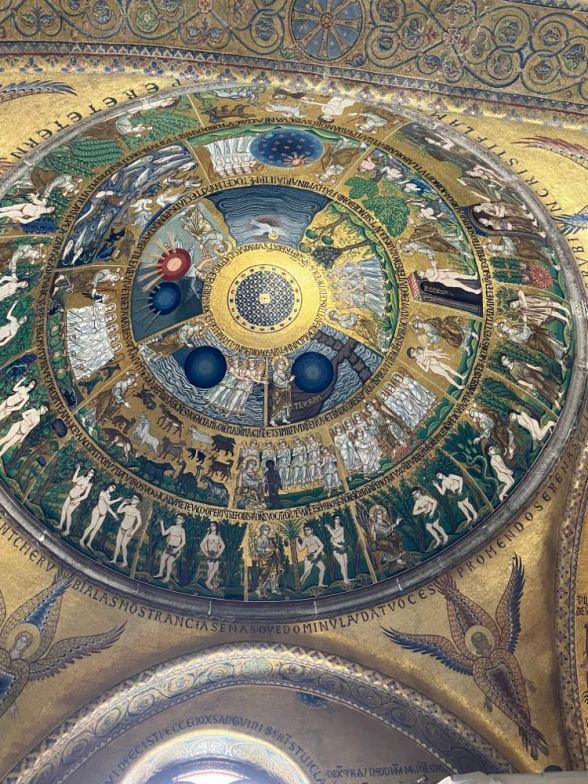
Let’s just study the dome. This is from Venice and tells the story of Adam and Eve.

I have sent a message to my physician saying that they may want to rephrase the questions. “Do you have any sexual partners?” would be more enlightening as far as sexually transmitted disease risk. Heh. The whole thing cracked me up. My blood pressure was still 108 over 70. Ha, so there, heart disease. My English/Scots father’s family is adapted to tobacco and alcohol and my father ran a low blood pressure even with 55 years of unfiltered Camels in his lungs.

Heh.

For the Ragtag Daily Prompt: dome. This is the Basilica San Marcos, which has multiple domes. This one tells the story of Adam and Eve. I now want to paint one of my ceilings. The bathrooms have too much moisture. I suspect this will not enthuse future realtors.

Alone and lonely are not the same thing.

Fantasy is good.

L is for lust

L is for Lust, another of the 7 sins.

I’d better talk about the photograph first! I took the picture of my son, playing outdoors before my friends’ wedding! He volunteered to play as the guests arrived and played from memory, dressed in his grandfather’s tuxedo. L is for love as well as lust….

I have said that we are all human and all have the potential for all feelings. But lust… now that is complicated to write about.

noun
1. intense sexual desire or appetite.
2. uncontrolled or illicit sexual desire or appetite; lecherousness.
3. a passionate or overmastering desire or craving (usually followed by for): a lust for power.
4. ardent enthusiasm; zest; relish: an enviable lust for life.
5. Obsolete. pleasure or delight.
desire; inclination; wish.

Now those aren’t all bad. And don’t we as a culture celebrate sexual desire in the “right” context? We don’t agree on the “right” context as a culture or a world yet.

verb (used without object)
6. to have intense sexual desire.
7. to have a yearning or desire; have a strong or excessive craving (often followed by for or after).

I am reading four books concurrently. Perhaps I have a lust for books. Is that a sin or a feeling or an exaggeration?

I found a mystery called The Dante Club, by Matthew Pearl. This is set right after the civil war and is a murder relating to the translation of Dante’s Inferno. The characters include Henry Wadsworth Longfellow and Oliver Wendell Holmes, MD. Part of the plot includes the Harvard Corporation putting pressure on to stop publication of the translation because many of the Harvard faculty and alumni don’t approve. “Modern” Italian is scorned compared to Latin and Greek and  there is argument about whether it is too Catholic. Discrimination all over the place.

And what does this have to do with lust? I came across my copy of a translation of Dante Alighieri’s Inferno, translated by John Ciardi, and started reading that. The circles of Hell as he describes them don’t exactly match the 7 sins: he has nine. The Second Circle has the souls of the “carnal, those who betrayed reason to their appetities and who abandoned themselves to the tempest of their passions.” The dead people are insubstantial and are blown about by the winds, forever denied the light of reason and of God.  There are couples there. This circle has less suffering and Dante feels compassion for the lovers.

But further down is Circle Eight with the panderers and seducers. These are punished much more cruelly and suffer more deeply. And Dante feels that it is more deserved…. Circle Eight has many others: flatterers, hypocrites, thieves, evil counsellors, sowers of discord. Each level descends and indicates a worse sin.

L

The third book is Come as you are by Emily Nagoski, PhD. A friend gave this to me for my birthday and it’s a wonderful book about the myths, mysteries and current science about sexuality, male and female. She writes that we have ideas that are NOT borne out in scientific testing and that many people who feel sexually “broken” are not broken at all. We all have the same parts, just arranged differently, and then our family and culture and experience add to that, and it becomes confusing!

Currently, she writes, 30% of women in testing have responsive desire. That is, they don’t have “spontaneous desire”. Our culture is still getting over men owning other people and owning women, so the cultural “ideal” is that we all have spontaneous desire. But it turns out that we don’t all have it, and there is nothing wrong with those who don’t, including the men! She writes about everyone having both an accelerator and brakes related to sex and that some people have a strong brake and others have a strong accelerator. Above all she stresses that the best thing is for each person to experience pleasure and their own definition of pleasure! That can be complicated for a couple, especially when they expect the other person to be a certain way…. the most loving thing is to find out what a person is really like, not pressure them to fit a cultural idea.

And lastly I am reading a romance, by Nora Roberts. It is very interesting to read it concurrently with the other three. Especially when the couple is “overcome” by “desire”. Certainly the romances I have read nearly all have the same idea about the heroine: when she meets her soulmate, her body knows it and she will be overcome with desire. What’s more, her body is always right even though the two of them argue and resist their true love! This is the myth in romances and it doesn’t match Dr. Nagoski’s book at all! She writes about nonconcordance: that is, that the brain and the body are not always in agreement. Men have a genital response which agrees with their brain response of “sexually appealing” about 50% of the time. Women’s genital response agrees with their brain response of “sexually appealing” only 10% of the time. And if you want to have a happy spouse or partner, it is the brain that you want to appeal to, not the body. If you think about it, there’s not much more of a bigger turn off then someone saying “Your body isn’t responding the way I expect it to and therefore you feel x.” That’s silly, isn’t it? If we want to know what someone is feeling, aren’t we all more complicated then pure body language? Dr. Nagoski also distinguishes between “sexually relevant” and “sexually appealing”, which are not at all the same. An ad for a car with a nearly nude female model draped on the hood may be sexually relevant and not at all appealing to me… I think, yeah, using lust to sell cars and objectifying women again. Unappealing, in fact. I think we have to get past the terrible damaging myth that if a woman is interested in sex with someone, that indicates true love — or that a woman will only be interested in sex if it is true eternal love!

John Ciardi: http://www.poetryfoundation.org/bio/john-ciardi

More on Dante: http://www.worldofdante.org/inferno1.html

Mathew Pearl’s website: http://www.matthewpearl.com/

Nora Roberts: http://www.noraroberts.com/

Dr. Nagoski’s blog: http://www.thedirtynormal.com/