Taken at the Baltimore Aquarium in 2017.
For the Ragtag Daily Prompt: whiskers.



Sometimes I just despair as I read new guidelines. Don’t you? Maybe you are not a physician and don’t try to keep all of this impossible stuff in your head. Mine is full. Tilt.
Diabetes alone: if someone has type II diabetes, there are specific blood pressure guidelines, cholesterol guidelines, we are to do a hgbA1C lab test every six months minimum and more often if they are out of control, and a urine microalbumin/creatinine ratio yearly. If that starts being abnormal we are to start one of two classes of blood pressure medicines even if they have normal blood pressure.
Oh, and don’t forget: a yearly eye test and we are supposed to check their feet at EVERY visit to make sure they are not getting diabetic ulcers.
Got that? And that is just type II diabetes. And there are a whole raft of medicines, about forty right now. Some are weekly shots, some are daily tablets, some are twice a day or with every meal and they all have their own side effects, how fun. Check drug interactions, are their kidneys ok? Is their liver ok? Diabetes increases the risk of heart attack and stroke and don’t forget those feet.
Diabetes is one of the most complicated sets of guidelines, but there are a rather appalling number of guidelines. Maybe we should sic an AI on that job: Mr. Smith has type II diabetes poorly controlled, hypertension, erectile dysfunction, feels a little short of breath and has a bruise on his left shin after tripping yesterday. Please, AI, organize a twenty minute visit to cover as many things as possible efficiently and have the note finished and followup arranged by the end of it. Then it turns out that what Mr. Smith really wants to talk about is his niece who has just overdosed and nearly died from heroin, so everything else goes out the window. Maybe I should see him weekly for the next month.
Do you want to keep it simple and stay out of the doctor’s office and more importantly out of the hospital? If you are 25 and healthy, you don’t much care because old is unimaginable.
But there is a very nice study that looked at just five things regarding health, over 28 years for men and 34 for women: “The researchers looked at NHS and HPFS data on diet, physical activity, body weight, smoking, and alcohol consumption that had been collected from regularly administered, validated questionnaires.”
Here is an article about the study: https://www.health.harvard.edu/blog/healthy-lifestyle-5-keys-to-a-longer-life-2018070514186
Here is the study: https://www.ahajournals.org/doi/10.1161/CIRCULATIONAHA.117.032047
So let’s break the five things down. Here are the more formal definitions: “Using data from the Nurses’ Health Study (1980–2014; n=78 865) and the Health Professionals Follow-up Study (1986–2014, n=44 354), we defined 5 low-risk lifestyle factors as never smoking, body mass index of 18.5 to 24.9 kg/m2, ≥30 min/d of moderate to vigorous physical activity, moderate alcohol intake, and a high diet quality score (upper 40%), and estimated hazard ratios for the association of total lifestyle score (0–5 scale) with mortality.”
First: never smoking. I would add never vaping and not living in a cave and burning wood and hopefully not living right next to a 12 lane superhighway, all of which are bad for the lungs. Ok, while we are at it, don’t use methamphetamines or heroin or cocaine or krocodil, right? They didn’t even include those in the study.
Second: Body mass index 18.5-25. If you aren’t there, it is diet and exercise that need to change.
Third: Thirty minutes or more per day of moderate to vigorous physical activity. That can be ten minute intervals. Three can have an enormous effect on number two.
Fourth: moderate alcohol intake. Ok, alcohol is bad for the heart, period. So is tobacco. They defined moderate as less than or equal to “5 to 15 g/d for women and 5 to 30 g/d for men”. Let’s do the math: a 12 ounce beer that is 5% has 14gm of alcohol. Here: https://www.niaaa.nih.gov/alcohols-effects-health/overview-alcohol-consumption/what-standard-drink. The 8.9% 16 ounce beer at our local pub has quite a bit more. Here is a website where you can calculate how much alcohol is in a drink: https://www.rethinkingdrinking.niaaa.nih.gov/Tools/Calculators/Cocktail-Calculator.aspx.
Fifth: Diet. There is an overwhelming amount of confusing information on the internet and some of it is not only confusing but wrong. “Diet quality in the NHS, HPFS, and NHANES was assessed with the Alternate Healthy Eating Index score (Methods in the online-only Data Supplement), which is strongly associated with the onset of cardiometabolic disease in the general population.” I have not assessed my own Alternate Healthy Eating Index score. However, there are a couple very straightforward things that help with diet. First: No sweetened drinks. That means that sugary coffee with the syrup should go. I quit drinking mochas when I read that a 12 ounce one has 62 grams of carbohydrate. I would rather have a small dark chocolate. And sodas are just evil and juice not much better. Eat the fruit instead. Second: eat vegetables, every meal. A fruit is not a vegetable and no, potato chips don’t count. I mean a green or yellow or red vegetable. You can saute any vegetable, or any that I can think of. I am not counting grains as a vegetable, so pasta, pizza, potato chips and so forth do not count. Beans do count. Third: the DASH diet recommends only a tablespoon of sweetener per day. That is not very much. You can make that cheesecake slice last a week! A small piece of dark chocolate daily or tablespoon size chunk of that cheesecake.
I had a diabetic patient who would be fine, fine, fine, then out of control. “WHAT are you eating? And drinking?” The first time it was two 16 ounce Mochas a day. Then he was fine for a year and a half. Then labs went haywire again. “What are you drinking?” “Well,” he said, not wanting to admit it, “Ok, I decided to try Caramel Machiattos.” “No, no, no! You can’t do that! You’ll end up on insulin!” “Ok, ok, got it, got it.”
And what is the difference if I try to do those five things, you ask, skeptical. “We estimated that the life expectancy at age 50 years was 29.0 years (95% CI, 28.3–29.8) for women and 25.5 years (95% CI, 24.7–26.2) for men who adopted zero low-risk lifestyle factors. In contrast, for those who adopted all 5 low-risk factors, we projected a life expectancy at age 50 years of 43.1 years (95% CI, 41.3–44.9) for women and 37.6 years (95% CI, 35.8–39.4) for men.The projected life expectancy at age 50 years was on average 14.0 years (95% CI, 11.8–16.2) longer among female Americans with 5 low-risk factors compared with those with zero low-risk factors; for men, the difference was 12.2 years (95% CI, 10.1–14.2).”
____________________
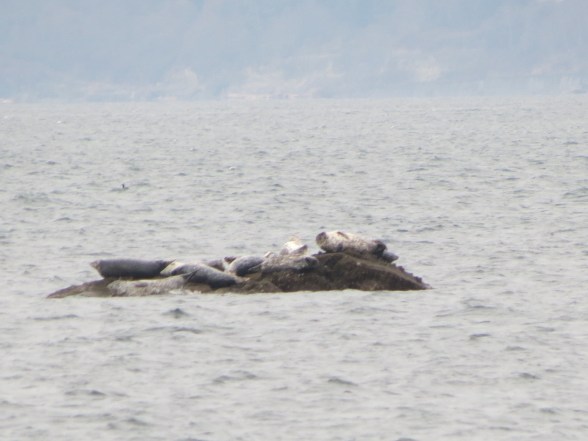
I took the photograph from Marrowstone Island. What does a healthy seal diet look like? I am so lucky to have miles of beach to hike, as long as I watch the tides and don’t mind rain.

A sign of spring, downtown, yesterday!
For Cee’s Flower of the Day.

I am looking through photographs looking for a Satyr. Or Satyrs. I know that I have Fauns on a frieze in a very peculiar old repurposed Elks Club in Portland, but Fauns are not quite Satyrs. And satirical is from a different origin than Satyr.
Really, though, I am surprised that no one was dressed as a Satyr at the Great Port Townsend Kinetic Sculpture Race.

The costumes are always amazing.
Here is a sculpture with the rider. A Satyr or not?

This is the day before the race, with the parade and the brake test and the water test. The water is in the 40s or low 50s.
What do we call a female Satyr?

No, surely she is not one. Will the Judges permit Satyrs?

It does not appear that they will.
The cover picture is most satirical to me: the joyful silliness of the human powered race, on land, on sea and through mud, with a sailboat race in the background and Indian Island, with a crane and a military presence. Let’s have more more more joyful silliness.
___________________________________
The Great Port Townsend Bay Kinetic Sculpture Race: https://www.ptkineticrace.org/
This is the 2018 Race.
For the Ragtag Daily Prompt: Satyr.

“amongst those who treat addicts of any kind generally agree that anger and shame help no one and is actively counter-productive.”*
Wait.
I have to think about that statement.
I do not agree at all.
Ok, for the physician/ARNP/PAC, anger at the patient and shaming the patient are not good practice, don’t work, and could make them worse. BUT anger and shame come up.
In many patients.
Sometimes it goes like this with opioid overuse: the person shows up, gets on buprenorphine, and is clean.
It may be a long time since they have been “clean”.
One young man wants to know WHY I am treating him as an opioid overuse patient. “Why are you treating me like an addict?”
I try to be patient. I recommended that he go inpatient, because I don’t think we will cut through the denial outpatient. Very high risk of relapse. “You have been buying oxycodone on the street for more than ten years.”
“I’ve been buying it for back pain, not to party.”
“Did you ever see a doctor about the back pain?”
“Well, no.”
“Buying it illegally is one of the criteria of opiate overuse.”
“But I’m not an addict! I’ve never tried heroin! I have never used needles!”
“We can go through the criteria again.”
He shakes his head.
He is in denial. He is fine. He doesn’t need inpatient. He is super confident, gets work again, is super proud.
And then angry. “My family still won’t talk to me!”
“Um, yes.”
“I’m clean. I’m going to the stupid AA/NA groups! Though I don’t need to. I’m fine!”
“What have you noticed at the groups?”
“What a bunch of liars!” he says, angry. “There are people court ordered there and they are still using! I can tell. They are lying through their teeth!”
“Obvious, huh?”
“Yeah!”
“Did you ever lie while you were taking the oxycodone?”
Now he ducks his head and looks down. “Well, maybe. A little.”
“Do you think your family and friends could tell?”
He glances up at me and away. “Maybe.”
“Your family may be angry and may have trouble trusting you for a while.”
“But I’ve been clean for four months!”
“How many years did you tell untruths?”
“Well.”
Shame and anger. Anger from the family and old friends, who have heard the story before, who are not inclined to trust, who are hurt and sad. The first hurdle is getting clean, but that is only the first one. Repairing relationships takes time and some people may refuse and they have that right! Sometimes patients are shocked that now that they are clean, a relationship can’t be repaired. Or that it may take years to repair. My overuse folks are not exactly used to being patient. And sometimes as they realize how upset the family and friends are, they are very ashamed. And some are very sad, at years lost, and friendships, and loved ones. I have had at least one person disappear, to relapse, after describing introducing someone else to heroin. He died about two years later, in his forties.
Shame and anger definitely come up in overuse illness.
The above is not a single patient, but cobbled together from more than one.
______________________
*from an essay titled “F—ing yes, I’m a fatphobe” on everything2.com. Today there are two with that title. The quotation is from the second essay.


Disarmed
unarmed
armless
without my right hand
unhandy
unable to shoulder much
diminished
injured
wounded
tendonitis
inflamed
irritated
limited
reduced range of motion
careful
out of reach
guarded dancing
sinister takes over
left fills in
ow
______________
I am going through physical therapy for a right biceps tendonitis. I have to pay attention not to make it worse, all that automatic reaching for things. I wrote this thinking about the word disarmed.
I am listening to Chess Blues vol. 4 1960-1967.

After the sunset, taken from North Beach.
For the Ragtag Daily Prompt: sunset.

It was cold and raining yesterday, but I have purple flowers in the grass, hoping for some sun. It sleeted too.
For Cee’s Flower of the Day.

Taken yesterday, for Cee’s Flower of the Day.
BLIND WILDERNESS
in front of the garden gate - JezzieG
Discover and re-discover Mexico’s cuisine, culture and history through the recipes, backyard stories and other interesting findings of an expatriate in Canada
Or not, depending on my mood
All those moments will be lost in time, like tears in rain!
An onion has many layers. So have I!
Exploring the great outdoors one step at a time
Some of the creative paths that escaped from my brain!
Books, reading and more ... with an Australian focus ... written on Ngunnawal Country
Engaging in some lyrical athletics whilst painting pictures with words and pounding the pavement. I run; blog; write poetry; chase after my kids & drink coffee.
Coast-to-coast US bike tour
Generative AI
Climbing, Outdoors, Life!
imperfect pictures
Refugees welcome - Flüchtlinge willkommen I am teaching German to refugees. Ich unterrichte geflüchtete Menschen in der deutschen Sprache. I am writing this blog in English and German because my friends speak English and German. Ich schreibe auf Deutsch und Englisch, weil meine Freunde Deutsch und Englisch sprechen.
En fotoblogg
Books by author Diana Coombes
NEW FLOWERY JOURNEYS
in search of a better us
Personal Blog
Art from the Earth
𝖠𝗇𝗈𝗍𝗁𝖾𝗋 𝖶𝗈𝗋𝖽𝖯𝗋𝖾𝗌𝗌.𝖼𝗈𝗆 𝗌𝗂𝗍𝖾.
Taking the camera for a walk!!!
From the Existential to the Mundane - From Poetry to Prose
1 Man and His Bloody Dog
Homepage Engaging the World, Hearing the World and speaking for the World.
Anne M Bray's art blog, and then some.
My Personal Rants, Ravings, & Ruminations
 KO Rural Mad As Hell Blog
You must be logged in to post a comment.