
fraud in medicine: navigating your failing healthcare system

Navigating health care in the United States is challenging and challenged. Currently the 800+ insurance companies, each with multiple “products”, the 500+ electronic medical records that don’t talk to each other, the increasing volume of information and the decreasing number of physicians make getting care very challenging. Here are some steps to help you navigate.

1. Get your records and keep copies.

Get the disc of any radiology studies: MRI, xray, CT scan, echocardiogram. Keep them. Hand carry to your visit with the specialist. Yes, I know your doctor said they’d be sent and I know the specialist’s office said they’d get them, but I have two friends so far this week in two days who traveled 2 hours or more to a specialist who DID NOT HAVE THE STUDIES. Do NOT give your only copy to the specialist. Demand two. Either get them on different days or just pay for the second disc.

A clinic closed in our area a year ago. It was in three counties, 3400+ patients. The physician owner was not paying the bills, including the electronic medical record. We couldn’t get records, the emr company wouldn’t release them. Gone. Thirteen people called to be new patients with me the day the clinic closed and we took five new patients a week for 6 months. You need a copy of your records.

2. In the specialist’s office or ER, do NOT give your records to the receptionist.

Hand them to the physician only. Hand them copies, you keep copies. “When will you be getting back to me?” That is, if it’s two hundred pages of complicated records, when does the physician think they can read (some) of them? The real truth is that WE CANNOT READ ALL OF THE OLD RECORDS. We don’t have time. We have to sleep. We read what we can and there are MOUNTAINS of old records that we haven’t read. I have files of old records and I pull them for visits so we can look up specific things. I have asked patients to go through and find specific things: find me the MRI report of your back.

Because what is really happening in many offices is that the information is being scanned but not read. Truly. I think this is dangerous. I had a patient who had five specialists and me. I was sending updates to his rheumatologist, with letters, asking questions and not getting a word back. Finally the patient went for the two hour trip to see the specialist, who called me: “I had not read any of your notes! I didn’t know what was happening!” I saw RED. Oh, so my letters and the ER notes and the other specialist notes that I faxed to you MYSELF about a very sick, very complicated medicine WERE NOT READ? I wanted to scream at her, but I didn’t. I just said, “We really need your help and I have been trying to keep you informed.” Through gritted teeth. Then later I kick and hit my heavy bag. And at that point the specialist was finally helpful. It still makes me furious just to think about it, so I have to work on forgiveness once again.

In my office, if a physician (me) has not read it, it has not been scanned. There will NOT be surprises in the scanned chart. The unread old records are filed alphabetically and when I have a time turner, I will have time to read them all, right? And then in a visit, the person asks if I got their mammogram report. I have to LOOK, because I sign off on about a billion different pieces of paper a day and I really don’t remember the names of all the people who had normal mammograms. I don’t try to remember that: I know who has an abnormal one, because I am worrying about them.

3. Make a record trail that you can quote.

When you call the physicians office, get the name of each person you speak to. Write it down. Have them spell it. Ask how soon you will be called back. Ask what you should do if you do not get a call back. (That being said, every physician has to prioritize the calls. It’s sickest first, not first come first served. If your call really is an emergency, then you should be in an ambulance, not calling your doctor.)Our local mental health was in such disarray, understaffed, underfunded, that my instructions to non-suicidal patients were: “Call every day, be polite, and call until they make you an appointment. Do not wait for the call back. Call daily, they just don’t have enough staff.”

If you fax them the missing notes, keep a copy of the fax proof. Call after your fax the missing records. Ask if they received them and then write down the name of the person you spoke to, date and time. I put a computer message in the chart for 99% of the phone calls I have with patients. I may miss 1% because I get interrupted or a really sick patient arrives or another phone call or whatever. Ask when the physician or his assistant will be calling you back about the records or better yet, make an appointment: “He did not have the records, so I would like an appointment as soon as possible now that he has them.” This forces your physician to look at the old records, because the patient is coming in. I do not read old records before a new patient shows up. I used to, but then people no show for a one hour new patient visit and I feel used, abused and grumpy. So I don’t touch the old records until you show up. After two one hour new patient no shows we tell the person they need to find another physician. Two strikes on the new patient visit and they are out.

4. Hospital.

If a person is really really sick, family or friends should be there. Ask questions. Who is each person who comes in the room? Do they have the clinic notes? Don’t assume they do, I am not on our hospital’s EMR because it costs 2 million dollars. The inpatient hospitalist doctors almost never call for my notes. I fax my notes anyhow and call them, but the information gap is BIG ENOUGH TO DRIVE THE MOON THROUGH. Really. I am sorry to burst the electronic medical record bubble, but we have 500ish different EMRs in the US right now and they do not talk to each other, so every patient arrives accompanied by 2 years of paper records (or more), 200 pages or more. I joke that they need a bigger doctor because the paper is too heavy for my 130 pounds. And many many times, the hospital medicine list is wrong. It is old. It’s out of date. The person is sick as hell in the emergency room and they don’t remember that their lisinopril dose was changed three weeks ago. One person in the room with the sick person and keep a notebook and write down what the physicians and nurses say, time, date. Then if they start contradicting each other, ASK.

5. In clinic

Give your doctor the whole list right away: my foot hurts, my chest is really bad when I try to run up the stairs, there’s this thing on my arm and is my cholesterol too high? Don’t discuss one thing in detail and then bring up the next. I have long visits, but I can’t do justice to that list in one visit and I have to prioritize. This requires negotiation: the chest pain has my attention. You may be focused on your foot, but the number one killer is heart, so your doctor will worry about your heart first.

If the doctor asks you to bring in all your pills, bring them all in. There are three different types of metoprolol and five strengths of each. Do you know the type and strength of every drug? I want to see your vitamin bottles because vitamin B1 can cause neuropathy from too high doses and yes, they can sell high doses. I want to see the supplements: why are you taking bovine thymus/testicle pills? By the way, if the doctor actually looks at the supplements, keep that doctor. Most don’t.

6. Be careful out there. Good luck.

P for prior authorization

The letter P and my theme is happy things. But what comes to mind are these P words: prior authorization,Β  pharmaceutical, payer.

Prior authorizations are NOT a happy thing. The latest twist from insurance companies, three different ones in the last week, is that they are requiring prior authorization for old inexpensive medicines. I ordered a muscle relaxant for night time only on Thursday last week for a person with a flare of back pain. Friday I was dismayed to see that the insurance company was requiring a prior authorization. I have to prioritize the order of urgency of all the work: I did not have time. I called the patient who had paid cash for it. The insurance company wins. They didn’t have to pay for a covered medicine because they made it difficult to get. They keep the patient’s money.

Prior authorizations are on the rise very rapidly. With over 800 insurance companies, each with a different website, each with multiple insurance “products”, no one can keep up with it. It is a shell game, the ball under the cup, three cups moving, but the ball is the money and it’s already palmed by the insurance companies. I predict that this will continue to get worse. We do need a single payer system for the simple reason that physicians will not be able to hire enough staff to learn and navigate 800 different websites. I do most prior authorizations on the phone in the room with the patient: the other day we spent 35 minutes on the phone only to have the insurance company say that we had called the wrong number. Call another one. Not the one on the insurance card. We could complain to the state insurance commissioner, but my patient is afraid of losing their insurance. Time’s up. The prior authorization is not obtained, and we are five minutes into the next patient’s visit. People are finding that the medicine they have taken for 20 years suddenly requires prior authorization.

And remember: prior authorization is your insurance company making rules and extra paperwork for your physician. It is advertised as a way to save money, but it costs YOU money. Back in 2009, the estimate was that physicians in the US had to spend 90,000$ per year EACH on employees to do prior authorizations by computer or phone. And YOUR insurance dollars go to the employees at the insurance company refusing medicines and dreaming up new medicines to refuse. They change the contract. Every year and during the year. The law is now that 80 cents of each dollar must go to healthcare, not profit, but those computer and phone employees are counted as healthcare. Do we really think that is healthcare?

Take CT scans. Medicare does NOT require prior authorization. But most insurance companies do. Think about that. Is age the difference? CT scans increase cancer risk over time so physicians don’t order them by reflex.

And for pharmaceuticals, insurance companies often have an on line formulary. But it is different for every insurance “product” in individual companies. A patient and I were trying to sort out a less expensive medicine on a website and we were having difficulty figuring out which insurance she had. Multiple abbreviations and color coding and we could spend the entire clinic visit just figuring it out. Is that what medicine is in the United States? You can say that someone else in the office could do it, but the more employees your physician hires, the less time the physician will spend with you, because he or she has to pay all of those people.

If there was one set of rules, one website, I would learn it. Medicare for all, single payer, when will the United States people wake up and tell congress: if you want our vote, make it so.

P

But wait, where are the happy things? I am so happy that I still am in business in my small clinic, p for patients and patience and prayer and single payer, we will have medicare for all in my lifetime. Whether I am still a practicing physician in the US at that time is uncertain. If I can’t afford my own health insurance, my clinic will close. Wouldn’t that be ironic?


bust

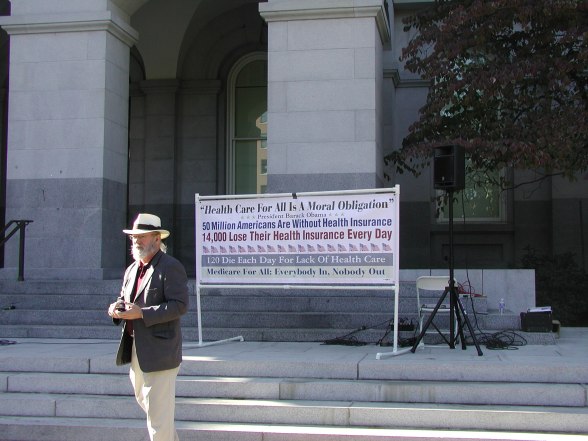
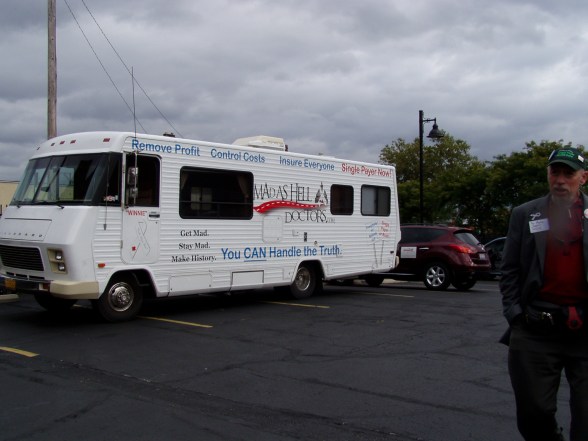
I took this in 2011, as a Mad as Hell Doctor, traveling around California talking about single payer.

We are losing more and more physicians. Our three counties, 450,000 people, are down from 8 neurologists ten years ago, to 2. The last one standing in the county of 350,000 says that he is really tired.

Single payer, medicare for all….. because I dream of other countries, civilized countries, countries where there is one set of rules, I can take care of any person who comes to me, I know what is covered and what is not, and I actually get paid….


Patients or profit?

We can choose single payer, medicare for all, with overhead of 3-4 percent. That means 96-97 cents out of every dollar goes to HEALTH CARE, not PROFIT.

Or we can choose PROFIT:Β  the current law says that the private insurance companies have to spend 80 cents of every dollar on health care. 20 cents to PROFIT.

The insurance companies’ goal is to earn money, PROFIT, not give health care.Β  They are posting BILLIONS in profit.

The person on the phone who says your medicine or care is not covered? I think the insurance companies say that is health care. They are paying the person to refuse your care. They send us weekly updates on what has changed in the 1300 different insurance companies and I don’t know how many insurance plans because they all have more than one. You ask me, your doctor, if something is covered and I say, “I have no idea. It was covered last month. It should be covered. I don’t know.” The insurance companies pay people to write an individual website for every insurance company: 1300 websites. Can YOU keep track of 1300 log ons and 1300 passwords? And I think the insurance companies say that the money paid to set up the website is health care. I don’t think it’s health care, do you?

I want my health care dollar to go to HEALTH CARE not PROFIT.

Stop the bill. Stop the insanity. Stop putting INSURANCE COMPANY PROFITS in front of HEALTH CARE. We the people of the United States can decide and can tell Congress what we want.

Medicare for all, one set of rules, 3-4% overhead, we are one nation, under God, indivisible.

And we do not put profit first.

Physicians for a National Health Program: http://www.pnhp.org/

March for people

My daughter and I marched yesterday.

She decided to come home from college for the weekend, planning to leave Saturday night. I decided not to go to the Seattle Womxn’s march, but do the Port Townsend one and asked her to join me.

We went out to breakfast and then to our small downtown. I no longer have television and look at news sites daily though a bit erratically, so neither of us had a pink hat. I wore my Mad As Hell Doctors t-shirt, my lab coat from working at the National Institutes of Health with the National Cancer Institute Patch, my Rotary name badge and pins gathered from going across the country trying to get medicare for all, single payer health care, from 2009 until now.

to womxn'smarch 089.JPG

Four bus loads went from our county to the Seattle march. We heard that the Bainbridge ferry was FULL. That is, they couldn’t not take any more walk on people. Another thirty people or more flew to the Washington DC march. And in Port Townsend, my guess is that we still had 200-300 people, women, men and children, people in wheelchairs, babies, gay, lesbian, straight, bi, trans, that marched from a small park downtown to the Haller Fountain. Galetea, naked statue at the fountain, sported a pussy hat.

to womxn'smarch 104.JPG

Our local organizer spoke and our House Representative, Derek Kilmer.

to-womxnsmarch-139

Older women spoke about demonstrating over and over in their lives. A friend of mine called me up to help her sing Holly Near’s Singing for Our Lives, making up new verses on the fly. They invited people to speak.

to womxn'smarch 152.JPG

I spoke: “I am one of your local doctors. I want to be able to treat anyone who comes to my clinic. We are one nation: health care for all. No discrimination: medicare for all.”

to womxn'smarch 157.JPG

to womxn'smarch 114.JPG

to womxn'smarch 150.JPG

Home then, and tired. My daughter has decided she wants to learn guitar, to play while people sing. I taught her basic chords and basic strumming. We sang Jamaica Farewell. She picks it up immediately, after all of those years of viola. And she will take one of my father’s guitars back to college.

And this is amazing: https://www.nytimes.com/interactive/2017/01/21/world/womens-march-pictures.html?smid=fb-share

Blessings all around.

Physicians for a National Health Care Program: http://www.pnhp.org/

https://dailypost.wordpress.com/prompts/successful/

Bruise, muscle and bone

I asked an older patient recently, “What is a bruise?”

She thought about it and said, “I don’t know.”

A bruise is blood, bleeding. Old blood changes color and is reabsorbed by the body as it heals. But where does that blood come from?

Any tissue in the body can bleed. Even a tooth, if broken into the center.

So what is bleeding for MOST bruises?

Muscle. Muscle, muscle, muscle, tendon, ligament, fascia, occasionally bone if broken and internal organs can bleed as well.

Somehow we entirely fail to teach this, at least in the US.

If you fall, or like my mountain biking daughter, hit something, your body will bleed. I tried to train the mountain bike team to carry an ace wrap and use it any time they hit something hard with an extremity. I pretty much failed. Why do I want an ace wrap and why use it immediately?

Trauma or hitting something hard causes bleeding. The more the muscle and tissue bleeds, the more swollen it gets. Usually the peak of bleeding and swelling is at about 48 hours after the injury. By then the body is sending immune system cells and repair cells to fix the trauma. It is swollen, red, hot, inflamed and painful! If we ace wrap our ankle or foot or elbow immediately, the bleeding stops faster. Wrap it, ice and elevate to keep the bleeding down. The torn muscles are held in their normal position, the bleeding stops more quickly, there is less swelling, less redness, inflammation and pain!

Our acronym is RICE:
Rest
Ice
Compression
Elevation

There are things that you can’t ace wrap: don’t ace wrap your neck or ribs and if it’s bad trauma to the head, neck, chest or abdomon, go to the emergency room! But even then, ice and compression help. First check airway, breathing and circulation, that the heart is beating if you happen on a trauma. But then try to use pressure on bleeding.

Do not put heat on a bruise for that first 48 hours. Why? It bleeds more and swells more. The exception may be if you do much more exercise than usual without a localized injury: hydrate, stay away from alcohol and a hot tub or hot bath may help. The hydration and hot water help the muscles relax and wash out the CK, creatine kinase, the protein from tiny muscle traumas that make us “stiff”.

The I in RICE used to mean ibuprofen as well. However, ibuprofen and aspirin and naprosyn are all blood thinners, so they may help with pain and inflammation, but may make the bruising worse. Acetominophen is not a blood thinner and also doesn’t do as much for inflammation, but it may be a better choice. It does help with pain.

In her third year of mountain bike racing, the Introverted Thinker had a quarter size bruise on her knee after a race.

“Are you going to do anything about that bruise?” I asked.

“No, it’s small.” she said.

“Ok.”

Two hours later: “Mom? Would you look at my knee?” Now the bruise is the size of an orange.

“Hmmm. What are you going to do about that?”

“I think I might ace wrap it and ice it and put it up for a while. Where is the ace wrap?”

Good plan. It didn’t get any bigger.

I see the handouts from the emergency room given for back pain and they are terribly misleading. It shows the spine and talks about the discs. 99% of the back pain I see is NOT a disc: it is the six layers of back muscles, and complex web of tendons, muscles and ligaments that hold the spine together and let us move in very complex ways. I pull my Netter Anatomy out daily in clinic and show people the six layers of back muscles.

What happens after a muscle is torn and bruised and bleeding? The muscle cramps up to stop the bleeding and attempt to keep from being torn more. No, I don’t like muscle relaxers much as medicines and they are useless long term. For sleep only right after injury. I am not talking about major trauma, but back pain and injuries.

If the muscle heals in the cramped position, it won’t work right any more. It can form scar tissue. It takes about six weeks for a muscle or ligament or tendon tear to heal and during that time we need to gently stretch the muscles without tearing them, so that they heal in the right position. Once they are healed in a scarred position, it’s more work to rehabilitate them, but it can be done. Physical therapy, massage therapy, chiropractor, acupuncture, but the most important work is done BY the patient, not TO them. I can’t fix it with pills. Yes, it is work.

You can bruise bone too. Ow. The surface of the bone is living cells and the bones are continually torn down by osteoclasts and rebuilt by osteoblasts. The bone can be bruised without breaking. Again, 6 weeks to heal, little kids faster and 90 year olds kind of slow.

Take care of your muscles, ligaments and tendons, and they will take care of you.


I took the photograph on the first Mad as Hell Doctors tour for health care for all in 2009. I will be marching again today:Β  WE ARE ONE NATION! HEALTH CARE FOR ALL!Β NO DISCRIMINATION!Β  MEDICARE FOR ALL!


Your health care dollar

I have been writing posts about fraud in medicine: but I think I am using the wrong title. Instead it should be your health care dollar: how the US medical corporate system wastes your health care dollar.

Think about it. What do you want to spend that dollar on?

Do you want it to go to 1300 different insurance companies and their web sites, their advertising, their competition and their profit? Do you want your healthcare dollar to go to complex coverage rules and contracts, to forms for prior authorization, for the weekly postcards and emails that they send me telling me that they have changed your coverage? Is it any surprise that I have no idea if your insurance company covers a test? They may have last week and not this week. The overhead for medicare is 2-3% administrative costs. Now why would we privatize that when the overhead for the health insurance companies is 20-30%?

How much of your health care dollar do you want to go to corporate competition?

I don’t want ANY of my health care dollar going to corporate competition and profit. I want my health care dollar going to my HEALTH. We spend the most per person in the world, almost twice as much per person per year as the next most expensive: and we don’t guarantee care. Hello, the next most expensive and all of the other nearly 40 countries, first and second world, have universal care for all their citizens. So is our care twice as good?

No, no, no, and no.

Hello, new administration. Let’s put the health care dollar where it is paying for health…. in medicare for all and in a single payer system. We have guideline after guideline on how we should treat illnesses, here:

US Preventative Task Force

The guidelines are regularly updated. If we have medicare for ALL then I will KNOW whether a test is covered or not. I have memorized the entire list of medicare covered screening tests and all the details: screen for abdominal aortic aneurysm is covered in male patients age 65-75 who have smoked more than 100 cigarettes in their life and any patient who has a family history. I have the whole list in my brain.

You CAN make a difference. Write to your congresspeople, state and national. Call them. Email them. They all have websites. Tell them YOUR health care story or the story of a friend or family member.

Join Health Care Now and Physicians for a National Health Program.

I want my health care dollar to go to HEALTH CARE.

For the Daily Post Prompts: gone and interior. Interior because I am so angry at the poor spotty costly health care for my fellow people in the US. And gone: your health care dollars is GONE: let’s use the next one wisely.