For the Daily Prompt: finally.
Patrick Rubida took the photograph, used with permission. I put up the hearts.
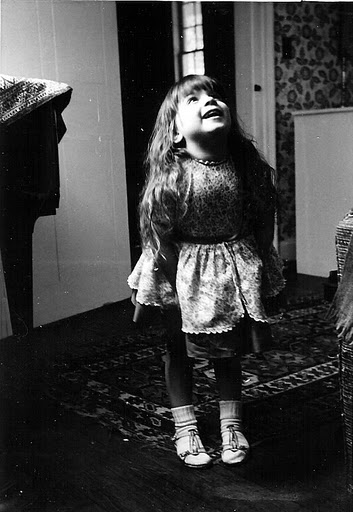
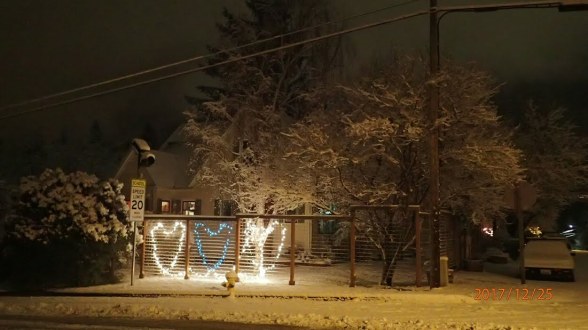
For the Daily Prompt: finally.
Patrick Rubida took the photograph, used with permission. I put up the hearts.

For the Daily Prompt: finally.

The sun is coming back!
For the Daily Prompt: miraculous!

This morning, the sun again!
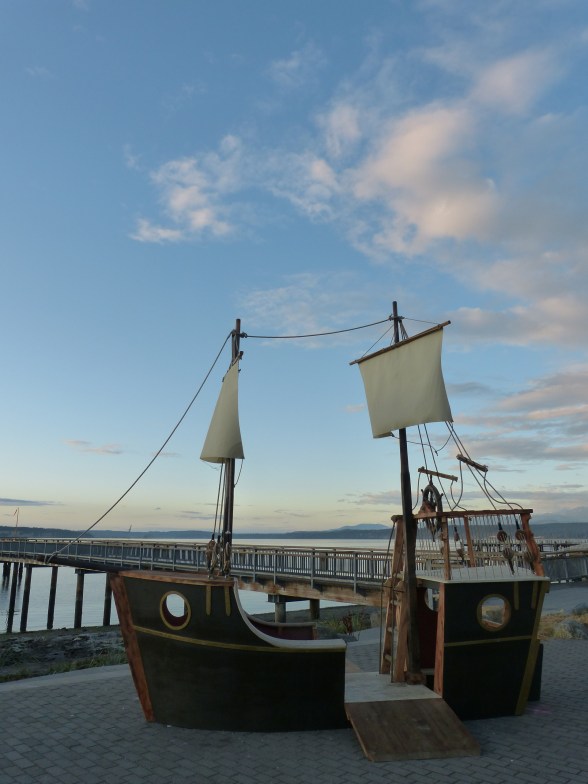
For Wordless Wednesday.

Prayers for people and animals and horses in California.
And everywhere else.
I have just spent a week in San Antonio, Texas at the AAFP FMX: American Academy of Family Physicians Family Medicine Experience.
Whew. Long acronym.
However, I attended two programs on PTSD. One was a three hour offsite one put on by the U. of Texas Health Sciences Department of Family Medicine. The other was a one hour program about active duty military and PTSD.
The biggest message for me is HOPE. Hope for treatment, hope for diagnosis, hope for destigmatization, hope for remission. I am not sure if we should call it a “cure”. Once a diabetic, always a diabetic, even if you lose 100 pounds.
In medical school 1989-1993 I learned that PTSD existed but that was about it. There was no discussion of medicines, treatment, diagnosis or cure.
Ditto residency. I learned much more about psychiatry reading about addiction and alcoholism and Claudia Black’s books then I did in residency.
Fast forward to 2010, when I opened my own clinic. I worked as a temp doc at Madigan Army Hospital for three months.
The military was aggressively pursuing treatment and diagnosis of depression, anxiety, PTSD and traumatic brain injury. I worked in the walk in clinic from 6:30 to 8:00 four days a week. Every walk in had to fill out a screen for depression. They were trying to stem the suicides, the damage, the return to civilian life problems and addiction too. They were embedding a behavioral health specialist in every section of the military. I was amazed at how hard the military was working on behavioral health.
In 2010 I took the buprenorphine course, which is really a crash course in addiction medicine, at the University of Washington Med School. I took it because it was free (I had just opened a clinic) and I thought we were as a nation prescribing WAY too many damned opioids. Yes! I found my tribe!
This gave me a second DEA number, to prescribe buprenorphine for opiate overuse, but also hooked me up with the University of Washington Telemedicine. I presented about 30 opiate overuse problem patients (anonymously, there is a form) to the team via telemedicine over the next year. The team includes a pain specialist, addiction specialist, psychiatrist and physiatrist. They do a 30 minute teaching session and then discuss 1-2 cases. They often do not agree with each other. They reach consensus and fax recommendations to me. The Friday addiction one was shut down and now I present to the Wednesday chronic pain one.
But, you say, PTSD? Well, chronic pain patients and opiate overuse patients have a very high rate of comorbid psychiatric diagnoses. It’s often hard to sort out. Are they self medicating because they have been traumatized or were they addicted first and then are depressed/traumatized and anxious? And what do you treat first?
There was an ADHD program at this conference that said we should deal with the ADHD first. One of the PTSD courses said deal with the PTSD first. The thing is, you really have to address BOTH AT ONCE.
Tools? PHQ-9, GAD-7, PCLC and there is an ADHD one too. These are short screening tools. I don’t diagnose with them. I use them to help guide therapy along with the invaluable urine drug screen. Love your patients but verify. That is, the chronic pain patient and the addiction patient tell me the same thing: but one is lying. I don’t take it personally because they are lying to themselves. Also, studies have shown that many patients lie, about their hypertension medicine or whatever. If they have to choose between food and medicine…. I think food may come first.
The San Antonio program has a behavioral health person embedded in their clinic (like a diamond) and if a PTSD screen is positive, the doctor or provider can walk them over and introduce them and get them set up. This is more likely to get the person to follow up, because there is still stigma and confusion for ALL mental health diagnoses and people often won’t call the counselor or psychologist or god forbid, psychiatrist.
They have a protocol for a short term four week treatment. Four weeks? You can’t treat PTSD in four weeks! Well, sometimes you can. But if you are making no progress, the person is referred on if they will go. I have the handouts. I do not have an embedded behavioral health person. I wish I did. I am thinking of setting a trap for one or luring them in to my clinic somehow, or asking if the AAFP would have one as a door prize next year, but…. meanwhile, I may do a trial of DIY. No! you say, you are not a shrink! Well, half of family medicine is actually sneaky behavioral health and I have the advantage of being set up to have more time with patients. Time being key. Also I have seven years of work with the telemedicine and access to that psychiatrist. Invaluable.
So what is the most common cause of civilian PTSD? Motor vehicle accidents. I didn’t know that. I would have said assault/rape. But no, it’s MVAs. Assault and rape are up there though, with a much higher PTSD rate if it is someone the victim knows or thought loved them. Rates in the US general population is currently listed at 1%, but at 12% of patients in primary care clinics. What? One in ten? Yes, because they show up with all sorts of chronic physical symptoms.
Re the military, it’s about the same. BUT noncombatant is 5%. High intensity combat has a PTSD risk of 25%, which is huge. One in four. Not a happy thing. In 2004 less then half the military personnel who needed care received it. PTSD needs to be destigmatized, prevented, treated compassionately and cured.
The risk of suicidality: 20% of PTSD people per year attempt. One in five.
Men tend to have more aggressiveness, women more depression.
Back to that PCLC. A score of over 33 is positive, over 55 is severe. There is sub threshold PTSD and it does carry a suicide risk as well. In treatment, a score drop of 10 is great, 5-10 is good and under 5, augment the treatment. Remember, the PCLC is a screening tool, not a diagnosis. I often ask people to fill out the PCLC, the GAD7 and the PHQ9 to see which is highest, to help guide me with medicines or therapy. If I need a formal diagnostic label, off to psychiatry or one of my PhD psychologists or neuropsych testing. Meanwhile, I am happy to use an adjustment disorder label if I need a label. If the patient is a veteran and says he or she has PTSD, ok, will use that.
Untreated PTSD, the rate of remission is one third at a year, the average remission is 64 months.
Treated PTSD, the rate of remission is one half at a year, and the average duration is 36 months. So treatment is not perfect by any means.
Pharmacology: FDA approved medicines include paroxetine and fluoxetine, and both venlafaxine and one other SSRI help.
Benzodiazepines make it worse! Do not use them! They work at the same receptor as alcohol, remember? So alcohol makes it worse too. There is no evidence for marijuana, but marijuana increases anxiety disorders: so no, we think it’s a bad idea. Those evil sleep medicines, for “short term use” (2 weeks and 6 weeks), ambien and sonata, they are related to benzos so I would extrapolate to them, don’t use them, bad.
Prazosin helps with sleep for some people. It lowers blood pressure and helps with enlarged prostates, so the sleep thing is off label and don’t stop it suddenly or the person could get rebound hypertension (risk for stroke and heart attack). I have a Vietnam veteran who says he has not slept so well since before Vietnam.
Part of the treatment for the PTSD folks at the U. of Texas Medical Center is again, destigmatization, normalization, education, awareness and treatment tools.
Hooray for hope for PTSD and for more tools to work with to help people!
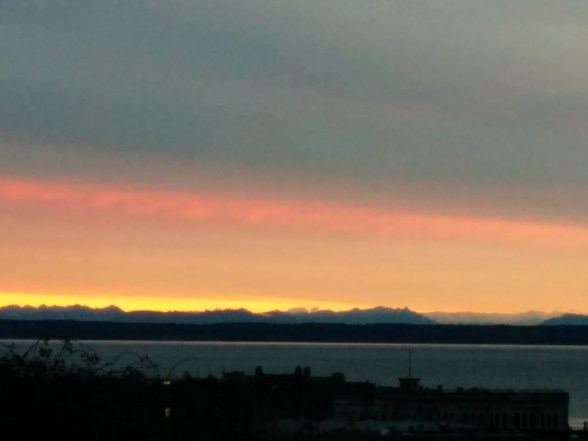
For Wordless Wednesday.
ShelterBox is a disaster relief organization that delivers a box with a family size tent, solar lights, water storage and purification equipment, thermal blankets and cooking utensils, and some things for children. The goal is immediate shelter and to help start the process of creating a home. The boxes are delivered to people world wide that have been hit by a disaster, man made or natural. They prepare and adjust them for local conditions.
ShelterBox started in 2000 in Helston, Cornwall, UK. That year, the Rotary Club of Helston-Lizard adopted it as its millennium project. The first shipment of 143 boxes went to was sent to victims of the 2001 Gujarat earthquake. ShelterBox ramped up during the 2004 Indian Ocean earthquake and tsunami. ShelterBox provided shelter for 28,000 families after the 7.0 magnitude earthquake in Haiti in 2010, about 25% of the tents sent by charities.
In the US, a ShelterBox costs $1000.00 to sponsor. Our small Sunrise Rotary Club buys at least one each year. We are notified that our box from last year went to Syrian refugees. I am so glad to be part of an organization that is doing something that is specific and positive in the world. Also, we are in a serious earthquake and tsunami zone: I hope someone sends us ShelterBoxes when we get hit. I prepare, but I keep wondering where to store things. If the house falls down, it seems unlikely that I could get to my stores….
ShelterBox gets a very high rating from Charity Navigator. Rotary International chose ShelterBox as their first Project Partner in 2012 and has renewed the partnership with ShelterBox in 2016 for another three year term.
ShelterBox: https://www.shelterbox.org/
Rotary and ShelterBox: http://www.shelterboxusa.org/about.php?page=16
wikipedia: https://en.wikipedia.org/wiki/ShelterBox
Charity Navigator: https://www.charitynavigator.org/index.cfm?keyword_list=ShelterBox&Submit2=Search&bay=search.results
Music: Would you harbor me?
http://ptsunriserotary.org/
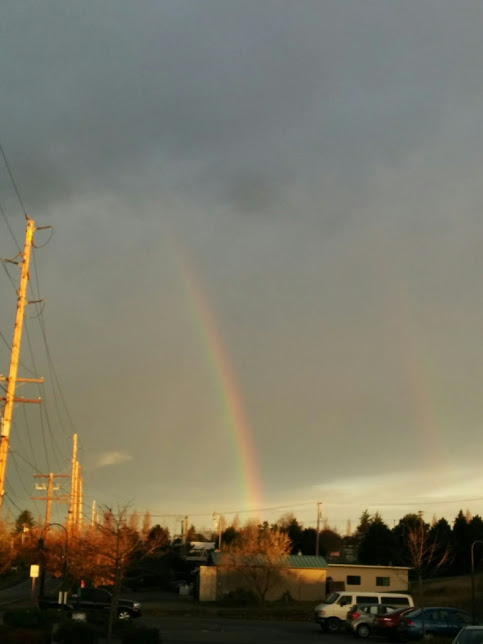
I was going to work at clinic one day last week and I was feeling down and tired. I saw this rainbow and stopped in a parking lot to photograph it. And the brighter one is leading directly to my clinic and my work.
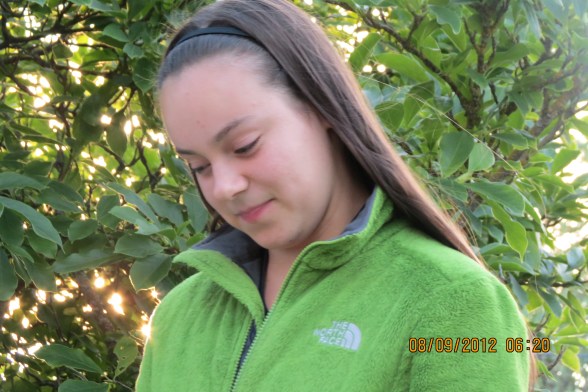
Fool hope sings in my heart, always.
I took this photograph in 2012.
BLIND WILDERNESS
in front of the garden gate - JezzieG
Discover and re-discover Mexico’s cuisine, culture and history through the recipes, backyard stories and other interesting findings of an expatriate in Canada
Or not, depending on my mood
All those moments will be lost in time, like tears in rain!
An onion has many layers. So have I!
Exploring the great outdoors one step at a time
Some of the creative paths that escaped from my brain!
Books, reading and more ... with an Australian focus ... written on Ngunnawal Country
Engaging in some lyrical athletics whilst painting pictures with words and pounding the pavement. I run; blog; write poetry; chase after my kids & drink coffee.
Coast-to-coast US bike tour
Generative AI
Climbing, Outdoors, Life!
imperfect pictures
Refugees welcome - Flüchtlinge willkommen I am teaching German to refugees. Ich unterrichte geflüchtete Menschen in der deutschen Sprache. I am writing this blog in English and German because my friends speak English and German. Ich schreibe auf Deutsch und Englisch, weil meine Freunde Deutsch und Englisch sprechen.
En fotoblogg
Books by author Diana Coombes
NEW FLOWERY JOURNEYS
in search of a better us
Personal Blog
Art from the Earth
𝖠𝗇𝗈𝗍𝗁𝖾𝗋 𝖶𝗈𝗋𝖽𝖯𝗋𝖾𝗌𝗌.𝖼𝗈𝗆 𝗌𝗂𝗍𝖾.
Taking the camera for a walk!!!
From the Existential to the Mundane - From Poetry to Prose
1 Man and His Bloody Dog
Homepage Engaging the World, Hearing the World and speaking for the World.
Anne M Bray's art blog, and then some.
My Personal Rants, Ravings, & Ruminations
 KO Rural Mad As Hell Blog
You must be logged in to post a comment.