Balancing act

I am working at a site in the greater Seattle area, but I am not going to say where. Why? Two reasons. One is that the patient diversity is huge: the organization is organized to take care of low income, uninsured and immigrant patients. The second is that I am still trying to decide if the balance of the organization is working. It may be working but it might not be working for me.

I am at a large clinic, with primary care, dental, behavioral health, a nutritionist, a pharmacy and three in person translators. In any one day I will probably use translators for at least six languages. English, Spanish, Dari, Hindi, Punjabi, Arabic, French, Somali and sometimes languages that I have to look up the country because I don’t know where that language is spoken. The work is fast and furious.

The overall no show rate is 20%. This makes the day very unpredictable. It can be very very fast and busy with everyone showing up and then later there are three no shows in a row. I think that the no show rate has been less than 20% but on Tuesday it was more. However, everyone showed up in the morning and there was a hospital follow up that should have had 40 minutes and only had 20 and of course then we ran later. My lunch theoretically starts at 12 but I went to lunch at 12:50 and came back 6 minutes late, at 1:06. Then people no showed while I worked to finish off everything from the morning. It did feel a bit nuts.

We are using the electronic medical record EPIC. I find EPIC epically frustrating. It is “feature rich” which means it has too many ways to do things. If I ask someone how to record a phone call to a patient, it takes eight steps. A week later I have to do it again, I ask again, and the next person shows me a DIFFERENT set of eight steps. And there have to be at least eight ways to do anything, so it is very confusing. Also, the “home” page can be personalized to the extent that people look at my version (I have not personalized it much) and say, “Mine looks different. I don’t know how to do that on yours.”

Whew. So, how to cope with the fast furious unpredictable schedule? I am “precharting”. For this Tuesday, I spent 70 minutes going through the patient charts on Saturday. Then I may know why they are coming in, if they had a heart attack two weeks ago and are following up, if it is a well child check and the last one was two years ago, if there are outstanding issues like a elevated liver tests or they have not been in for their out of control diabetes for a year. Then, of course, some of them do not show up. It is so busy that all I feel when someone no shows is some relief, like a ray of sunlight in a dark forest. Ok, the person who was horribly sick and in the hospital for a week and had surgery, they really do need to follow up. But I cannot make them, no one can.

We have live translators, outside translators who come with the patient, family sometimes translates and two phone translation systems. Our live translators cover the following. One Spanish only, one Dari, Arabic and ?maybe Russian. A third language. The third does Hindi, Punjabi and something else. I can’t tell by language who is a recent immigrant or refugee or who is a citizen of the United States for thirty years.

The clinic system has high standards for care of an often vulnerable population. However, I have not decided if it falls into a statement by my grandfather: “The higher the ideals of an organization, the worse its’ human relations.” My job in Alamosa had very high ideals, but I was fifth senior doctor out of 15 in a mere two years. A burnout job. This one has three new doctors coming in soon. My training and assistance to learn EPIC has been sparse and not up to my standards. If the new doctors are treated the same way then this is a burnout job as well. This is a place that I could work in intermittently alternating with other places in the country, but only if it is balanced for both the patients and the physicians. The jury is still out, but there are many red flags. It is a six month job and I am two months in, so we shall see.

Hugs to everyone.

_____________________________

For the Ragtag Daily Prompt: nuts.

The photograph is from Larrabee State Park this weekend. My daughter came out and saw many of her friends, stayed with me, and we camped for one night at Larrabee.


Conserving energy

I was out of clinic for two years and then very part time for a year and now not quite full time as a temp. I bargained to not quite be full time.

The electronic medical record is having a consequence, along with the pressure to see more people faster. The primary care doctors, at least the younger ones, do not seem to call their peer specialists any more. (Family Medicine is a specialty, just as Internal Medicine and Obstetrics/Gynecology are.) I called a gastroenterologist and left a message last week about a difficult and complex patient. The patient had cried three times during our visit. The gastroenterologist was very pleased I had called, was helpful, agreed with my plan of using the side effects of an antidepressant to try to help our patient, and thanked me three times for calling her. Wow. I am used to calling because during my first decade in Washington State, our rural hospital had Family Practice, General Surgery, a Urologist, Orthopedics and a Neurologist. For anything else, we called. I knew specialists on the phone for a one hundred mile radius and some knew me well enough that they’d say a cheery hi.

Now communication is by electronic medical record and email on the medical record and by (HORRORS) TEXT. Ugh. I think that there is quite a lot of handing the patient off by referring them to the Rheumatologist or Cardiologist or whatever, but the local Rheumatologist is booked out until February for new patients. That leaves the patient in a sort of despair if we don’t keep checking in on the problem. If I am worried, I call the Rheumatologist and say, “What can I do now?” I’ve had two people dropping into kidney failure and both times a call to the Nephrologist was very very helpful. I ordered the next tests that they wanted and got things rolling. One patient just got the renal ultrasound about three months after it was ordered. Sigh.

I have one patient who is booked in February for a specialist. I called that specialist too, they did not want any further tests. I told the patient, “You aren’t that sick so you won’t be seen for a while. It isn’t first come first serve: it is sickest first. We all have to save room for the emergencies and sometimes those are overwhelming.” The specialist agreed and the patient is fine with that and I think pleased to know that we do not think she’s that sick. She feels better. If things get worse, she is to come see me and might get moved up. Neither I nor the specialist think that will happen.

Is this conservation of energy, to communicate by email and text? I don’t think so. I think sometimes a phone call is much more helpful, because the other physician knows exactly what I am worrying about and they can tell me their thoughts swiftly. Sometimes they want me to start or change a medicine. Things can get lost in the overwhelming piles of data and the emails and labs and xrays and specialist notes all flowing in.

My Uncle Jim (known as AHU for Ancient Honorable Uncle Jim) used to sing part of this:

Yeah, that’s just how I call my fellow specialists.

For the Ragtag Daily Prompt: conservation. Don’t cats win at conservation of energy?

The isolated working

I ran my own small clinic from 2010 to 2022, working somewhere else, got Covid, was on oxygen for a year and a half, did some healing and then came back to work.

There has been a culture change in medicine that feels very strange to me. I did not notice it because I was in a solo clinic and not “part of the system”.

All the doctors, providers, are more isolated. I got a compliment yesterday when I was doing a “warm hand off” of the most sick or complicated patients, three new diabetics, a person with cancer, a person with a genetic heart problem. The doctor who I was handing off to is in the same clinic but we have barely talked since May. I don’t know her at all. She complimented me on excellent care “and calling specialists”.

I thought, huh. But I think that is a dinosaur doctor thing. I think mostly people communicate through the electronic medical record email, send messages about patients. For the decade that I was solo, I had to call other specialists because I was on a different electronic medical record. The email didn’t connect. The hospital reluctantly gave me a “link” to their system, but it was only a link to look. I could not write or send anything.

About two months ago I got an echocardiogram result. I read it and thought, ok, it’s not normal but what does it mean? Outflow obstruction by the thickened heart wall. Hmm. I called cardiology and spoke to the cardiologist who read it. He sounded surprised and said, “Idiopathic hypertrophic cardiomyopathy, most likely. It’s a classic echo.” “So, what do I do?” “Send him to me.” “Anything that I should change meanwhile?” “Yes,” says the cardiologist. He had me stop one medicine and start another. “No vasodilators and the beta blocker slowing the heart rate should help decrease the outflow obstruction.” “Got it.” I said. He also gave me two more tests to order.

I referred the patient to cardiology but it was a month before he got in. The two tests were done and they ordered more. If the diagnosis is correct, he’ll be sent to a special clinic in Denver. I called my patient while we were waiting for the cardiology visit. The medicine change had not made much difference as far as he could tell.

I was also told when I got here that I would never get a local nephrologist to see a patient, they were two busy. However, I have called two nephrologists about two patients and both took the patient and again, gave me instructions.

Two specialties have been very difficult to contact: orthopedics and gastroenterology. I have no idea why they are so difficult.

I can see that email feels faster. But there is no human contact, asking follow up questions is difficult, I don’t get that bit of further helpful education: this is what you do next. I have learned so much over the years by touching base with specialists. Once I fussed at a patient to go to hematology oncology about their high platelet count. The patient didn’t want to. He came back and said, “Apparently I have this newly found genetic problem. They put me on two medicines, not expensive. And I feel better than I have in 20 years.” I asked the oncologist about it the next time I called. He lit up, excited, and told me about the JAK-2 mutation. It is so exciting to learn about new areas in medicine and my patient says, “I have to thank you for pushing me to see the oncologist. I feel so much better.” Wow and cool.

Clinic feels like I am mostly isolated, a silo, an island, rarely talk to the other physicians unless I go to find them. I think hospital administrations like this, keeping the physicians in line by having their schedule be so packed that they almost never talk to each other. What a good way to keep physicians from interfering in the money making production! Ugh, I think it is quite horrible and unhealthy for the providers and for our countries medical system in the long run. I was seriously less lonely in a solo clinic.

The prognosis for our current medical system is very poor. The patients say to me, “Why do my doctors keep leaving?” They aren’t attached, they are isolated, I don’t think the physicians know what they are missing. Colleagues. Not silos.

For the Ragtag Daily Prompt: prognosis.

The photograph is from the Fruita Fall Festival.

Love gently

Honey is older, nearly thirty years since that first feeling of being bitten by ants. She is back in corporate medicine, as a temp. Temporary, short term, maybe that will work better.

It is a joy to go in a room and be alone with a person and their monsters. Theirs and hers. Sometimes the younger ones haven’t experienced it, they are terrified if one of their monsters becomes a little bit visible, they hate seeing them. Honey tries to be gentle. If they only want to talk about the sore shoulder and not the stress and violence, well, she leaves the door open a crack. Sometimes the monsters cry.

Older people may be stiff to start with, but when they realize their monsters are seen, acknowledged, this isn’t another robot doctor in to say increase your diabetes medicine, lower your diabetes medicine, tell them a plan without ever connecting, the older ones lean back, sigh, and relax. The monsters play on the floor, Honey’s monsters playing with theirs, happy, engaged.

The hard part is the clinic staff. Honey is with them daily. The medical assistants are young. They kick their monsters aside as they walk down the hall. It is terribly hard and heartbreaking to work at her desk, with the medical assistants’ monsters cowering under their desks, kicked, abused, silent tears and holding bruises. Honey’s monsters mind. They climb into her lap and hide their faces in her shirt, under her jacket, peer over her shoulder. They don’t understand! Why can’t she be nice to THESE monsters?

Honey whispers to her monsters when the medical assistants are rooming patients. “I am so sorry, loves. If I acknowledge these, the monsters of the women working, I become a demon. It is very hard to share an office, no wonder I worked in a clinic alone for eleven years.” Honey has been through that. It is still inconceivable that some people don’t see the monsters at all. Is it learned blindness? Or just not developed unless someone had to learn it? Unless someone grows up in terror and seeing the monsters is the only way to survive.

Honey thinks some people learn to see them as adults, at least their own monsters. Hard enough to do that, without seeing the monsters clinging to other people.

Honey is tired of her monsters crying in sympathy with the staff’s monsters. She thinks maybe there are small crumbs that she can leave for these demons. Little gifts. Her monsters can creep under the desk when she is the only one in the room and leave something. A flower. A dust bunny. A crumb of a crisp. A small rock. A little gift to let them know they are seen and loved. A poem. A prayer. Just a tiny bit of love.

_____________________________

For the Ragtag Daily Prompt: crisp.

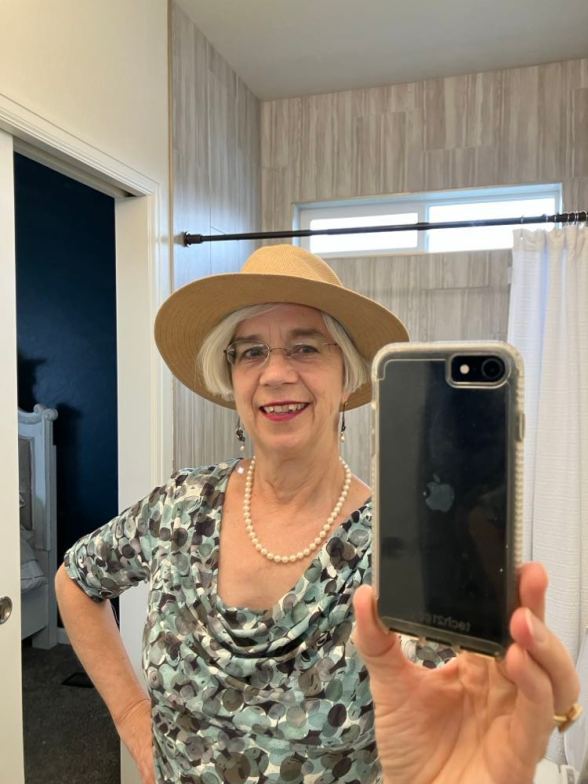
The photograph is me all dressed up for the 1940s ball.

______________________________

Doctors are leaving medicine

https://www.healthgrades.com/pro/7-reasons-doctors-are-leaving-medicine?CID=64embrdTINL120523

Ok, reason number five: “One study finds doctors spend two hours on EHR record-keeping for every single hour in clinical contact with patients. EHR dissatisfaction has been linked to higher burnout scores, and burnout can lead doctors to leave clinical practice or quit medicine altogether.”

Back in 2009 I argued with my employer about their policy. They had put us all to 20 minute visits, one 40 minute one a day, and continuous visits 8-noon and 1 to 5. Also, they had daily meetings from noon to 1. Full time was four eight hour days, except they are nine hours with the meetings. I said, “Look, one day of clinic generates at least two hours of work: reading lab results, reading radiology reports, calling patients, calling specialists, dealing with insurance, dealing with phone calls, refills, patient requests, calling pharmacies. So four 8 hour clinic days generates another 8 hours minimum of work, plus I have call nights, plus those four hours of meetings every weeks, so I am working 44 hours of week minimum and with call I can hit 60-80 hours in a week.” The administration did not care. I promptly cut to 3.5 patient days. They initially said, “You can only do 3 or 4 days, not 3.5.” I said, “Why?” They said it was not the most efficient use of clinic space. I said, “You don’t have anyone to put in for the full day, so using it for a half day generates more income than having it empty.” They reluctantly agreed.

I could finish a clinic EMR (electronic medical record) note in the room with the patient in 25 minutes but not 20, during the visit. The administration and computer loving doctors had said, this system is to let you finish the note in the room. It took me three years to be able to consistently do that in 25 minutes. Many providers were allowing their home computer to access the system. This meant they were working after hours at home after everyone else was asleep or on weekend morning. I refused to have it at home. I came into clinic at 5 am to do the work, since then I wouldn’t get interrupted, but I wanted home to be home. Also, I live four blocks from that employer.

I decided that I was sticking with finishing the notes in the room. I ran late. I apologized to patients, saying that the hospital was now requiring a quota of 18 patients a day and that I disagreed with it. I tried to convince the administration that I needed more time and help, but they dispensed with me.

Two years later another physician quit medicine and the hospital dropped the quota to 16 patients a day.

So it makes me laugh to see that it says in that article that eight hours of clinic generates sixteen hours of “EMR work”. The implication is often that it is busywork but much of it is NOT busywork. I have to read the xray report and decide what to do with it. Same for every lab. Same for the specialist letter. Same for physical therapy, respiratory therapy, home health, hospice, occupational therapy, notes from psychology or psychiatry, notes from the hospitalization here or elsewhere. Read, decide if I need to do anything, update the EMR? Sign the document off. Decide, decide, decide and get it right. Call the patient or a letter or call a specialist or ask my partner for a second set of brains, am I missing something? This is all WORK.

At one point a clinic shut down in three counties. My clinic (post hospital) took a new patient daily for months. We couldn’t get the notes so we had to look at med lists, get history from the patients and wing it. Or get hospital records labs xrays specialist notes. Yep. Nearly every patient had “deferred maintenance”: they were behind on colonoscopy, mammogram, labs, specialist visit, echocardiogram. We ordered and ordered. Then we had to deal with all the results! After about five months I say to my receptionist, “I’m TIRED.” She was too. We dropped to three new patients a week. Then two. Then one.

I also spent an hour with new patients and my visits were 30 minutes. I was the administrator of my clinic too, and pointed out to the physician (me) that we were not making much money. With 30 minutes I could look at things during the visit and explain results and get much of it, but not all, done.

So if a 20 minute clinic visit generates 40 more minutes of work, in labs, reviewing old records, reading specialist notes, reading about a new medical problem, keeping up on continuing medical education, reading xray reports, echocardiograms, writing letters for jury duty exclusion, sports physicals, disability paperwork, sleep apnea equipment, oxygen equipment, cardiac rehab reports and orders,etc, then how many patients would give us a forty hour week? At one hour per patient, that is 40 patients a week, right? 18 patients daily for 4 days is 72 per week and that is not including the on call or obstetrics done at night and on the weekend. 72 patients would generate another 144 hours of work according to that article which is untenable. 36 hours+144 hours+call = over 180 hours weekly. And so I am not surprised at the levels of burnout and people quitting.

We have to value the actual work of not only “seeing a patient” but “thinking about the patient, reading about a disorder, reading all of the notes and test results and specialist notes”. Isn’t that what we want, someone who will really spend the time and think?

As I was going to Washington, DC

As I was going to Washington, DC

I met insurance CEOs who said “Whee”!

500 Insurance CEOs said Weeee!

Have ten insurance plans EEEEEach!

Every plan has it’s own website!

Every plan is different, password for each site!

Every plan refuses coverage for different treatments, right?

Every plan demands prior authorization, doctor’s office up all night

If they refuse chemotherapy the doctor has to fight?

Prior auths, treatments, passwords, plans

Insurance companies, all those demands

As I was going to DC

How many passwords will I need?

______________________

For the Ragtag Daily Prompt: snail.

I was pricing health insurance in case I get well enough to work more. I can get an $800 a month with a $8000 deductible or a $1435 a month with a $2000 deductible. I would very much like to work part time treating Long Covid. But, ironically enough, looks like I can’t afford health insurance. It costs more than the malpractice would. Ironic, huh? It’s not like we need doctors. (I do not have a medical release yet anyhow, but time to do research. It’s making me gloomy.)

You know, if we do get Artificial Intelligence, it will take one look at the United States Medical non-system, decide we are insane, and wipe us out.

And honestly, when I was working for the hospital clinics, I thought the most brilliant person in our office was the woman who could extract a prior authorization from so many insurance companies. I would send the referral to print and half the time she would have it authorized by the time the patient got to the front desk. And why do we waste all that brilliance on giving health insurance companies a profit of 20 cents out of every dollar? That is $20,000,000 out of $100,000,000. Looks worse with bigger numbers, doesn’t it?

Physicians for a National Healthcare Program: https://pnhp.org/.

If it don’t fit, don’t force it

Templates in primary care medicine suck.

Why? The problem with templates in primary care medicine is they focus on getting a specific list of questions answered for something like ear pain or back pain. They miss the weird stuff. They miss the outliers.

I hated the templates when we got our first electronic record in the early 2000s. The doctors who liked computers spent a year picking the system. Then they trained all the clinics for one week and we all went live. One of the biggest problems was that they liked computers and talked the language. We didn’t. We quit asking questions within a week, because when we asked a question it 1. Was a user problem and 2. They treated us like we were stupid and 3. They answered in Geek, which we did not understand.

We quit asking questions. The nurses and I all filed for workman’s comp because our shoulders locked up. Our shoulders hurt. We figured out how to get the stupid thing to work. Every doctor and nurse and PAC and nurse practitioner worked to figure it out on our own.

Two years later, they set up some standards for use. We resisted again, because they gave us orders in Geek and anyhow, we had no respect for them and we didn’t care. Change what we were doing? After no support for two years? Good luck!

It took me two years and three months to get the system to write what I considered a good clinic note. I had contacted an outside specialist three months in and asked how our notes were.

“You want me to be honest?” he said.

“Yes.”

“They suck. They are useless.”

“That’s what I thought.” I went on fighting the system and hating it. I won, eventually. Parts of my note continued to suck, but I figured out how to work around the stupid templates and put in some REAL information.

Now wait, you say, is the template totally useless?

In some situations, like emergency rooms, it may be very useful. It helps keep a harried ER team with four people from a car wreck from missing something. And if you are an ENT, otolaryngologist, you do see a lot of ear and mouth and throat things, so templates may help. But I think they are terrible for primary care.

They are good for billing, though. If you have all the boxes checked, the insurance company pays, and you can move on to the next victim. The insurance companies pay more if you see more people in a day. That is why our administration said, “See people for one thing per visit.”

However, that is not ethical. Say it is a 70 year old diabetic with atrial fibrillation on coumadin with a bladder infection. You cannot just say bladder infection and slap them on sulfa. For one thing sulfa screws up the coumadin and puts them at risk for bleeding. For a second, diabetes can affect kidney function and so can age and you have to adjust antibiotic dose for lower kidney function. For a third, if their glucose levels are out of control, the infection may not be controlled by an antibiotic. It’s not one thing. And the average patient has 4 chronic disorders in a study way back in the early 2000s. That means some people have none, some people have eight or more and most people have 3-5. Hypertension, diabetes, toe fungus, chronic shoulder pain, heart disease, the list goes on and on.

In any visit, I am alert for the things the DON’T fit. One time I am doing a new patient visit for back pain and note that she is hoarse. I bug her about the hoarseness. She admits it is continuous and has been there for two months. I do two referrals, because continuous hoarseness can be laryngeal cancer.

When she returns, she thanks me. She has vocal cord polyps, not cancer, but needs laser surgery. “You didn’t have to do that but you did.” she says. And do I feel good about not ignoring it? The visit went over time, but I’d rather go over time than miss laryngeal cancer, right?

We were taught to let the patient talk. Open ended questions. They’ve done studies that doctors cut people off from telling their stories very very quickly. If you let people talk, sometimes they say something that doesn’t fit the template, and we have to pay attention. Sometimes a comment or a couple comments are the clue, the key, the thing that doesn’t fit. Don’t force it into the template. Pay attention instead.

_______________________

The very serious group of people is a county medical meeting, 2014.

fraud in medicine: navigating your failing healthcare system

Navigating health care in the United States is challenging and challenged. Currently the 800+ insurance companies, each with multiple “products”, the 500+ electronic medical records that don’t talk to each other, the increasing volume of information and the decreasing number of physicians make getting care very challenging. Here are some steps to help you navigate.

1. Get your records and keep copies.

Get the disc of any radiology studies: MRI, xray, CT scan, echocardiogram. Keep them. Hand carry to your visit with the specialist. Yes, I know your doctor said they’d be sent and I know the specialist’s office said they’d get them, but I have two friends so far this week in two days who traveled 2 hours or more to a specialist who DID NOT HAVE THE STUDIES. Do NOT give your only copy to the specialist. Demand two. Either get them on different days or just pay for the second disc.

A clinic closed in our area a year ago. It was in three counties, 3400+ patients. The physician owner was not paying the bills, including the electronic medical record. We couldn’t get records, the emr company wouldn’t release them. Gone. Thirteen people called to be new patients with me the day the clinic closed and we took five new patients a week for 6 months. You need a copy of your records.

2. In the specialist’s office or ER, do NOT give your records to the receptionist.

Hand them to the physician only. Hand them copies, you keep copies. “When will you be getting back to me?” That is, if it’s two hundred pages of complicated records, when does the physician think they can read (some) of them? The real truth is that WE CANNOT READ ALL OF THE OLD RECORDS. We don’t have time. We have to sleep. We read what we can and there are MOUNTAINS of old records that we haven’t read. I have files of old records and I pull them for visits so we can look up specific things. I have asked patients to go through and find specific things: find me the MRI report of your back.

Because what is really happening in many offices is that the information is being scanned but not read. Truly. I think this is dangerous. I had a patient who had five specialists and me. I was sending updates to his rheumatologist, with letters, asking questions and not getting a word back. Finally the patient went for the two hour trip to see the specialist, who called me: “I had not read any of your notes! I didn’t know what was happening!” I saw RED. Oh, so my letters and the ER notes and the other specialist notes that I faxed to you MYSELF about a very sick, very complicated medicine WERE NOT READ? I wanted to scream at her, but I didn’t. I just said, “We really need your help and I have been trying to keep you informed.” Through gritted teeth. Then later I kick and hit my heavy bag. And at that point the specialist was finally helpful. It still makes me furious just to think about it, so I have to work on forgiveness once again.

In my office, if a physician (me) has not read it, it has not been scanned. There will NOT be surprises in the scanned chart. The unread old records are filed alphabetically and when I have a time turner, I will have time to read them all, right? And then in a visit, the person asks if I got their mammogram report. I have to LOOK, because I sign off on about a billion different pieces of paper a day and I really don’t remember the names of all the people who had normal mammograms. I don’t try to remember that: I know who has an abnormal one, because I am worrying about them.

3. Make a record trail that you can quote.

When you call the physicians office, get the name of each person you speak to. Write it down. Have them spell it. Ask how soon you will be called back. Ask what you should do if you do not get a call back. (That being said, every physician has to prioritize the calls. It’s sickest first, not first come first served. If your call really is an emergency, then you should be in an ambulance, not calling your doctor.)Our local mental health was in such disarray, understaffed, underfunded, that my instructions to non-suicidal patients were: “Call every day, be polite, and call until they make you an appointment. Do not wait for the call back. Call daily, they just don’t have enough staff.”

If you fax them the missing notes, keep a copy of the fax proof. Call after your fax the missing records. Ask if they received them and then write down the name of the person you spoke to, date and time. I put a computer message in the chart for 99% of the phone calls I have with patients. I may miss 1% because I get interrupted or a really sick patient arrives or another phone call or whatever. Ask when the physician or his assistant will be calling you back about the records or better yet, make an appointment: “He did not have the records, so I would like an appointment as soon as possible now that he has them.” This forces your physician to look at the old records, because the patient is coming in. I do not read old records before a new patient shows up. I used to, but then people no show for a one hour new patient visit and I feel used, abused and grumpy. So I don’t touch the old records until you show up. After two one hour new patient no shows we tell the person they need to find another physician. Two strikes on the new patient visit and they are out.

4. Hospital.

If a person is really really sick, family or friends should be there. Ask questions. Who is each person who comes in the room? Do they have the clinic notes? Don’t assume they do, I am not on our hospital’s EMR because it costs 2 million dollars. The inpatient hospitalist doctors almost never call for my notes. I fax my notes anyhow and call them, but the information gap is BIG ENOUGH TO DRIVE THE MOON THROUGH. Really. I am sorry to burst the electronic medical record bubble, but we have 500ish different EMRs in the US right now and they do not talk to each other, so every patient arrives accompanied by 2 years of paper records (or more), 200 pages or more. I joke that they need a bigger doctor because the paper is too heavy for my 130 pounds. And many many times, the hospital medicine list is wrong. It is old. It’s out of date. The person is sick as hell in the emergency room and they don’t remember that their lisinopril dose was changed three weeks ago. One person in the room with the sick person and keep a notebook and write down what the physicians and nurses say, time, date. Then if they start contradicting each other, ASK.

5. In clinic

Give your doctor the whole list right away: my foot hurts, my chest is really bad when I try to run up the stairs, there’s this thing on my arm and is my cholesterol too high? Don’t discuss one thing in detail and then bring up the next. I have long visits, but I can’t do justice to that list in one visit and I have to prioritize. This requires negotiation: the chest pain has my attention. You may be focused on your foot, but the number one killer is heart, so your doctor will worry about your heart first.

If the doctor asks you to bring in all your pills, bring them all in. There are three different types of metoprolol and five strengths of each. Do you know the type and strength of every drug? I want to see your vitamin bottles because vitamin B1 can cause neuropathy from too high doses and yes, they can sell high doses. I want to see the supplements: why are you taking bovine thymus/testicle pills? By the way, if the doctor actually looks at the supplements, keep that doctor. Most don’t.

6. Be careful out there. Good luck.

Long notes and unhappy patients.

A patient of mine saw a cardiologist recently.

His previous cardiologist has retired. The patient had a cardiac bypass in the past, he has a stent, he has known coronary heart disease and he’s in the young half of my practice. That is, under 60.

He had not seen a cardiologist for 2-3 years because he had a work injury, worked with Labor and Industries, the case was closed, he couldn’t go back to work, he found a lawyer. He lost his regular health insurance along with the job, so couldn’t see the cardiologist.

The L & I case is reopened. A physiatrist recommended specific treatment that was not done, and that allowed the case to reopen.

The specific treatment center then notes that he has heart disease and that he needs clearance from a cardiologist. I set him up with a new cardiologist.

“How was the visit?” I ask.

He shrugs. “The staff was nice.”

“I have the note.”

“The cardiologist spent under ten minutes with me. It was clear that she was rushed. She did not seem very interested. It was difficult to get my questions answered.”

“Her note is six pages.”

He snorts. “Great that she could get a six page note out of that visit.”

“Do you want a copy?”

“No.”

He is cleared for the specific treatment.

I have no doubt that the cardiologist spent more than 6-8 minutes on his visit and his note. But not in the room. Other people are entering the information filled out in the waiting room, medicines, allergies, past medical history, family history. Hopefully the cardiologist is reading my note and letter. But the problem is, doctors aren’t doing it in the room. So the impression left with the patient is that we spend 6-8 minutes on their visit, we are late, we are rushed. Doctors are looking at data. They are not listening to patients.

Medical Economics, a journal that arrives without me asking for it, says over and over that we need more physician “extenders”, that we need to have people doing the data entry, people doing the patient teaching, more people and machines….No. They are wrong. We need LESS barriers between us and the patients, not MORE. We need more time with patients. Every single extender we add burns physicians out more, because the salary has to be paid AND more patients seen faster to do that AND we are still ultimately responsible for knowing and reading and absorbing every single piece of information that is placed in that patient’s chart. An extender is NOT an extension of my brain and an extender is another person I have to communicate with and train.

Just. Say. No. to the managers who pile MORE barriers between the physician and the patient. NO.


It just makes me so mad that he lost his health insurance BECAUSE he got injured at work and so then his heart disease goes untreated as well… can’t afford medicines…if he then has a heart attack while uninsured we lifeflight him to Seattle, it costs a fortune, he loses his house and property and then is on medicaid and may end up on permanent disability, and what are the chances he returns to work? The US medical corporate money grubbing is insane. Single payer, medicare for all, make the US great again.

Templates and the death of medicine

One of the many problems that are killing medicine in the US and especially primary care is templates.

Templates are a nightmare.

Why?

In a template, for back pain, there is a list of questions and in some there is also a list of answers. The “provider” asks the questions on the list and then checks off the answers. This is absolutely terrible brainless stupid failure of medicine. Because the most important answer that the patient gives is the one that does not fit the routine pattern of back pain or ear pain.

For example, I saw a woman for a new patient visit for back pain. Years ago. Half way through the questions about back pain I say, “How long have you been hoarse?”

She stops. She has to think about it. “Three months.”

“Continuously or does it come and go?”

Again, thought. “Continuously.”

On with the back pain. But she gets TWO referrals, one to an otolaryngologist. I ask other voice and throat questions.

When she returns she thanks me. Continuous hoarseness is worrisome for vocal cord cancer. You have to rule it out. She did not have vocal cord cancer. She did have vocal cord polyps and was going to have laser surgery.

But as a physician or “provider” you have to PAY ATTENTION. And ignoring the thing that doesn’t “fit” or isn’t relevant or isn’t on the god damned template — just don’t do it.

Another new patient. Back pain. Routine, routine, routine, one in four people get it in their lives. All the questions indicating that it’s musculoskeletal, not a disc, 99% are not discs, until:

“Sometimes my leg goes numb from the knee down.”

I stop. “How often? The whole leg?”

“Whole leg, yes.” She doesn’t know how often.

“If that happens I want to see you right away. Call.”

…because that is not a disc and it’s not musculoskeletal. And people say that but usually it can’t be confirmed on exam.

She calls. “Both legs are numb from the knee down.”

“Get in here.”

On exam she is not only numb but the muscles of her feet and ankles are weak and the reflexes don’t work right. I call neurology, anxious. “MRI from her head to her tailbone.”

She has multiple sclerosis lesions, more than one, in her brain. And a normal brain MRI from a few years before when she also had weird symptoms….

So it is NOT the template, the routine questions, that diagnose odd things in medicine. It’s the off hand comment, the puzzle piece that doesn’t fit, the symptom or sign that I notice and that gets my attention.

I hate the templates when we first get an electronic medical system. It sucks. It generates unreadable generic sentences: “The patient has ear pain. The quality of the ear pain is sharp. The ear pain has gone on for 6 weeks. The level of the ear pain is high.” Etc. Ok, that patient sounds like a robot. I quickly figure out how to type into the stupid boxes and avoid the templates as much as possible. I also start offering additions to the templates. “Ok, add this to quality of ear pain: It feels like being kicked over and over with the metal pointed tip of a cowboy boot.” Also to tachycardia: “It feels like a salmon is swimming upstream in my chest.”

See patients for one thing only. That would have really helped the hoarse woman, right?Β  Do the template. Do 10, 15, or 20 minute visits. The best doctors are rebelling and quitting, especially in primary care, because this is killing medicine. Why see people for one thing only? MONEY. MONEY MONEY MONEY. No. I like to work in medicine and I like to dig down, pay attention, listen and watch for the little details that stick out, the puzzle pieces that don’t fit….

….because that is what real medicine is. Not template robot medicine.