
Update on PTSD 2017: hope!

I have just spent a week in San Antonio, Texas at the AAFP FMX: American Academy of Family Physicians Family Medicine Experience.

Whew. Long acronym.

However, I attended two programs on PTSD. One was a three hour offsite one put on by the U. of Texas Health Sciences Department of Family Medicine. The other was a one hour program about active duty military and PTSD.

The biggest message for me is HOPE. Hope for treatment, hope for diagnosis, hope for destigmatization, hope for remission. I am not sure if we should call it a “cure”. Once a diabetic, always a diabetic, even if you lose 100 pounds.

In medical school 1989-1993 I learned that PTSD existed but that was about it. There was no discussion of medicines, treatment, diagnosis or cure.

Ditto residency. I learned much more about psychiatry reading about addiction and alcoholism and Claudia Black’s books then I did in residency.

Fast forward to 2010, when I opened my own clinic. I worked as a temp doc at Madigan Army Hospital for three months.

The military was aggressively pursuing treatment and diagnosis of depression, anxiety, PTSD and traumatic brain injury. I worked in the walk in clinic from 6:30 to 8:00 four days a week. Every walk in had to fill out a screen for depression. They were trying to stem the suicides, the damage, the return to civilian life problems and addiction too. They were embedding a behavioral health specialist in every section of the military. I was amazed at how hard the military was working on behavioral health.

In 2010 I took the buprenorphine course, which is really a crash course in addiction medicine, at the University of Washington Med School. I took it because it was free (I had just opened a clinic) and I thought we were as a nation prescribing WAY too many damned opioids. Yes! I found my tribe!

This gave me a second DEA number, to prescribe buprenorphine for opiate overuse, but also hooked me up with the University of Washington Telemedicine. I presented about 30 opiate overuse problem patients (anonymously, there is a form) to the team via telemedicine over the next year. The team includes a pain specialist, addiction specialist, psychiatrist and physiatrist. They do a 30 minute teaching session and then discuss 1-2 cases. They often do not agree with each other. They reach consensus and fax recommendations to me. The Friday addiction one was shut down and now I present to the Wednesday chronic pain one.

But, you say, PTSD? Well, chronic pain patients and opiate overuse patients have a very high rate of comorbid psychiatric diagnoses. It’s often hard to sort out. Are they self medicating because they have been traumatized or were they addicted first and then are depressed/traumatized and anxious? And what do you treat first?

There was an ADHD program at this conference that said we should deal with the ADHD first. One of the PTSD courses said deal with the PTSD first. The thing is, you really have to address BOTH AT ONCE.

Tools? PHQ-9, GAD-7, PCLC and there is an ADHD one too. These are short screening tools. I don’t diagnose with them. I use them to help guide therapy along with the invaluable urine drug screen. Love your patients but verify. That is, the chronic pain patient and the addiction patient tell me the same thing: but one is lying. I don’t take it personally because they are lying to themselves. Also, studies have shown that many patients lie, about their hypertension medicine or whatever. If they have to choose between food and medicine…. I think food may come first.

The San Antonio program has a behavioral health person embedded in their clinic (like a diamond) and if a PTSD screen is positive, the doctor or provider can walk them over and introduce them and get them set up. This is more likely to get the person to follow up, because there is still stigma and confusion for ALL mental health diagnoses and people often won’t call the counselor or psychologist or god forbid, psychiatrist.

They have a protocol for a short term four week treatment. Four weeks? You can’t treat PTSD in four weeks! Well, sometimes you can. But if you are making no progress, the person is referred on if they will go. I have the handouts. I do not have an embedded behavioral health person. I wish I did. I am thinking of setting a trap for one or luring them in to my clinic somehow, or asking if the AAFP would have one as a door prize next year, but…. meanwhile, I may do a trial of DIY. No! you say, you are not a shrink! Well, half of family medicine is actually sneaky behavioral health and I have the advantage of being set up to have more time with patients. Time being key. Also I have seven years of work with the telemedicine and access to that psychiatrist. Invaluable.

So what is the most common cause of civilian PTSD? Motor vehicle accidents. I didn’t know that. I would have said assault/rape. But no, it’s MVAs. Assault and rape are up there though, with a much higher PTSD rate if it is someone the victim knows or thought loved them. Rates in the US general population is currently listed at 1%, but at 12% of patients in primary care clinics. What? One in ten? Yes, because they show up with all sorts of chronic physical symptoms.

Re the military, it’s about the same. BUT noncombatant is 5%. High intensity combat has a PTSD risk of 25%, which is huge. One in four. Not a happy thing. In 2004 less then half the military personnel who needed care received it. PTSD needs to be destigmatized, prevented, treated compassionately and cured.

The risk of suicidality: 20% of PTSD people per year attempt. One in five.

Men tend to have more aggressiveness, women more depression.

Back to that PCLC. A score of over 33 is positive, over 55 is severe. There is sub threshold PTSD and it does carry a suicide risk as well. In treatment, a score drop of 10 is great, 5-10 is good and under 5, augment the treatment. Remember, the PCLC is a screening tool, not a diagnosis. I often ask people to fill out the PCLC, the GAD7 and the PHQ9 to see which is highest, to help guide me with medicines or therapy. If I need a formal diagnostic label, off to psychiatry or one of my PhD psychologists or neuropsych testing. Meanwhile, I am happy to use an adjustment disorder label if I need a label. If the patient is a veteran and says he or she has PTSD, ok, will use that.

Untreated PTSD, the rate of remission is one third at a year, the average remission is 64 months.

Treated PTSD, the rate of remission is one half at a year, and the average duration is 36 months. So treatment is not perfect by any means.

Pharmacology: FDA approved medicines include paroxetine and fluoxetine, and both venlafaxine and one other SSRI help.

Benzodiazepines make it worse! Do not use them! They work at the same receptor as alcohol, remember? So alcohol makes it worse too. There is no evidence for marijuana, but marijuana increases anxiety disorders: so no, we think it’s a bad idea. Those evil sleep medicines, for “short term use” (2 weeks and 6 weeks), ambien and sonata, they are related to benzos so I would extrapolate to them, don’t use them, bad.

Prazosin helps with sleep for some people. It lowers blood pressure and helps with enlarged prostates, so the sleep thing is off label and don’t stop it suddenly or the person could get rebound hypertension (risk for stroke and heart attack). I have a Vietnam veteran who says he has not slept so well since before Vietnam.

Part of the treatment for the PTSD folks at the U. of Texas Medical Center is again, destigmatization, normalization, education, awareness and treatment tools.

Hooray for hope for PTSD and for more tools to work with to help people!

primary care medicine: schedule

I see patients from 8:30 or 8:00 am until 2:00 pm.

We have people say, “You are off after 2:00.”

Well, no. Most days I work for 2-3 hours beyond the patient contact time. Sometimes I come in early and sometimes it is from 2pm to 5pm and sometimes it is the weekend or into the evening.

So what am I doing?

  1. returning phone calls
  2. doing refills. To do a refill I check when the patient was last seen and whether they are due for laboratory.
  3. reading specialist notes and updating medicine lists, diagnoses and contacting patients to get tests or follow up that the specialist has recommended
  4. reviewing lab results and sending a letter or signing to be scanned and to be available at the follow up visit or calling the patient
  5. reading emergency room notes and hospital discharge summaries and setting those patients up for follow up, updating medicine lists and adding to diagnosis lists.
  6. dealing with multiple stupid letters from insurance companies questioning the medication that I have prescribed. Mostly I mail these to patients.
  7. running my small business: long term planning, short term planning, advertising, commercial insurance
  8. 50 hours of continuing medical education yearly
  9.  Updating my medical license, medical specialty board eligibility, business license, CAQH, DEA number, Clia lab waiver, medicare’s shifting rules, medicaid’s shifting rules, tricare’s rules, and 1300 insurance company’s shifting rules and medicine rejections and prior authorizations even for a medicine a person has been on for 20 years.
  10. Worrying about small business costs as reimbursement costs drop: health insurance. Retirement. L&I. Employees. Malpractice insurance, small business insurance, the lease, staff costs.
  11.  Discussing and updating medical supplies and equipment, office supplies and equipment
  12. Updating clinic policies and paperwork per the change in laws. Have you read the Obamacare Law? Over 3000 pages. HIPAA. The DEA. Recommendations from the CDC, federal laws, state laws, internet security, patient financial and social security security.
  13. Trying to track what we collect. That is, say I bill $200.00. Since I accept insurance, the insurer will tell me what is the “allowed” amount per me contracting as a “preferred” provider. The “allowed” amount is really the contracted amount. Then the insurance company either pays it or says that the patient has a deductible. This could be $150 per year or $5000.00 per year. With medicare I then have to bill a secondary if the person has it and then anything left is billed to the patient. Oh, don’t forget copays, if they don’t pay that we have to bill it. So to get paid the complete contracted amount, aka “allowed” we may have to submit bills to two or even three insurances and the patient. We might be done two months after the patient is seen.
  14. Trying to convince recalcitrant computers and printers and equipment that indeed, it doesn’t have a virus, oh, or maybe it does, and fixing them.

My goals are to give excellent care AND to work 40 hours a week. Half of my patients are over 65 and many are complicated, with multiple chronic illnesses.  When I saw patients 4 days a week for 8 hours, with an hour hospital clinic meeting every day, I also spent at least an additional 8 hours and more trying to keep up with most of those things above. The average family practice physician makes more money than I do. But they also report working 60-70 hours a week on average. I do not think this is good for patients or doctors or doctors’ families or their spouses or children. The primary care burn out report rose from 40% to 50% of the doctors surveyed.

We need change, we need it now, and we need to be realistic about how much work is healthy.

When I was still delivering babies, women would ask if I could guarantee doing the delivery. I would explain: “We do call for up to 72 hours. If you go into labor at the end of that, you would rather have a physician who is awake and rested and has good judgement. Besides, I’m a bit grumpy after 72 hours. ” And they agreed that they really don’t want an exhausted burned out physician.

I took the photograph of Mordechai, our skeleton, today. She is genuine plastic. I wish she would do some of the paperwork, but at least she lightens things by making us laugh. She gets various wigs and outfits and sometimes comes out to show a patient a hip joint.

I am NOT attracted to paperwork. I think I am repelled. For the Daily Prompt: magnetic.


Forgiveness 2

I wrote this poem in 2009 when I was struggling with forgiveness and wanting to forgive. How do we forgive when someone does not apologize? When they do not explain nor listen to your hurt and grief? Yet forgiveness is internal in each of us. The external is reconciliation and that requires listening from both sides.

Forgiveness

I want to forgive something
Someone
In fact a group
Something that hurt a lot
I’ve tried logic
I tell myself
“It was an expression of concern”

My heart doesn’t agree
It is sullen
Immobile and grumpy
It whispers
“They have not apologized”
It whispers
“When people say you’re crazy
It could be a joke
An expression of concern
It wasn’t
It was a palm held out
At arm’s length
To distance me.”

My head argues
“That’s what it felt like to you.
You don’t know their intentions.”

I want to write
A poem of forgiveness
Hoping my heart will follow

My conscious doesn’t write my poems
My conscious wrestles with an idea
The poem comes out of this struggle
I look at the poem I’ve written
I think,
“That is what I would like
my conscious heart to feel.”
My poem is often more generous
than my conscious feels

My poems are not mine
They are a gift
From the unconscious
It is much larger
Than the small conscious me
I dream of feeling envy
I climb into a bathtub
And transform myself
To battle a trickster
We are transported
To the bottom of the ocean

In the ocean
The trickster and I are one
It is unlimited
It is not my unconscious
There is no separation
It is all unconscious

I did not think
A poem would give forgiveness
But pain drove me
Into the sea
I am connected
You gave me these pearls
Thank you


I am submitting this to the Daily Prompt: jiffy. I wish this could happen in a jiffy…. but it is slow….

Health and teeth

For the Daily Prompt: toothbrush.

Here is a young rabbit. Their front teeth grow and get worn down eating. Their nails keep growing too and need to be worn down or clipped if they are pets.

In my county there are no dentists who take the state Medicaid for dental. And in some states Medicaid covers orthodontia for children but not in mine. Teeth are not covered on Washing ton State for my Medicare or Medicaid. And there are still battles going on about covering mental health including addiction. Is mental health not part of health? Are teeth not part of health? Why do we put health insurance profitable before basic life saving health coverage that covers all of us?

Health care should be like a toothbrush. We all need it. We all should have it.


Substandard

What comes to mind for today’s Daily Prompt: substandard?

As a rural Family Practice Physician, what comes to mind is the United States current health care system.

There is nothing substandard about our health insurance system: it does what it is supposed to, which is earn money for owners and investors. But it is frankly terrible at delivering health care, health care is not the goal, and we spend twice as much per US citizen as the next most expensive health care system in the world. And we do not have universal health care for our citizens and we rank below 30th in health care measures.

Wake up, US citizens. Let’s buy health care with our dollars, not health insurance. Single payer, one system, low overhead, clear rules and coverage and everyone in, no one out.


sunrise

Joy  today. I am so deeply thankful that this health insurance bill has been voted down. Health insurance because it was not going to improve health care. It would have increased profits and worsened citizens’ health.

Our chorus performed last night and the music is still playing in my head… from a Shawn Kirchner piece. “It shall be well with you…..”

I took this in 2012.

But I don’t want to pay for the obese smoking couch potato

I wrote this in 2010 and I am posting it again. It’s TIME, Congress, time for single payer, medicare for all! Lots of Senators are all talk about repealing Obamacare. One part of that law is that your health insurance company can ONLY keep 20% of each dollar for profit. The other 80% must be spent on health care. Before that, health insurance companies kept 30% of every health dollar. So tell me, US citizens, WHY do you want to repeal that? So health insurance corporation owners can go back to keeping 30% of every premium? Call you Senator and say NO.

And by the way, Senators who want to repeal Obamacare. You could have been writing a new bill with transparency and honesty for the last seven years, but all you’ve done is say “We will repeal Obamacare.” Saying “We can do better,” is boasting: you haven’t done the work. Stop hiding behind closed doors. I am submitting this to the Daily Prompt: hidden.

From 2010:

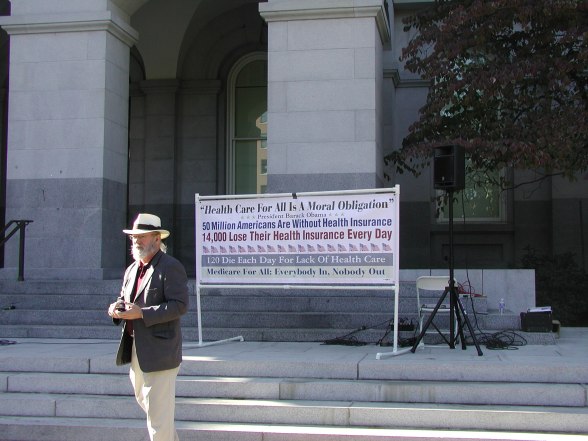
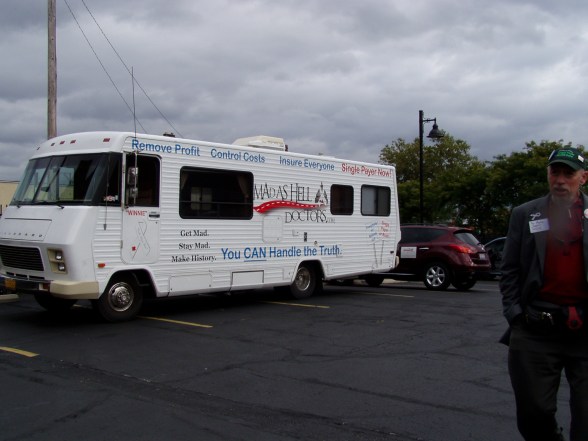
I went on the Mad as Hell Doctor’s tour for a week. I went from Seattle to Denver with stops for town halls one to three times a day. We are talking about single payer, HR676.

One question or objection to a single payer system was: Why should my money go to pay for some obese person who drinks and smokes, doesn’t exercise and doesn’t eat right?

Three answers to start with:

1. You already pay for them.

2. Put out the fire.

3. People want to change.

First: You already pay for them. As a society, we have agreed that people who show up in an emergency room get care. Suppose we have a 53 year old man, laid off, lost his insurance, not exercising, not eating right, smokes, drinks some and he starts having chest pain. Suppose that he lives in my small town.

He calls an ambulance. They take him to our rural emergency room. Oh, yes, he is having a heart attack, so they call a helicopter to life flight him from small town hospital to a big one in Seattle. This alone costs somewhere between $7000 and $12000. Now, do you know how many clinic visits he could have had for $7000? To see me, a lowly rural specialist in Family Practice where I would have looked at his blood pressure and nagged, that is, encouraged him to stop smoking. We would have talked about alcohol and depression. And who is paying for the helicopter meanwhile? All of us. The hospital has to pass on the costs of the uninsured to the rest of the community, the government is paying us extra, with a rural hospital designation. 60% of health care dollars already flow through the government. One estimate of the money freed from administrative costs by changing to a single payer system is $500 million.

Taking care of people only when they have their big heart attack is ridiculously expensive. It is a bit like driving a car and never ever doing maintenance until suddenly it dies on the highway. No oil, tires flat, transmission shot and ran into a tree in the rain because the windshield wiper fluid had been gone for a while. I get to take care of Uncle Alfred. He is 80 and has not seen a doctor for 30 years and is now in the hospital. “But he’s been fine,” says the family. Nope. He has had high blood pressure for years, that has led to heart failure, he has moderate kidney failure, his lungs are shot from smoking, turns out he developed diabetes sometime in the last 30 years and he’s going blind. Can’t hear much either. We have a minor celebration in the ICU because he doesn’t drink, so his liver actually works. He goes home on 8 new medicines.

Secondly: Put out the fire. When someone’s house is burning down, as a society we do not say, well, she didn’t store her paint thinner right or trim her topiary enough and she has too many newspapers stacked up. We go put out the fire. Putting out the fire helps us as a society: it keeps the fire from spreading to other houses. It saves lives and is compassionate. We think firemen and women are heros and heroines. And they are.

In the past, a homeowner would have to pay for fire service and would have a sign on their home. If the house was on fire and a different company was going by, that company wouldn’t put out the fire. We have the equivalent with health insurance right now. It would be much more efficient and less costly to have a single payer. Medicare has a 3-4% overhead: it is a public fund paying private doctors and hospitals. For private insurers the administrative costs are 30% or greater. That is, 1/3 of every dollar of your premium goes to administration, not health care. The VA is a socialized system, with the hospitals owned by the government and the medical personnel paid by them.

When someone asks why they should help someone else, I also know that they haven’t been hit yet. They have not gotten rheumatoid arthritis at age 32 or had another driver run in to them and broken bones or had another unexpected surprise illness or injury that happened in spite of the fact that they don’t smoke, don’t drink, eat right and exercise. Everyone has a health challenge at sometime in their life.

Third: people want to get better. Really. In clinic I do not see anyone who doesn’t hope a little that their life could change, that they could lose weight, stop smoking. True, there are some drinkers who are in denial, but I will never forget taking the time to tell a patient why he would die of liver failure if he didn’t stop drinking. He came back 6 weeks later sober. I said, “You are sober!” (We don’t see that response very frequently.) He looked at me in surprise: “You said I’d die if I didn’t stop.” He never drank again. It made it really hard to be totally cynical about alcohol and I can’t do it. People change and there is hope for change. I feel completely blessed to support change in clinic and watch people do it. They are amazing. But they need support and they need someone to listen and they need a place to take their fears and their confusion. Primary care is, in a sense, a job of nagging. But it is also a job of celebration because people do get better.

We are already paying, in an expensive, inefficient and dysfunctional way. It saves money to put out the fire. People want to get better. Winston Churchill said, “Americans always do the right thing after they have exhausted all other possibilities.” It is time to do the right thing. Single payer. The current bill is HR676. We can and we will.

Patients or profit?

We can choose single payer, medicare for all, with overhead of 3-4 percent. That means 96-97 cents out of every dollar goes to HEALTH CARE, not PROFIT.

Or we can choose PROFIT:  the current law says that the private insurance companies have to spend 80 cents of every dollar on health care. 20 cents to PROFIT.

The insurance companies’ goal is to earn money, PROFIT, not give health care.  They are posting BILLIONS in profit.

The person on the phone who says your medicine or care is not covered? I think the insurance companies say that is health care. They are paying the person to refuse your care. They send us weekly updates on what has changed in the 1300 different insurance companies and I don’t know how many insurance plans because they all have more than one. You ask me, your doctor, if something is covered and I say, “I have no idea. It was covered last month. It should be covered. I don’t know.” The insurance companies pay people to write an individual website for every insurance company: 1300 websites. Can YOU keep track of 1300 log ons and 1300 passwords? And I think the insurance companies say that the money paid to set up the website is health care. I don’t think it’s health care, do you?

I want my health care dollar to go to HEALTH CARE not PROFIT.

Stop the bill. Stop the insanity. Stop putting INSURANCE COMPANY PROFITS in front of HEALTH CARE. We the people of the United States can decide and can tell Congress what we want.

Medicare for all, one set of rules, 3-4% overhead, we are one nation, under God, indivisible.

And we do not put profit first.

Physicians for a National Health Program: http://www.pnhp.org/

Templates and the death of medicine

One of the many problems that are killing medicine in the US and especially primary care is templates.

Templates are a nightmare.

Why?

In a template, for back pain, there is a list of questions and in some there is also a list of answers. The “provider” asks the questions on the list and then checks off the answers. This is absolutely terrible brainless stupid failure of medicine. Because the most important answer that the patient gives is the one that does not fit the routine pattern of back pain or ear pain.

For example, I saw a woman for a new patient visit for back pain. Years ago. Half way through the questions about back pain I say, “How long have you been hoarse?”

She stops. She has to think about it. “Three months.”

“Continuously or does it come and go?”

Again, thought. “Continuously.”

On with the back pain. But she gets TWO referrals, one to an otolaryngologist. I ask other voice and throat questions.

When she returns she thanks me. Continuous hoarseness is worrisome for vocal cord cancer. You have to rule it out. She did not have vocal cord cancer. She did have vocal cord polyps and was going to have laser surgery.

But as a physician or “provider” you have to PAY ATTENTION. And ignoring the thing that doesn’t “fit” or isn’t relevant or isn’t on the god damned template — just don’t do it.

Another new patient. Back pain. Routine, routine, routine, one in four people get it in their lives. All the questions indicating that it’s musculoskeletal, not a disc, 99% are not discs, until:

“Sometimes my leg goes numb from the knee down.”

I stop. “How often? The whole leg?”

“Whole leg, yes.” She doesn’t know how often.

“If that happens I want to see you right away. Call.”

…because that is not a disc and it’s not musculoskeletal. And people say that but usually it can’t be confirmed on exam.

She calls. “Both legs are numb from the knee down.”

“Get in here.”

On exam she is not only numb but the muscles of her feet and ankles are weak and the reflexes don’t work right. I call neurology, anxious. “MRI from her head to her tailbone.”

She has multiple sclerosis lesions, more than one, in her brain. And a normal brain MRI from a few years before when she also had weird symptoms….

So it is NOT the template, the routine questions, that diagnose odd things in medicine. It’s the off hand comment, the puzzle piece that doesn’t fit, the symptom or sign that I notice and that gets my attention.

I hate the templates when we first get an electronic medical system. It sucks. It generates unreadable generic sentences: “The patient has ear pain. The quality of the ear pain is sharp. The ear pain has gone on for 6 weeks. The level of the ear pain is high.” Etc. Ok, that patient sounds like a robot. I quickly figure out how to type into the stupid boxes and avoid the templates as much as possible. I also start offering additions to the templates. “Ok, add this to quality of ear pain: It feels like being kicked over and over with the metal pointed tip of a cowboy boot.” Also to tachycardia: “It feels like a salmon is swimming upstream in my chest.”

See patients for one thing only. That would have really helped the hoarse woman, right?  Do the template. Do 10, 15, or 20 minute visits. The best doctors are rebelling and quitting, especially in primary care, because this is killing medicine. Why see people for one thing only? MONEY. MONEY MONEY MONEY. No. I like to work in medicine and I like to dig down, pay attention, listen and watch for the little details that stick out, the puzzle pieces that don’t fit….

….because that is what real medicine is. Not template robot medicine.