Look longing

This is for Ronovanwrites weekly haiku challenge #75: the words are charm and look. The prompt includes that the first two lines should make a sentence with the opposite meaning of the sentence made by the second two lines…..

you gift a young girl
I see your charm, look longing
see you lie to me

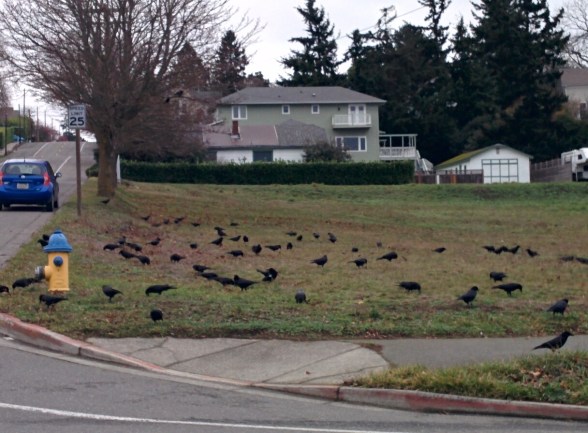
I took the photo across the street from my clinic just a few days ago.

Live germ

This is for Ronovan’s Weekly Haiku Challenge #72, prompt words life and give.

They say they protect
life given by taking a
life, germ live alone

I am thinking of more than one definition of germ: an ovum and a sperm are germ cells, that could develop into an organism. When there is fighting and death over abortion I remember that the egg and the sperm are alive too separately. They can’t all live: we don’t have room or food, do we? And I was playing with more than one meaning and pronunciation of live.

Full Definition of GERM

1a :  a small mass of living substance capable of developing into an organism or one of its parts
b :  the embryo with the scutellum of a cereal grain that is usually separated from the starchy endosperm during milling

2:  something that initiates development or serves as an origin :  rudiments, beginning

3:  microorganism; especially :  a microorganism causing disease

I took the photo at our home swim meet.

Dream state

I am in the soft dream state
longing for my love and mate
my heart won’t stop or hesitate

I cross the border into dreams
nothing quite is what it seems
I stop and play in bubbling streams

I wander in the tall green grass
years since the mower’s pass
unsullied by the smell of gas

I lean against a tree
I feel quiet happy free
I feel accepted just as me

my childhood was a frightened place
the woods were the safest space
if I spoke my heart would race

my work is with adults in pain
scars deep as canyons bleeding strain
my tears fall as gentle rain

my youngest child has reached eighteen
she’s bright and smart and kind not mean
I wonder what her eyes have seen

my adult work is nearly done
it’s time for me to have some fun
beneath the tree in moon or sun

I wander as a child
heart gentle meek and mild
connected to the world so wild

Safe harbor

For Ronovanwrites haiku challenge #70, prompt words cover and color.

cover, shelter all
colors, would you harbor me
should be a cover

Sweet Honey in the Rock: Would you harbor me? https://www.youtube.com/watch?v=i0XBXJjoXJ4

I thought about cover meaning shelter and meaning the song, and the refugees needing shelter, harbor and cover. We are frightened and seek cover, shelter, harbor. Who do we have to harbor us but each other?

The photo is a synchronized swimmer in 2012.

Walk away

I used to carry my phone around
hoping you would call me now
I walk away

my house is three stories and
I can’t hear the phone and still
I walk away

I long to hear your voice I send
a hopeful query to you then
I walk away

I leave the phone plugged in the wall
and go up the stairs and down the hall
I walk away

I listen in the quiet to hope sighing
in my heart and maybe dying as
I walk away

I took the photo at the National Junior Synchronized Swimming Competition in 2009.

Songs to raise girls: Long Black Veil


This and The Fox are what I think of as the two core family songs. We sang this from as early as I can remember and my father played the Band’s version on the record player all the time. I taped his records to take to college…

This is the song my parents chose to raise girls on? Oh, and I do have it memorized….

Ten years ago on a cool dark night
There was someone killed ‘neath the town hall light
There were few at the scene and they all did agree
That the man who ran looked a lot like me

Ok, it starts with a murder. Someone is killed, in the town, at night. Be careful, little girls, bad things can happen at night.

The judge said “Son, what is your alibi?
If you were somewhere else then you won’t have to die”
I spoke not a word although it meant my life
I had been in the arms of my best friend’s wife

It is about infidelity and not only infidelity, but infidelity with his best friend’s wife. This song is a morality play. He doesn’t speak. I see the magazines at the counters in the grocery store and think about how different this song is from our current culture. Divorce and splashed all over the papers, that’s what the celebrities do today.

She walks these hills in a long black veil
She visits my grave where the night winds wail
Nobody knows, no, and nobody sees
Nobody knows but me

So she doesn’t speak either. She remains faithful to him in visiting his grave, but the marriage must continue, because she only goes at night.

The scaffold was high and eternity neared
She stood in the crowd and shed not a tear
But sometimes at night when the cold wind moans
In a long black veil she cries over my bones

She watches him die for what they considered a sin. This song is about ethics, really. The two of them had broken their code of honor and paid the price, which was that he died for a different crime. And did the man who really killed the person in the first stanza then go free?

Why wouldn’t they speak up? Perhaps she had children and he couldn’t support them. Perhaps they truly considered it a sin, a dishonor, a horrible mistake. Perhaps honor and honoring his best friend was more important than love…. Our current culture seems to think that love conquers all, but it doesn’t in this song. Did they do the right thing? This is a song to discuss and to think about and yes, a song to raise girls.

Though I think the husband and any children would know that there was something…. a parent and partner can’t really hide that deep sorrow….

It was written by Danny Dill and Marijohn Wilkin in 1959 and originally recorded by Lefty Frizzell.

Lefty Frizzell: [https://www.youtube.com/watch?v=50k18gL76AU]

The Band, 1968

Johnny Cash, 1968

Lots of others…. and us.

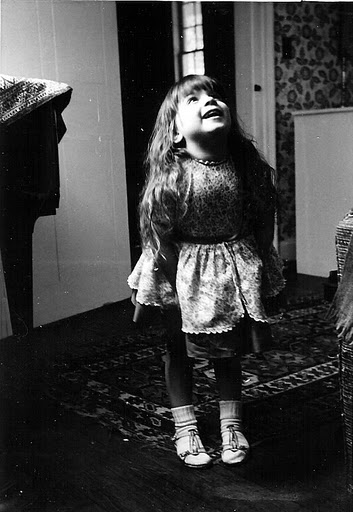
The photo is me and my sister, probably in 1993 or 1994.
 

Songs to raise girls: Pack up your sorrows

This song interests me. It is the fourth in my series about the songs that my sister and I learned growing up.

When we recorded our family songs, my sister said she liked it. I said, I think it is creepy, with that juxtaposition of a sweet tune and then words that are not so sweet.

No use cryin’
Talking to a stranger
Namin’ the sorrows you’ve seen

Oh, ’cause there are
Too many bad times
Too many sad times
Nobody knows what you mean

If somehow
You could pack up your sorrows
And give them all to me

You would lose them
I know how to use them
Give them all to me

The line that bothered me was “I know how to use them”. What does that mean? Use them for what?

No use ramblin’
Walkin’ in the shadows
Trailin’ a wanderin’ star

No one beside you
No one to hide you
An’ nobody knows where you are

Ah, if somehow
You could pack up your sorrows
And give them all to me

You would lose them
I know how to use them
Give them all to me

And how could you give your sorrows to someone else? The singer is offering to listen to sorrows but also take them away. “You would lose them.” And then the singer “knows how to use them”.

No use roamin’
Walking by the roadside
Seekin’ a satisfied mind

Ah, ’cause there are
Too many highways
Too many byways
Nobody’s walkin’ behind

Ah, if somehow
You could pack up your sorrows
And give them all to me

You would lose them
I know how to use them
Give them all to me

I never got around to asking my sister if it was the tune she liked or the words or what it meant to her. I chose to play that recording at her Washington memorial. I could not go to her California memorial because I was too ill. My father had terrible emphysema and was on oxygen. I thought I had pertussis but it turned out to be systemic strep A, which hurts. At any rate, I was too sick to travel. Her Washington Memorial was a month or two later, when I was well enough to organize it…..

You would lose them
I know how to use them
Give them all to me

It is by Pauline Baez. The version by Richard and Mimi Farina is the one I’m familiar with, so my parents probably had the record:  https://www.youtube.com/watch?v=U4LbU8w7Th4.

Joan Baez, Pauline and Mimi Farina were sisters. Joan Baez recorded it https://www.youtube.com/watch?v=NAMe1bRW8Ao. So did Peter, Paul and Mary: https://www.youtube.com/watch?v=IVxNleqVpx4.

And so did Johnny Cash and June Carter: https://www.youtube.com/watch?v=_ctVhDEuTYE

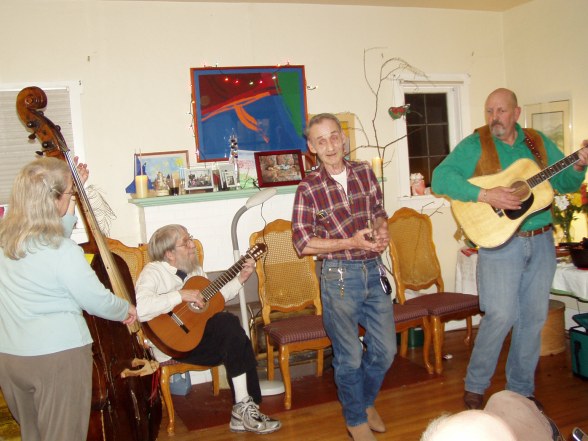
The picture is a music party at my house in 2009, my father seated and Andy Makie on harmonica, Jack Reid standing with the guitar.

Songs to raise girls: Dark as a Dungeon

We sang Dark as a Dungeon as a family song and at singing parties from when my sister and I were very little. We learned many of the songs before we knew what the words meant. At some age I considered this a cautionary song and was glad that my father was not mining coal. I also decided that I didn’t want to mine coal.

It was written by Merle Travis, whose father was a miner in an Appalachian shaft mine: https://www.youtube.com/watch?v=-FPmSLzsbdM&list=RD-FPmSLzsbdM#t=1. Johnny Cash sang it: and Willie Nelson: https://www.youtube.com/watch?v=nKGCKwACj1I and Willie Nelson https://www.youtube.com/watch?v=s66nbyzqq8o. It became a protest song, to fight for safer conditions. We learned this and Drill ye Terriers, Drill and Sixteen Tons, so we were raised on protest songs.

The song words have morphed a little, since we sang from memory. Here is our version:

Come all ye young fellows so young and so fine
And seek not your fortune in the dark, dreary mines
It will form as a habit and seep in your soul
‘Til the stream of your blood runs as black as the coal

Where it’s dark as a dungeon and damp as the dew
Where the danger is double and the pleasures are few
Where the rain never falls and the sun never shines
It’s dark as a dungeon way down in the mines

I wrote an essay in college about a song that I learned from my mother. I researched versions of Green Grow the Rushes Oh. I had always wondered about some of the verses, because it’s a counting song, from one to 12. Twelve for the twelve apostles and eleven for the eleven that went up to heaven. In an atheist household it takes a while to figure out the meaning of apostle. But other verses are mysterious to this day: nine for the nine Bright Shiners and eight for the April Rainers. In oral traditions if you forget a verse you make up a new one.

There’s many a man that I have seen in my day
Who lived just to labor his whole life away
Like a fiend with his dope and a drunkard his wine
A man will have lust for the lure of the mine

The comparison of  mining to addiction impressed me: “it will creep in your soul, til the stream of your blood runs as dark as the coal”. “Like a fiend with his dope” — opiate addicts were called fiends. And people were called drunkards. So this song also made me cautious about both drugs and alcohol.

We didn’t learn the third verse:

The midnight, the morning, or the middle of the day
It’s the same to the miner who labors away
Where the demons of the death often come by surprise
One fall of the slate and you are buried alive

The last verse interested me. I liked the idea of bones turning to coal over time. My parents were atheists and did not go to church, but there were lots of songs that talked about God or heaven or the devil: including sacred music. We went to big chorus rehearsals when my parents couldn’t find a sitter and we were expected to behave politely during concerts: The Messiah. And we got to go to operettas. I saw Ruddigore in Ithaca at Cornell when I was 5 and the ancestral ghosts stepping out of their portraits and singing was terrible and wonderful.

I hope when I’m gone and the ages shall roll
My body will blacken and turn into coal
Then I’ll look out the door of my heavenly home
And I’ll pity the miners A-diggin’ my bones

The photo is my father’s family and he is in the back, first trumpet. This is the Bayers Family Orchestra. My great grandfather is conducting, my grandmother on violin and my grandfather on saxophone. They became a band when my grandparents moved away, because my grandmother was the only string player.

Call

For RonovanWrites weekly haiku challenge #67.

The words are cheer and call.

Calling brings up my sister, calling her and waiting for her to call back. She died in 2012 of cancer. Grief, not cheer.

Cheer and call

cheer and call. I re
member dismember memo
ry no cheer or call

The photo is the Mount Saint Helen’s crater in 2012, with the recovering area below starting to be green again.

Full lunar eclipse

Long long ago, when the universe was forming, the Moon fell in love with the Sun.

The Moon was afraid that the Sun wouldn’t see her, because the Sun was so bright. Slowly she pulled herself together. After careful thought, she chose to orbit the Earth.

Now it is another full lunar eclipse. Her face reflects the Sun’s glory back to him. She slides behind the Earth in a three hour version of her usual cycle, from full to only her own light back to full.

“Where are you, Moon?” bellows the Sun. He hates these quick disappearances. He yells and bellows and tantrums. But the Moon knows that he will forget quickly and that he has not bothered to learn and predict her cycles. He doesn’t like to be reminded of loss and endings and death.

The Sun likes it best when he has her full glory, face reflected back to him. He doesn’t see her light. Each month she moves from reflecting his light towards her quiet time when it is only her light that is visible from Earth. She needs this time to remember that she has her own light, even if it is a shadow compared with the sun.

“You should orbit me!” says the Sun, but the Moon knows that if she orbited him she would be burned and barren and dead, no rest and no light of her own. One night a month the Moon remembers who she is and is alone. She lets her quiet darkness shine. The Earth whispers, “Why do you love the Sun so? Don’t cry, Sister.” The Earth’s salt water tides move like tears.

Sometimes the Moon longs for ending, but she remembers: all love, returned or not, is longing and praise for the Beloved. Maybe she will not be loved or seen as she longs to be in this life, but she too will return to the Beloved and be One. And after her time in the dark she slowly returns to reflecting the Sun.

And the Sun loves her in his way. He loves to watch his reflection grow on her face each month, preens in it, until she is full. He is more irritable in the second half, as she turns her face away again. She wishes that he would look past his own light and see her.

Now the little eclipse is ending and she is rapidly becoming full again. The Sun is cheering up.

“It’s silly of you to hide your face.” says the Sun, fondly.

The moon does not smile. The Sun sees his own smile reflected in her face.


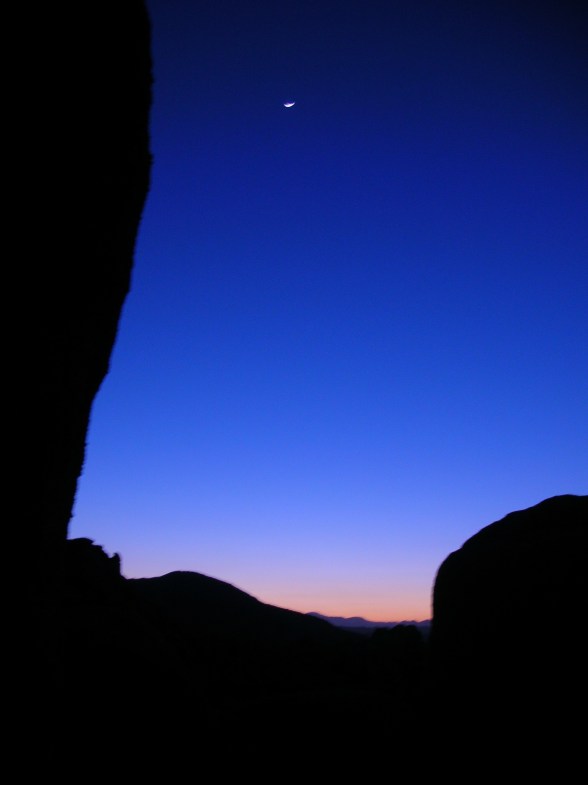
I took the photo in 2009 at Joshua Tree.